
How to Build an MVP That Can Survive Its First Major Pivot
Practical architectural decisions that help product teams adapt to changing requirements without rebuilding their applications from scratch.

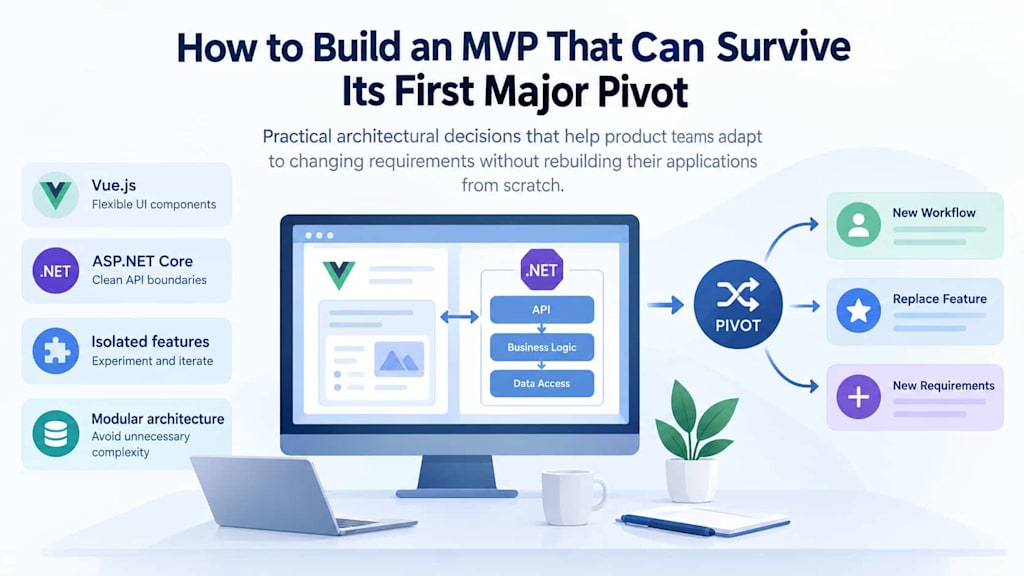
A minimum viable product (MVP) is designed to test assumptions, validate demand, and bring a working solution to users as quickly as possible. However, the first release rarely represents the final direction of a product. Customer feedback may reveal that a core workflow needs to change, a promising feature may prove ineffective, or a new market opportunity may require capabilities that were not part of the original plan.
These changes are a natural part of product development, but they can expose weaknesses in the initial architecture. If frontend components contain business rules, backend endpoints are tightly coupled to specific screens, or experimental features affect unrelated workflows, even relatively small adjustments can become expensive.
The objective is not to build an MVP with the architecture of a mature enterprise platform. Instead, teams should focus on building an MVP around evolving product requirements, making deliberate decisions that preserve flexibility without delaying the first release.
1. Design for Change, Not for Every Possible Future
One of the most common architectural mistakes is treating the initial product specification as a permanent contract. Developers implement the first set of requirements as efficiently as possible, but the resulting application may be difficult to modify once the product direction changes.
A more resilient approach starts by identifying which parts of the application are likely to evolve. These might include user onboarding, pricing rules, approval workflows, recommendation logic, subscription models, or integrations with external services.
Not every component requires the same level of flexibility. Authentication, for example, may remain relatively stable, while the workflow that determines how users complete a task could change several times after launch.
Teams should distinguish between stable foundations and uncertain product decisions. Stable foundations deserve clear interfaces and dependable implementations. Uncertain features should be easier to replace, test, or disable.
This does not mean introducing abstractions everywhere. A practical MVP architecture should make likely changes inexpensive while keeping straightforward functionality straightforward. The best design is one that reduces the cost of realistic changes rather than attempting to anticipate every hypothetical requirement.
2. Keep Vue.js Components Separate From Business Logic
The frontend is often where product changes become immediately visible. A pivot may introduce a different onboarding sequence, replace a dashboard with a guided workflow, or change the information users need before completing an action.
Vue.js supports component-based development, making it possible to organize interfaces into reusable building blocks. However, componentization alone does not guarantee adaptability. A component can still become difficult to maintain if it combines presentation, business rules, API communication, validation, and workflow coordination.
When developing adaptable frontend interfaces with Vue.js, teams should assign clear responsibilities to different parts of the application.
Presentation components should primarily handle how information is displayed and how users interact with it. They can receive data through props and communicate user actions through events. Business rules, data transformation, and communication with backend services should be handled in more appropriate layers.
For example, imagine an MVP for a project management platform. The first release allows users to create tasks through a simple form. After launch, feedback suggests that users need a multi-step task creation process with conditional questions.
If the original form contains all validation rules, workflow decisions, and API calls, replacing it may require rewriting a substantial portion of the frontend. If those responsibilities are separated, the team can introduce a new interface while preserving the underlying task-related functionality.
Useful practices include:
Separating reusable UI components from feature-specific components.
Keeping API communication in dedicated service modules or composables.
Avoiding business decisions that depend directly on the current page layout.
Sharing validation and formatting logic where reuse is genuinely needed.
Organizing code around product capabilities rather than creating an excessively deep component hierarchy.
The goal is to make it possible to change how a feature works for users without automatically changing every other part of the application.
3. Establish Clear API Boundaries With ASP.NET Core
Frontend flexibility becomes less valuable when every product change requires modifications across multiple backend endpoints. A clear API contract allows the Vue.js application and the ASP.NET Core backend to evolve with fewer dependencies.
The API should represent meaningful product operations rather than mirror the structure of individual frontend screens. For instance, an endpoint that creates an order should represent the order creation operation, not depend on whether the request originated from a checkout page, an administrative interface, or a future mobile application.
This separation becomes especially important during a pivot. A team may replace a multi-page checkout with a single-page experience without needing to redesign the entire order-processing backend.
ASP.NET Core provides a practical foundation for defining these boundaries through controllers or minimal APIs, request and response models, validation, and application services. When product requirements change, working with ASP.NET developers for evolving backend requirements can help teams refine API contracts, adapt business logic, and introduce new capabilities without disrupting existing workflows or rebuilding the entire backend.
A useful structure separates several responsibilities:
API layer: Receives requests, validates their basic structure, and returns appropriate responses.
Application layer: Coordinates use cases, such as creating an order or approving a submission.
Domain layer: Contains business rules that need to remain consistent regardless of the interface.
Infrastructure layer: Handles database access, external APIs, messaging, and other technical dependencies.
An MVP does not necessarily need four separate projects to achieve this separation. These responsibilities can initially exist in well-organized folders and modules within one deployable application.
The important point is that controllers should not become the only place where business logic exists, and database entities should not automatically define the public API contract.
When API models and persistence structures are tightly coupled, a database change can force changes in every client. Explicit request and response models reduce this risk and allow internal implementation details to evolve independently.
4. Isolate Experimental Features and Uncertain Workflows
Early product decisions are hypotheses. Some features will succeed, others will need adjustment, and a few may be removed entirely. The architecture should reflect this uncertainty.
Feature isolation begins with keeping experimental functionality from spreading throughout the application. If a new recommendation engine is being tested, unrelated order processing or account management should not depend directly on its implementation.
A straightforward strategy is to place the experimental behavior behind a clear interface. The rest of the application interacts with that interface rather than with a specific implementation. The team can then replace the original algorithm or introduce a different provider without rewriting every consumer.
Feature flags provide another useful mechanism. They allow teams to enable or disable selected functionality without deploying a separate codebase for every experiment. For an MVP, flags can be implemented through configuration or a dedicated feature-management service, depending on the product's needs.
However, feature flags should have a defined purpose and lifecycle. Temporary experiments that become permanent should be cleaned up rather than accumulating into a confusing network of conditions.
Data models also require attention. If an experimental feature introduces new fields, the team should consider whether those fields belong to a stable business entity or are specific to the experiment. Avoiding unnecessary changes to shared entities can reduce the risk of disrupting established workflows.
Isolation does not mean that every experiment needs its own service or database. Often, a dedicated module, an interface, a configuration option, and a few targeted tests are sufficient.
5. Avoid Premature Complexity Without Creating Technical Debt
The pressure to make an MVP flexible can lead to the opposite problem: designing a system for hypothetical scale before the product has demonstrated demand.
Microservices, event-driven communication, generic plugin frameworks, extensive abstraction layers, and elaborate domain models may be appropriate for certain products. They are not automatically necessary because requirements might change.
A small team can often move faster with a modular monolith: one deployable application containing clearly separated functional areas. This approach keeps deployment and debugging relatively simple while allowing internal modules to evolve independently.
The principle of avoiding unnecessary complexity in the first product release is to invest in boundaries where they reduce a credible risk.
For example, a single database may be perfectly adequate even if the application has separate modules for billing, user management, and reporting. The modules can maintain clear ownership of their operations without requiring independent infrastructure.
Similarly, introducing a generic repository abstraction for every database interaction may create more code without improving flexibility. If a particular persistence mechanism is unlikely to change and the abstraction provides no concrete benefit, direct, well-contained access may be the better choice.
The same reasoning applies to caching, queues, distributed transactions, and sophisticated orchestration. Add them when measurable requirements justify them, not simply because they might become useful someday.
A good MVP architecture minimizes two costs simultaneously: the cost of changing the product and the cost of maintaining the architecture itself.
6. Structure ASP.NET Applications Around Business Capabilities
As an MVP grows, the way backend code is organized increasingly affects the team's ability to respond to product changes.
A common early-stage problem is organizing the entire application around technical categories. All controllers are placed in one folder, all services in another, and all data models in a third. As the codebase expands, implementing a single business change may require navigating dozens of unrelated files.
Organizing code around business capabilities can make these relationships easier to understand.
For example, a project management MVP might have separate modules for task management, team administration, notifications, and reporting. Each module can contain the application logic, models, and supporting components relevant to its responsibilities.
This does not require a sophisticated framework. The main requirement is clear ownership: developers should understand where a business rule belongs and which modules are allowed to depend on it.
When structuring ASP.NET applications for future growth, teams should also establish rules for cross-module communication. One module should not freely modify another module's internal data structures simply because they share the same database.
Instead, modules can expose application services or well-defined interfaces. Database transactions and shared data requirements should be handled deliberately, particularly when a workflow spans multiple capabilities.
Testing these boundaries is equally important. Unit tests can protect business rules, while integration tests can verify that API contracts, persistence operations, and critical workflows continue to function after changes.
The resulting architecture remains simple enough for an MVP but provides a clearer path for expanding or replacing individual capabilities.
7. Build a Change-Friendly Delivery Process
Architecture alone cannot guarantee that a product will survive a pivot. The development process must also make changes safe and observable.
First, maintain automated tests around the workflows that matter most to the business. A team preparing to redesign onboarding should be able to verify that registration, account creation, and authorization still work as expected.
Second, use continuous integration to run tests and catch obvious regressions before changes reach production. For deployments that affect critical functionality, staged releases or feature flags can reduce the impact of unexpected behavior.
Third, treat database changes as part of the application lifecycle. Schema migrations should be version-controlled, reviewed, and designed with deployment compatibility in mind. When necessary, teams can introduce changes in stages so that old and new application versions can coexist during a release.
Finally, document important architectural decisions, particularly when they involve trade-offs. A short explanation of why a workflow uses a particular API contract or why a feature is isolated behind an interface can save future developers from accidentally removing an important boundary.
The development team should regularly reassess these decisions as the product becomes better understood. Some abstractions may prove unnecessary, while other areas may deserve stronger separation after repeated changes reveal genuine friction.
Conclusion
An MVP that survives its first major pivot is not necessarily the one with the most sophisticated architecture. It is the one whose design makes likely product changes manageable without turning every adjustment into a system-wide rewrite.
Separating Vue.js presentation from business logic, establishing stable API boundaries with ASP.NET Core, isolating experiments, organizing backend code around business capabilities, and resisting premature complexity all contribute to that goal.
These decisions allow teams to replace interfaces, adjust workflows, introduce new business rules, and remove unsuccessful features while preserving the parts of the application that still work.
The most effective approach is incremental: build only what the current product needs, maintain clear boundaries around areas likely to change, and strengthen the architecture when actual experience justifies it. This gives an MVP room to evolve without sacrificing the speed and simplicity that made its first release possible in the first place.
About the Creator
Chudovo
Chudovo is a custom software development company, focused on complex systems implementation.
Enjoyed the story? Support the Creator.
Subscribe for free to receive all their stories in your feed.
Comments
There are no comments for this story
Be the first to respond and start the conversation.