
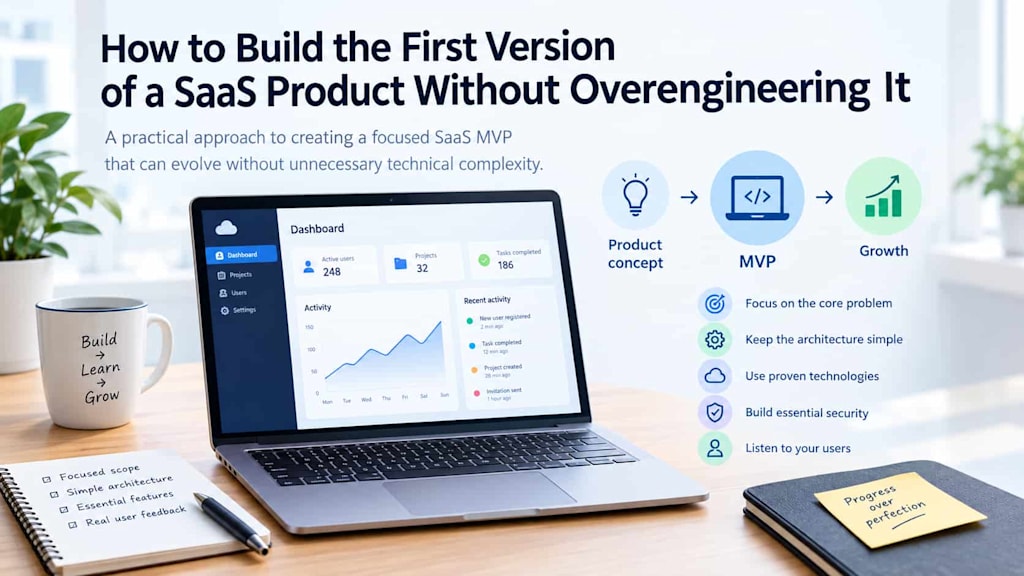
How to Build the First Version of a SaaS Product Without Overengineering It
A practical approach to creating a focused SaaS MVP that can evolve without unnecessary technical complexity.

Start With a Narrow Product Scope
Building a SaaS product often begins with an ambitious idea. Founders may imagine multiple user roles, advanced dashboards, automated workflows, integrations, analytics, mobile applications, artificial intelligence features, and highly configurable settings. The problem is that trying to implement everything in the first release can make the product slower and more expensive to develop.
The first version should answer a much simpler question: can the product solve a specific problem for a clearly defined group of users?
This means identifying the core workflow that creates value and building around it. If the product helps businesses manage customer requests, for example, the first release might need account creation, request management, basic notifications, and a simple administrative interface. Complex reporting, extensive integrations, and customizable workflows can wait until users demonstrate that they are needed.
A focused scope also makes it easier to collect meaningful feedback. Instead of asking users what they think about dozens of features, a development team can observe whether the central workflow actually solves their problem.
Define the Minimum Viable Architecture
Avoiding overengineering does not mean ignoring architecture. A SaaS application still needs a technical structure that supports development, testing, deployment, and future changes.
The goal is to establish only the architectural components required by the first version. A typical SaaS MVP might include a web frontend, backend application, relational database, authentication mechanism, cloud infrastructure, logging, and basic monitoring.
At this stage, a modular monolith can often be more practical than a collection of microservices. Keeping application logic within one deployable system reduces operational overhead and makes development easier. Individual modules can still have clear boundaries so that they can be separated later if scale or organizational requirements justify it.
The same principle applies to infrastructure. A managed database, established cloud services, and automated deployment pipelines may provide enough reliability without requiring a complex container orchestration platform or extensive custom infrastructure.
The objective is not to predict every future requirement. It is to create an architecture that is easy to understand and inexpensive to change.
Prioritize the Core User Journey
A SaaS product can contain many screens, but users usually care about completing a small number of important tasks.
Before development begins, map the primary user journey from beginning to end. Consider what happens when someone first creates an account, performs the product's main action, receives the result, and returns to use the service again.
This journey should guide the MVP backlog.
For example, a project management SaaS might focus initially on creating a workspace, inviting team members, creating tasks, assigning tasks, and tracking their status. Advanced permissions, custom fields, detailed analytics, calendar integrations, and automated workflows can remain outside the first release.
This approach helps turning an early product concept into working software without allowing secondary requirements to dominate development.
It also provides a useful way to evaluate proposed features. Every feature should have a clear connection to the product's main user problem. If that connection is unclear, the feature can usually be postponed until there is stronger evidence that it is necessary.
Choose Technologies for Practical Reasons
Technology choices can easily become a source of overengineering. Teams may spend considerable time comparing programming languages, frameworks, databases, cloud platforms, and architectural patterns before writing meaningful product functionality.
For an early SaaS product, familiarity and ecosystem support are often more valuable than theoretical technical advantages.
A technology stack should allow the team to develop features quickly, find qualified developers, troubleshoot problems, and integrate common services. Established frameworks and managed cloud services can reduce the amount of infrastructure that needs to be built and maintained internally.
The database is another area where simplicity usually helps. A relational database can support many SaaS applications effectively, particularly when the product involves accounts, subscriptions, users, permissions, transactions, or structured business data.
New technologies should be introduced when they solve a demonstrated problem rather than because they might become useful later.
Design for Change, Not for Every Possibility
Avoiding overengineering does not mean creating disposable code. Some decisions made during MVP development can become expensive to change later, particularly around data structures, authentication, security, and application boundaries.
The key is to distinguish between areas that require deliberate design and areas where flexibility can be postponed.
For example, user and account relationships should be modeled carefully if the product is intended for multiple organizations. Authentication should use established security practices from the beginning. Sensitive information should be protected appropriately, and database backups should be considered before production data accumulates.
At the same time, there is little reason to build an elaborate plugin system if the product has no confirmed plugin requirements.
The right question is not "How can we make this architecture future-proof?" It is "What reasonable future changes should this architecture avoid making unnecessarily difficult?"
That distinction helps teams building the technical foundation for a SaaS product while keeping the first implementation manageable.
Keep the First Release Operationally Simple
A product is not ready simply because its application works on a developer's computer. Even an MVP needs basic operational capabilities.
Automated deployment can reduce manual errors. Version control should be used consistently. Application logs should make it possible to investigate failures. Basic monitoring can reveal outages or unusual behavior. Database backups should be configured and periodically checked.
Error tracking is also valuable because early users frequently encounter situations that developers did not anticipate.
However, operational maturity should grow with the product. A small SaaS application does not necessarily need a large observability platform, multiple production environments, elaborate infrastructure-as-code modules, or sophisticated distributed tracing from its first week.
Start with the capabilities required to operate the service responsibly, then expand them as usage and complexity increase.
Build Security Into the MVP
Security should not be postponed until after product-market validation. Some security practices are inexpensive to implement early and difficult to retrofit later.
Authentication, authorization, password handling, session management, data encryption, secure configuration, dependency updates, and input validation should be treated as standard development requirements.
Teams should also minimize the amount of sensitive information they collect. Every additional piece of stored personal or business information increases the potential consequences of a security incident and adds compliance responsibilities.
Third-party services can reduce development effort, but they also introduce dependencies. Before integrating a service, the team should understand what information it receives, how authentication works, what happens if the service becomes unavailable, and whether the dependency is essential to the core user journey.
Measure Before Adding Complexity
The first version should generate information, not just revenue or user accounts.
Product analytics can help identify where users complete or abandon important workflows. Support requests can reveal recurring problems. Interviews and direct conversations can uncover requirements that were invisible during initial planning.
These observations should influence the next development cycle.
If users consistently request a particular integration, it may become a priority. If an advanced feature receives little interest, it can remain on the backlog. If the existing architecture repeatedly slows down development, that may provide evidence for a technical redesign.
This creates a feedback loop in which complexity is introduced because there is a demonstrated reason for it.
Conclusion
Building the first version of a SaaS product is primarily an exercise in prioritization. The goal is not to create the most sophisticated architecture or anticipate every possible future requirement. It is to build a reliable product around a clearly defined problem while keeping the system understandable and adaptable.
A focused feature set, pragmatic technology choices, simple architecture, essential security, basic operational tooling, and continuous user feedback can provide a strong starting point. As the customer base and product requirements grow, the technical architecture can evolve in response to real evidence.
The best protection against overengineering is therefore not avoiding technical planning altogether. It is making deliberate decisions about what the product needs now, what can wait, and what evidence will justify greater complexity later.
About the Creator
Chudovo
Chudovo is a custom software development company, focused on complex systems implementation.
Enjoyed the story? Support the Creator.
Subscribe for free to receive all their stories in your feed.
Comments
There are no comments for this story
Be the first to respond and start the conversation.