
How to Plan a Legacy Software Modernization Project: Budget, Risks, and Vendor Selection
A practical guide for business and technology leaders to setting priorities, controlling costs, managing risks, and choosing the right modernization partner.

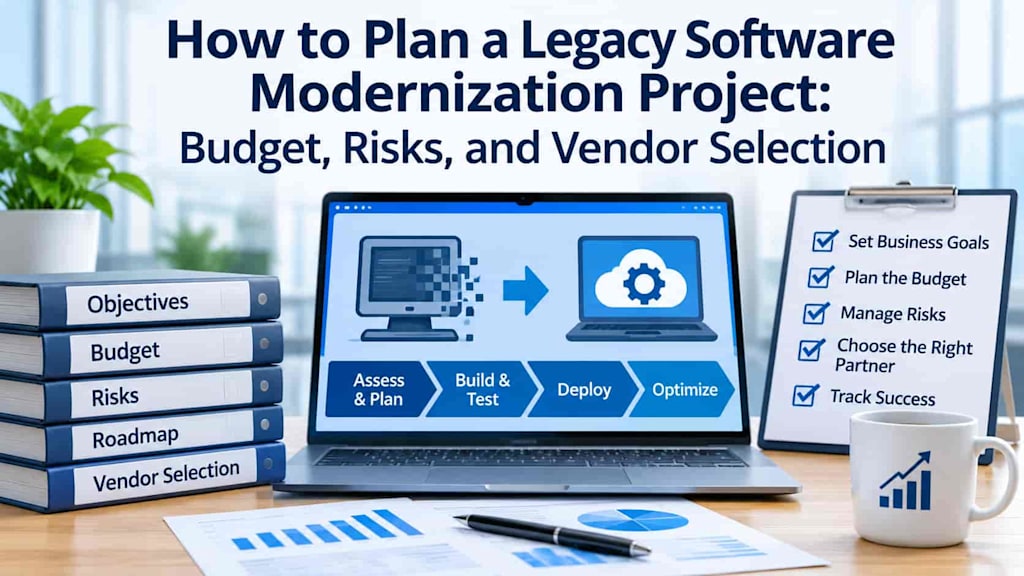
Legacy software modernization is a strategic business decision that affects far more than an organization's IT infrastructure. Outdated applications can slow down product development, increase maintenance expenses, limit integration capabilities, and make it harder for companies to respond to changing market demands. However, replacing or updating established systems also introduces financial, operational, and technical risks that require careful planning.
For CTOs, CIOs, IT directors, and business decision-makers, successful modernization starts well before development begins. Organizations need to understand what they want to achieve, determine which systems require attention first, estimate the full project budget, and establish a realistic risk management strategy. They must also decide whether internal teams have the necessary expertise or whether working with an external development partner would be more effective.
A structured planning process helps businesses avoid unnecessary expenses, reduce operational disruptions, and maintain control over modernization initiatives from initial assessment to long-term support.
1. Define Business Objectives and Modernization Priorities
Before allocating resources, organizations should establish why modernization is necessary and what business outcomes they expect. A project driven exclusively by aging technology or a desire to adopt newer tools may lack a clear return on investment.
Instead, decision-makers should connect modernization objectives to specific operational and strategic challenges.
Common business objectives include:
Reducing maintenance expenses associated with outdated applications.
Improving system reliability and minimizing unplanned downtime.
Supporting business growth and increasing application scalability.
Enabling integrations with modern enterprise platforms.
Strengthening information security and regulatory compliance.
Improving employee productivity and customer experience.
Accelerating the development and introduction of new digital products.
These objectives should be translated into measurable priorities. For example, if an outdated application prevents employees from accessing information across departments, improving integration capabilities may be more important than replacing its entire technology stack.
Similarly, if a business-critical system frequently experiences outages, operational stability should take priority over introducing additional functionality.
An important planning activity is assessing legacy systems before modernization. This involves reviewing the current application portfolio, identifying technical dependencies, evaluating maintenance requirements, and understanding how individual systems support business processes.
Organizations should consider several factors when prioritizing applications:
Business criticality: How directly does the application affect revenue, customer service, and essential operations?
Technical condition: How difficult is the system to maintain, extend, test, and secure?
Dependency complexity: Which other applications, databases, third-party services, or business processes rely on it?
Future requirements: Can the existing solution support anticipated business growth and integration needs?
Financial impact: How much does the organization spend maintaining the application, and what additional costs result from its limitations?
The result should be a prioritized modernization roadmap rather than a collection of disconnected IT initiatives.
It is also useful to distinguish between modernization and migration when discussing project objectives. The distinction in legacy modernization vs. legacy migration is important because transferring an existing application to a different environment does not necessarily resolve its underlying maintenance, usability, or functional limitations.
2. Estimate the Initial Modernization Budget
Budget planning should account for the complete project lifecycle, not just the development work. One of the most common mistakes is estimating expenses based on the number of developers required or the expected duration of implementation.
In reality, modernization involves multiple activities, and each can influence the final project cost.
A comprehensive preliminary budget should include the following categories.
1. Technical assessment and project planning
Before development starts, specialists need to understand the existing system, evaluate its limitations, identify dependencies, and establish modernization priorities. This stage may involve technical audits, business process analysis, application documentation, and project architecture planning.
2. Software development and engineering
Development costs typically represent a significant part of the budget. They include application changes, new functionality, improvements to existing components, and the engineering work required to meet business requirements.
The estimated effort depends on system complexity, the availability of documentation, the condition of existing code, and the scope of modernization.
3. Integration with existing systems
Modernized applications rarely operate independently. They may need to exchange information with ERP, CRM, accounting, payment, logistics, or other enterprise platforms.
Integration requirements should be identified early because undocumented dependencies and inconsistent data formats can increase development effort.
4. Testing and quality assurance
Testing should be treated as a separate budget category rather than an activity that receives whatever resources remain at the end of development.
Organizations need to account for functional testing, integration testing, regression testing, performance evaluation, security validation, and user acceptance testing.
5. Data migration and validation
Moving business information from existing systems requires planning, validation, and reconciliation. Costs can increase when organizations work with inconsistent records, incomplete historical information, outdated databases, or undocumented data structures.
6. Deployment, infrastructure, and ongoing support
The budget should also include deployment activities, infrastructure expenses, software licenses, monitoring tools, documentation, employee training, and post-launch technical support.
At this stage, organizations should request estimates for individual work packages instead of relying exclusively on a single total project figure.
This makes it easier to understand how the budget is distributed and identify areas where additional clarification is necessary.
3. Account for Hidden Costs and Budget Contingencies
Even carefully prepared estimates can overlook expenses that become visible only after the project starts.
Hidden costs are particularly common when companies modernize applications that have been operating for many years. Their original documentation may be incomplete, integrations may be poorly understood, and some business rules may exist only in employees' experience.
Several potential expenses deserve special attention.
Undocumented functionality and dependencies. Development teams may discover features, integrations, or automated processes that were not included in the original project documentation. Reproducing or replacing these capabilities can require additional work.
Data quality problems. Duplicate records, inconsistent formats, missing information, and historical data errors may require additional cleaning and validation.
Operational downtime. Even planned interruptions can affect revenue, customer service, and employee productivity. Organizations should account for the resources needed to minimize and manage these disruptions.
Parallel system operation. During transitional periods, businesses may need to maintain both old and modernized applications. This creates additional infrastructure, licensing, support, and administrative expenses.
Employee training and organizational changes. New workflows and application interfaces may require training sessions, updated internal procedures, and temporary productivity adjustments.
Security and compliance requirements. Additional assessments, external audits, access controls, or regulatory reviews may become necessary as project requirements become clearer.
To manage these uncertainties, organizations should establish a contingency budget.
A contingency reserve should reflect the complexity and uncertainty of the project rather than follow an arbitrary percentage. Projects involving poorly documented systems, multiple integrations, or business-critical databases generally require more financial flexibility than initiatives involving well-understood applications.
It is also important to establish a formal change management process. Any proposed scope modification should include an explanation of its business value, estimated additional effort, financial impact, and effect on delivery priorities.
This prevents minor changes from gradually turning into substantial budget overruns.
4. Identify and Manage the Main Modernization Risks
Modernization projects can introduce operational risks even when the development work is technically successful. Decision-makers should identify these risks during planning and assign clear responsibility for managing them.
Downtime and service interruptions
An application may support essential business activities, including customer transactions, inventory management, financial operations, or internal communication.
Unexpected downtime during modernization can disrupt these processes. Companies should establish acceptable interruption windows, define recovery procedures, and agree on escalation responsibilities before implementation begins.
Data loss or inconsistencies
Data migration creates risks involving incomplete transfers, corrupted records, duplicated information, and differences between old and new systems.
Businesses should require backup procedures, data validation, reconciliation activities, and documented recovery plans.
Legacy dependencies
Some outdated applications depend on external services, hardware, databases, or software components that are no longer supported.
These dependencies can complicate modernization and introduce unexpected compatibility problems. A dependency assessment should therefore be part of the initial planning process.
Operational disruption
Employees may need to work with different interfaces, processes, or reporting systems after modernization. If these changes are introduced without adequate preparation, productivity can temporarily decline.
Involving department representatives, communicating changes, and organizing user acceptance testing can reduce this risk.
Budget and scope overruns
Unclear requirements, incomplete assessments, and uncontrolled changes can increase project expenses.
To prevent this, organizations should establish scope boundaries, approval procedures, milestone-based financial reviews, and regular reporting.
Risk ownership should also be explicit. The internal IT department, business stakeholders, and external development partner should understand who is responsible for identifying, reporting, and resolving individual risks.
5. Plan Modernization in Phases Without Interrupting Operations
For many organizations, completing modernization in one large release creates unnecessary operational pressure. A more controlled phased modernization approach allows businesses to distribute investment, validate results progressively, and reduce the impact of unexpected problems.
The exact sequence depends on application dependencies and business priorities, but a typical project can be organized into several stages.
Phase 1: Discovery and assessment
The organization evaluates existing applications, identifies business requirements, reviews dependencies, and defines the modernization roadmap.
The deliverable should include an agreed project scope, preliminary budget, risk register, and prioritized implementation plan.
Phase 2: Preparation and pilot implementation
Before modifying business-critical functionality, teams can validate their assumptions through a limited pilot or a lower-risk application component.
This helps identify integration difficulties, documentation gaps, and testing requirements before the project expands.
Phase 3: Incremental development and integration
Modernization work is divided into manageable releases. Each release should have defined functionality, acceptance criteria, testing requirements, and business stakeholders responsible for approval.
Where practical, existing applications should remain operational until the corresponding modernized functionality has been validated.
Phase 4: Controlled transition
The organization prepares for production deployment, validates migrated information, trains employees, and establishes monitoring and support procedures.
Depending on business requirements, the transition may involve temporary parallel operation of old and new systems.
Phase 5: Stabilization and continuous improvement
After deployment, teams monitor application performance, resolve remaining issues, collect user feedback, and review whether the expected business outcomes have been achieved.
This staged structure gives decision-makers more opportunities to evaluate progress and adjust priorities without committing the entire budget at the beginning.
However, phased delivery requires careful coordination. Dependencies between applications must be understood, and temporary integration arrangements should not become permanent sources of complexity.
6. Evaluate Modernization Vendors Beyond Their Hourly Rates
Selecting an external development partner is one of the most important decisions in a modernization project. The lowest proposal does not necessarily represent the best commercial value.
A suitable vendor should understand both the technical condition of legacy applications and the business consequences of changing them.
Several criteria should guide the selection process.
Relevant modernization experience
Look for companies that have completed projects involving applications with comparable complexity, business requirements, and operational constraints.
Experience in general software development is valuable, but it does not automatically demonstrate the ability to modernize business-critical legacy systems.
Ask for examples of completed modernization projects, including the initial challenges, scope of work, team responsibilities, and measurable outcomes.
Technical expertise
Evaluate whether the proposed team has experience working with established enterprise applications, databases, integrations, testing processes, and security requirements.
The vendor should also demonstrate the ability to work with existing systems rather than assuming that every component can be easily replaced.
Completed projects and client references
Case studies provide useful information, but direct references from previous clients can offer additional insight.
Ask about communication quality, project management, unexpected difficulties, delivery reliability, and post-launch support.
Pricing transparency
A professional proposal should explain how costs are calculated, which activities are included, and what circumstances may generate additional expenses.
Be cautious of estimates that provide a single fixed amount without explaining assumptions, exclusions, or dependencies.
Cooperation models
Different organizations require different engagement arrangements.
A fixed-price model can be appropriate when requirements and deliverables are clearly defined. Time-and-materials arrangements may provide more flexibility when project scope is expected to evolve. Dedicated development teams can be useful when modernization is a long-term initiative requiring continuous engineering capacity.
The selected model should match the organization's internal management capabilities, financial controls, and expected level of involvement.
Industry recognition and reputation
External recognition can help validate a vendor's market presence and professional standing. For example, industry recognition in legacy software modernization may provide an additional indication of expertise when supported by credible awards, independent reviews, and documented project experience.
For organizations evaluating international partners, recognition for legacy software modernization expertise in Europe may also be relevant, particularly when the vendor has experience working with European businesses, regulatory expectations, and distributed development teams.
Nevertheless, awards and directory rankings should never replace technical evaluation, reference checks, and a detailed review of the proposed delivery team.
7. Questions to Ask a Modernization Partner Before Signing a Contract
Vendor selection should include structured discussions about responsibilities, project governance, financial arrangements, and potential risks.
Before signing an agreement, decision-makers should ask questions that reveal how the partner will manage real project challenges.
Important questions include:
About experience and expertise
Have you completed modernization projects involving systems with similar complexity?
Can you provide relevant case studies and client references?
What challenges did your previous modernization projects encounter, and how were they resolved?
Will the specialists presented during negotiations actually participate in our project?
About project planning and delivery
How will you assess our existing applications and identify dependencies?
What information and documentation will you need from our internal teams?
How will you divide the project into milestones and deliverables?
How will you minimize interruptions to business operations?
What testing and acceptance procedures do you recommend?
About costs and contracts
What exactly is included in your initial estimate?
Which activities or expenses are excluded?
How do you handle unexpected technical discoveries?
How are scope changes evaluated and approved?
What reporting will we receive regarding completed work and remaining budget?
About cooperation and support
Who will be responsible for project management and communication?
How frequently will progress and risks be reviewed?
How will you transfer documentation and knowledge to our internal team?
What support do you provide after deployment?
Who owns the developed software, documentation, and related deliverables?
The answers should be reflected in the project agreement or supporting documentation wherever possible.
Contracts should clearly define scope, responsibilities, acceptance criteria, payment terms, intellectual property rights, confidentiality requirements, warranty conditions, and procedures for handling disputes or project changes.
8. Define Success Metrics and Monitor Modernization Costs
A modernization project should not be considered successful simply because the new application has been deployed.
The organization needs measurable indicators showing whether the initiative has delivered the expected business and operational improvements.
Useful performance indicators include:
System availability: Measures whether the modernized application meets agreed service availability requirements.
Incident frequency: Tracks the number and severity of production issues after implementation.
Maintenance effort: Evaluates how much time internal teams spend supporting and maintaining the application.
Integration performance: Measures the reliability and effectiveness of information exchange between enterprise systems.
User adoption: Shows whether employees have successfully incorporated the modernized application into their daily workflows.
Delivery performance: Compares completed milestones and approved scope against the original project plan.
Budget variance: Tracks the difference between planned and actual spending, including approved changes and contingency usage.
Organizations should establish baseline values before modernization begins. Without an understanding of existing application performance and maintenance expenses, it becomes difficult to determine whether the project has achieved meaningful improvements.
Financial monitoring should take place throughout implementation rather than only at major project milestones.
A practical approach includes monthly budget reviews, milestone-based cost reporting, forecasts of remaining expenses, and documented approval of additional work.
Decision-makers should also distinguish between one-time modernization expenses and ongoing operating costs. Infrastructure, licensing, monitoring, maintenance, and support expenses can influence the long-term financial performance of the modernized application.
Finally, project stakeholders should periodically review whether the modernization roadmap remains aligned with business priorities. If market conditions, operational requirements, or organizational objectives change, investment priorities may need to be adjusted.
Conclusion
Planning a legacy software modernization project requires more than choosing a development team and estimating engineering expenses. It involves understanding business objectives, evaluating existing systems, identifying operational risks, accounting for hidden costs, and establishing a realistic implementation strategy.
A well-structured budget should cover assessment, development, integrations, testing, data migration, deployment, and ongoing support. Contingency reserves and transparent change management procedures help organizations maintain financial control when unexpected challenges arise.
Choosing the right external partner is equally important. Relevant experience, completed projects, technical expertise, transparent pricing, clear cooperation models, and reliable communication should all influence the selection decision.
By combining careful preparation, phased delivery, measurable success criteria, and continuous cost monitoring, organizations can make modernization more predictable and manageable. Most importantly, they can ensure that technology investments support long-term business objectives while protecting the continuity of essential operations.
About the Creator
Chudovo
Chudovo is a custom software development company, focused on complex systems implementation.
Enjoyed the story? Support the Creator.
Subscribe for free to receive all their stories in your feed.
Comments
There are no comments for this story
Be the first to respond and start the conversation.