
How to Plan a Phased Manufacturing IT Modernization Without a Big-Bang Migration
A practical approach to modernizing manufacturing IT step by step while protecting production continuity, reducing migration risk, and preserving critical legacy capabilities.

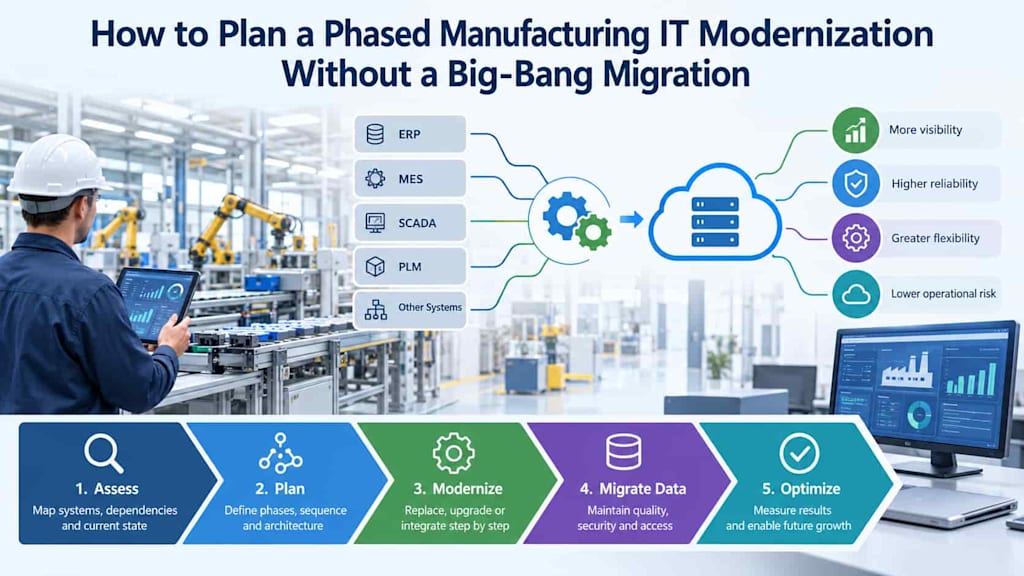
Manufacturing companies rarely have the luxury of replacing their entire IT environment at once. Production facilities depend on systems that have evolved over many years, including ERP platforms, manufacturing execution systems, warehouse applications, machine interfaces, databases, reporting tools, and custom integrations. Some may be outdated, but they can still support essential processes.
A big-bang migration attempts to replace or transform many of these components within one large project. While this approach can create a clean target environment, it also concentrates technical, operational, and business risks into a single transition. If something goes wrong, production schedules, inventory management, quality processes, or order fulfillment can be affected simultaneously.
A phased modernization strategy takes a different approach. It divides the transformation into manageable stages, allowing the organization to improve selected parts of its technology landscape while keeping critical operations running. The key is not simply to modernize gradually, but to determine the right sequence, dependencies, boundaries, and transition points.
Start With the Existing Manufacturing IT Landscape
Before deciding what should be replaced, companies need a clear picture of what they already operate. Manufacturing environments often contain applications introduced by different departments, facilities, vendors, and technology teams. Documentation may be incomplete, while some integrations exist only because someone remembers how they work.
The first stage should therefore establish an inventory of applications, infrastructure, interfaces, databases, machines, users, data flows, and business processes.
This is where mapping dependencies across the manufacturing IT landscape becomes important. A system that appears to be an isolated legacy application may actually exchange production orders with an MES, inventory information with an ERP platform, and quality data with another application.
The assessment should document at least:
ERP and financial systems
MES and production-management platforms
Warehouse and inventory applications
Quality-management systems
Product lifecycle and engineering systems
Machine and industrial control interfaces
Databases and reporting platforms
APIs, middleware, and file-based integrations
Authentication and identity services
Cloud and on-premises infrastructure
Custom applications and scripts
Data ownership and retention requirements
The objective is not to create documentation for its own sake. It is to understand which systems can change independently and which ones are connected closely enough that modernization must be coordinated.
Identify Dependencies Before Choosing a Migration Sequence
Once the current environment is documented, the next task is to understand how systems depend on one another.
For example, replacing an ERP component may appear straightforward until the team discovers that production planning data is transferred to the MES through a custom interface. That MES may then communicate with machine-level systems using another integration layer. A seemingly simple ERP migration can therefore become a production technology project.
A structured dependency assessment should examine data flows in both directions. Teams should determine which system creates information, which system consumes it, how frequently it moves, and what happens when the connection is unavailable.
Particular attention should be given to reviewing ERP, MES, and integration dependencies before defining project phases.
A dependency map can help classify systems into several groups:
Systems that can be modernized independently.
Systems that require changes to an upstream or downstream application.
Systems that must remain temporarily because another modernization stage depends on them.
Systems that are candidates for complete replacement.
Systems that may only require interface, security, or infrastructure improvements.
This classification provides a more realistic foundation for creating a roadmap than simply ranking applications by age.
Divide Modernization Into Business-Relevant Phases
A phased strategy works best when each stage has a clear business and technical objective. Instead of creating one enormous migration project, organizations can define several modernization increments.
For example, a roadmap could begin with infrastructure and integration improvements, followed by selected application modernization, data platform changes, and eventually ERP or MES transformation.
Another company might begin with a reporting platform because it can be modernized without changing production execution. The resulting experience can then inform more complex phases.
Possible modernization phases include:
Phase 1: Discovery and Stabilization
The organization documents the environment, removes unnecessary technical risks, establishes monitoring, and addresses urgent security or infrastructure problems.
Phase 2: Integration Modernization
Legacy interfaces can be consolidated or replaced with better-managed APIs, middleware, or event-based integration mechanisms where appropriate.
Phase 3: Selected Application Modernization
Individual applications with clear business value and manageable dependencies can be upgraded, replaced, or re-engineered.
Phase 4: Data and Analytics Modernization
Reporting databases, dashboards, data pipelines, and analytics platforms can be improved without necessarily changing transactional production systems.
Phase 5: Core System Transformation
More complex platforms such as ERP or MES can then be addressed with better knowledge of the surrounding environment.
The exact sequence will vary by organization. The important principle is that each stage should reduce complexity or risk rather than simply add another technology layer.
Decide What Should Actually Be Replaced
Modernization does not mean replacing every legacy system.
Some applications may be old but stable, well understood, and relatively inexpensive to maintain. Others may present significant security, integration, scalability, or vendor-support problems.
The modernization team should therefore assess deciding which legacy systems can remain in place as part of the roadmap rather than treating replacement as the default.
A legacy application may be retained when:
It performs a narrowly defined function reliably.
Its technology does not create unacceptable security exposure.
Integration with modern systems is technically feasible.
The vendor or internal team can continue supporting it.
Replacement would create disproportionate operational risk.
Its data and interfaces are sufficiently well understood.
However, keeping a legacy system should be an intentional decision. The organization should document why it remains, what risks are associated with it, and what conditions would trigger future replacement.
This creates a controlled coexistence strategy instead of allowing old systems to remain indefinitely without ownership.
Protect Production During Every Phase
Manufacturing modernization differs from many conventional IT transformation projects because technology changes can have direct operational consequences.
A failure in an office application may inconvenience employees. A failure in a production-related system can potentially interrupt manufacturing, delay shipments, or affect quality processes.
For this reason, reviewing production IT without disrupting operations should be a core principle of the modernization program.
Assessment and implementation activities should be separated where possible. Teams can begin with passive monitoring, documentation, architecture reviews, and data analysis before making changes to production systems.
Testing should also reflect real operating conditions. A system that works correctly in a development environment may behave differently when connected to production equipment, real-time interfaces, large datasets, or high transaction volumes.
Useful safeguards include:
Separate development, testing, staging, and production environments.
Clearly defined rollback procedures.
Backups and tested recovery procedures.
Pilot deployments.
Maintenance windows coordinated with production teams.
Parallel operation where practical.
Monitoring before and after major changes.
Documented escalation procedures.
Business continuity plans for critical applications.
The manufacturing and IT teams should jointly define acceptance criteria. Technical success alone is not enough if production personnel cannot use the resulting system effectively.
Create a Transitional Architecture
A phased migration often means that old and new systems must operate together for months or even years. The architecture therefore needs to support coexistence.
This transitional state should be designed rather than treated as an accidental byproduct of the project.
For example, a new application may initially receive data from a legacy system through an integration layer. Later, the source of that data can be changed to a modern platform without requiring the downstream application to be redesigned.
This approach creates architectural flexibility and reduces the pressure to migrate everything simultaneously.
It is also useful to distinguish between temporary and strategic components. A temporary adapter may be acceptable during migration, but the organization should know when it can be removed. Otherwise, temporary interfaces can become permanent technical debt.
Establish a Clear Data Migration Strategy
Data is one of the most difficult parts of manufacturing modernization because historical information often exists across multiple systems and formats.
Not all data needs to be migrated into every new platform. The organization should determine which information is operationally required, which must be retained for regulatory or business reasons, and which can remain in an archive.
Data migration planning should address:
Data ownership
Data quality
Historical records
Master data
Product and material information
Production records
Customer and supplier data
Retention requirements
Data transformation rules
Synchronization between old and new systems
In some cases, maintaining read-only access to a legacy database may be more appropriate than transferring decades of historical information into a new application.
Consider the Reality of German Industrial Environments
Industrial organizations in Germany frequently operate complex technology landscapes shaped by long production lifecycles, established engineering practices, and significant investments in specialized applications.
When evaluating manufacturing software environments in German industrial companies, modernization teams should consider the relationship between corporate IT and production technology, as well as the operational importance of established processes.
This does not mean every German manufacturer follows the same architecture. Company size, industry, plant age, product complexity, and previous modernization projects can create very different environments.
However, the broader principle remains relevant: modernization should account for the operational context in which software is used rather than evaluating applications only from an abstract technical perspective.
Measure Progress Beyond Technology Replacement
A modernization program should define measurable outcomes for each phase.
Technical metrics might include deployment frequency, system availability, integration failures, infrastructure costs, or application response times. Business metrics can include production downtime, order-processing time, inventory accuracy, quality reporting speed, and manual workload.
The organization should also measure whether modernization is reducing dependency on fragile components.
Modern software environments behind modern manufacturing operations should make it easier to introduce improvements without repeatedly redesigning the entire technology landscape.
Each phase should therefore answer three questions:
What problem has been solved?
What new capability has been created?
What future modernization work has become easier as a result?
This keeps the roadmap focused on measurable progress instead of technology replacement for its own sake.
Build a Roadmap With Decision Points
A phased modernization roadmap should not be a fixed list of projects stretching several years into the future. Manufacturing environments change, and new information becomes available as individual phases are completed.
Each phase should therefore include decision points.
For example, after modernizing an integration layer, the organization may discover that a particular legacy application can remain in operation longer than expected. Alternatively, testing may reveal that an application has deeper dependencies than originally documented.
A flexible roadmap allows the next stage to reflect these findings.
A practical roadmap might contain:
Current-state assessment
Target architecture
Dependency map
Business priorities
Modernization phases
Estimated effort
Risks and mitigations
System ownership
Testing requirements
Rollback plans
Success metrics
Decision points between phases
This structure gives executives, IT teams, and production managers a shared view of the transformation.
Conclusion
Manufacturing IT modernization does not have to be a single high-risk migration event. A phased approach allows organizations to improve infrastructure, integrations, applications, data, and core platforms progressively while maintaining control over production operations.
The most important work happens before migration begins: understanding dependencies, identifying critical systems, deciding which legacy components genuinely need replacement, protecting production continuity, and designing an architecture that supports coexistence between old and new technologies.
A successful modernization roadmap is therefore less about moving everything as quickly as possible and more about creating a controlled sequence of improvements. Each phase should reduce technical complexity, address a meaningful business need, and make the next stage more manageable. This approach allows manufacturers to modernize their technology environment while preserving the operational stability that their production processes depend on.
About the Creator
Chudovo
Chudovo is a custom software development company, focused on complex systems implementation.
Enjoyed the story? Support the Creator.
Subscribe for free to receive all their stories in your feed.
Comments
There are no comments for this story
Be the first to respond and start the conversation.