

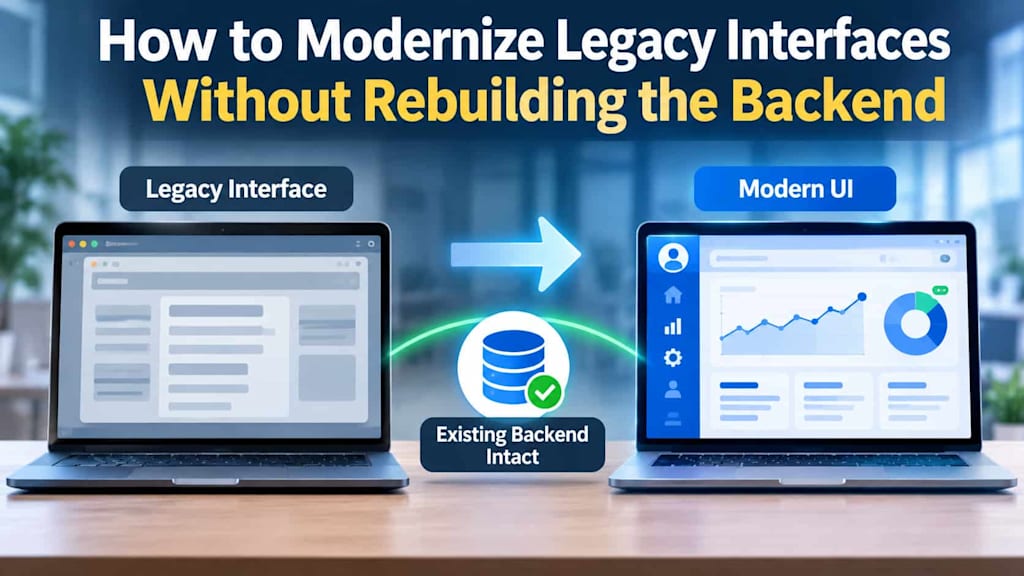
Modernizing a legacy application does not always require rebuilding the entire technology stack. In many organizations, the backend continues to perform essential business functions reliably, even though the user interface has become outdated, difficult to maintain, or incompatible with modern devices and user expectations.
Replacing a complete application can introduce unnecessary costs, operational risks, and lengthy development cycles. Existing databases, business rules, integrations, and APIs may already support complex workflows that would be expensive to reproduce. In such situations, modernizing the frontend while retaining the backend can offer a more practical alternative.
However, separating the user interface from established backend systems requires careful planning. Developers must understand existing interfaces, maintain data consistency, preserve business logic, and ensure that the new application behaves correctly under real-world conditions.
This guide explores the main approaches to legacy interface modernization, including frontend rewrites, low-code platforms, integration strategies, and long-term maintenance considerations.
Why Modernize the Interface Instead of the Entire Application?
Legacy applications often contain two relatively independent technology layers: the frontend, which users interact with, and the backend, which handles business operations, data processing, and integrations.
Although these layers communicate with each other, they do not necessarily need to be modernized simultaneously.
An organization might operate a business application built on an older Java or .NET backend that still processes transactions reliably. Its web interface, however, may depend on outdated JavaScript libraries, lack responsive layouts, or provide a poor experience on mobile devices.
Rebuilding the backend in this situation could introduce risks without delivering significant business value.
Several circumstances make frontend modernization particularly attractive:
The backend supports stable and well-understood business processes.
Existing APIs provide sufficient access to application functionality.
The database structure is reliable and does not require immediate replacement.
Users experience performance or usability problems primarily in the interface.
The organization wants to introduce mobile access without changing existing infrastructure.
Backend redevelopment would require extensive regression testing and operational disruption.
A frontend-focused modernization project can improve accessibility, usability, responsiveness, and development flexibility while preserving investments in established systems.
Nevertheless, retaining the backend does not mean that every existing interface or integration can remain unchanged. Some APIs may require extensions, authentication mechanisms may need updating, and older communication protocols may need adaptation.
The objective is to modernize the user experience without unnecessarily disturbing the systems responsible for business operations.
Decide Whether to Rewrite the Frontend or Improve It Incrementally
The first architectural decision is determining how much of the existing interface should be replaced.
For relatively simple applications, incremental improvements may be sufficient. Developers can update visual components, introduce responsive layouts, improve navigation, and replace obsolete frontend libraries without changing the application's overall structure.
This approach is appropriate when the existing codebase remains understandable and its architecture supports further development.
A complete frontend rewrite becomes more attractive when the application has accumulated significant technical debt. Examples include tightly coupled UI components, unsupported frameworks, inconsistent state management, and limited compatibility with modern browsers or mobile platforms.
A rewrite also makes sense when the organization needs capabilities that the existing frontend cannot reasonably support, such as offline functionality, advanced mobile interactions, or a substantially different user experience.
Consider a company operating a business application with an established .NET backend and a mobile client developed using .NET MAUI. If the organization decides to move toward React Native, the decision should be based on long-term platform requirements, development skills, ecosystem compatibility, and maintenance costs.
Rewriting a .NET MAUI app in React Native may provide access to a different development ecosystem and reusable JavaScript or TypeScript expertise. However, it also means rebuilding interface components, navigation, state management, and native integrations.
The existing backend can remain operational, provided that the new client communicates with it through compatible APIs.
The decision should therefore be based on the condition of the frontend rather than an assumption that replacing the entire application is inherently beneficial.
Preserve Existing Business Logic and Data Through API Integration
The backend is usually the most sensitive part of a legacy application modernization project. It contains business rules, database operations, authentication mechanisms, and integrations that may have evolved over many years.
A new interface must interact with these capabilities without introducing unexpected changes.
The preferred approach is to use existing APIs as the primary communication layer between the frontend and backend. If APIs are unavailable or incomplete, developers may need to introduce an integration layer that exposes the required functionality without directly modifying core business logic.
For example, an enterprise application might provide customer management, order processing, and financial reporting through separate backend services. A modern frontend can combine these capabilities into a unified user experience while continuing to use the existing services.
Several integration considerations deserve particular attention:
API compatibility. Existing endpoints should be evaluated for their ability to support new interface requirements. Changes should be introduced carefully to avoid breaking older clients or external integrations.
Authentication and authorization. The modernized interface must respect existing access policies. Authentication mechanisms may need to support modern security standards, token management, and multi-factor authentication.
Data consistency. Operations involving multiple backend services should preserve transaction integrity and avoid duplicate or incomplete updates.
Error handling. The frontend should interpret backend errors consistently and provide meaningful feedback without exposing sensitive technical information.
Performance. Excessive API requests can make a modern interface feel slow even when its visual design is excellent. Developers should consider request batching, caching, pagination, and efficient data loading.
These principles are particularly important when the new interface introduces workflows that combine several previously separate backend operations.
Preserve Application Behavior During a Mobile Rewrite
A new interface may look and feel different while still needing to reproduce the same underlying business behavior.
This distinction is important because users often depend on specific workflows, validation rules, notifications, and operational exceptions that are not immediately visible in the interface design.
Preserving application behavior during a mobile rewrite requires more than reproducing screens and navigation paths.
Developers should first document existing user journeys and identify the backend operations associated with each one. They should also record validation conditions, permissions, error responses, and expected results.
For example, a mobile application used by field employees might allow users to register completed tasks, upload photographs, and update customer records. The replacement application must preserve the existing validation rules, data relationships, and submission requirements.
If offline operation is supported, additional attention is needed. The new client must correctly handle locally stored changes, synchronization conflicts, interrupted connections, and repeated submissions.
A useful testing strategy includes:
Comparing old and new interfaces using identical test accounts and data.
Verifying that business calculations produce equivalent results.
Checking validation and authorization behavior.
Testing interrupted network connections and synchronization.
Confirming that updates appear correctly in the existing backend.
Reviewing edge cases and error handling with actual users.
The backend should remain the authoritative source of business data unless the project explicitly introduces a different data-management model.
Consider Low-Code and No-Code Platforms for Simpler Interfaces
Not every interface modernization project requires a conventional frontend development team.
For internal business applications, administrative dashboards, approval workflows, and data-entry tools, low-code platforms can provide a faster route to modernization.
Low-code and no-code platforms for legacy modernization allow organizations to create interfaces using visual development environments, reusable components, and configurable integrations.
These platforms can be particularly useful when the backend already exposes suitable APIs or connects to established enterprise systems.
For example, a company might retain its existing ERP backend while introducing a low-code interface for inventory updates, employee requests, or management approvals.
The advantages include shorter development cycles, reduced dependence on specialized frontend developers, and easier implementation of relatively standard workflows.
However, platform selection requires careful evaluation.
Some solutions provide extensive API integration capabilities, while others work best within a particular vendor ecosystem. Licensing costs, deployment options, customization restrictions, and data governance requirements can also influence the decision.
There are important limitations of low-code modernization that organizations should understand before committing to this approach.
Complex user interactions, advanced offline functionality, demanding performance requirements, and specialized mobile integrations may exceed the practical capabilities of a particular platform.
Vendor dependency is another concern. Applications built around proprietary components can become difficult or expensive to migrate if licensing conditions change or the organization decides to adopt another technology.
Low-code should therefore be selected according to the complexity and expected lifespan of the application, not simply because it promises faster initial development.
Build a Maintainable Frontend Architecture
A modern interface should not become another legacy system within a few years.
One common mistake is replacing outdated technologies without addressing the architectural problems that made the original frontend difficult to maintain.
A sustainable solution requires clearly defined responsibilities for presentation, application state, API communication, authentication, and business-related validation.
For web applications, modern frameworks can provide reusable components, predictable state management, and structured routing. For mobile applications, developers should consider navigation patterns, native device capabilities, accessibility, and platform-specific behavior.
A well-designed cross-platform application architecture can reduce duplicated development effort while allowing individual platforms to support their specific requirements.
For example, a shared API client and common data models can be used across web and mobile applications. However, the interface itself should account for differences in screen sizes, navigation conventions, and device capabilities.
The architecture should also isolate backend dependencies. Instead of allowing individual interface components to communicate directly with multiple services, developers can introduce dedicated API clients or service layers.
This makes it easier to update endpoints, change authentication mechanisms, and introduce additional backend integrations without modifying large portions of the interface.
The result should be an architecture that supports future development rather than simply reproducing the structure of the old application using newer tools.
Test the Modernized Interface Before Replacing the Old One
Testing is essential because frontend modernization changes how users interact with existing business systems.
Even when the backend remains untouched, new clients can expose previously unnoticed API limitations, send requests in unexpected sequences, or handle responses differently.
A comprehensive testing strategy should include several levels.
Functional testing verifies that important user workflows produce the expected results.
API integration testing checks communication between the new interface and existing backend services, including authentication, data formats, and error responses.
Regression testing confirms that existing business operations continue to work correctly after integration changes.
Cross-device testing evaluates the interface across supported browsers, operating systems, screen sizes, and mobile devices.
Performance testing identifies slow API calls, inefficient rendering, excessive network requests, and other bottlenecks.
It is also useful to introduce the modernized interface gradually. A limited group of users can evaluate the new application while the existing interface remains available as a fallback.
This allows teams to collect feedback, identify integration problems, and correct usability issues before completing the transition.
Plan for Long-Term Maintenance and Incremental Modernization
Frontend modernization should be treated as part of a broader incremental enterprise software modernization strategy rather than an isolated design project.
Even if the backend remains unchanged initially, future requirements may eventually justify API improvements, database restructuring, or changes to business services.
The modernization roadmap should account for these possibilities.
Teams should maintain API documentation, automated regression tests, frontend dependency updates, security reviews, and clear ownership of shared components.
Monitoring is equally important. Application logs, API performance metrics, crash reports, and user feedback help identify problems that may not appear during development.
Organizations should also establish clear rules for managing changes to shared backend services. API versioning and backward compatibility can prevent frontend updates from disrupting other applications that depend on the same infrastructure.
The long-term target architecture for legacy migration should provide a clear separation between the user interface, integration mechanisms, and business services. This makes future modernization more manageable without requiring another complete application rewrite.
Conclusion
Modernizing legacy interfaces without rebuilding the backend can be an effective way to improve user experience while protecting existing technology investments.
The right approach depends on the condition of the frontend, the capabilities of existing APIs, application complexity, and long-term business requirements. Incremental improvements may be sufficient for maintainable interfaces, while a complete frontend rewrite can be justified when the existing technology creates significant limitations.
Low-code platforms offer another option for simpler workflows, although their integration capabilities and long-term constraints must be evaluated carefully.
Regardless of the chosen approach, successful modernization depends on preserving business behavior, maintaining data continuity, testing integrations thoroughly, and establishing a maintainable frontend architecture.
The ultimate objective is to give users a modern application experience without unnecessarily replacing the backend systems that already support essential business operations.
About the Creator
Chudovo
Chudovo is a custom software development company, focused on complex systems implementation.
Enjoyed the story? Support the Creator.
Subscribe for free to receive all their stories in your feed.
Comments
There are no comments for this story
Be the first to respond and start the conversation.