
How to Modernize Enterprise Software Without Replacing Every Existing System
A practical approach to upgrading enterprise technology while preserving valuable systems, integrations, and business knowledge.

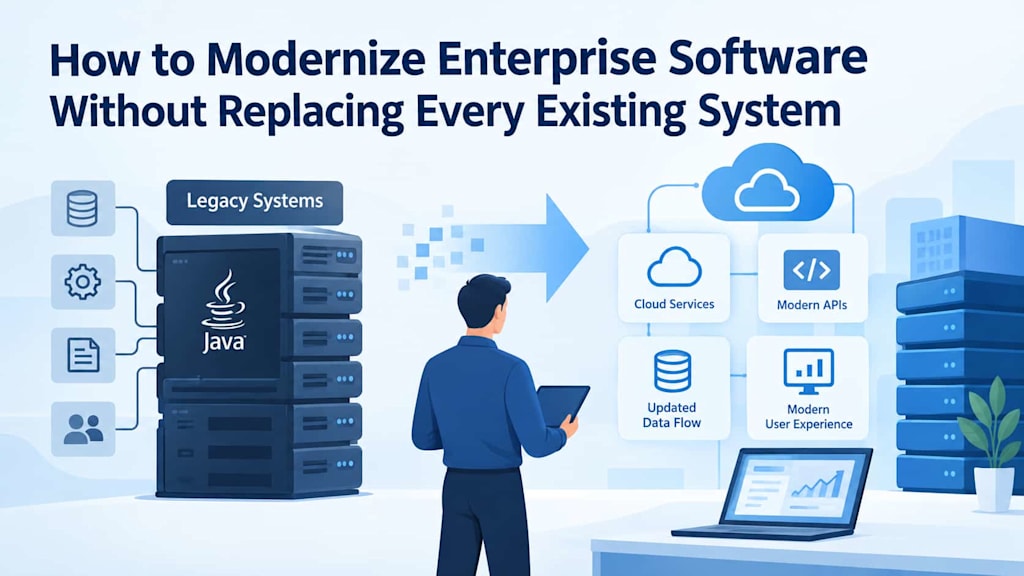
Enterprise software modernization is often associated with replacing outdated applications, migrating everything to a new platform, or rebuilding an entire technology landscape from scratch. For many organizations, however, that approach is neither necessary nor practical.
Large enterprises typically depend on systems that have been developed, customized, and integrated over many years. Some may use older technologies but continue to perform critical business functions reliably. Replacing them all at once can introduce significant operational risks, disrupt workflows, and require substantial investment.
A more practical strategy is selective modernization. Instead of treating every legacy application as a problem that must be eliminated, organizations can identify which systems need change, which can remain stable, and where new technology can be introduced around them.
Start With the Existing Technology Landscape
Before modernization begins, organizations need a clear picture of the current environment. Enterprise applications rarely operate independently. A single business process may involve a customer-facing application, an ERP platform, databases, APIs, reporting tools, authentication services, and several internal systems.
Creating an inventory of applications and integrations helps reveal these dependencies. Teams should document which systems exchange data, which applications support critical workflows, where business rules are implemented, and which components depend on older technologies.
This assessment should also consider technical condition. An application that looks outdated may still have a stable architecture and predictable performance. Conversely, a relatively modern application can create serious problems if it has fragile integrations, insufficient monitoring, or difficult-to-maintain custom code.
The goal is not simply to identify old technology. It is to understand the role and condition of every major component.
Decide What Should Stay, Change, or Be Replaced
Once the technology landscape is documented, applications can be divided into several modernization categories.
Some systems may not require significant changes. If an application is stable, secure enough for its role, and expensive to replace without providing meaningful benefits, keeping it in place may be reasonable.
Other systems may benefit from incremental improvements. These could include updating dependencies, improving APIs, introducing automated testing, restructuring parts of the codebase, or moving selected workloads to more modern infrastructure.
A third category may contain applications that are becoming difficult to operate or extend. These systems may eventually need partial or complete replacement, but that does not necessarily mean they must be rebuilt immediately.
This approach allows modernization resources to be directed toward areas where technical change can address concrete business or operational problems.
Modernize Around Critical Legacy Systems
One of the most effective strategies is to modernize the surrounding architecture while leaving a stable core application in place.
For example, an enterprise may retain an established Java application responsible for important business rules while introducing modern APIs, cloud services, new user interfaces, or event-driven components around it. The existing application continues to perform its core role while newer components gradually take responsibility for additional functions.
This can reduce the scope of each modernization project. Instead of rebuilding the entire application, development teams can isolate specific capabilities and expose them through well-defined interfaces.
Organizations working with long-running Java systems may need finding Java expertise for the systems that remain business-critical when internal teams no longer have sufficient knowledge of older frameworks, architectures, or custom implementations. Access to appropriate technical expertise can help organizations maintain continuity while modernization progresses.
Use APIs to Create Clear Boundaries
APIs can play an important role in selective modernization because they provide boundaries between old and new components.
A legacy application might continue managing customer records, inventory calculations, or financial processes while modern services access selected capabilities through APIs. Over time, individual functions can be moved into newer services without requiring the entire system to be replaced simultaneously.
API-based architecture also makes it easier to introduce new front ends. A business can develop a modern web or mobile experience while keeping established backend logic in place.
However, APIs should not simply expose every internal function of a legacy application. Poorly designed interfaces can reproduce the original architecture's limitations. Teams should identify stable business capabilities and design interfaces around those capabilities rather than around internal implementation details.
Modernize Data Flows Carefully
Data is another major consideration. Enterprise systems often contain years of business information and may rely on complex synchronization processes.
Modernization projects should establish which system is authoritative for each important data domain. Teams also need to understand how information moves between applications and what happens when one system is unavailable.
Rather than moving all data immediately, organizations can introduce controlled synchronization mechanisms. Change-data capture, integration services, queues, and event-driven communication can help newer applications consume information without forcing an immediate migration of every database.
Data validation and reconciliation are particularly important when old and new systems operate simultaneously. Even small inconsistencies can create problems in financial reporting, inventory management, customer records, or regulatory processes.
Introduce Modernization in Manageable Stages
A modernization program becomes easier to control when it is divided into clearly defined stages.
The first stage can focus on assessment and dependency mapping. The second might address technical risks in the most problematic applications. Later stages can introduce new services, replace selected modules, or migrate specific workloads.
Each stage should have measurable objectives. These might include reducing deployment time, improving application observability, removing unsupported dependencies, increasing test coverage, or making a particular business capability easier to change.
This incremental approach also makes it possible to learn from each project before expanding the modernization program.
Avoid Creating New Technology Silos
Selective modernization can introduce another problem if every department launches independent technology projects without a common architectural direction.
For example, several teams might independently create APIs, integration services, data pipelines, or authentication mechanisms. Over time, the organization could end up with a new collection of disconnected components alongside its legacy systems.
Architecture governance can help prevent this outcome. Teams should establish shared principles for APIs, security, identity management, observability, deployment, data ownership, and integration.
The objective is not to force every project onto one technology stack. Instead, it is to make sure individual modernization initiatives contribute to a coherent technology environment.
Connect Individual Projects to a Broader Strategy
An organization may begin modernization with a single application because it has an obvious maintenance problem or business requirement. That project can become more valuable when its lessons, architectural patterns, and reusable components inform subsequent initiatives.
This is where organizations can focus on turning isolated modernization projects into a broader transformation. A successful API modernization, for example, can establish integration standards that later projects adopt. Improvements in automated testing can become a reusable engineering practice across multiple applications.
The broader objective is to create momentum without requiring the organization to launch a massive transformation program on day one.
Know When External Expertise Is Useful
Enterprise modernization often requires knowledge that is not available within the existing development team. Internal engineers may understand the business extremely well but have limited experience with a legacy framework. Alternatively, they may be highly skilled technically but lack capacity to manage modernization alongside daily operational responsibilities.
In these situations, an external development partner can supplement the existing team without taking complete ownership of the technology landscape. A useful approach is bringing a trusted development partner into a client project to address a specific architectural, development, integration, or migration challenge while internal stakeholders remain involved in key decisions.
The arrangement can also support knowledge transfer. Documentation, architectural workshops, code reviews, and joint development can help internal teams retain knowledge after the external engagement ends.
Recognize When an Application Needs More Than Maintenance
Not every old application needs modernization immediately. However, certain recurring problems can indicate that maintaining the existing system is becoming increasingly expensive or risky.
Common signs that legacy Java application needs modernization include difficulty hiring developers with relevant skills, unsupported dependencies, frequent production incidents, slow release cycles, fragile integrations, insufficient automated testing, poor observability, and growing difficulty implementing new business requirements.
Security and compliance requirements can also create pressure for change. An application may continue functioning correctly while its underlying libraries, runtime environment, or infrastructure become increasingly difficult to maintain securely.
These indicators should be evaluated together rather than treated as automatic reasons for replacement. The appropriate response could be targeted refactoring, infrastructure modernization, application decomposition, or eventual replacement.
Protect Business Continuity During Modernization
The most important constraint for many enterprise modernization programs is continuity.
Critical applications cannot simply be taken offline while new systems are developed. Migration strategies therefore need to account for parallel operation, rollback procedures, data synchronization, testing, and gradual user adoption.
Techniques such as strangler-style modernization can help organizations replace individual capabilities progressively. A new component takes over a specific function while the existing application continues handling the remaining workload.
Feature flags, automated regression testing, monitoring, and controlled releases can further reduce operational risk.
Measure Modernization by Business and Technical Outcomes
Modernization should not be evaluated only by the number of applications migrated or the amount of legacy code removed.
More meaningful measurements can include deployment frequency, incident rates, system availability, development lead time, infrastructure costs, integration reliability, and the time required to implement business changes.
These metrics connect technical work with operational outcomes. They also help organizations decide whether a modernization initiative should continue, change direction, or expand to another part of the technology landscape.
Conclusion
Modernizing enterprise software does not require replacing every existing system. In many environments, the more practical approach is to preserve stable business-critical applications while progressively improving the architecture around them.
By mapping dependencies, establishing clear API boundaries, managing data carefully, modernizing in stages, and maintaining architectural consistency, organizations can reduce the risks associated with large-scale replacement.
The key is to treat modernization as a controlled process rather than a single technology migration. Existing systems can continue delivering business value while selected components are gradually improved, replaced, or surrounded by modern services. This allows enterprises to move toward a more maintainable technology environment without unnecessarily disrupting the systems and knowledge that their operations already depend on.
About the Creator
Chudovo
Chudovo is a custom software development company, focused on complex systems implementation.
Enjoyed the story? Support the Creator.
Subscribe for free to receive all their stories in your feed.
Comments
There are no comments for this story
Be the first to respond and start the conversation.