
How to Connect ERP Systems and Analytics Without Creating Data Silos
Building a consistent data environment that connects enterprise applications, improves reporting accuracy, and supports better business decisions.

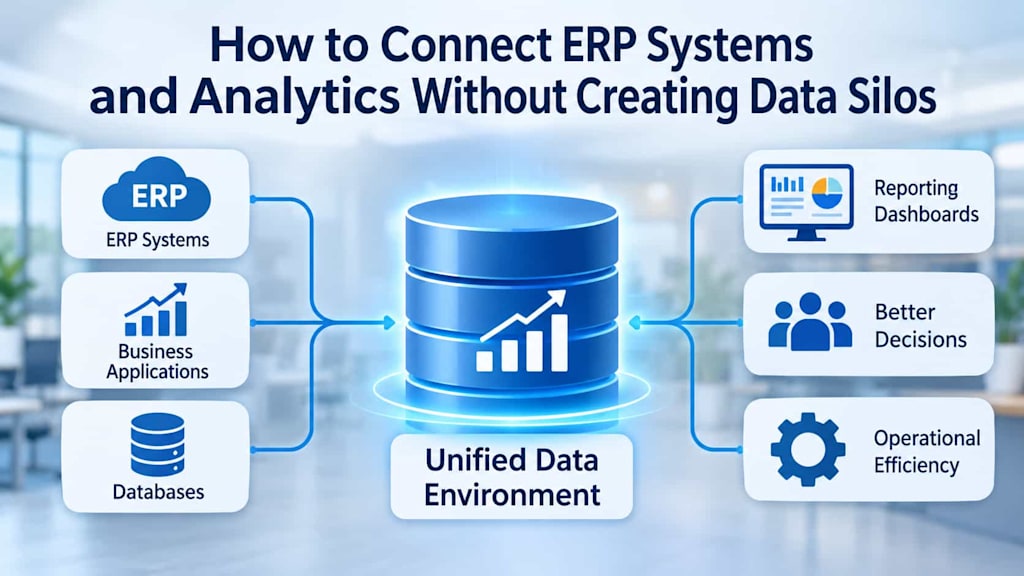
Enterprise Resource Planning (ERP) systems play a central role in managing business operations. They store information about financial transactions, procurement, inventory, sales, production, and other essential activities. However, as organizations expand their technology environments, ERP platforms rarely remain the only source of operational data. Customer Relationship Management (CRM) applications, e-commerce platforms, warehouse management systems, business intelligence tools, and separate databases all contribute information that businesses need to understand their performance.
The challenge is that these systems do not always communicate effectively. Different applications may maintain separate records, use inconsistent definitions, or update information according to different schedules. As a result, managers can encounter conflicting reports, incomplete performance indicators, and difficulties comparing information across departments.
Connecting ERP systems with analytics requires more than transferring data between applications. Businesses need a coordinated approach to data management that establishes consistent definitions, improves accessibility, and ensures that information remains reliable throughout the reporting process.
Why ERP and Analytics Environments Become Fragmented
Data silos often emerge gradually as organizations introduce new applications to address specific operational requirements. A finance department might use an ERP platform, while sales teams rely on CRM software and marketing specialists maintain separate reporting databases. Each solution serves its immediate purpose, but the organization eventually struggles to establish a unified view of its activities.
Acquisitions and international expansion can make the situation more complicated. Different subsidiaries may operate separate ERP installations, maintain different product catalogs, or follow their own accounting practices. Even when applications support similar business functions, their data structures and terminology may not match.
Another source of fragmentation is the accumulation of custom integrations. Businesses frequently connect applications through individual interfaces or scheduled exports. Although these connections can solve immediate problems, they may create dependencies that are difficult to maintain as systems evolve.
The consequences extend beyond technical maintenance. Finance teams may report different revenue figures from sales departments, inventory reports may not reflect the latest warehouse information, and executives may spend considerable time reconciling numbers before making decisions.
Establishing Consistent Data Definitions Across Business Systems
A connected reporting environment begins with agreement on what business data actually represents. Different applications can use similar labels for different concepts or different labels for identical information.
For example, one system might classify a customer as active after a recent purchase, while another uses account status or contractual activity. If reporting tools combine these records without accounting for the differences, customer performance metrics become unreliable.
Organizations should establish shared definitions for important business entities and indicators. These typically include customers, products, suppliers, transactions, revenue, inventory levels, and operational costs.
A common data dictionary can document:
Standard names and descriptions for business entities.
Definitions of financial and operational indicators.
Accepted formats for dates, currencies, and identification numbers.
Rules for handling missing, duplicated, or inconsistent records.
Ownership and responsibility for maintaining individual data categories.
Master data management is particularly important when several applications contain information about the same customers, products, or suppliers. Businesses need clear rules for identifying authoritative records and resolving conflicts between systems.
Standardization does not necessarily mean forcing every department to abandon its existing applications. Instead, organizations should create shared definitions that allow information from different environments to be interpreted consistently.
Aligning ERP Customization With Business Requirements
ERP platforms often require adjustments to reflect an organization's specific workflows, reporting requirements, and operational structure. However, customization decisions can directly influence how easily ERP information connects with analytics applications.
For example, businesses implementing NetSuite customization and integration may need to align financial records, sales information, inventory data, and external applications within a consistent reporting environment. Custom fields and workflows should support actual business requirements while preserving the ability to exchange information with other systems.
A similar consideration applies when adapting Odoo ERP to business processes. Organizations may introduce additional modules, modify existing workflows, or connect third-party applications to accommodate their operations. These changes should be evaluated not only according to their immediate functionality but also according to their impact on data consistency and reporting.
Excessive customization can create additional dependencies. If different departments introduce their own field structures or calculation rules, combining information becomes increasingly difficult.
Therefore, businesses should focus on deciding which ERP functions to customize based on operational value, integration requirements, and long-term maintenance responsibilities. Standard functionality should generally be retained when it already meets business needs. Custom development is more appropriate when existing capabilities cannot support essential processes or when a specific modification provides measurable operational benefits.
Coordinating Data Exchange Through ETL and ELT Processes
Once business data definitions are established, organizations need reliable mechanisms for moving information between operational applications and analytical environments.
ETL and ELT approaches provide two common ways to coordinate this exchange. ETL extracts information from source systems, transforms it according to defined rules, and then loads it into a target environment. ELT loads the extracted information first and performs transformations within the destination platform.
The choice depends on the organization's infrastructure, data volumes, processing requirements, and analytical objectives.
Well-managed ETL and ELT data integration processes help businesses standardize information from different applications before it reaches reporting environments. For example, transaction records from several ERP installations can be converted into a consistent format, while customer information from CRM systems can be matched against shared identifiers.
However, successful integration involves more than selecting a processing approach. Organizations must also establish clear rules for data updates, error handling, synchronization frequency, and record ownership.
Not every business requires immediate synchronization across all applications. Financial reporting may operate on daily or periodic updates, while inventory management might require more frequent information exchange. Matching update schedules to business requirements helps balance reporting accuracy with infrastructure costs.
Using a Centralized Data Warehouse for Consistent Reporting
When information is distributed across multiple operational systems, a centralized analytical environment can provide a common foundation for business reporting.
A data warehouse collects information from different sources and organizes it according to consistent structures and business definitions. Instead of requiring managers to access several applications independently, the organization can provide a unified environment for analyzing historical and current business performance.
Centralized data warehouse development should begin with an understanding of the reporting requirements that matter most. Finance teams may need consolidated revenue and expense information, while operations managers may require visibility into inventory movements, procurement activity, and production performance.
The warehouse should preserve sufficient context to make comparisons meaningful. For example, financial information from different subsidiaries may need currency conversion, standardized accounting classifications, and consistent reporting periods.
Data warehouses also help separate operational workloads from analytical activities. Complex reporting queries can be executed against prepared analytical datasets rather than placing unnecessary demands on ERP databases.
Nevertheless, centralization does not automatically eliminate data silos. If the warehouse receives incomplete records or inconsistent information, the resulting reports will reproduce existing problems in a different environment. Data validation, governance, and clearly defined ownership remain essential.
Improving Business Visibility Through Reporting Dashboards
A connected data environment becomes valuable when employees can use the information to understand business performance and identify problems.
Reporting dashboards provide a practical interface for presenting information collected from ERP platforms, warehouses, and other business applications. They allow managers to monitor indicators without manually combining spreadsheets or requesting separate reports from individual departments.
Effective reporting dashboards for business data should reflect the decisions users need to make rather than simply display every available metric.
For example, executive dashboards might focus on revenue, profitability, cash flow, and overall operational performance. Department-level dashboards can provide more detailed information about purchasing, customer activity, inventory turnover, or production efficiency.
Consistency is especially important when different departments use the same indicators. If finance and sales teams calculate revenue differently, their dashboards may present conflicting results even when they access the same underlying warehouse.
Organizations should therefore maintain shared calculation rules and ensure that dashboard metrics are connected to approved data definitions.
It is also important to provide appropriate access permissions. Employees should receive the information necessary for their responsibilities without automatically gaining access to sensitive financial, customer, or personnel records.
Managing Integration Complexity Across Multiple ERP Systems
Larger organizations frequently operate more than one ERP platform. This may result from acquisitions, regional business structures, different operational requirements, or gradual technology modernization.
Connecting these environments requires particular attention to interoperability. Applications may differ in their data models, supported interfaces, business rules, and approaches to managing transactions.
Managing integration complexity across ERP systems requires organizations to define how information should move between platforms and which application should be considered authoritative for each business entity.
For instance, one ERP installation may manage procurement, while another handles financial consolidation. The organization must establish how purchase orders, supplier records, invoices, and payment information relate to one another.
A centralized integration layer can help coordinate these exchanges and reduce the need for numerous direct connections between individual applications.
However, businesses should avoid introducing unnecessary architectural components. Integration solutions should address actual coordination requirements rather than create additional systems that require independent maintenance.
Documentation is equally important. Teams need to understand existing connections, data dependencies, synchronization rules, and the responsibilities associated with each integration.
Regular reviews help identify outdated interfaces, duplicated records, and changes that could affect downstream reporting.
Consolidating Reporting Without Losing Business Context
The ultimate objective of connecting ERP systems and analytics is to make information more useful across the organization.
Consolidating reporting across multiple data sources allows businesses to compare operational and financial performance without depending on isolated departmental reports.
For example, management can analyze sales alongside inventory availability, procurement costs, and delivery performance. Finance teams can compare actual expenditure with operational activity, while executives can evaluate profitability across business units.
However, consolidated reporting should not remove the context that makes individual datasets meaningful. Regional differences, business-specific workflows, accounting policies, and operational conditions may require separate reporting dimensions.
A useful reporting environment therefore combines standardized definitions with the flexibility to examine performance from different perspectives.
Organizations should also establish processes for reviewing data quality and investigating discrepancies. When a dashboard displays an unexpected result, employees need to be able to trace the figure back to its source and understand how it was calculated.
This transparency builds confidence in analytical systems and encourages departments to use shared information rather than maintain competing versions of business performance.
Conclusion
Connecting ERP systems with analytics requires a coordinated approach to data governance, application interoperability, and business reporting. Simply transferring information between applications is not enough. Organizations must establish consistent data definitions, determine ownership of critical records, and ensure that information remains reliable throughout its lifecycle.
ERP customization, ETL and ELT processes, data warehouses, and reporting dashboards all contribute to this objective. Their effectiveness, however, depends on how well they support the organization's actual operational and analytical requirements.
By prioritizing interoperability, standardized reporting, and clear data management responsibilities, businesses can reduce information fragmentation and create a more dependable foundation for decision-making. The result is not just a better-connected technology environment but a clearer understanding of business performance across departments, applications, and organizational boundaries.
About the Creator
Chudovo
Chudovo is a custom software development company, focused on complex systems implementation.
Enjoyed the story? Support the Creator.
Subscribe for free to receive all their stories in your feed.
Comments
There are no comments for this story
Be the first to respond and start the conversation.