
How to Decide What to Customize in an ERP and What to Keep Standard
A practical framework for balancing ERP flexibility, maintainability, and business requirements.

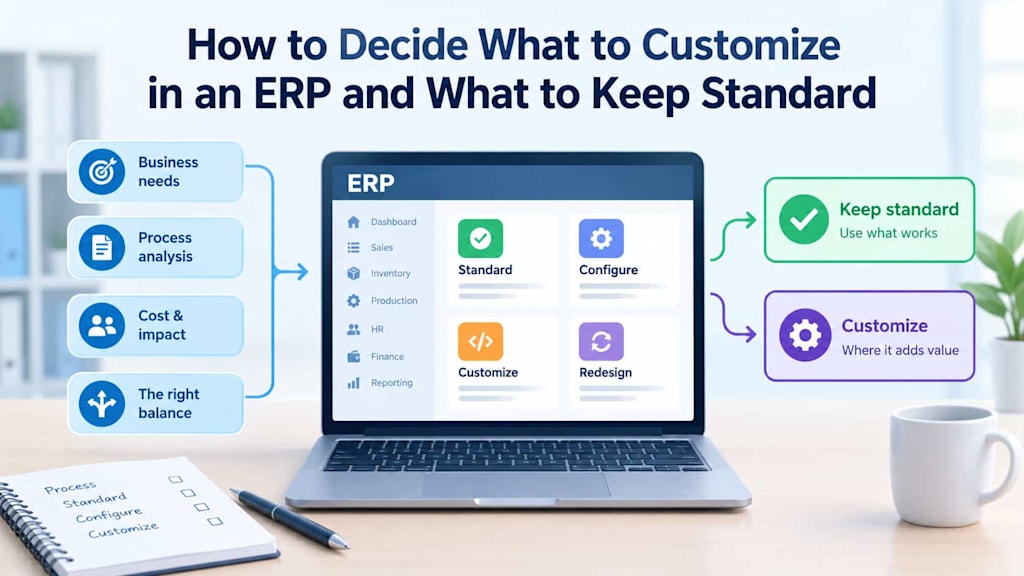
ERP systems are designed to bring business processes into a shared operational framework. Yet no two organizations work in exactly the same way. Companies often discover that some standard ERP features match their processes closely, while others create friction, require unnecessary workarounds, or fail to support important business rules.
This creates a fundamental implementation question: Which parts of the ERP should be customized, and which should remain standard?
The answer has long-term consequences. Excessive customization can make upgrades expensive and increase maintenance requirements. Refusing to customize anything, however, can force employees into inefficient processes that undermine the value of the ERP. The objective is not to eliminate customization but to apply it selectively where it provides measurable business value.
Start With the Business Process, Not the Software
A common mistake is to begin customization discussions by looking at individual ERP screens or features. A better approach starts with the business process itself.
Document how the organization currently handles activities such as purchasing, inventory, sales, production, finance, customer service, or reporting. Identify the people involved, systems used, approvals required, data exchanged, and exceptions that occur.
The next step is to compare those processes with the ERP's standard capabilities. This creates a clearer distinction between genuine business requirements and habits that developed around legacy systems.
For example, an organization may believe that a particular approval sequence must be customized because employees have always followed it. During process analysis, however, it may become clear that the existing sequence exists only because an older system lacked appropriate workflow capabilities.
This distinction matters. Customizing an unnecessary legacy practice simply transfers old complexity into a new ERP environment.
Classify Requirements Before Making Customization Decisions
Not every difference between the current process and the standard ERP requires development. A practical classification can divide requirements into several groups.
Keep standard requirements are already supported by the ERP and do not create meaningful operational problems. These should normally remain unchanged.
Configure requirements can be handled through settings, permissions, workflows, fields, reports, or other built-in capabilities. Configuration is generally preferable to custom development because it preserves more of the platform's standard behavior.
Customize requirements involve genuine business rules or capabilities that cannot reasonably be achieved through configuration. These may justify extensions, custom modules, integrations, or specialized interfaces.
Redesign requirements represent processes where the company may benefit from changing its existing way of working rather than reproducing it inside the ERP.
This classification prevents every difference from automatically becoming a software-development project.
Identify Where Standard Functionality Creates Real Friction
Customization becomes more defensible when a standard process creates measurable operational problems.
Consider a warehouse operation in which the standard ERP workflow requires employees to enter the same information several times. If the duplication creates frequent errors and delays, a targeted customization could provide significant value.
The same principle applies to complex manufacturing rules, industry-specific compliance requirements, specialized pricing logic, or integrations with critical external systems.
The important question is not simply whether the ERP can behave differently. It is whether the difference matters enough to justify the additional technical and operational complexity.
Teams evaluating Odoo, for example, may encounter situations where standard Odoo stops fitting the workflow becomes an important architectural question. At that point, the organization should document the specific limitation, its business impact, possible configuration alternatives, and the expected cost of customization before development begins.
Protect Core ERP Processes From Unnecessary Changes
Some ERP functions are better left close to the standard product even when customization is technically possible.
Core financial processes are a good example. Altering fundamental accounting behavior can create additional testing, reporting, compliance, and upgrade requirements. Similarly, standard inventory or purchasing processes may already incorporate years of product development and testing.
Customization should therefore be approached differently depending on where it occurs.
A custom customer-facing interface may be relatively easy to isolate from the ERP core. A modification to the accounting engine may have consequences across numerous modules.
The architectural principle is simple: the deeper the customization reaches into core ERP logic, the stronger the justification should be.
Measure the Total Cost of Customization
Development cost is only one part of the equation.
A customization may also generate costs for testing, documentation, security reviews, employee training, troubleshooting, monitoring, and future upgrades. Organizations should estimate these costs before approving substantial modifications.
For example, a feature that costs $10,000 to develop may appear inexpensive compared with changing an established business process. But if it requires repeated modifications during every major ERP upgrade, its lifetime cost can become considerably higher.
A useful business case should therefore consider:
Initial development
Integration and testing
Documentation
Training
Maintenance
Security implications
Upgrade compatibility
Future changes to the business process
This broader calculation can reveal that a seemingly small customization is actually a long-term technical commitment.
Consider the Frequency and Stability of the Requirement
Another useful factor is how stable the business requirement is.
A process that has remained unchanged for years and represents a genuine competitive or regulatory requirement may justify customization. A temporary process that is likely to change within six months probably does not.
For example, a company may introduce a temporary approval procedure during a restructuring period. Building a sophisticated custom workflow for a process with a short expected lifespan could create unnecessary technical debt.
Conversely, a specialized manufacturing calculation that is central to the company's operations may remain relevant for many years. In that situation, investing in a well-designed extension may make more sense.
The more stable and strategically important the requirement, the stronger the case for a carefully isolated customization.
Use a Customization Governance Process
ERP customization should not be decided informally by individual developers or department managers. Organizations benefit from establishing a simple governance process.
Every proposed customization can be evaluated using a standard set of questions:
What business problem does it solve?
How frequently does the problem occur?
What is the measurable operational impact?
Can standard functionality solve the problem?
Can configuration solve it?
Can the business process be redesigned instead?
What happens if the ERP is upgraded?
What will the customization cost over its expected lifetime?
Who owns the requirement and approves future changes?
This creates a consistent decision-making framework and makes customization easier to control as the ERP environment grows.
Design Customizations for Isolation
When customization is necessary, architecture matters.
Custom functionality should be separated from standard ERP components wherever practical. Extensions, APIs, custom modules, integration layers, and well-defined interfaces can make future maintenance easier.
Documentation is equally important. Teams should record why the customization exists, which business requirement it addresses, which ERP components it affects, and what dependencies it has.
This information becomes particularly valuable when developers change, business processes evolve, or the ERP platform receives a major upgrade.
The objective is not merely to make a customization work today. It is to make its purpose and boundaries understandable several years later.
Revisit Customizations Over Time
An ERP customization should not automatically become permanent.
Standard ERP products evolve. Features that once required custom development may eventually become part of the standard platform. Business processes also change, making some customizations unnecessary.
Organizations should periodically review their extensions and ask whether each one still provides sufficient value.
A useful review can identify three possible outcomes: keep the customization, replace it with newer standard functionality, or remove it because the underlying requirement no longer exists.
This process helps prevent technical debt from accumulating indefinitely.
Conclusion
The decision to customize an ERP should be based on business value, not on the desire to reproduce every existing process exactly.
Standard functionality is generally preferable when it meets operational needs without significant friction. Configuration should be considered before custom development, while genuine business, regulatory, integration, or competitive requirements may justify carefully designed extensions.
The most sustainable ERP environments are not necessarily those with the fewest customizations. They are the ones where every customization has a clear purpose, measurable value, defined ownership, and an architecture that limits its long-term impact.
By evaluating requirements systematically and treating customization as a long-term investment rather than a quick development task, organizations can create ERP systems that support their unique operations without making future maintenance and upgrades unnecessarily difficult.
About the Creator
Chudovo
Chudovo is a custom software development company, focused on complex systems implementation.
Enjoyed the story? Support the Creator.
Subscribe for free to receive all their stories in your feed.
Comments
There are no comments for this story
Be the first to respond and start the conversation.