
How to Choose a Data Platform for Analytics and IoT Workloads
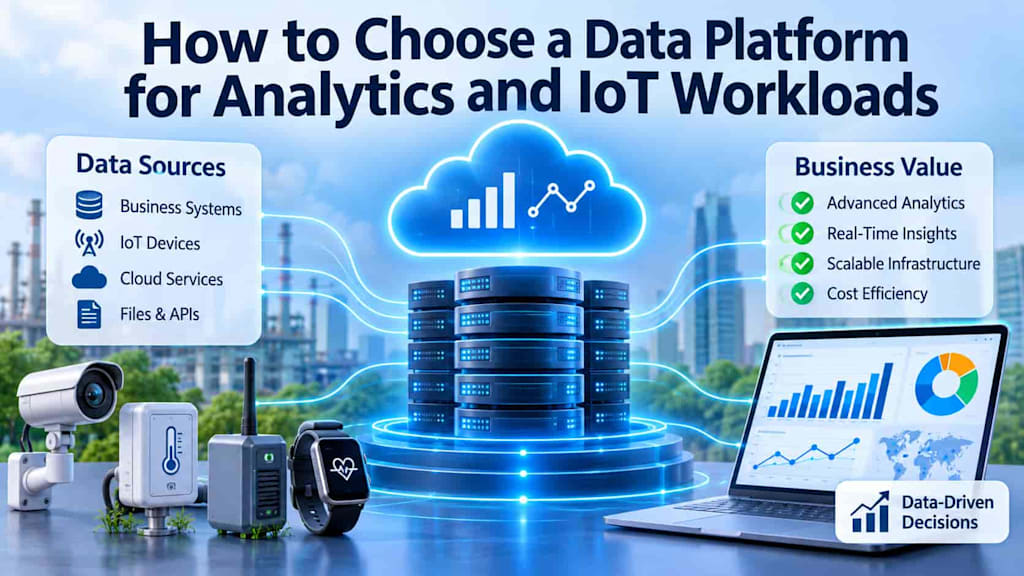
Evaluating data architecture, processing requirements, scalability, and infrastructure costs to build a reliable foundation for analytics and connected business operations.

1. Start With Business Requirements, Not Technology
Choosing a data platform is an important decision for organizations that want to improve reporting, understand business performance, and use information generated by connected devices. As datasets grow and systems become more interconnected, businesses need infrastructure that can support both everyday operations and more advanced analytical activities.
The right platform should reflect the company's actual objectives. Some organizations primarily need to consolidate information from CRM, ERP, financial, and marketing systems. Others work with industrial sensors, smart equipment, connected vehicles, or IoT products that continuously generate streams of information. In many cases, these requirements overlap.
Before evaluating technologies, decision-makers should identify the business questions they want to answer. This may involve improving operational visibility, predicting equipment failures, understanding customer behavior, identifying inefficiencies, or supporting more informed strategic planning. Evaluating data science opportunities at this stage helps distinguish practical analytical goals from experiments that may require substantial investment without delivering measurable value.
A data platform should be selected according to the expected workload, the value of the insights it can produce, and the organization's ability to maintain it over time.
2. Understand Data Volume, Velocity, and Variety
The amount of information an organization stores is only one factor influencing platform selection. The speed at which data arrives, its structure, and how frequently it must be processed are equally important.
Traditional business systems often generate relatively structured information, such as transactions, customer records, invoices, orders, and inventory updates. These datasets may be processed in scheduled batches and stored for historical analysis. IoT workloads introduce different characteristics, including continuous streams, irregular events, device telemetry, time-series measurements, and potentially large volumes of semi-structured data.
Organizations collecting data from connected IoT devices need to understand how many devices will be active, how frequently they transmit information, how much data each event contains, and how long the information must be retained.
A small connected-device network may generate manageable amounts of data, while thousands of sensors transmitting readings every few seconds can create substantial storage and processing demands. The platform must be capable of handling peak workloads without making routine analytical queries unnecessarily expensive.
Estimating these characteristics early helps businesses avoid choosing infrastructure that either lacks sufficient capacity or is significantly more expensive than their actual requirements.
3. Separate Operational Processing From Analytical Workloads
One of the most important architectural considerations is understanding the difference between operational data processing and analytical workloads.
Operational systems are designed to support immediate business activities. They process transactions, update customer profiles, manage inventory, register device events, and maintain current application states. Their priorities usually include reliability, low latency, data consistency, and predictable response times.
Analytical workloads have different objectives. They aggregate information across multiple systems, examine historical trends, perform complex calculations, and support reporting or decision-making. These operations may involve large datasets and intensive queries that would negatively affect transactional systems if executed directly against them.
A platform designed primarily for transactional processing may struggle with large-scale analytical queries. Conversely, an analytical warehouse is not necessarily appropriate for managing real-time application transactions.
Organizations should consider separating these workloads while ensuring that information can move between them efficiently. This separation allows operational applications to remain responsive while analytics teams access consolidated data without creating unnecessary pressure on production databases.
The architecture should also determine which information needs to be available immediately and which can be processed periodically. Not every business report requires real-time updates, and unnecessary processing frequency can increase infrastructure costs.
4. Evaluate Cloud Data Engineering Capabilities
Cloud infrastructure provides organizations with flexible storage, processing, and integration capabilities that can support increasingly complex analytical workloads. Instead of maintaining all computing resources locally, businesses can scale selected services according to demand and use managed technologies to reduce infrastructure administration.
Cloud data engineering involves designing systems that collect information, validate it, transform it, organize it, and make it accessible to downstream applications and analytics tools. The quality of this engineering work directly influences the reliability of reporting and the usefulness of business insights.
For example, data engineering on Microsoft Azure may be part of an organization's broader approach to integrating enterprise applications, storing information centrally, and supporting business intelligence processes. The key evaluation criteria should include integration capabilities, processing performance, governance features, automation, operational complexity, and pricing.
Similarly, building data pipelines on AWS may be relevant when an organization needs scalable processing and storage capabilities for application data, IoT telemetry, or analytical workloads.
Rather than evaluating services in isolation, businesses should assess how well their cloud data engineering environment supports the complete lifecycle of information. The objective is to create a dependable foundation that can accommodate new sources, changing business priorities, and growing analytical demands.
5. Design Reliable Data Pipelines for Multiple Sources
A data platform is only as useful as the information it receives and the processes that prepare that information for consumption. Data pipelines connect source systems with storage, processing environments, and analytical tools.
Businesses frequently work with a mixture of databases, APIs, SaaS applications, files, device gateways, and event streams. Each source may have different formats, update frequencies, access restrictions, and reliability characteristics.
Designing data pipelines across cloud environments requires attention to interoperability, data transfer costs, security, monitoring, and dependencies between services. A pipeline should not simply transfer information from one location to another. It should also handle incomplete records, duplicate events, unexpected formats, failed transfers, and changes in source schemas.
For IoT data, these challenges can be more complicated. Devices may disconnect, send delayed events, report inconsistent timestamps, or transmit values outside expected ranges. Without appropriate validation, such problems can distort analytical results.
Organizations should evaluate whether their pipelines can recover from interruptions, maintain data lineage, monitor processing failures, and support evolving requirements without extensive manual intervention.
6. Prepare IoT Data for Business Analysis
Raw IoT information rarely provides immediate business value. Device-generated readings must often be cleaned, standardized, contextualized, and combined with other enterprise information before analysts can use them effectively.
For example, temperature readings from industrial equipment may be useful for monitoring operating conditions, but meaningful analysis requires additional context. Analysts may need equipment identifiers, facility locations, maintenance records, operating schedules, product information, and historical performance.
Preparing business data for analytics involves establishing consistent formats, handling missing values, identifying anomalies, applying business rules, and ensuring that datasets are understandable to their intended users.
Timestamp consistency is particularly important when combining device data from different locations or systems. Time zones, clock drift, duplicated events, and delayed transmission can produce misleading trends if not addressed.
Businesses should also establish rules for data retention. Some IoT information may be needed only for short-term operational monitoring, while selected measurements should be retained longer to support performance analysis, predictive maintenance, or regulatory reporting.
A well-designed platform makes these preparation processes repeatable, allowing analytical teams to work with trusted datasets instead of repeatedly correcting raw information.
7. Choose Analytics and Reporting Tools That Fit Users
Data platforms should make information accessible to the people who need it. Engineers may require detailed datasets and technical monitoring tools, while managers and business stakeholders often prefer interactive dashboards, summaries, and visual reports.
Business intelligence capabilities should support different reporting needs, including operational dashboards, historical comparisons, performance indicators, and ad hoc analysis. The choice of visualization software should take into account ease of use, integration, licensing costs, access controls, and the technical skills available within the organization.
For companies interested in visualizing business data with Tableau, the platform's role should be considered alongside the broader data architecture. Reporting tools are most effective when they connect to well-organized datasets with consistent definitions and reliable refresh schedules.
Organizations should avoid building dashboards directly on poorly structured raw data whenever possible. A curated analytical layer can simplify reporting, improve performance, and reduce inconsistencies between departments.
The goal is not to create the largest number of dashboards. It is to provide relevant information that helps users make decisions and understand what is happening across the business.
8. Consider Infrastructure Costs, Scalability, and Future Growth
Data platform costs extend beyond storage and compute resources. Organizations should account for data ingestion, transformation, orchestration, networking, query execution, monitoring, software licenses, security, and ongoing engineering support.
Cloud environments can make scaling easier, but poorly optimized workloads may create unpredictable expenses. Frequent processing of unnecessary data, inefficient queries, excessive retention, and duplicated storage can gradually increase operating costs.
Businesses should estimate costs using realistic workload scenarios rather than relying exclusively on initial project budgets. These scenarios should consider expected dataset growth, device expansion, reporting frequency, peak processing periods, and future analytical requirements.
For organizations moving existing data workloads to the cloud, it is important to assess whether historical processes should be transferred unchanged or redesigned to take advantage of a more suitable architecture. Existing systems may contain inefficient data transformations, redundant reporting processes, or outdated retention practices that should be addressed before scaling.
Scalability also includes organizational factors. A platform that requires highly specialized expertise for every routine change may become difficult to manage as analytical needs expand. Documentation, automation, governance, and maintainability should therefore be part of the selection criteria.
Conclusion
Choosing a data platform for analytics and IoT workloads requires balancing performance, scalability, integration capabilities, data quality, reporting requirements, and long-term operating costs. Businesses should begin with clear objectives and a realistic understanding of their data characteristics rather than selecting technologies based on popularity or isolated technical features.
Separating operational processing from analytical workloads, building dependable data pipelines, preparing IoT information for analysis, and providing accessible reporting tools can create a more sustainable data architecture.
The most effective platform is one that supports current business needs while remaining adaptable to new data sources, connected devices, analytical use cases, and organizational growth. A thoughtful evaluation process helps companies avoid unnecessary complexity and build an infrastructure that turns growing volumes of data into practical business value.
About the Creator
Chudovo
Chudovo is a custom software development company, focused on complex systems implementation.
Enjoyed the story? Support the Creator.
Subscribe for free to receive all their stories in your feed.
Comments
There are no comments for this story
Be the first to respond and start the conversation.