
How to Prepare Messy Business Data for Analytics and Machine Learning
A practical guide to consolidating, cleaning, validating, and structuring fragmented business data for reliable analytics and machine learning.

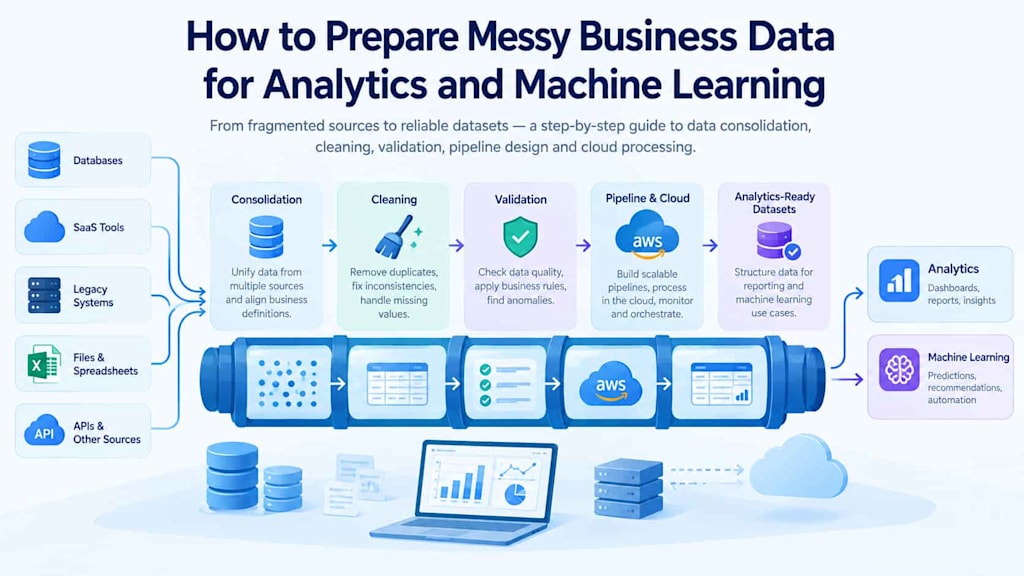
Start by Understanding Where the Data Actually Lives
Many analytics and machine learning projects fail before modeling even begins. The problem is rarely a lack of sophisticated algorithms. Instead, companies often discover that their data is scattered across databases, SaaS platforms, spreadsheets, legacy applications, APIs, and manually maintained files.
Different systems may describe the same business entity in different ways. One application might identify a customer by email address, another by an internal account number, and a third by a CRM identifier. Dates may use different formats, product names may contain spelling variations, and financial values may be stored in different currencies.
Before building dashboards or machine learning models, organizations need to understand this environment.
Start by creating a data inventory that identifies the major sources, their owners, update frequency, formats, dependencies, and business purpose. Map which systems produce operational data and which consume it. This helps reveal duplicated information, isolated datasets, missing fields, and sources that should not be treated as authoritative.
The goal is not necessarily to move everything into one database. It is to establish a clear picture of what data exists and how different sources relate to each other.
Consolidate Data Around Common Business Definitions
Once the sources are mapped, the next challenge is consolidation.
Combining data is more than putting files or database tables into the same storage system. The datasets need consistent definitions. If one system calls something a "customer" while another treats every billing contact as a customer, simply joining the tables can produce misleading results.
Organizations should establish common definitions for important business entities and metrics. These may include customers, products, orders, subscriptions, transactions, employees, locations, and revenue.
Key fields also need standardization. Names, addresses, timestamps, currencies, identifiers, status values, and units of measurement should follow consistent conventions.
For example, an analytics dataset should not contain several representations of the same status:
"Completed"
"complete"
"COMP"
"Closed"
"1"
A transformation layer can convert these values into a controlled vocabulary.
The same principle applies to identifiers. If several systems contain customer information, an identity-resolution process may be necessary to determine when records from different sources refer to the same customer.
This work creates the foundation for trustworthy analysis. Without it, dashboards may show conflicting numbers and machine learning models may learn patterns caused by inconsistent data rather than real business behavior.
Clean the Data Before Trying to Analyze It
Data cleaning is often one of the most time-consuming parts of a data project because real-world business information is rarely complete or consistent.
Common problems include duplicate records, missing values, incorrect data types, invalid dates, inconsistent capitalization, unexpected categories, and obsolete records. Some datasets may also contain extreme values that require investigation.
The correct response is not to automatically delete everything that looks unusual.
A missing value could mean that information was unavailable, not that the record is incorrect. An unusually large transaction could be a data-entry error—or a legitimate enterprise purchase. Cleaning rules should therefore reflect the business context.
Teams should define explicit rules for handling common problems. Depending on the use case, these might include:
Removing exact duplicates
Standardizing formats and units
Normalizing categorical values
Validating dates and numeric ranges
Handling missing values
Flagging suspicious records
Resolving conflicting identifiers
Recording transformations for traceability
Keeping the original data alongside transformed versions can also be valuable. It allows teams to reproduce results and investigate how a particular value changed during processing.
Add Validation and Data Quality Checks
A cleaned dataset is not automatically a reliable dataset. Validation needs to continue as data moves through the pipeline.
Quality checks can verify whether expected fields are populated, values fall within reasonable ranges, relationships between tables remain valid, and new data follows established patterns.
For example, an order should normally reference an existing customer. A transaction date should not unexpectedly precede the customer's account creation date. A product price should not suddenly become negative unless the business process explicitly allows it.
Automated validation is particularly important for recurring pipelines. A dataset that was correct yesterday can become unreliable tomorrow if a source system changes its schema or begins sending incomplete records.
Data-quality rules should therefore be treated as part of the data infrastructure rather than as a one-time cleanup exercise.
Monitoring can also track metrics such as missing-value rates, duplicate counts, record volumes, processing failures, and unexpected changes in distributions. Alerts can then identify problems before they reach dashboards or machine learning workflows.
Design a Pipeline That Can Be Repeated
Manual data preparation may work for a one-off analysis, but it becomes a serious limitation when data needs to be refreshed regularly.
A production-ready pipeline should separate major stages such as ingestion, transformation, validation, storage, and consumption. This makes it easier to identify where a problem occurred and to modify individual stages without rebuilding the entire workflow.
The architecture should also account for different data-processing requirements. Some information may need to be processed in near real time, while other datasets can be refreshed once per day.
Cloud platforms can provide scalable storage and processing resources, but the architecture still needs to be designed around actual business requirements. Building the data pipeline around AWS infrastructure can involve services for storage, processing, orchestration, monitoring, and access control, but choosing those components should follow the data workflow rather than precede it.
A well-designed pipeline should also be observable. Teams need to know when data arrived, which transformations were applied, whether validation succeeded, and whether downstream datasets are current.
Prepare Datasets Specifically for Analytics and ML
Analytics and machine learning do not always require the same dataset structure.
A reporting dataset might be organized around business dimensions such as customer, product, region, and time. A machine learning dataset may instead require carefully selected features, historical observations, labels, and a consistent time window.
Feature preparation deserves particular attention. Variables may need to be aggregated, normalized, encoded, or transformed before they can be used by a model.
Time-based data introduces additional risks. Teams must avoid using information that would not have been available at the time a prediction was supposed to be made. Otherwise, the model can accidentally learn from future information, producing misleadingly strong validation results.
The dataset should also be divided appropriately into training, validation, and test sets. The exact strategy depends on the use case, especially when records are time-dependent or related to the same customers and transactions.
This is where the engineering work behind analytics-ready data becomes critical. Data scientists may develop the models, but reliable modeling depends on repeatable processes for collecting, transforming, validating, and serving the underlying data.
Make the Data Reproducible and Governed
As datasets become more important to business operations, organizations need to know where the data came from and how it was transformed.
Data lineage can connect analytical fields back to their original sources. Versioning can help teams understand which dataset was used for a particular report or model. Access controls can restrict sensitive information to authorized users and systems.
Documentation is equally important. A field called "status" is not particularly useful if nobody knows which values it accepts or what each value means.
Metadata should describe important datasets, including their owners, refresh schedules, definitions, quality expectations, and downstream uses.
These practices become especially valuable when models are retrained regularly. A prediction system is only as reproducible as the data preparation process supporting it.
Turn Data Preparation Into an Ongoing Process
Preparing messy business data should not be treated as a project that ends when the first clean dataset is delivered.
Source systems change. New applications are introduced. Business definitions evolve. Customers and products are added. Data volumes grow. As a result, pipelines and validation rules need ongoing maintenance.
A mature data environment therefore treats data quality as an operational responsibility. Monitoring, automated testing, documentation, and ownership help keep datasets reliable as the business changes.
The objective is to create a repeatable path from raw information to trustworthy analytical assets rather than repeatedly cleaning the same problems by hand.
Conclusion
Turning fragmented business data into something useful for analytics and machine learning requires much more than selecting a database or training an algorithm. The difficult work often happens earlier: identifying sources, consolidating information, standardizing definitions, cleaning records, validating quality, and building repeatable pipelines.
Once these foundations are in place, teams can focus on turning prepared data into useful models and predictions instead of spending most of their time fixing inconsistent inputs.
A practical data strategy does not attempt to make every source perfect. It creates reliable processes for transforming imperfect operational data into datasets that analysts, engineers, and data scientists can use with confidence. That foundation makes analytics more consistent, machine learning more reproducible, and future data initiatives easier to scale.
About the Creator
Chudovo
Chudovo is a custom software development company, focused on complex systems implementation.
Enjoyed the story? Support the Creator.
Subscribe for free to receive all their stories in your feed.
Comments
There are no comments for this story
Be the first to respond and start the conversation.