
How to Build a Regression Testing Strategy for Legacy .NET Modernization
Protect critical application behavior during modernization by establishing testing baselines, validating service contracts, and detecting unexpected changes across APIs, business logic, and database operations.


Modernizing a legacy .NET application introduces risks that extend beyond compilation errors or failing unit tests. A migrated component may build successfully, pass basic validation, and still behave differently from its original implementation. Changes in serialization, database query behavior, transaction handling, service communication, or error processing can create problems that only appear when the application interacts with other systems.
Regression testing is therefore essential to preserving application reliability throughout modernization. Its purpose is to verify that existing functionality continues to behave as expected while teams introduce framework upgrades, architectural changes, and new technical capabilities.
A structured regression testing strategy helps developers identify behavioral differences early, protect business-critical workflows, and avoid discovering compatibility problems after deployment.
1. Why Regression Testing Is Critical During .NET Modernization
Legacy applications often support business operations that have evolved over many years. Their behavior may depend on undocumented conventions, workarounds, historical data structures, or external consumers that cannot be updated immediately.
Successful compilation does not guarantee behavioral compatibility. For example:
A service may return a valid response but use different field names or namespaces.
An API endpoint may return HTTP 200 instead of the previously expected 404 for a particular condition.
A database query may return a different set of records because of changed null handling or query translation.
A transaction may no longer include all operations that previously succeeded or failed together.
An application may handle dates, decimal precision, or enum values differently.
These changes can affect users even when no obvious technical errors occur.
Regression testing provides a controlled way to compare the existing system against the modernized version. It establishes what the application does today, defines which behaviors must remain stable, and gives the team repeatable evidence that modernization has not unintentionally changed critical functionality.
The strategy should focus on protecting observable behavior, not simply testing whether the new implementation meets its own internal expectations.
2. Establish a Behavioral Baseline Before Changing Legacy Code
A regression strategy should begin before developers modify the application. Without a reliable baseline, it becomes difficult to determine whether differences in the modernized system represent intentional improvements or unintended regressions.
Teams should capture representative behavior from the existing application across three major areas: service interfaces, API endpoints, and database operations.
For APIs, record representative requests and their responses, including HTTP status codes, headers, serialized payloads, validation messages, and error conditions. Select scenarios covering successful requests, missing data, invalid inputs, unauthorized access, and boundary conditions.
For WCF services, document service operations, SOAP envelopes, namespaces, message structures, faults, and relevant communication behaviors. Where possible, retain representative request and response messages for comparison.
For database operations, capture expected results from important queries, stored procedures, transaction scenarios, and business workflows. Use realistic test data to reproduce existing behavior, including edge cases.
These baselines should be stored in a version-controlled or otherwise controlled test repository so they remain accessible throughout the modernization project.
Teams conducting auditing legacy .NET dependencies before modernization should also identify which behaviors are influenced by third-party libraries, shared components, framework-specific features, or external systems. Those dependencies may require additional test scenarios because their behavior cannot be validated through application code alone.
3. Understand the Different Types of Regression Tests
A reliable strategy combines multiple testing levels. Each type of test detects different problems, and no single level can protect an entire legacy application.
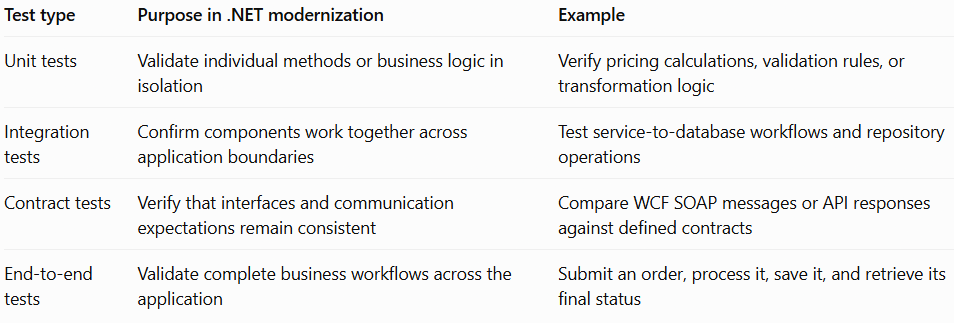
Unit tests are generally fast and useful for identifying logic regressions. Integration tests help detect issues caused by dependencies, configuration, database access, and interactions between components. Contract tests protect interfaces consumed by other systems, while end-to-end tests validate that critical workflows function across the entire application.
Legacy modernization requires all four. A large collection of unit tests may provide confidence in individual classes but fail to detect a broken API contract or a database transaction that no longer behaves correctly.
Teams should use unit tests for frequent feedback, integration and contract tests for compatibility validation, and end-to-end tests for a smaller set of high-value workflows.
4. Design Contract Tests for WCF Services and External Consumers
WCF services often support multiple consumers with different release schedules. Internal applications may be updated alongside the service, but external clients, partner integrations, or older desktop applications may continue using existing contracts for years.
Contract testing helps protect these relationships. It verifies that service operations remain compatible with the expectations of consumers, rather than only checking whether the service itself works.
For SOAP-based integrations, contract tests should cover:
Service operation names and availability.
SOAP namespaces and message structure.
Request and response element names, types, and ordering where relevant.
Required and optional fields.
SOAP headers and authentication expectations.
Fault structures and error-handling behavior.
Representative requests from existing external consumers.
A useful approach is to save representative SOAP requests and responses from the original system and replay them against the modernized service. Tests should validate both the structure of the returned messages and the expected business results.
For example, a service may continue returning a valid SOAP response but change a field from an empty element to an omitted element. A consumer with strict deserialization rules could fail despite the service appearing healthy.
Teams evaluating WCF migration options, including CoreWCF, REST, and gRPC, should use consumer compatibility requirements to define the regression suite. The test strategy should remain independent of the implementation choice so it can validate whichever service architecture is ultimately adopted.
5. Detect Breaking Changes in ASP.NET Web API Responses
API regression testing should focus on observable behavior. Clients may depend on details that developers consider insignificant, including response field presence, status codes, error messages, serialization formats, and header values.
When modernizing ASP.NET Web API applications, teams should capture and compare representative HTTP responses before and after changes.
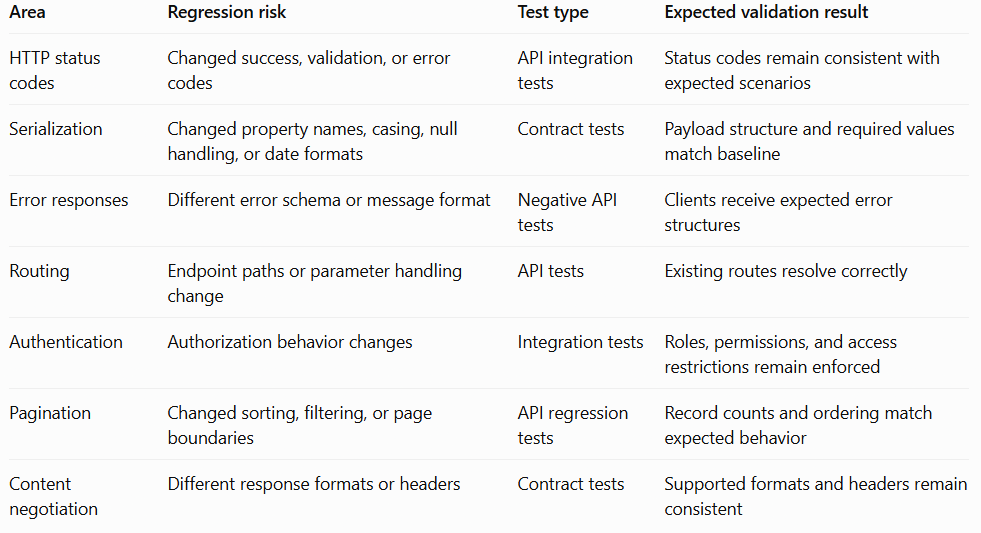
Automated response comparison should avoid blindly comparing every byte. Some values, such as timestamps, correlation IDs, or generated identifiers, may change between executions without representing a regression.
Instead, tests should compare meaningful fields and explicitly define which differences are acceptable. Strict comparison is appropriate for stable contract properties, while dynamic values should be normalized or excluded using documented rules.
This approach makes API compatibility issues during ASP.NET Core migration easier to detect without producing excessive false positives.
6. Validate Database Behavior When Moving From EF6 to EF Core
Database regression testing deserves particular attention because framework changes can affect query execution, object mapping, tracking, and transaction behavior without producing obvious application errors.
Teams should build test scenarios around the actual database operations used by the application, rather than testing only whether entities can be inserted or retrieved.
Key areas include:
Query behavior. Verify filtering, sorting, joins, projections, aggregation, pagination, null handling, and query results. Queries that previously executed successfully may behave differently because of translation changes or differences in how expressions are evaluated.
Data mapping. Validate entity-to-database mappings, relationships, keys, enum conversions, nullable fields, decimal precision, date and time handling, and any custom mapping rules. Ensure that persisted data can be read back correctly and that existing records remain compatible.
Transactions. Test operations that involve multiple database updates. Confirm that successful workflows commit all required changes and that failures roll back operations consistently. Check transaction boundaries, concurrency scenarios, and error handling where multiple components participate.
Tracking and state management. Validate inserts, updates, deletes, relationship changes, and workflows involving multiple entities. Tests should identify unexpected duplicate records, missed updates, stale values, or differences in entity state.
Stored procedures and raw SQL. Where the application relies on database-side logic, verify parameters, returned values, result sets, execution behavior, and error conditions.
The migration considerations for Entity Framework 6 and EF Core should be reflected in the regression suite through targeted scenarios based on the application's actual usage patterns.
An effective database test should compare expected results, persisted state, and transaction outcomes against the original implementation. For high-risk operations, it should also verify that the same business rules apply when executed against representative datasets.
7. Prioritize Regression Tests Based on Business-Critical Workflows
Not every feature deserves the same level of regression testing. Testing priorities should be based on the consequences of failure, the probability of behavior changes, and the team's ability to detect those changes.
Start by identifying the workflows that directly affect revenue, customer operations, financial calculations, security, or important integrations. Map each workflow to the components it uses, including service interfaces, APIs, business logic, and data access.
A workflow such as processing an order may involve several layers:
A customer-facing API receives the request.
Business logic validates the order and calculates its price.
A service communicates with inventory or payment systems.
Database operations create records and update order status.
The API returns the final response to the client.
A regression in any one of these components could disrupt the complete workflow. Therefore, testing priorities should reflect the end-to-end dependency chain rather than treating each component as an isolated unit.
Suggested test prioritization
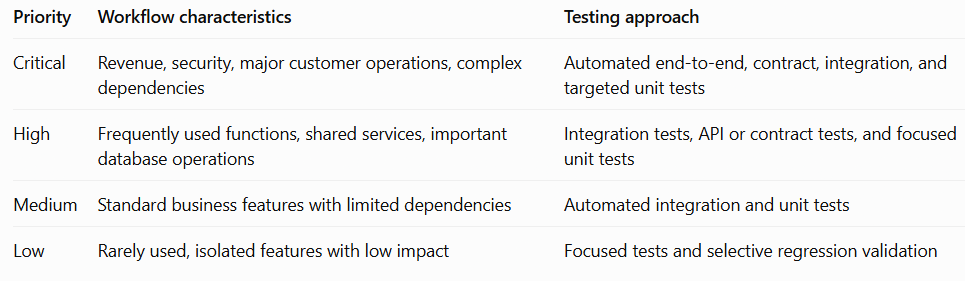
Testability should influence the sequence, too. If a critical workflow has no reliable tests, teams may need to establish its baseline and testing infrastructure before making changes. If a low-risk component has good coverage, it can provide a convenient early validation target.
Prioritization is not about ignoring low-priority functionality. It is about ensuring that testing resources protect the most important behavior first, while gradually increasing coverage across the application.
8. Automate Regression Testing in CI/CD Pipelines
Regression testing becomes more valuable when it runs consistently throughout development. Manual testing alone is rarely sufficient for applications with many service contracts, API endpoints, database operations, and business workflows.
Teams should integrate automated tests into their CI/CD pipelines so that changes are validated before they are merged or deployed.
A practical pipeline can include:
Build and static checks: Compile the application, validate dependencies, and run basic code-quality checks.
Unit testing: Execute fast tests against business logic and isolated components.
Contract testing: Validate API responses, service interfaces, and compatibility expectations.
Integration testing: Run tests against configured databases and dependent services.
End-to-end testing: Validate selected critical workflows in a controlled environment.
Regression reporting: Publish results, highlight failures, and compare results with previous runs.
Tests should be divided into appropriate execution groups. Unit tests can run on every commit, while database-heavy integration tests and end-to-end scenarios may run during pull requests, scheduled builds, or pre-release validation, depending on execution time and infrastructure availability.
Teams should also ensure test data is repeatable. Uncontrolled databases, shared test accounts, unpredictable external services, and changing test environments can create flaky results that reduce confidence in automated regression checks.
CI/CD automation should not simply produce a pass-or-fail signal. It should help developers understand which behavior changed, which tests failed, and which components are affected.
9. Practical Regression Testing Checklist for .NET Migration
Use this checklist to verify that the regression testing strategy is ready and remains effective throughout modernization.
Baseline preparation
Identify critical business workflows and their technical dependencies.
Capture existing API requests, responses, status codes, and error formats.
Save representative WCF SOAP requests, responses, and fault messages.
Record expected results for important database queries and operations.
Identify undocumented behaviors that external consumers may rely on.
Establish test data and repeatable execution environments.
Service and API validation
Validate service operations, message structures, namespaces, and headers.
Test existing WCF consumer scenarios.
Verify API routes, HTTP methods, status codes, and response schemas.
Check serialization, null handling, dates, enums, and error responses.
Test authentication, authorization, validation, and negative scenarios.
Compare new behavior against recorded baselines.
Database regression testing
Validate queries, filtering, sorting, joins, and pagination.
Test entity mappings and relationships.
Verify inserts, updates, deletes, and persisted values.
Check transaction success and rollback scenarios.
Test concurrency and entity tracking where applicable.
Validate stored procedures and raw SQL dependencies.
Automation and release readiness
Run unit tests automatically during development.
Integrate contract and API tests into CI/CD.
Automate critical database integration scenarios.
Include end-to-end tests for business-critical workflows.
Review test failures and behavioral differences before accepting changes.
Confirm unresolved regression risks have documented owners and mitigation plans.
The checklist should be adapted to each application. The purpose is not to require every test for every component, but to ensure that critical behaviors are validated systematically and that untested risks are visible before release.
Conclusion
Regression testing is one of the most important safeguards during legacy .NET modernization. Successful builds and passing unit tests alone cannot guarantee that service interfaces, APIs, database operations, and external integrations will continue to behave as expected.
By capturing behavioral baselines, designing contract tests, validating data access operations, and prioritizing tests around business-critical workflows, development teams can identify compatibility problems before they affect users. Automation makes these checks repeatable and ensures that regression coverage continues to protect the application as modernization progresses.
A practical regression testing strategy allows teams to make technical changes with greater confidence while maintaining backward compatibility during .NET migration where existing consumers and business operations require it. Ultimately, the value of regression testing lies in ensuring that the modernized application delivers new technical capabilities without unintentionally losing the functionality that made the legacy system dependable.
About the Creator
Chudovo
Chudovo is a custom software development company, focused on complex systems implementation.
Enjoyed the story? Support the Creator.
Subscribe for free to receive all their stories in your feed.
Comments
There are no comments for this story
Be the first to respond and start the conversation.