
How to Audit a Legacy .NET Application Before Modernization
Identify hidden dependencies, compatibility risks, and critical application behaviors before committing to a legacy .NET modernization project.


Modernizing a legacy .NET application can be significantly more complicated than replacing outdated frameworks or upgrading libraries. Applications that have been running for years often contain undocumented dependencies, unexpected interactions between services, and business logic that is difficult to separate from infrastructure code. Even components that appear independent may rely on specific database behaviors, API response formats, or service contracts that other systems cannot easily change.
A technical audit helps development teams understand these relationships before modernization begins. Rather than immediately planning implementation, engineers should examine how the application works today, identify the boundaries between its components, and determine which changes can be introduced independently.
The objective is to build a realistic understanding of the existing system, reduce uncertainty, and establish a migration sequence based on evidence rather than assumptions.
1. Map Service Contracts and Their Consumers
Service interfaces are often among the most important modernization risks because their dependencies may extend beyond the application itself. A legacy .NET system might expose WCF services used by internal applications, partner integrations, desktop clients, scheduled jobs, or external business systems.
The first audit task is to identify every service contract and its consumers. Teams should document the operations exposed by each service, request and response structures, authentication requirements, transport protocols, error-handling conventions, and dependencies between service methods.
A WCF service may appear to be a self-contained component, but it could have consumers that rely on specific SOAP headers, namespaces, message structures, or communication patterns. Updating the service without understanding those relationships can disrupt systems that are outside the modernization project's direct scope.
Service dependency discovery should combine source-code analysis with configuration reviews, log analysis, and discussions with system owners. Engineers should look for references to service interfaces, client proxies, endpoint configuration, generated service references, and environment-specific bindings.
The audit should also distinguish consumers that can be updated alongside the service from those that must remain unchanged. This information helps determine whether a service can be modernized independently or whether it requires coordinated changes across multiple systems.
2. Assess API Behavior and Compatibility Risks
Legacy ASP.NET Web API 2 applications frequently contain behaviors that clients depend on but that are not explicitly documented. These may include routing conventions, response codes, JSON formatting, validation behavior, authentication filters, pagination rules, and error messages.
A seemingly minor change can affect client applications. For example, a consumer may expect a particular property to be present even when its value is null, depend on a specific date format, or interpret an empty response differently from a missing response.
Teams should inventory API endpoints and identify the clients using them. Existing API documentation, logs, integration tests, and network traces can help reveal actual usage patterns. When documentation is incomplete, observing real traffic may be the most reliable way to understand how the application behaves.
This process helps expose API compatibility risks during ASP.NET Core migration before implementation begins. Teams should record which behaviors are contractually important, which are accidental but widely relied upon, and which can be changed with minimal impact.
The audit should avoid assuming that an API's intended behavior and its actual behavior are identical. Existing consumers may have adapted to inconsistencies over time, making undocumented details part of the effective contract.
3. Examine Data Access Dependencies and Database Behavior
Data access layers are frequently more tightly coupled to application logic than their architecture diagrams suggest. In legacy applications, Entity Framework 6 may handle database queries, transaction boundaries, lazy loading, entity tracking, stored procedure calls, and object relationships that are relied upon by multiple services.
An audit should identify how data access is organized and whether business logic directly depends on EF6-specific behavior. Teams should look for shared DbContext instances, repositories, unit-of-work patterns, direct database access from controllers, complex LINQ queries, stored procedures, raw SQL, and entity relationships.
The objective is evaluating the move from Entity Framework 6 to EF Core from a dependency and compatibility perspective, rather than simply reviewing which framework version is supported.
Some components may be relatively isolated because they use simple repository interfaces and predictable database operations. Others may depend on database-specific logic, complicated entity graphs, or behavior that is difficult to reproduce and test.
Teams should record which database operations are essential to business workflows, which are shared between modules, and which could be tested independently. They should also identify data access assumptions that may be invisible in the code, such as transaction behavior, query ordering, concurrency, and reliance on database defaults.
This assessment helps establish where changes could affect multiple parts of the application and where a smaller, independently testable scope may be possible.
4. Identify Third-Party Libraries and External Dependencies
Legacy .NET applications often depend on NuGet packages, commercial libraries, internal shared components, and integrations that were introduced years ago. Some may no longer be actively maintained, while others may depend on framework-specific functionality that complicates modernization.
The audit should include a complete dependency inventory covering direct and transitive packages, licensing requirements, maintenance status, framework compatibility, and the role each library plays in the application.
Special attention should be given to packages that influence multiple application layers, such as authentication providers, logging frameworks, serialization libraries, caching components, reporting tools, and background job schedulers.
Teams should distinguish between dependencies that can be replaced independently and those that are embedded in business workflows. A library used by one isolated reporting module may represent a manageable risk, while a dependency shared by service contracts, business logic, and database operations may require a coordinated approach.
The presence of an outdated package does not automatically mean it must be replaced immediately. Its actual usage, security exposure, business importance, and compatibility constraints should determine its priority.
5. Establish Baseline Tests and Existing System Behavior
Modernization decisions become more reliable when teams can demonstrate how the existing application behaves before changes begin. Unfortunately, many legacy applications have incomplete automated test coverage or rely heavily on manual verification.
The audit should examine unit tests, integration tests, API tests, service-level tests, database testing practices, and any existing regression suites. It should identify the areas that are well protected and those where a change could introduce unexpected consequences.
When automated tests are missing, teams should prioritize establishing baseline tests around critical business operations and external interfaces. These tests do not need to cover every line of code. They should capture the behaviors that must remain stable, including important calculations, workflows, authorization rules, and integration responses.
Logs, sample requests and responses, database snapshots, and repeatable test scenarios can supplement formal tests where necessary. The goal is to have measurable reference points for comparing the legacy application with its future implementation.
Without baseline coverage, teams may discover that a modernization change has altered application behavior but lack the evidence needed to determine whether the difference is intentional or a regression.
6. Build a Practical Dependency Inventory
A useful audit produces a concrete inventory rather than a collection of observations. The inventory should connect technical components to their dependencies, risks, and assessment actions.
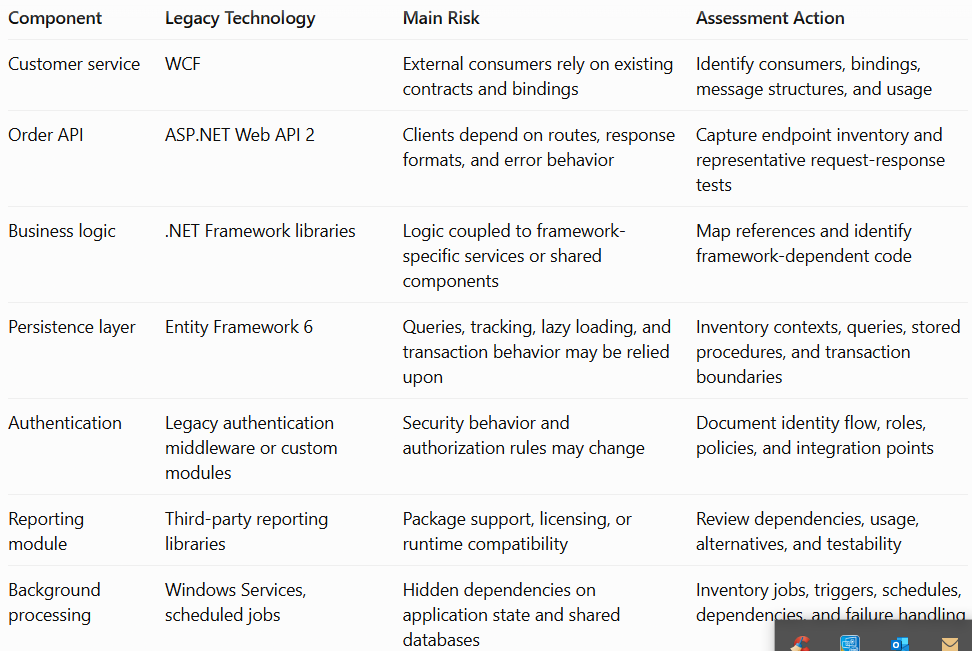
This inventory should be maintained throughout the assessment. If a component's dependencies remain uncertain, that uncertainty should be recorded as a risk rather than treated as a confirmed absence of dependencies.
7. Use a Dependency Inventory Checklist
A practical inventory should be detailed enough to help engineers trace relationships without turning the audit into an exhaustive code-review exercise. The following checklist provides a starting point.
Service contracts and consumers
List WCF services, interfaces, operations, endpoints, bindings, and authentication requirements.
Identify internal, external, and unknown consumers of each service.
Record generated proxies, shared contract assemblies, and configuration dependencies.
Identify consumers that cannot be updated on the same schedule as the service.
ASP.NET Web API 2 behavior
Inventory controllers, routes, HTTP methods, and endpoint usage.
Record response formats, serialization conventions, status codes, and validation rules.
Identify custom filters, authentication handlers, middleware-like components, and exception handling.
Capture representative API behavior through tests or documented request-response examples.
Entity Framework 6 and database dependencies
Inventory DbContext classes, entity models, repositories, and unit-of-work implementations.
Identify lazy loading, tracking behavior, navigation properties, and complex LINQ queries.
Document stored procedures, raw SQL, database triggers, and transaction boundaries.
Identify shared database access between modules and services.
Third-party libraries
List NuGet packages, internal libraries, and external integrations.
Check framework dependencies, support status, security concerns, and licensing.
Identify packages used across multiple components.
Determine whether replacement or isolation is needed before other changes.
Existing test coverage
Review unit, integration, API, service, and regression tests.
Identify critical business operations without automated coverage.
Capture baseline behavior for high-risk interfaces and workflows.
Determine which components can be tested independently and which require shared environments.
The inventory should also capture the business owner, technical owner, criticality, dependency confidence, and testing readiness of each component. This makes the audit actionable for both engineering teams and management.
8. Determine Which Components Can Migrate Independently
A legacy application may contain components that are technically separated but operationally connected. Independence should be evaluated using actual dependencies rather than folder structure, project boundaries, or naming conventions.
A component is a strong candidate for independent modernization when it has a clear interface, limited shared state, stable contracts, manageable dependencies, and automated tests that can validate it without requiring the entire application.
For example, an internal reporting module that reads from a stable data interface may be easier to isolate than a WCF service used by several external applications. A business logic library that depends on shared framework utilities may also require additional preparation before it can be separated safely.
Teams should classify components into three groups:
Independent candidates: Components with stable boundaries, limited coupling, and sufficient test coverage.
Coordinated candidates: Components that can be changed but require simultaneous updates to specific consumers, shared libraries, or database dependencies.
High-uncertainty candidates: Components with undocumented behavior, unknown consumers, limited test coverage, or complex shared state.
This classification helps prevent teams from assuming that every application layer can be modernized in isolation. It also supports decisions about choosing between CoreWCF, REST, and gRPC at the appropriate point, when service dependencies and consumer constraints are understood, without prematurely committing to a particular interface strategy.
9. Prioritize Audit Findings and Establish a Migration Sequence
Once dependencies are mapped, teams need a consistent way to prioritize components. The order should not be determined solely by technical complexity or by which project appears easiest to upgrade.
A practical prioritization model should consider three factors:
Compatibility risk: How likely is the component to break existing consumers, contracts, database behavior, or dependent systems?
Business criticality: What would be the operational, financial, or customer impact if the component became unavailable or behaved differently?
Testability: How confidently can engineers verify the component before and after changes?
Recommended prioritization approach
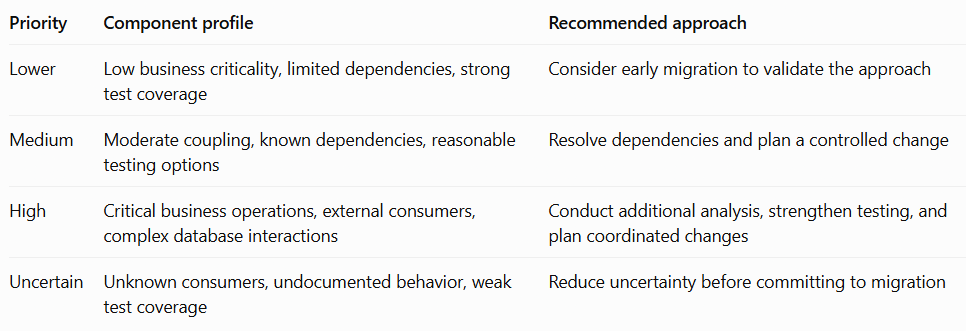
A component with high business criticality should not automatically be migrated first, even if it is technically straightforward. Likewise, a low-risk component is not necessarily a good starting point if it offers little value or depends on infrastructure that is not yet ready.
Teams should look for components that provide useful learning while keeping compatibility risks manageable. The findings can then inform a practical roadmap for modernizing legacy ASP.NET applications, grounded in verified dependencies and the actual capabilities of the development team.
The audit should also explicitly identify compatibility obligations. Maintaining backward compatibility during .NET migration may require certain services, APIs, or database interactions to remain stable while other parts of the application change. These obligations influence the sequencing of work and may require temporary coexistence between old and new components.
Conclusion
A successful legacy .NET modernization project begins with understanding the application as it actually operates—not simply how it was originally designed. Service contracts may have external consumers, API endpoints may contain undocumented behavioral expectations, and Entity Framework 6 data access may be tightly connected to business workflows.
A structured audit of interfaces, API behavior, database dependencies, third-party libraries, and test coverage helps teams uncover these risks before implementation starts. By documenting dependencies, distinguishing independent components from coordinated changes, and prioritizing work according to compatibility, business criticality, and testability, organizations can make more informed decisions about what to modernize and when.
The result is a more realistic modernization effort, fewer surprises during implementation, and a technical foundation for change that preserves essential business functionality while enabling the application to evolve.
About the Creator
Chudovo
Chudovo is a custom software development company, focused on complex systems implementation.
Enjoyed the story? Support the Creator.
Subscribe for free to receive all their stories in your feed.
Comments
There are no comments for this story
Be the first to respond and start the conversation.