
How To Build a Digital Transformation Strategy That Actually Works in 2026
Practical steps for creating scalable, measurable, and future-ready business transformation plans

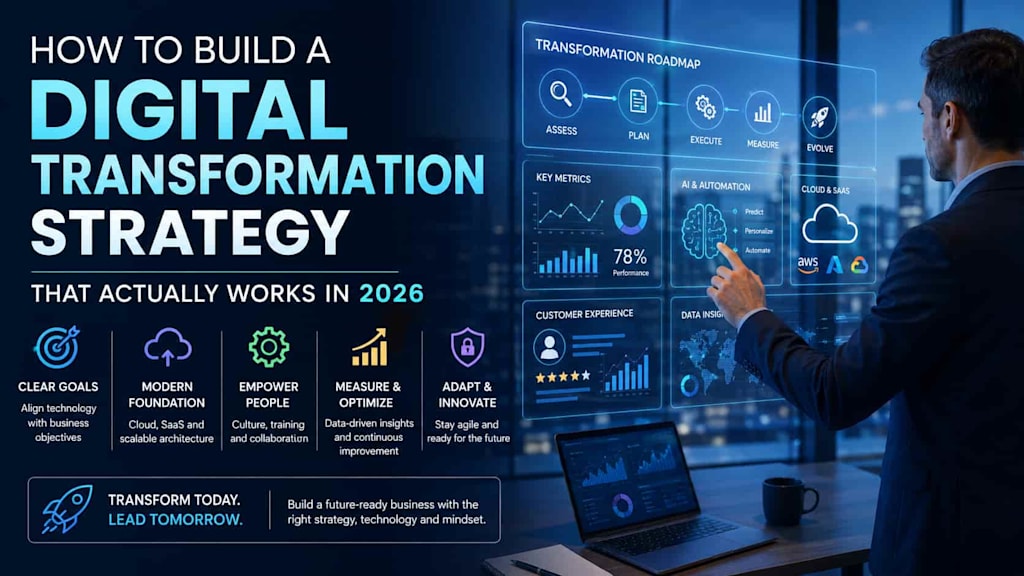
Digital transformation is no longer a side initiative reserved for large enterprises with unlimited budgets. In 2026, organizations of every size are under pressure to modernize operations, improve customer experiences, automate workflows, and adapt to rapidly changing technology landscapes. Yet despite billions invested globally, many transformation initiatives still fail to deliver meaningful business outcomes.
The reason is rarely the technology itself. Most failures happen because companies approach transformation as a collection of disconnected tools instead of a long-term business evolution. Buying software, migrating systems to the cloud, or adopting artificial intelligence does not automatically create innovation. Sustainable transformation requires alignment between leadership, processes, teams, customer expectations, and technical infrastructure.
Modern businesses also face an environment where markets shift quickly, customer behavior changes continuously, and new competitors emerge from unexpected industries. A successful strategy in 2022 may already feel outdated in 2026. This means organizations need transformation frameworks that are flexible, measurable, and capable of evolving over time.
The most effective digital transformation strategies today are built around clear business objectives rather than technology hype. Companies that succeed focus on operational efficiency, employee productivity, customer retention, data-driven decision-making, and scalable digital ecosystems. Technology becomes an enabler instead of the final goal.
This article explains how organizations can build a realistic and effective digital transformation strategy for 2026, including leadership alignment, technology priorities, implementation planning, organizational culture, and future scalability.
Define Business Goals Before Choosing Technology
One of the most common mistakes organizations make is selecting technologies before identifying business problems. Companies often adopt trending tools simply because competitors are doing so or because vendors promise revolutionary results. This creates fragmented systems, rising operational costs, and low adoption rates among employees.
Successful transformation begins with a deep understanding of the company’s current limitations and future objectives. Leadership teams should first identify the core challenges affecting growth, customer satisfaction, efficiency, or profitability.
Common transformation objectives include:
- Reducing operational bottlenecks
- Improving customer experience
- Accelerating product delivery
- Increasing data visibility
- Enhancing cybersecurity
- Supporting remote and hybrid work
- Automating repetitive processes
- Creating scalable service infrastructure
Once priorities are clearly defined, organizations can evaluate technologies based on measurable business value instead of trends alone.
For example, a logistics company struggling with delayed reporting may benefit more from workflow automation and centralized analytics than from investing heavily in experimental AI systems. Similarly, a retail company focused on customer engagement may prioritize personalization platforms and omnichannel integrations instead of rebuilding its entire infrastructure immediately.
Transformation leaders should also establish measurable KPIs before implementation begins. Without measurable outcomes, it becomes impossible to determine whether the strategy is producing results.
Examples of transformation KPIs include:
- Customer retention rates
- Deployment frequency
- Revenue per digital channel
- Employee productivity metrics
- Automation coverage
- Infrastructure downtime reduction
- Conversion rates
- Operational cost savings
The strongest strategies connect every technology investment directly to one or more business outcomes.
Another important factor in 2026 is adaptability. Organizations should avoid creating rigid multi-year plans that cannot evolve. Technology ecosystems now change too quickly for static roadmaps. Instead, companies should build flexible frameworks that support iterative modernization.
This is especially important as AI trends continue reshaping enterprise operations across industries. Businesses that remain adaptable can integrate emerging technologies gradually without disrupting existing systems or overwhelming internal teams.
Build a Scalable Technology Foundation
A digital transformation strategy can only succeed when the underlying infrastructure supports future growth. Many organizations still operate with legacy systems that create integration problems, slow development cycles, and limit innovation.
Modern transformation strategies focus on scalability, interoperability, and cloud-native architecture. Instead of relying on isolated systems, companies increasingly move toward integrated ecosystems that support continuous improvement.
One major shift in 2026 is the expansion of modular architecture. Businesses are replacing monolithic platforms with smaller, flexible services that can evolve independently. This allows teams to release updates faster, reduce risk during deployments, and integrate new capabilities without rebuilding entire systems.
Cloud adoption remains central to transformation efforts because it provides flexibility, scalability, and faster deployment capabilities. However, cloud migration alone is not transformation. Companies must also redesign workflows, governance models, and operational processes to fully benefit from cloud environments.
Modern SaaS platforms continue playing a major role in digital modernization because they reduce infrastructure management complexity and accelerate implementation timelines. Organizations increasingly rely on subscription-based ecosystems for CRM, HR, analytics, collaboration, finance, cybersecurity, and customer support operations.
At the same time, integration strategy becomes increasingly important. Businesses now operate with dozens or even hundreds of digital tools. Without proper integration planning, organizations create disconnected data silos that reduce efficiency and decision-making accuracy.
API-first development has become essential because it allows systems to communicate more effectively across platforms. Companies investing in interoperability gain greater flexibility when adapting to future technology changes.
The frontend layer also deserves strategic attention. Customer expectations for digital experiences continue rising rapidly, especially across mobile and web applications. Businesses can no longer treat user interfaces as secondary considerations.
Modern frontend trends emphasize:
- Faster page rendering
- Accessibility compliance
- Responsive multi-device experiences
- Personalized interfaces
- Low-code content management
- Real-time interaction capabilities
- Progressive web applications
- Component-driven architectures
Organizations that ignore frontend modernization often struggle with customer engagement even when backend systems improve significantly.
Technology leadership must also evaluate which programming languages best support long-term maintainability and scalability goals. Different ecosystems offer different advantages depending on industry requirements, talent availability, and infrastructure strategy.
For example:
- Python remains dominant in automation and AI development
- JavaScript and TypeScript continue driving frontend ecosystems
- Go gains popularity for scalable cloud services
- Rust attracts attention for security-sensitive systems
- Java remains strong in enterprise environments
The right technology stack depends less on hype and more on organizational capabilities, business requirements, and long-term sustainability.
Create a Culture That Supports Transformation
Technology alone cannot transform a business. Organizational culture often determines whether transformation initiatives succeed or fail.
Many companies underestimate the human side of transformation. Employees may resist change because of uncertainty, lack of training, unclear communication, or fear of job displacement. Leadership teams that fail to address these concerns often experience low adoption rates even after investing heavily in new platforms.
A successful transformation strategy requires strong internal alignment across leadership, technical teams, operations, and business departments.
The first step is transparent communication. Employees need to understand:
- Why transformation is happening
- What problems it solves
- How workflows will change
- What support and training will be available
- How success will be measured
Organizations should position transformation as an opportunity for growth rather than a threat to existing roles.
Upskilling also becomes increasingly important in 2026. Rapid technological advancement means many employees need continuous learning opportunities to remain effective in evolving environments.
Companies investing in internal education programs often see better adoption outcomes because teams feel more confident using new systems and workflows.
Areas commonly included in transformation training programs include:
- Data literacy
- Automation workflows
- Cybersecurity awareness
- Cloud operations
- AI-assisted productivity tools
- Agile collaboration methods
- Digital communication practices
Cross-functional collaboration is another critical success factor. Traditional organizational silos slow innovation and create conflicting priorities between departments.
Modern transformation initiatives increasingly rely on product-oriented teams that combine developers, designers, analysts, operations specialists, and business stakeholders into unified delivery groups.
This collaborative structure improves decision-making speed and helps organizations respond more effectively to changing market demands.
Leadership style also matters significantly. Transformation requires executive sponsorship, but it also requires operational flexibility. Companies that rely on rigid top-down management structures often struggle with adaptation because decision-making becomes too slow.
Instead, successful organizations empower teams to experiment, iterate, and improve continuously.
One major shift in 2026 is the growing role of AI-assisted work environments. Businesses are integrating intelligent tools into daily operations for content generation, analytics, customer service, workflow automation, and software development.
However, organizations that deploy AI without governance frameworks often encounter ethical, security, or operational challenges.
Strong governance models should address:
- Data privacy
- AI accountability
- Human oversight
- Regulatory compliance
- Risk management
- Transparency standards
Transformation is not only about adopting innovation but also managing innovation responsibly.
Focus on Incremental Execution Instead of Massive Overhauls
One reason many transformation projects fail is because organizations attempt to change everything simultaneously. Large-scale overhauls create operational risk, overwhelm employees, and make troubleshooting extremely difficult.
In 2026, successful companies increasingly adopt phased transformation models instead of “big bang” implementations.
Incremental execution provides several advantages:
- Faster measurable results
- Lower operational disruption
- Easier stakeholder alignment
- Reduced technical risk
- Continuous feedback opportunities
- Better budget management
Organizations should prioritize initiatives based on business impact and implementation complexity.
A common approach involves dividing transformation into stages such as:
- Infrastructure modernization
- Workflow automation
- Data centralization
- Customer experience optimization
- Advanced analytics and AI integration
Each phase should include measurable goals and evaluation checkpoints.
Agile methodologies continue supporting transformation because they encourage iterative delivery and continuous improvement. Instead of waiting years for a final outcome, companies can release smaller improvements regularly and adjust strategies based on real-world results.
Data also becomes increasingly important during execution. Organizations need visibility into operational metrics, adoption rates, customer behavior, and system reliability throughout the transformation process.
Real-time analytics help leaders identify problems early and optimize decision-making continuously.
Cybersecurity must also remain integrated into every transformation stage rather than treated as a separate initiative. As businesses expand digital ecosystems, attack surfaces grow significantly.
Modern cybersecurity strategies focus on:
- Zero-trust architecture
- Identity management
- Endpoint protection
- Cloud security monitoring
- Employee awareness training
- Automated threat detection
Companies that treat security as an afterthought often face costly disruptions that undermine transformation progress.
Vendor selection is another critical consideration. Many organizations depend heavily on third-party platforms, consultants, and service providers during modernization initiatives.
However, overreliance on vendors can create long-term dependency problems.
Businesses should prioritize partners that support flexibility, interoperability, and knowledge transfer instead of locking organizations into rigid ecosystems.
Strong governance structures also improve execution quality. Transformation programs should include clear ownership models, budget visibility, accountability frameworks, and reporting processes.
Without governance, even well-funded initiatives can drift away from original objectives.
One overlooked factor is maintaining operational continuity during transformation. Businesses cannot pause daily operations while modernizing systems. Successful organizations balance innovation with stability by implementing changes gradually and maintaining fallback procedures when needed.
This balance becomes especially important in industries with regulatory requirements, high transaction volumes, or mission-critical infrastructure.
Prepare for Continuous Transformation Beyond 2026
Digital transformation is no longer a one-time project with a clear endpoint. In 2026, transformation becomes a continuous operational capability.
Technological evolution now happens too rapidly for static modernization cycles. Businesses must build systems and cultures capable of adapting continuously.
Future-ready organizations focus on resilience, scalability, experimentation, and long-term performance.
Several trends will continue influencing transformation strategies in the coming years:
- Expansion of generative AI
- Greater automation across operations
- Increased demand for real-time analytics
- Growth of edge computing
- Stronger cybersecurity regulations
- Sustainability-focused technology strategies
- Hyper-personalized digital experiences
- Autonomous workflow management
Organizations should prepare for ongoing change instead of waiting for stability that may never fully arrive.
This requires investment not only in technology but also in operational flexibility.
Businesses increasingly adopt composable architecture models that allow teams to swap components, integrate new services, and scale systems dynamically without major disruptions.
Data strategy will also become even more important. Companies that successfully centralize, govern, and analyze data gain significant competitive advantages because they can make faster and more accurate decisions.
Transformation leaders should prioritize data accessibility while maintaining strong privacy and governance standards.
Another major factor is customer expectation evolution. Consumers increasingly expect seamless digital experiences across every interaction channel. Companies unable to deliver convenience, speed, personalization, and reliability risk losing market share quickly.
This means transformation strategies must remain closely connected to customer experience objectives rather than focusing only on internal efficiency.
Talent strategy will continue shaping transformation success as well. Organizations need environments that attract adaptable professionals capable of learning continuously.
Flexible work models, collaborative culture, modern tooling, and professional development opportunities increasingly influence recruitment and retention outcomes.
Sustainability considerations are also becoming integrated into technology planning. Businesses now evaluate energy consumption, infrastructure efficiency, and environmental impact as part of broader modernization initiatives.
Forward-looking organizations recognize that digital transformation intersects with nearly every aspect of business strategy, including operations, customer engagement, workforce development, risk management, and long-term competitiveness.
The companies that thrive after 2026 will not necessarily be the ones with the biggest technology budgets. They will be the organizations capable of adapting quickly, learning continuously, and aligning innovation with measurable business value.
Conclusion
Building a digital transformation strategy that actually works in 2026 requires far more than adopting trendy technologies. Successful organizations focus on business objectives first, then align technology, culture, processes, and leadership around measurable outcomes.
The most effective strategies are flexible, scalable, and iterative. Companies that approach transformation as a continuous evolution rather than a one-time project are better positioned to adapt to changing markets and emerging technologies.
Modern transformation efforts depend on strong infrastructure, cross-functional collaboration, customer-centered design, responsible AI adoption, and long-term operational adaptability. Organizations must also recognize that employees play a central role in transformation success, making communication, training, and cultural alignment essential components of any modernization initiative.
As industries continue evolving rapidly, businesses that prioritize agility, interoperability, and continuous improvement will gain the greatest competitive advantages. Digital transformation in 2026 is no longer optional. It is a foundational requirement for long-term growth, resilience, and innovation.
About the Creator
Markus Koch
I am a professional IT consultant with 5+ years of experience.
Enjoyed the story? Support the Creator.
Subscribe for free to receive all their stories in your feed.
Comments