
How to Balance Performance, Security, and Scalability in Software Development
Building software that grows efficiently, stays secure, and delivers consistent user experiences

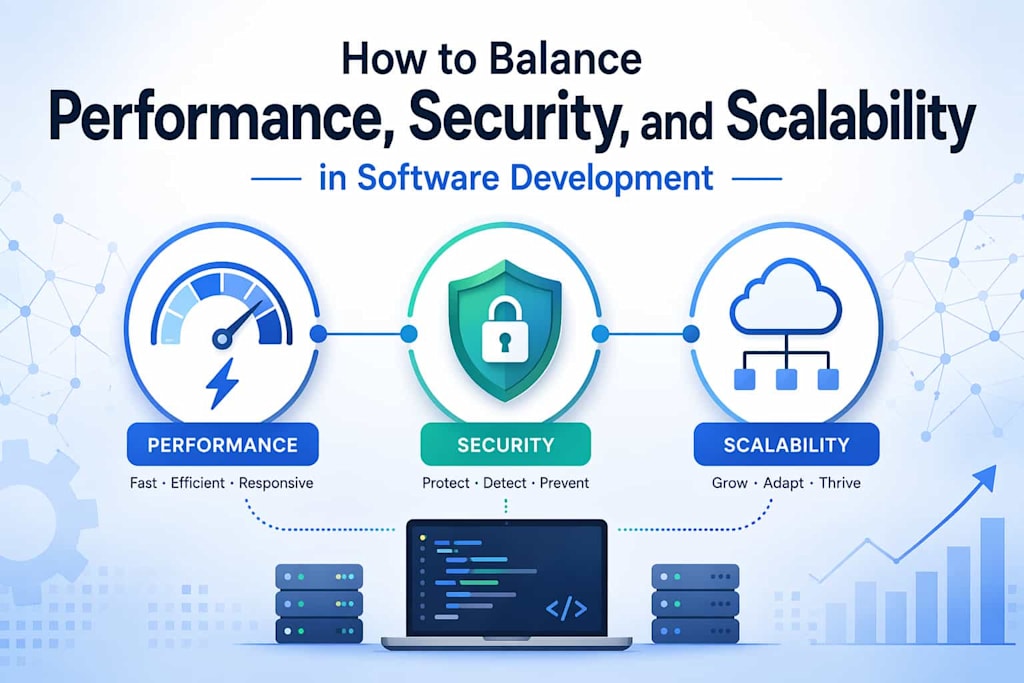
Modern software development involves far more than delivering functional applications. Organizations today must ensure that their systems remain fast, secure, and capable of handling growth without sacrificing reliability or user satisfaction. Achieving the right balance between performance, security, and scalability has become one of the most significant challenges facing development teams.
Many projects prioritize one area at the expense of another. A system optimized solely for speed may expose critical security vulnerabilities. A platform designed with maximum security controls may introduce performance bottlenecks. Likewise, applications built for immediate needs often struggle when usage grows unexpectedly.
The most successful software products are designed with all three objectives in mind from the beginning. Rather than treating performance, security, and scalability as competing priorities, modern engineering teams view them as interconnected components of long-term software quality.
This article explores practical approaches to balancing these essential requirements while maintaining flexibility, compliance, and sustainable growth.
Understanding the Relationship Between Performance, Security, and Scalability
Performance, security, and scalability are often discussed independently, yet they influence one another throughout the software lifecycle.
Performance focuses on responsiveness, resource efficiency, and user experience. Applications must load quickly, process requests efficiently, and remain stable under varying workloads.
Security protects systems, users, and data from unauthorized access, misuse, and cyber threats. Strong security measures are essential for maintaining trust and meeting regulatory requirements.
Scalability ensures that applications can support increasing numbers of users, transactions, and services without major architectural changes.
The challenge arises because improvements in one area may affect another. For example, extensive encryption, authentication checks, and logging mechanisms can increase processing overhead. Similarly, aggressive caching strategies that improve performance may create security concerns if sensitive information is stored improperly.
Development teams must therefore evaluate trade-offs carefully. Decisions should be based on business requirements, risk assessments, expected growth patterns, and user expectations.
Modern organizations increasingly rely on data-driven decision-making and continuous monitoring to identify areas where adjustments are needed. This proactive approach helps teams optimize systems without creating unintended consequences.
Furthermore, today's software ecosystems are often distributed across multiple environments and services. Understanding how infrastructure choices influence system behavior is essential when balancing competing priorities.
Building Scalable Foundations with Smart Architecture Decisions
Long-term scalability begins with architecture. Systems that are difficult to maintain or expand often become expensive bottlenecks as organizations grow.
One of the most important considerations is selecting appropriate infrastructure strategies. Different cloud service models provide varying levels of control, flexibility, and operational responsibility. Infrastructure-as-a-Service, Platform-as-a-Service, and Software-as-a-Service offerings each introduce unique scalability and security considerations.
Organizations should evaluate workload requirements before selecting an approach. Highly customized enterprise systems may require greater infrastructure control, while rapidly growing startups often benefit from managed services that reduce operational complexity.
Architectural modularity also plays a crucial role. Breaking systems into manageable components allows teams to scale individual services independently rather than expanding entire applications unnecessarily.
This approach supports efficient resource utilization and simplifies maintenance efforts. It also enables teams to adopt new technologies gradually without requiring large-scale system replacements.
Successful engineering organizations frequently rely on clean architecture to separate business logic from infrastructure concerns. This separation improves maintainability, simplifies testing, and reduces dependencies that can limit future scalability.
Database design deserves similar attention. Poorly optimized data structures can become major performance bottlenecks as traffic increases. Proper indexing strategies, partitioning methods, and query optimization practices help maintain responsiveness under growing workloads.
By addressing architectural considerations early, organizations establish a foundation that supports both current requirements and future expansion.
Improving Performance Without Sacrificing Security
Performance optimization remains a primary objective for software teams because user expectations continue to rise. Even small delays can affect customer satisfaction, conversion rates, and overall business outcomes.
However, optimization efforts must be implemented carefully. Removing security controls for the sake of speed often creates unacceptable risks.
The most effective approach involves identifying performance optimization techniques without violating compliance rules. Rather than bypassing security measures, teams should focus on improving efficiency within established regulatory and governance frameworks.
Caching represents a common example. Properly implemented caching can significantly reduce response times while maintaining appropriate protections for sensitive information. The key is ensuring that confidential data is never exposed through insecure storage or access mechanisms.
Load balancing also improves performance while supporting scalability objectives. Distributing traffic across multiple resources helps prevent overload conditions and improves system resilience during peak demand periods.
Efficient API design contributes significantly to both performance and security. Well-structured APIs minimize unnecessary data transfers, reduce processing overhead, and provide clear mechanisms for authentication and authorization.
Monitoring plays an equally important role. Performance metrics should be collected continuously to identify emerging bottlenecks before they impact users. Real-time observability allows teams to respond quickly to changing conditions and maintain consistent service levels.
Development teams should also evaluate application dependencies regularly. Third-party libraries and services can introduce hidden performance challenges as well as potential security vulnerabilities. Ongoing reviews help ensure that external components continue to meet operational requirements.
When performance improvements are approached strategically, organizations can achieve faster systems without weakening their security posture.
Security as a Continuous Engineering Practice
Security is no longer a final-stage activity performed before deployment. Modern software development requires security considerations throughout the entire lifecycle.
This shift has led to the widespread adoption of DevSecOps practices, where security becomes a shared responsibility across development, operations, and quality assurance teams.
Threat modeling is one valuable technique. By identifying potential attack vectors early, teams can design appropriate safeguards before vulnerabilities become embedded in production systems.
Automated security testing further strengthens protection efforts. Static analysis, dynamic testing, dependency scanning, and infrastructure validation help detect issues before they reach users.
Authentication and authorization mechanisms require particular attention. Modern applications frequently integrate with multiple services, devices, and third-party platforms. Consistent identity management strategies reduce risks while supporting scalability goals.
Encryption remains another critical component of modern security programs. Data should be protected both in transit and at rest, particularly when handling personal information, financial records, or regulated business data.
Development teams working with enterprise systems should also remain informed about software development trends and IT updates. Security threats evolve continuously, and staying current helps organizations adapt their defenses proactively rather than reactively.
Documentation and security awareness training further strengthen organizational resilience. Technical controls alone cannot eliminate risk. Developers, administrators, and stakeholders must understand their responsibilities and follow established security procedures consistently.
Security becomes most effective when it is integrated into daily engineering workflows rather than treated as a separate compliance requirement.
Practical Strategies for Modern Development Teams
Successfully balancing performance, security, and scalability requires a combination of technical expertise, operational discipline, and continuous improvement.
Development teams should begin by establishing measurable objectives for each area. Clear performance benchmarks, security requirements, and scalability targets help guide decision-making throughout projects.
Regular architecture reviews are equally important. As applications evolve, original assumptions may no longer reflect current business needs. Periodic evaluations ensure that systems remain aligned with organizational goals.
For teams working within the Microsoft ecosystem, adopting best practices for .NET development can significantly improve maintainability and operational efficiency. Proper dependency management, asynchronous processing, optimized data access, and secure coding standards contribute to stronger overall outcomes.
Front-end development also deserves careful attention. Modern user experiences depend heavily on efficient client-side performance. Following best practices for modern front-ends helps reduce load times, improve accessibility, and maintain responsive interfaces across devices.
Automation provides another major advantage. Continuous integration and continuous deployment pipelines enable teams to validate code quality, security requirements, and performance expectations consistently throughout development.
Observability should be treated as a core capability rather than an optional feature. Comprehensive logging, metrics collection, and distributed tracing provide the visibility necessary to identify issues quickly and support informed decision-making.
Finally, organizations should embrace continuous learning. Technology landscapes evolve rapidly, and successful teams remain adaptable by reviewing lessons learned, refining processes, and incorporating new tools when appropriate.
Balancing competing priorities is not a one-time achievement but an ongoing process that requires regular attention and adjustment.
Conclusion
Performance, security, and scalability are among the most important qualities of modern software systems. While these objectives may sometimes appear to compete with one another, successful development teams recognize that they are deeply interconnected.
Strong architecture, thoughtful infrastructure choices, continuous security practices, and proactive performance management create a foundation for sustainable software growth. Organizations that address these considerations early are better positioned to adapt to changing business requirements, evolving threats, and increasing user demands.
The key is not maximizing a single objective but achieving an appropriate balance that aligns with organizational goals. By adopting a holistic approach and continuously evaluating trade-offs, development teams can build systems that remain fast, secure, and scalable throughout their lifecycle.
In an increasingly competitive digital environment, this balance is no longer optional—it is essential for long-term success.
About the Creator
Markus Koch
I am a professional IT consultant with 5+ years of experience.
Enjoyed the story? Support the Creator.
Subscribe for free to receive all their stories in your feed.
Comments
There are no comments for this story
Be the first to respond and start the conversation.