
How to Automate Link Building with AI Tools
A practical guide to using AI-driven workflows for faster outreach, smarter prospecting, and scalable SEO growth

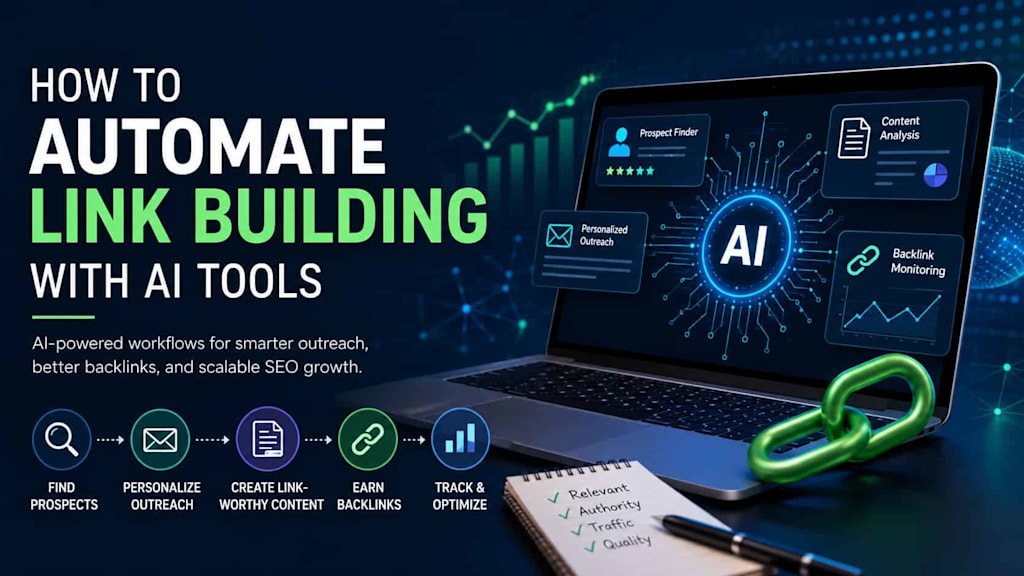
Link building remains one of the most important ranking factors in modern SEO, but it is also one of the most time-consuming. Traditional outreach campaigns often require hours of prospect research, email personalization, content evaluation, and follow-up management. As search algorithms evolve and competition grows, businesses are increasingly turning to AI tools to automate repetitive SEO tasks while maintaining quality and relevance.
Artificial intelligence is changing the way marketers approach backlinks. Instead of manually identifying opportunities, AI-powered platforms can analyze domains, score prospects, generate personalized outreach emails, and even monitor backlink performance automatically. This shift allows SEO teams to focus more on strategy and relationship building rather than repetitive administrative work.
In this article, we will explore how AI tools are transforming link building, which processes can be automated effectively, and how businesses can create scalable workflows without sacrificing quality or search engine compliance.
Why AI Is Becoming Essential for Modern Link Building
Manual link building can still produce results, but scaling it efficiently is difficult. A single campaign may involve researching hundreds of websites, evaluating domain relevance, checking backlink profiles, creating outreach messages, and tracking responses across multiple channels. AI significantly reduces the time required for these tasks.
Modern AI tools can process massive datasets within minutes. They can analyze competitor backlink profiles, identify websites likely to accept guest posts, detect broken link opportunities, and recommend outreach strategies based on historical performance. This creates a more data-driven approach to SEO.
One major advantage of AI automation is consistency. Human teams may overlook opportunities or evaluate websites differently depending on workload and experience. AI systems apply the same criteria across every prospect, resulting in cleaner data and more predictable campaigns.
AI is also improving content relevance. Outreach success rates depend heavily on personalization, and generic templates rarely perform well. Machine learning models can analyze a website’s tone, topic categories, and audience preferences to generate more targeted email introductions and pitches.
For businesses learning how to automate SEO content creation, AI-powered link building fits naturally into a broader automation strategy. Content production and backlink acquisition are closely connected. When AI tools support both processes, companies can build integrated SEO systems that scale more efficiently.
Another reason AI adoption is growing is cost efficiency. Smaller marketing teams can now handle campaigns that previously required multiple specialists. Instead of hiring large outreach departments, businesses can use automation platforms to streamline operations while maintaining competitive performance.
The Most Important Link Building Tasks You Can Automate
Not every part of link building should be fully automated. Relationship development and strategic partnerships still require human judgment. However, several repetitive tasks can be automated safely and effectively.
Prospect Discovery
AI-powered SEO platforms can scan thousands of websites to identify backlink opportunities based on niche relevance, domain authority, traffic quality, and content freshness. Instead of manually searching Google, marketers can use AI tools to build prospect lists automatically.
Some systems also analyze competitor backlinks and highlight websites that may be open to collaboration. This helps businesses uncover opportunities they may have missed through traditional research.
Email Outreach Personalization
One of the most powerful applications of AI is personalized outreach generation. Modern language models can create email drafts tailored to specific websites, authors, or industries. These tools analyze published content and generate messages that sound more natural and relevant than generic outreach templates.
AI can also optimize subject lines, follow-up timing, and email tone based on campaign performance data. This improves open rates and response rates over time.
Content Gap Analysis
Link-worthy content plays a major role in backlink acquisition. AI tools can identify topics that competitors rank for but your website does not cover yet. They can also evaluate which content formats attract the most backlinks within a niche.
This allows SEO teams to produce content specifically designed to earn links naturally. AI-assisted topic clustering and semantic analysis make content planning significantly faster.
Backlink Monitoring
Tracking backlinks manually can become overwhelming as campaigns grow. AI-powered monitoring tools automatically detect new backlinks, lost links, anchor text changes, and toxic domains.
Some platforms even provide predictive alerts when links are likely to disappear based on historical trends. This enables SEO teams to react quickly and protect valuable backlink assets.
Internal Linking Optimization
Although external backlinks receive most attention, internal linking is equally important for SEO performance. AI tools can now assist with automation of internal link building by analyzing content relationships and suggesting contextual internal links across large websites. This improves crawlability, user navigation, and topical authority without requiring extensive manual audits.
Building an AI-Powered Link Building Workflow
AI tools work best when integrated into a structured workflow. Instead of relying on disconnected automation tools, businesses should build systems where prospecting, content creation, outreach, and reporting work together seamlessly.
The first step is defining campaign goals. Some businesses focus on acquiring high-authority editorial backlinks, while others prioritize niche relevance or referral traffic. AI systems perform better when objectives and evaluation criteria are clearly defined.
The second step is selecting the right tools. Different AI platforms specialize in different aspects of SEO automation. Some focus on prospect discovery, while others emphasize outreach personalization or backlink analysis. The most effective workflows combine several tools into a unified process.
A typical AI-driven workflow may look like this:
- AI analyzes competitor backlinks.
- The system generates a qualified prospect list.
- Content gaps and linkable assets are identified.
- AI creates personalized outreach drafts.
- Outreach campaigns are automatically scheduled.
- Responses are categorized and prioritized.
- Backlink performance is monitored continuously.
Businesses exploring how to build an AI-powered SEO automation workflow often discover that integration is more important than individual tools. Automation becomes significantly more powerful when SEO platforms, CRM systems, email software, and analytics tools share data effectively.
Another important factor is human oversight. AI can accelerate workflows, but quality control remains essential. SEO specialists should review outreach messages, validate backlink opportunities, and monitor campaign performance regularly to avoid low-quality placements or spam-like behavior.
Companies should also establish ethical guidelines for AI usage. Over-automation can create repetitive outreach patterns that damage brand reputation. Successful SEO teams use AI to support human communication rather than replace it entirely.
Common AI Tools Used for Link Building
The AI SEO ecosystem is growing rapidly, and businesses now have access to a wide range of automation solutions. Some platforms focus specifically on link building, while others offer broader SEO automation capabilities.
AI Outreach Platforms
These tools generate personalized emails, automate follow-ups, and analyze outreach performance. Many platforms use natural language processing to improve personalization and identify messaging patterns that increase response rates.
SEO Intelligence Platforms
These systems analyze competitor backlinks, keyword opportunities, and domain authority metrics. They often include predictive analytics that estimate the likelihood of securing backlinks from specific websites.
Content Optimization Tools
AI writing and optimization tools help create linkable content assets such as research articles, industry reports, and guest posts. They also improve readability, semantic relevance, and search visibility.
Relationship Management Systems
Some advanced SEO teams integrate AI with CRM platforms to manage long-term publisher relationships. AI can track communication history, partnership opportunities, and content collaboration performance over time.
Workflow Automation Platforms
Automation software connects SEO tools, outreach systems, and reporting dashboards into unified pipelines. These integrations reduce manual data entry and improve campaign coordination.
When evaluating tools, businesses should prioritize transparency and customization. AI systems should provide clear reasoning behind recommendations rather than functioning as black boxes. Flexible workflows also allow teams to adapt automation processes as SEO strategies evolve.
Risks and Limitations of AI-Powered Link Building
Despite its advantages, AI-driven SEO automation also carries risks. Businesses that rely too heavily on automation may produce low-quality outreach campaigns that resemble spam. Search engines increasingly reward authenticity and relevance, making careless automation dangerous.
One common issue is over-personalization based on inaccurate data. AI-generated outreach may occasionally include irrelevant references or incorrect assumptions about a website. Human review remains essential for maintaining credibility.
Another limitation is the risk of prioritizing quantity over quality. Some automation tools encourage aggressive scaling without considering editorial standards or topical relevance. Low-quality backlinks can damage search visibility instead of improving it.
AI tools also struggle with nuanced relationship building. Strategic partnerships, podcast invitations, collaborative research, and high-authority editorial placements often require genuine human interaction. Automation can support these processes, but it cannot fully replace professional networking.
Privacy and compliance considerations are also becoming more important. Outreach campaigns must comply with email regulations and data privacy laws. Businesses should ensure that their automation systems follow legal requirements and avoid unethical scraping practices.
Finally, search engine algorithms continue evolving. Tactics that appear effective today may become risky tomorrow if automation produces unnatural backlink patterns. Sustainable SEO requires adaptability and long-term thinking rather than short-term volume strategies.
Conclusion
AI is transforming link building from a labor-intensive process into a scalable, data-driven operation. Businesses can now automate prospect research, outreach personalization, backlink monitoring, and content analysis with far greater efficiency than ever before.
However, successful AI-powered SEO is not about replacing people entirely. The most effective strategies combine automation with human creativity, relationship management, and editorial judgment. AI handles repetitive tasks, while SEO professionals focus on strategy, quality control, and long-term partnerships.
Companies that adopt balanced automation workflows can improve efficiency, reduce operational costs, and scale link acquisition more sustainably. As AI technology continues advancing, businesses that integrate intelligent automation into their SEO operations will likely gain a significant competitive advantage in organic search visibility.
About the Creator
Eugene Afonin
Experienced IT Consultant specializing in software development strategy, legacy system modernization, and digital transformation.
Enjoyed the story? Support the Creator.
Subscribe for free to receive all their stories in your feed.
Comments
There are no comments for this story
Be the first to respond and start the conversation.