
How to Automate SEO Content Creation and Publishing with AI Agents
A practical guide to building scalable AI-driven workflows for faster SEO content production and publishing

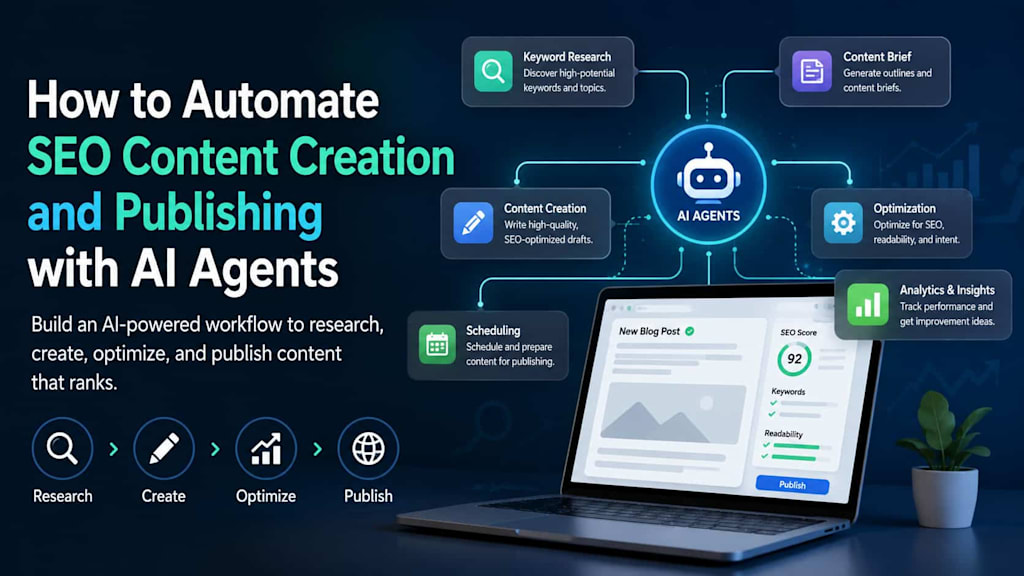
Search engine optimization has evolved far beyond keyword stuffing and manual blog publishing. Today, businesses are expected to publish high-quality, optimized content consistently across multiple platforms while keeping pace with changing algorithms and user behavior. For many marketing teams, this creates a difficult balancing act between quality, speed, and cost.
Artificial intelligence is changing that equation. AI agents can now research topics, generate outlines, write drafts, optimize metadata, schedule publications, and even monitor content performance with minimal human intervention. Instead of replacing marketers, these systems act as collaborative assistants that automate repetitive processes and improve workflow efficiency.
Companies of all sizes are beginning to use AI-powered systems to scale their content operations without building massive editorial teams. Whether you run a SaaS company, an eCommerce store, or a digital agency, automation can dramatically reduce production bottlenecks while maintaining consistency.
This article explains how AI agents are transforming SEO content operations, how to structure an effective automation system, and what businesses should consider before implementing AI-driven publishing pipelines.
Why AI Agents Are Changing SEO Content Operations
Traditional SEO content production often involves multiple disconnected steps. A strategist performs keyword research, a writer drafts the article, an editor optimizes it, and a content manager uploads and schedules the final version. While this process works, it can become slow and expensive at scale.
AI agents streamline this workflow by handling several tasks simultaneously. Modern systems can:
- Analyze search intent
- Research competitors
- Generate content briefs
- Create optimized article structures
- Suggest internal links
- Produce metadata
- Schedule content automatically
- Monitor ranking performance
Instead of treating AI as a single chatbot, businesses now deploy collections of specialized agents. One agent may focus on SERP analysis, another on writing, and another on publication or analytics. Together, they create a connected ecosystem that accelerates the entire content lifecycle.
The biggest advantage is operational scalability. A small marketing team can manage significantly larger publishing volumes without sacrificing workflow efficiency. This becomes especially important for companies targeting multiple regions, industries, or keyword clusters.
AI agents also reduce delays between planning and execution. Content opportunities can be identified and acted upon much faster than in traditional editorial cycles. This speed advantage matters in competitive niches where ranking timing can influence traffic growth.
Another important factor is consistency. Human teams naturally vary in writing style, formatting, optimization practices, and publishing routines. AI systems help standardize these processes through predefined rules and templates.
However, automation works best when paired with human oversight. Strategic decisions, brand positioning, factual validation, and creative storytelling still benefit greatly from experienced editors and marketers.
Building an AI-Powered SEO Workflow
Organizations looking to scale efficiently often begin by learning how to build an AI-powered SEO automation workflow that integrates research, writing, optimization, and publishing into one connected process.
A successful workflow usually starts with keyword discovery and intent analysis. AI tools can scan search trends, competitor pages, and ranking opportunities to identify topics with strong potential. Instead of manually reviewing hundreds of keywords, marketers can prioritize opportunities faster using automated clustering systems.
The next phase is content planning. AI agents can generate article outlines based on top-ranking competitors while identifying gaps that existing content fails to address. This allows businesses to produce more comprehensive resources that align with search intent.
Draft generation follows naturally from structured outlines. Modern language models can create long-form articles in seconds, but quality depends heavily on the instructions and frameworks provided. Teams that use detailed prompts, editorial rules, and SEO guidelines usually achieve stronger results.
Once drafts are created, optimization agents can enhance:
- Meta titles
- Descriptions
- Heading structures
- Keyword distribution
- Internal linking
- Readability
- Schema markup recommendations
The publishing stage is another major opportunity for automation. CMS integrations allow AI systems to upload articles directly into platforms like WordPress, Shopify, Webflow, or HubSpot. Articles can be formatted, categorized, tagged, and scheduled automatically.
Some advanced workflows even include feedback loops. Analytics agents monitor rankings, click-through rates, bounce rates, and engagement metrics to determine which content performs best. The system can then recommend updates or generate content refreshes automatically.
This continuous optimization cycle creates a much more adaptive content strategy compared to static publishing models.
Key Benefits of Automated SEO Content Publishing
The adoption of AI-driven publishing systems continues to grow because the operational advantages are substantial.
Faster Content Production
Manual content workflows often take days or weeks to complete. AI agents dramatically reduce turnaround times by automating research, drafting, optimization, and scheduling. Businesses can respond to trends and market opportunities far more quickly.
Lower Operational Costs
Hiring large editorial teams can become expensive, especially for businesses publishing at scale. AI automation reduces the amount of repetitive manual labor required for production. Teams can allocate more time to strategic planning and creative work instead of routine tasks.
Improved Scalability
Scaling traditional content operations usually requires proportional increases in staffing. AI systems make it possible to increase publishing output without dramatically increasing overhead.
This is particularly useful for:
- Multi-language SEO campaigns
- Large eCommerce catalogs
- Affiliate websites
- SaaS knowledge bases
- Enterprise content hubs
Enhanced Data Integration
AI agents can connect directly with analytics platforms, search console data, keyword tools, and CRM systems. This allows content strategies to adapt dynamically based on performance signals.
Instead of relying solely on intuition, businesses can automate decision-making around topic prioritization and content updates.
More Consistent Publishing Schedules
Search visibility often benefits from consistent publishing frequency. Automated workflows reduce delays caused by staffing limitations or editorial bottlenecks.
Reliable scheduling also improves audience engagement because readers know when to expect new content.
Common Challenges and Risks of AI Automation
Despite the advantages, businesses should avoid assuming that AI-generated content automatically guarantees SEO success.
One major challenge is quality control. AI-generated drafts may contain factual inaccuracies, repetitive language, or shallow explanations. Without human review, low-quality pages can damage brand credibility and search performance.
Another issue involves content differentiation. If many companies rely on similar prompts and generic AI outputs, the web may become saturated with nearly identical articles. Search engines increasingly prioritize originality, expertise, and unique perspectives.
Over-automation can also create workflow rigidity. AI systems excel at patterns and repetition, but they may struggle with nuanced storytelling, emotional branding, or thought leadership content.
There are also technical considerations. Automated publishing pipelines require:
- CMS integrations
- API management
- Prompt governance
- Content approval systems
- Data security policies
Organizations should establish clear editorial standards before deploying AI workflows at scale.
Search engine guidelines are another important factor. Major search engines do not necessarily penalize AI-generated content, but they strongly prioritize usefulness, originality, and user value. Thin or spammy AI content can still perform poorly.
The most effective strategies usually combine automation with human expertise. AI handles repetitive operational tasks while humans guide strategy, creativity, and quality assurance.
The Future of AI-Driven SEO Ecosystems
The future of SEO will likely involve increasingly autonomous systems that manage entire content ecosystems with minimal supervision.
Instead of isolated tools, businesses are moving toward integrated AI environments where agents collaborate continuously across:
- Keyword intelligence
- Content generation
- Technical SEO
- Link recommendations
- Publishing
- Analytics
- Performance optimization
These systems will become more proactive over time. Rather than waiting for instructions, AI agents may independently identify ranking opportunities, generate update recommendations, and trigger publishing actions automatically.
Voice search, multimodal search, and AI-powered search engines will also reshape optimization strategies. Future SEO workflows may involve generating not only text articles but also:
- Video summaries
- Interactive content
- Visual explainers
- Audio-based content assets
As personalization improves, AI systems may dynamically adjust content versions for different audience segments and search contexts.
The growing adoption of automation of SEO content creation and publishing with AI agents reflects a broader shift toward intelligent digital operations where marketing systems become increasingly adaptive and data-driven.
Still, human creativity will remain essential. Brands that succeed long term will likely be those that combine technological efficiency with authentic expertise and strong editorial identity.
Conclusion
AI agents are fundamentally changing how businesses approach SEO content production and publishing. By automating repetitive tasks such as keyword research, drafting, optimization, scheduling, and performance monitoring, organizations can scale their content operations more efficiently than ever before.
The biggest benefits include faster production cycles, reduced operational costs, improved consistency, and enhanced scalability. At the same time, businesses must remain aware of the risks associated with over-automation, including quality concerns, content duplication, and reduced originality.
The most effective approach is not fully autonomous publishing without oversight. Instead, successful organizations use AI as a collaborative system that supports human expertise rather than replacing it.
As search ecosystems continue evolving, AI-driven workflows will likely become a standard part of digital marketing infrastructure. Companies that invest early in well-structured automation systems will be better positioned to compete in increasingly crowded search environments.
About the Creator
Eugene Afonin
Experienced IT Consultant specializing in software development strategy, legacy system modernization, and digital transformation.
Enjoyed the story? Support the Creator.
Subscribe for free to receive all their stories in your feed.
Comments
There are no comments for this story
Be the first to respond and start the conversation.