
How to Build an AI-Powered SEO Automation Workflow Without Hiring a Large SEO Team
A practical guide to scaling SEO operations with automation, AI tools, and lean content workflows

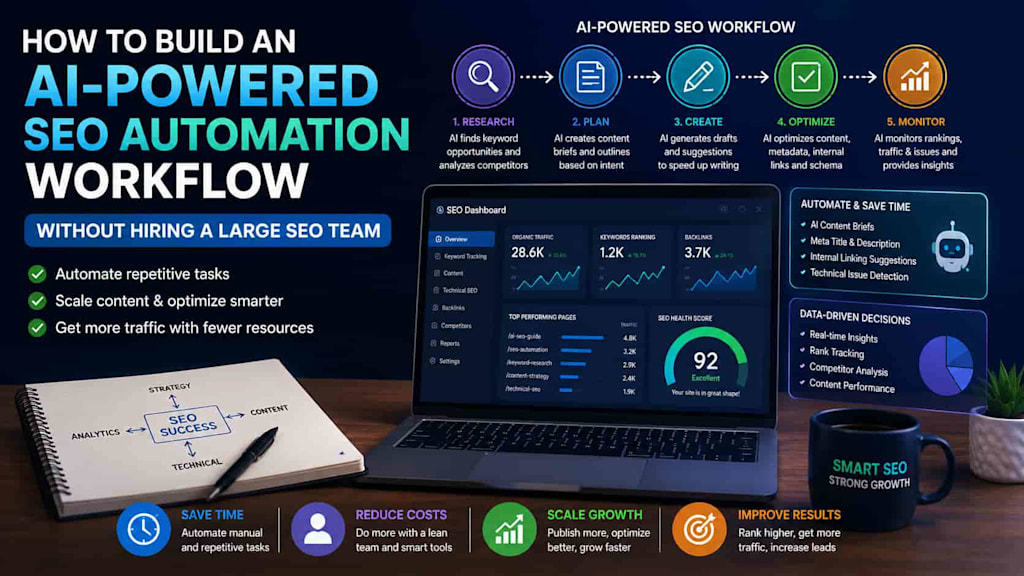
Search engine optimization has become more complex than ever. Businesses are expected to publish high-quality content consistently, optimize technical SEO, monitor ranking changes, analyze competitors, improve user experience, and adapt to evolving search engine algorithms. Traditionally, achieving all of this required a large SEO department made up of strategists, technical specialists, content writers, analysts, and outreach managers.
In 2026, however, artificial intelligence is changing the economics of SEO. Companies no longer need massive teams to build scalable organic growth systems. Instead, businesses can combine automation platforms, AI tools, and streamlined operational processes to create highly efficient SEO workflows with relatively small teams.
This shift is especially important for startups, SaaS companies, eCommerce businesses, agencies, and growing enterprises that need sustainable traffic growth without dramatically increasing operational costs. AI now helps automate repetitive SEO tasks, accelerate research, generate content drafts, optimize metadata, identify ranking opportunities, cluster keywords, monitor technical issues, and even assist with internal linking strategies.
However, many companies misunderstand what SEO automation actually means. Automation does not replace strategy, expertise, or editorial oversight. Instead, it removes operational bottlenecks and allows smaller teams to focus on higher-value decisions.
A successful AI-powered SEO workflow balances automation with human review. Businesses that rely entirely on fully automated content often struggle with quality, originality, search intent alignment, and long-term ranking stability. On the other hand, organizations that combine AI assistance with structured editorial processes can scale organic visibility much more efficiently.
This article explains how to build an effective SEO automation workflow in 2026 without hiring a large internal SEO team, including planning, content systems, technical automation, AI integration, and long-term optimization strategies.
Build a Lean SEO Framework Before Automating Anything
One of the biggest mistakes companies make is automating inefficient processes. Before introducing AI tools into SEO operations, organizations need a clear and repeatable framework.
Automation works best when workflows are already structured and measurable. Businesses should first define their SEO objectives and operational priorities.
Common SEO goals include:
- Increasing organic traffic
- Improving keyword rankings
- Generating qualified leads
- Supporting product discovery
- Expanding topical authority
- Improving local visibility
- Increasing conversion rates from search traffic
- Reducing content production costs
Once goals are defined, businesses should identify which SEO activities consume the most time while providing predictable outputs.
These usually include:
- Keyword research
- SERP analysis
- Content briefs
- Metadata generation
- Internal linking
- Technical audits
- Content updates
- Reporting and analytics
- Competitor monitoring
The key is separating strategic tasks from repetitive tasks.
For example, deciding which markets to target or which content pillars align with business goals requires human expertise. But gathering ranking data, generating structured outlines, or identifying broken links can often be automated effectively.
Companies should also build clear documentation for SEO processes before implementing automation tools. This creates consistency across workflows and reduces dependency on individual team members.
A lean SEO framework usually includes:
- Content strategy
- Keyword clustering system
- Technical SEO checklist
- Publishing workflow
- Content optimization standards
- Analytics and reporting structure
- Content refresh process
Without this operational foundation, automation often creates more chaos instead of efficiency.
Another important step is choosing realistic KPIs. SEO growth takes time, and businesses should avoid measuring success only through short-term ranking fluctuations.
Useful SEO metrics include:
- Organic traffic growth
- Indexed pages
- Keyword visibility
- Click-through rates
- Conversion rates
- Average engagement time
- Content production speed
- Backlink acquisition quality
Organizations should also recognize that search behavior is changing rapidly due to AI-driven search interfaces, conversational queries, and zero-click search experiences. SEO workflows built for 2018 no longer work effectively in 2026.
Modern SEO strategies increasingly focus on topical relevance, semantic depth, expertise signals, and user intent alignment instead of keyword stuffing or high-volume publishing alone.
Use AI for Research, Clustering, and Content Preparation
Once the operational structure is in place, AI can significantly accelerate research and content planning processes.
Keyword research traditionally required hours of manual analysis. Today, AI-powered platforms can process large search datasets quickly, identify semantic relationships, group related topics, and uncover hidden content opportunities.
Instead of targeting isolated keywords, businesses now build topic clusters around broader search intent categories. AI tools help organize these clusters more efficiently by analyzing user behavior patterns and SERP similarities.
For example, an SEO workflow may automatically:
- Collect ranking keywords from competitors
- Identify semantic keyword variations
- Group keywords by intent
- Detect content gaps
- Generate article structures
- Prioritize opportunities based on difficulty and traffic potential
This dramatically reduces research time while improving strategic consistency.
AI also improves content brief generation. Instead of manually reviewing dozens of ranking pages, businesses can use automation systems to extract common headings, search intent patterns, frequently asked questions, and semantic terms from top-performing content.
This allows writers and editors to focus more on expertise, storytelling, and originality rather than repetitive research.
Another major advantage is scalability. Smaller teams can now manage content calendars that previously required large editorial departments.
Some businesses even integrate AI-powered WordPress content generation into their publishing pipelines to accelerate draft creation and streamline editorial workflows across multiple websites.
However, successful companies avoid fully automated publishing without human review. Search engines continue prioritizing content quality, trustworthiness, and originality.
AI-generated content should be treated as a productivity accelerator rather than a complete replacement for human expertise.
Editorial review remains essential for:
- Fact-checking
- Brand consistency
- Industry expertise
- Tone refinement
- User intent validation
- Compliance review
- Content differentiation
The strongest workflows combine AI speed with human judgment.
Another emerging trend is multimodal SEO optimization. Modern search engines increasingly evaluate visual content, video integration, structured data, and interactive experiences.
AI tools now assist with:
- Image optimization
- Alt text generation
- Video transcription
- Schema markup suggestions
- FAQ extraction
- Featured snippet formatting
This helps smaller SEO teams compete more effectively against larger organizations with bigger production resources.
Automation also improves content refresh strategies. Many businesses lose rankings because old content becomes outdated or irrelevant.
AI systems can identify declining pages, detect outdated statistics, compare competitor updates, and recommend refresh opportunities automatically.
This allows organizations to maintain ranking stability with fewer manual audits.
Automate Technical SEO Monitoring and Reporting
Technical SEO is often one of the most resource-intensive parts of search optimization. Large websites may contain thousands of pages, making manual monitoring extremely difficult.
AI-driven automation significantly reduces this operational burden.
Modern SEO systems can continuously monitor:
- Crawl errors
- Broken links
- Redirect chains
- Duplicate content
- Page speed issues
- Structured data problems
- Indexation changes
- Mobile usability errors
- Core Web Vitals metrics
Instead of relying on monthly manual audits, businesses can now receive automated alerts when technical issues appear.
This proactive approach prevents small technical problems from becoming major ranking losses.
Technical automation becomes especially important for fast-growing websites where content is published frequently across multiple categories or markets.
Many organizations now integrate SEO monitoring directly into development workflows. For example, deployment pipelines can automatically test metadata structure, schema implementation, page speed, and canonical tags before content goes live.
This reduces the risk of technical SEO errors during rapid publishing cycles.
Cloud-based analytics platforms also simplify reporting. Businesses no longer need dedicated analysts manually exporting ranking reports or compiling spreadsheets every week.
AI-assisted dashboards can automatically track:
- Organic traffic changes
- Keyword movement
- Competitor visibility
- Conversion trends
- Content engagement
- Backlink growth
- Technical health scores
Automated reporting improves decision-making speed because teams can identify problems earlier and respond more effectively.
Another important advantage is prioritization.
Many SEO teams become overwhelmed by large audit reports filled with low-impact issues. AI systems increasingly help prioritize fixes based on estimated business impact, ranking influence, and implementation complexity.
This helps lean teams focus on high-value improvements instead of spending time on minor optimizations with little measurable effect.
Technical SEO automation also supports scalability across international markets.
For multilingual or multi-regional websites, automation tools help manage:
- Hreflang validation
- Regional metadata
- Localization consistency
- Translation quality checks
- International indexing issues
Without automation, managing global SEO operations often becomes operationally unsustainable for smaller teams.
Another major trend in 2026 is integrating AI into predictive SEO analysis.
Instead of only analyzing historical data, modern systems increasingly forecast:
- Potential ranking volatility
- Seasonal traffic shifts
- Emerging keyword opportunities
- Competitor content expansion
- Search intent changes
Predictive insights allow businesses to adapt proactively rather than reactively.
This gives smaller companies the ability to compete more strategically even without large enterprise-level SEO departments.
Build a Human-in-the-Loop Content Workflow
One of the biggest misconceptions about AI SEO automation is that humans become unnecessary. In reality, the most successful workflows use a “human-in-the-loop” model.
This means automation handles repetitive execution while humans oversee strategy, quality control, and decision-making.
Search engines continue evolving toward evaluating expertise, authenticity, and value. Fully automated content systems often struggle to meet these standards consistently.
A balanced workflow typically includes:
- AI-assisted research
- Automated outline generation
- Human editorial review
- AI-supported drafting
- Expert refinement
- SEO optimization checks
- Final quality approval
- Automated publishing and monitoring
This hybrid model allows organizations to scale output while maintaining quality.
Editorial consistency becomes especially important as businesses publish larger content volumes.
Companies should create detailed style guidelines covering:
- Tone of voice
- Formatting standards
- Linking rules
- Citation policies
- Brand terminology
- SEO structure
- Audience targeting
AI systems perform significantly better when guided by clear standards.
Another important factor is content differentiation.
As AI-generated content becomes more common, generic articles become easier to identify. Businesses that simply publish mass-produced AI content may struggle with long-term rankings because competitors can replicate similar material quickly.
Human expertise remains essential for creating:
- Original insights
- Industry analysis
- Case studies
- Expert commentary
- Real-world examples
- Strategic perspectives
Companies should focus on combining AI efficiency with unique business knowledge.
Workflow governance also matters.
Organizations should define approval responsibilities clearly, especially when using automated publishing systems. Without oversight, low-quality or inaccurate content can damage brand credibility.
Lean SEO teams often succeed by assigning specialized responsibilities instead of building massive departments.
For example:
- One strategist manages topic prioritization
- One editor oversees quality and optimization
- AI tools support research and drafting
- Automation systems handle monitoring and reporting
This structure allows small teams to manage surprisingly large SEO operations efficiently.
Another growing practice is integrating SEO automation with broader marketing workflows.
Modern businesses increasingly connect SEO systems with:
- CRM platforms
- Email marketing tools
- Social media automation
- Analytics platforms
- Customer support systems
- Product usage data
This creates more unified digital marketing ecosystems where SEO insights contribute directly to broader business decisions.
Optimize Continuously Instead of Chasing Short-Term Rankings
SEO automation should not focus only on publishing more content faster. Sustainable SEO success depends on continuous optimization.
Many companies still approach SEO as a campaign instead of an operational system. They publish content aggressively for several months, then reduce investment when immediate results do not appear.
In reality, modern SEO requires ongoing iteration.
AI-powered workflows help businesses maintain optimization cycles more consistently by automating repetitive monitoring and analysis tasks.
Continuous optimization includes:
- Updating outdated articles
- Improving internal linking
- Refreshing metadata
- Expanding semantic relevance
- Monitoring SERP changes
- Improving user engagement metrics
- Testing title variations
- Analyzing conversion behavior
Automation enables smaller teams to manage these activities at scale.
Another important consideration is search intent evolution.
Search behavior changes rapidly due to new technologies, market trends, and AI-driven search experiences. Pages that ranked well last year may become less relevant as user expectations shift.
AI systems increasingly help detect these changes early by analyzing ranking volatility, engagement patterns, and competitor updates.
Businesses should also focus on building durable topical authority instead of targeting isolated high-volume keywords.
Search engines now reward websites that demonstrate depth, consistency, and expertise across broader subject areas.
This means smaller teams often achieve better results by focusing deeply on niche expertise rather than publishing generic content across dozens of unrelated topics.
Content quality also matters more than sheer publishing volume.
A lean team with strong automation systems can outperform much larger organizations if workflows prioritize:
- Search intent accuracy
- Content usefulness
- Technical reliability
- User experience
- Content freshness
- Strategic consistency
The goal is not maximum automation. The goal is intelligent automation.
Businesses should regularly evaluate which tasks benefit from automation and which still require human oversight.
This balance will likely become even more important as search engines continue refining quality evaluation systems.
Organizations that rely entirely on automation may gain short-term efficiency but struggle with long-term trust and visibility.
Companies that combine AI scalability with strategic human expertise are far more likely to build sustainable organic growth systems.
Conclusion
Building an AI-powered SEO automation workflow in 2026 no longer requires a massive internal SEO department. Modern AI tools, automation platforms, and structured operational systems allow smaller teams to manage sophisticated SEO strategies efficiently and at scale.
The most successful businesses focus first on building clear workflows, measurable goals, and repeatable processes before introducing automation. AI then accelerates research, content preparation, technical monitoring, reporting, and optimization activities without completely replacing human expertise.
A balanced human-in-the-loop approach remains essential for maintaining content quality, strategic alignment, originality, and long-term search visibility. Organizations that rely solely on automation often struggle with differentiation and trust, while businesses that combine AI efficiency with editorial oversight gain stronger and more sustainable results.
SEO in 2026 is increasingly driven by adaptability, topical authority, semantic relevance, and operational efficiency. Companies that treat SEO as a continuous optimization system rather than a one-time campaign will be best positioned for long-term organic growth.
By combining automation with strategic thinking, even lean teams can compete effectively in highly competitive search environments without the costs and complexity of building a large traditional SEO department.
About the Creator
Eugene Afonin
Experienced IT Consultant specializing in software development strategy, legacy system modernization, and digital transformation.
Enjoyed the story? Support the Creator.
Subscribe for free to receive all their stories in your feed.
Comments
There are no comments for this story
Be the first to respond and start the conversation.