
How to Align Accounting Business Applications With Real Operational Workflows
Practical strategies for connecting accounting software with day-to-day business operations for better efficiency and accuracy

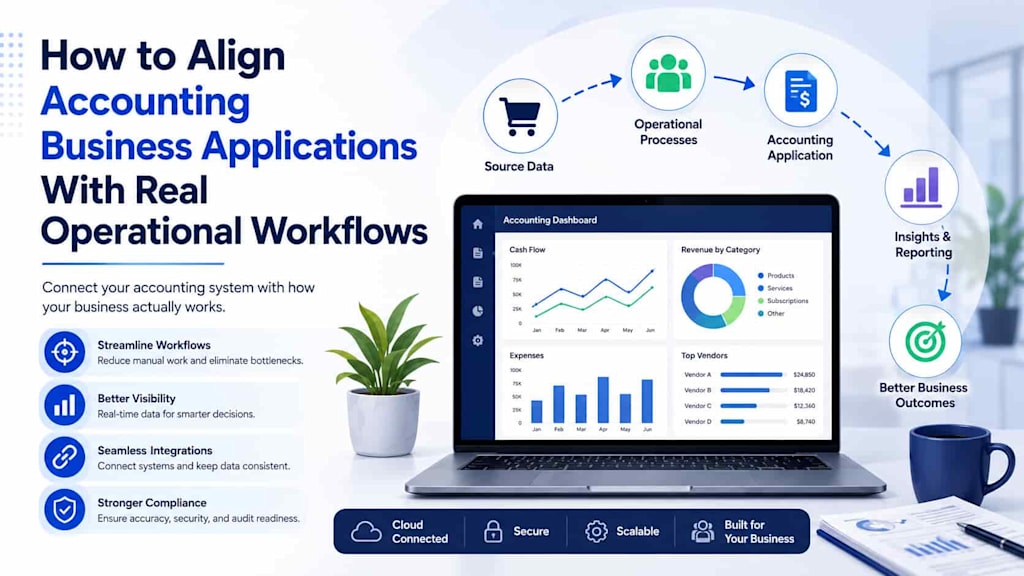
Modern organizations rely heavily on accounting platforms to manage financial records, reporting, compliance, and forecasting. Yet many companies still struggle with a disconnect between their accounting systems and the real operational workflows employees follow every day. When accounting applications are poorly aligned with business processes, organizations experience duplicated work, delayed reporting, manual corrections, communication gaps, and costly inefficiencies.
The challenge becomes even greater as businesses scale, adopt remote work models, and integrate multiple digital tools across departments. Finance teams need systems that not only process transactions but also reflect how the company truly operates. Operational alignment is no longer optional; it is essential for maintaining agility, accuracy, and competitiveness.
This article explores how organizations can better align accounting business applications with operational workflows, improve collaboration across departments, and create systems that support long-term growth.
Understanding the Gap Between Accounting Systems and Operational Reality
Many accounting platforms are implemented with a strong focus on compliance and reporting requirements. While these functions are critical, they often overlook the practical workflows used by employees in procurement, sales, logistics, customer support, and project management.
For example, an accounting department may require purchase approvals to follow a strict sequence in the software, while operational teams rely on faster informal communication channels to complete urgent orders. As a result, employees may bypass the system entirely, leading to incomplete financial records and reconciliation problems.
This issue highlights how accounting software changes the flows in organizations. Once a platform is introduced, teams frequently adapt their behavior to fit software limitations instead of improving the software to support operational needs. Over time, this creates friction between finance departments and operational staff.
A successful alignment strategy begins with understanding how employees actually perform their daily tasks. Businesses should map existing workflows before modifying or implementing accounting applications. This includes identifying:
- Approval chains
- Communication patterns
- Data entry responsibilities
- Reporting requirements
- Cross-department dependencies
- Manual processes still handled outside the system
When organizations analyze these workflows carefully, they can identify where accounting applications create unnecessary obstacles or duplicate tasks.
Another common problem is the assumption that standard accounting software configurations are sufficient for every organization. In reality, every company has unique operational structures, customer expectations, and internal procedures. Tailoring systems to those realities often becomes essential for long-term efficiency.
Building Workflow-Centered Accounting Infrastructure
The most effective accounting ecosystems are designed around workflows rather than isolated financial functions. This means the accounting system should support operational processes naturally instead of forcing employees into rigid procedures that reduce productivity.
One important strategy involves the refactoring of business apps for making processes tailored to the needs of specific departments and users. Refactoring does not necessarily mean rebuilding software from scratch. In many cases, it involves redesigning workflows, improving interfaces, automating repetitive tasks, and simplifying approval structures.
For example, a manufacturing company may need inventory updates to synchronize instantly with accounting records when warehouse employees scan products. A consulting firm may require automated project expense allocation tied directly to client billing. These operational realities should shape the accounting application architecture.
Organizations should also focus on minimizing redundant data entry. Employees become frustrated when they must manually enter the same information across multiple systems. This not only wastes time but also increases the risk of errors. Unified workflows can eliminate duplication while improving data accuracy.
Another critical factor is user adoption. Employees are more likely to follow standardized processes when the software supports their daily responsibilities instead of slowing them down. Simple interfaces, automation features, and intelligent workflows help increase compliance and reduce shadow processes outside the official system.
Workflow-centered infrastructure also improves transparency. Managers gain clearer visibility into operational bottlenecks, approval delays, and financial risks because data moves consistently across departments. Instead of fragmented information stored in separate tools, organizations benefit from a centralized operational view.
Additionally, companies should regularly evaluate whether existing systems still align with evolving business needs. Operational workflows change over time due to market shifts, growth, acquisitions, or remote work adoption. Accounting systems must evolve alongside those changes to remain effective.
The Role of Integrations in Operational Alignment
No accounting application can operate effectively in isolation. Modern businesses rely on a wide range of software platforms, including CRM systems, payroll tools, inventory management solutions, e-commerce platforms, project management software, and banking services.
This is why important integrations in accounting software play such a significant role in operational alignment. Integrations allow information to move automatically between systems, reducing manual intervention and improving consistency across departments.
For example:
- Sales data from CRM platforms can automatically generate invoices.
- Payroll systems can transfer labor costs directly into accounting records.
- Inventory management software can synchronize stock levels and purchase orders.
- E-commerce platforms can automate tax calculations and revenue tracking.
- Banking integrations can simplify reconciliation processes.
Without these integrations, finance teams often spend countless hours exporting spreadsheets, correcting inconsistencies, and manually validating transactions.
However, integration projects require careful planning. Poorly designed integrations can create additional complexity instead of solving operational problems. Organizations should prioritize integrations that directly support core workflows and reduce friction between departments.
Another important consideration is data standardization. Different systems may use inconsistent naming conventions, formats, or reporting structures. Aligning this data properly ensures reliable reporting and prevents synchronization issues.
Cloud-based technologies have made integrations significantly easier than in previous decades. APIs and middleware solutions now allow businesses to connect systems with greater flexibility and lower implementation costs. As a result, organizations can create more responsive digital ecosystems that support operational agility.
Companies should also monitor integration performance regularly. Changes in third-party platforms, software updates, or business processes may affect synchronization reliability over time. Ongoing maintenance helps preserve operational continuity and data accuracy.
Why IT Audits Matter for Accounting Workflow Optimization
Technology alignment is not a one-time initiative. Businesses must continuously evaluate whether their systems remain secure, efficient, and operationally effective. This is where the importance of IT audits becomes especially clear.
IT audits help organizations assess whether accounting applications and related systems support operational goals while maintaining compliance and security standards. These audits identify vulnerabilities, inefficiencies, outdated workflows, and integration failures that may otherwise go unnoticed.
A comprehensive audit typically examines:
- Access controls and security policies
- Workflow automation efficiency
- Data accuracy and synchronization
- Compliance with regulatory standards
- Integration reliability
- System scalability
- User permissions and accountability
- Backup and disaster recovery procedures
One major benefit of regular audits is the ability to identify hidden operational bottlenecks. For example, a company may discover that invoice approvals are delayed because certain workflow rules no longer match the organization’s management structure. Similarly, audits may reveal redundant processes that consume employee time without adding value.
Audits also support risk management. Financial systems often contain highly sensitive business information, making them attractive targets for cyber threats. Weak integrations, outdated permissions, or unsupported software can expose organizations to serious financial and reputational risks.
Another valuable outcome of IT audits is improved decision-making. Leadership teams gain clearer insights into how systems perform under real operational conditions. This allows organizations to prioritize technology investments based on measurable operational impact rather than assumptions.
Importantly, audits should involve both technical specialists and operational stakeholders. Finance teams, department managers, and employees who use the systems daily can provide practical insights that purely technical evaluations may miss.
Organizations that conduct regular IT audits are typically better positioned to adapt to growth, compliance changes, and digital transformation initiatives.
Creating Scalable and Sustainable Accounting Ecosystems
As businesses expand, operational complexity increases rapidly. Companies may add new departments, enter international markets, adopt hybrid work structures, or launch additional service lines. Accounting applications must support this growth without creating operational chaos.
This is where scalable cloud-connected web and desktop applications become highly valuable. Modern cloud architectures provide businesses with flexibility, accessibility, and integration capabilities that traditional isolated systems often cannot support.
Cloud-connected solutions offer several operational advantages:
- Real-time data synchronization
- Remote access for distributed teams
- Easier software updates
- Faster integrations
- Reduced infrastructure maintenance
- Improved collaboration between departments
- Better disaster recovery capabilities
At the same time, organizations should avoid excessive software complexity. Adding too many disconnected tools can create fragmented workflows and increase operational confusion. Instead, businesses should focus on building cohesive digital ecosystems where systems communicate efficiently and support unified processes.
Long-term sustainability also depends on designing maintainable systems that can evolve without requiring constant rebuilding. Software environments should support future integrations, changing regulations, organizational restructuring, and workflow modifications without major operational disruptions.
Employee training also plays a crucial role in sustainability. Even well-designed systems fail when users do not understand workflows or resist adoption. Businesses should invest in ongoing education, documentation, and process standardization to maximize system effectiveness.
Another important factor is governance. Organizations need clear ownership structures for workflows, integrations, and accounting technologies. Without accountability, systems often become fragmented as departments independently adopt tools that fail to align with enterprise-wide operations.
Ultimately, successful accounting ecosystems balance flexibility with consistency. They allow departments to work efficiently while maintaining centralized financial visibility and control.
Conclusion
Aligning accounting business applications with real operational workflows is essential for organizations seeking greater efficiency, transparency, and scalability. Accounting software should not function as an isolated financial tool disconnected from daily operations. Instead, it must actively support how employees collaborate, process information, and execute tasks across the business.
By understanding workflow realities, optimizing integrations, conducting regular IT audits, and investing in scalable technologies, organizations can create accounting ecosystems that improve productivity while reducing operational friction.
Businesses that prioritize operational alignment gain more than accurate financial reporting. They build adaptive digital infrastructures capable of supporting long-term growth, faster decision-making, stronger collaboration, and improved resilience in an increasingly complex business environment.
About the Creator
Markus Koch
I am a professional IT consultant with 5+ years of experience.
Enjoyed the story? Support the Creator.
Subscribe for free to receive all their stories in your feed.
Comments
There are no comments for this story
Be the first to respond and start the conversation.