
How to Build Scalable Cloud-Connected Web and Desktop Applications
Designing resilient multi-platform systems with cloud-native technologies, synchronization strategies, and modern software architecture

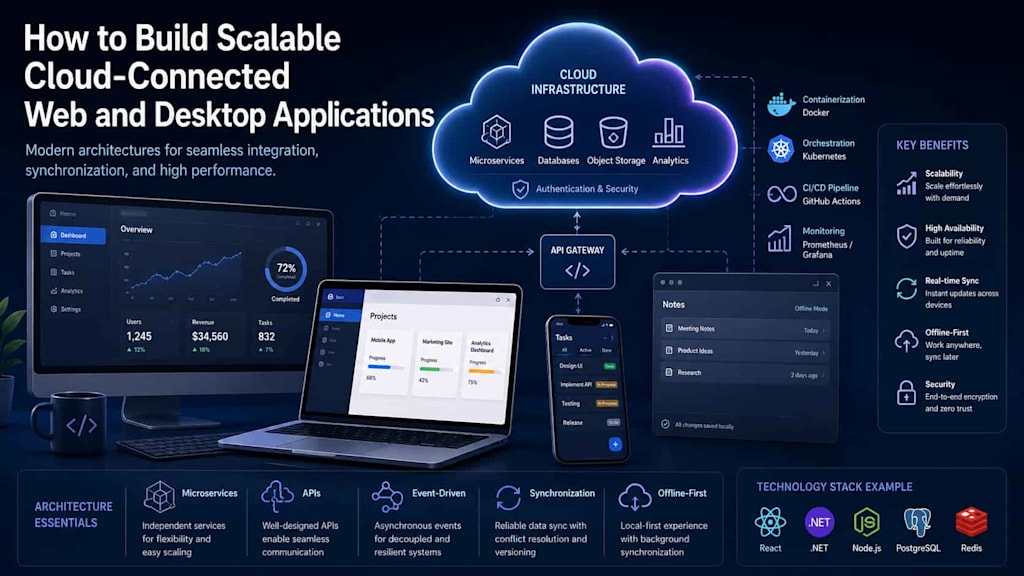
Modern software products are no longer isolated applications running on a single device or browser. Businesses now expect seamless connectivity between desktop applications, web platforms, mobile ecosystems, and cloud infrastructure. Users demand synchronized experiences across devices, real-time updates, offline capabilities, and high performance regardless of location or platform.
As organizations expand their digital ecosystems, scalable cloud-connected applications have become essential for operational efficiency, customer engagement, and long-term growth. Building these systems requires more than simply combining desktop and web technologies. Developers must design architectures that support distributed services, asynchronous communication, resilient synchronization, and scalable cloud operations.
Today’s software environments increasingly rely on microservices, APIs, event-driven systems, and containerized infrastructure to support modern application demands. Understanding how these technologies work together is critical for creating reliable and future-ready platforms.
Building a Cloud-Native Foundation for Multi-Platform Applications
Cloud-native architecture has fundamentally changed how modern applications are designed and deployed. Instead of relying on monolithic infrastructures, developers now build distributed systems composed of independent services that communicate through APIs and cloud-managed resources.
At the center of this model is scalability. Cloud platforms allow businesses to dynamically allocate computing resources based on demand, making applications more flexible and cost-efficient. This approach supports desktop clients, browser applications, and backend services simultaneously without requiring separate infrastructures for each platform.
One of the most important aspects of scalable application design is understanding the role of clouds in modern web apps. Cloud infrastructure enables centralized data storage, real-time synchronization, automated scaling, disaster recovery, and global content delivery. It also simplifies deployment pipelines and supports continuous integration and delivery practices.
For cloud-connected desktop applications, the cloud acts as a synchronization hub that connects users, devices, and services. Desktop software no longer operates as isolated local programs. Instead, it interacts continuously with cloud-hosted APIs, shared databases, authentication systems, and messaging queues.
This architecture enables features such as:
- Real-time collaboration
- Automatic updates
- Multi-device synchronization
- Centralized user management
- Cross-platform data consistency
- Remote monitoring and analytics
By separating services into modular cloud-based components, organizations can update individual systems independently without disrupting the entire application ecosystem.
Microservices and APIs as the Backbone of Scalability
Traditional monolithic applications often struggle to scale because all components are tightly interconnected. A failure or bottleneck in one module can affect the entire system. Modern distributed applications solve this challenge through microservices architecture.
Microservices divide applications into smaller independent services, each responsible for a specific business function. For example, authentication, billing, synchronization, notifications, and file management can all operate as separate services connected through APIs.
This structure provides several advantages:
- Independent scaling of services
- Faster development cycles
- Easier maintenance
- Improved fault isolation
- Flexible technology stacks
- Better deployment automation
APIs serve as the communication layer between desktop clients, web applications, and cloud services. REST APIs and GraphQL interfaces are commonly used for synchronous communication, while WebSockets and streaming protocols support real-time interactions.
Well-designed APIs create consistency across platforms. A desktop application and a web application can both interact with the same backend services without duplicating business logic. This reduces development overhead and improves maintainability.
Microservices also align closely with current trends in modern web development, where modular frontend architectures increasingly rely on distributed backend services and API-first ecosystems. Frontend frameworks today are designed to consume dynamic APIs efficiently, enabling scalable user experiences across browsers and devices.
However, microservices introduce complexity that organizations must manage carefully. Distributed systems require monitoring, service discovery, logging, orchestration, and robust security strategies. Without proper governance, fragmented services can become difficult to maintain.
To reduce architectural chaos, many development teams adopt standardized communication protocols, centralized observability systems, and infrastructure automation tools.
Containerization and Deployment Automation
As applications become more distributed, deployment consistency becomes increasingly important. Containerization technologies such as Docker and Kubernetes have become central to scalable cloud-connected application development.
Containers package applications and their dependencies into isolated environments that behave consistently across development, testing, and production systems. This eliminates many compatibility issues and simplifies deployment processes.
Container orchestration platforms allow businesses to manage thousands of application instances efficiently. Kubernetes, for example, automates service scaling, traffic routing, failover recovery, and infrastructure health monitoring.
For organizations building cloud-connected desktop and web applications, containerization offers several benefits:
- Faster deployment cycles
- Consistent environments across teams
- Simplified scaling
- Improved system resilience
- Easier rollback and version control
- Better infrastructure utilization
Modern deployment pipelines also rely heavily on automation. Continuous Integration and Continuous Deployment (CI/CD) workflows ensure that new features, patches, and updates can be delivered rapidly without destabilizing production environments.
This becomes especially important for multi-platform ecosystems where desktop clients, browser interfaces, APIs, and cloud services must remain synchronized during updates.
Infrastructure-as-Code (IaC) tools further streamline operations by allowing teams to manage cloud resources programmatically. Instead of manually configuring servers and services, developers define infrastructure through version-controlled templates.
This approach improves reproducibility, reduces configuration errors, and accelerates scaling efforts.
Synchronization and Offline-First Application Design
One of the biggest challenges in cloud-connected applications is maintaining synchronization between local devices and centralized cloud systems.
Desktop applications frequently operate in environments with unstable or intermittent internet connectivity. To maintain usability, modern systems increasingly adopt offline-first design principles.
Offline-first applications prioritize local functionality while synchronizing data with cloud services whenever connectivity becomes available. Instead of depending entirely on real-time server access, the application maintains a local data layer capable of handling user interactions independently.
This approach improves reliability, responsiveness, and user experience.
Synchronization systems typically involve:
- Local caching
- Conflict resolution mechanisms
- Event queues
- Background synchronization
- Incremental updates
- Data versioning
Event-driven architecture plays a major role in synchronization workflows. Rather than relying solely on direct requests, systems use asynchronous event streams to coordinate updates across distributed services and client applications.
For example, when a desktop user modifies a document offline, the application stores the change locally. Once connectivity resumes, synchronization services publish update events that propagate changes through the cloud infrastructure and notify other connected clients.
Event-driven systems improve scalability because services communicate asynchronously without blocking each other. This reduces latency and allows systems to process large volumes of operations more efficiently.
These architectures are particularly valuable for collaboration tools, enterprise management systems, financial platforms, and productivity applications where real-time synchronization is essential.
As desktop ecosystems evolve, developers are also adapting to tipps and trends in modern desktop development that emphasize lightweight interfaces, cloud synchronization, and hybrid application frameworks capable of sharing logic across multiple operating systems.
Optimizing User Experience and System Performance
Scalable infrastructure alone does not guarantee successful applications. Performance optimization remains essential for both desktop and web environments.
Users expect responsive interfaces, fast loading times, and seamless transitions between local and cloud-based operations. Poor performance can quickly undermine even the most technically advanced systems.
Frontend optimization strategies are particularly important for browser-based interfaces. Some common performance tips for web front-ends include minimizing unnecessary API requests, implementing lazy loading, reducing bundle sizes, optimizing rendering pipelines, and caching frequently accessed resources.
Desktop applications also benefit from performance-focused design. Efficient memory management, background processing, local caching, and asynchronous task execution help maintain smooth user experiences even during synchronization or heavy workloads.
Scalable applications must also address security and reliability. Distributed architectures increase the number of communication points within the system, making authentication, authorization, encryption, and monitoring critically important.
Modern platforms increasingly implement:
- Zero-trust security models
- Token-based authentication
- Role-based access control
- End-to-end encryption
- Centralized logging
- Automated threat detection
Equally important is maintaining architectural consistency as systems grow. Many engineering teams adopt clean architecture principles to separate business logic from infrastructure concerns. This improves maintainability and allows systems to evolve without tightly coupling core functionality to specific frameworks or cloud providers.
Long-term scalability depends not only on technology choices but also on organizational discipline, documentation quality, and operational processes.
Conclusion
Building scalable cloud-connected web and desktop applications requires a combination of modern architecture strategies, cloud-native infrastructure, and resilient synchronization systems. As businesses demand increasingly connected digital ecosystems, developers must design platforms capable of supporting real-time collaboration, offline functionality, distributed services, and seamless multi-device experiences.
Microservices, APIs, containerization, and event-driven systems provide the technical foundation for scalability and flexibility. Meanwhile, synchronization strategies and offline-first design ensure reliability in real-world operating conditions.
Cloud infrastructure continues to reshape how applications are deployed, maintained, and expanded. Organizations that invest in scalable architectures today will be better positioned to adapt to future technologies, user expectations, and operational demands.
Successful application ecosystems are no longer defined by individual platforms alone. They are defined by how effectively desktop clients, web interfaces, cloud services, and distributed infrastructure work together as a unified digital environment.
About the Creator
Markus Koch
I am a professional IT consultant with 5+ years of experience.
Enjoyed the story? Support the Creator.
Subscribe for free to receive all their stories in your feed.
Comments
There are no comments for this story
Be the first to respond and start the conversation.