
Every Alternative Is an Admission
Why the Current Redistricting System Fails Before the Vote Is Cast

The Current System Should Not Be Treated as the Neutral Baseline
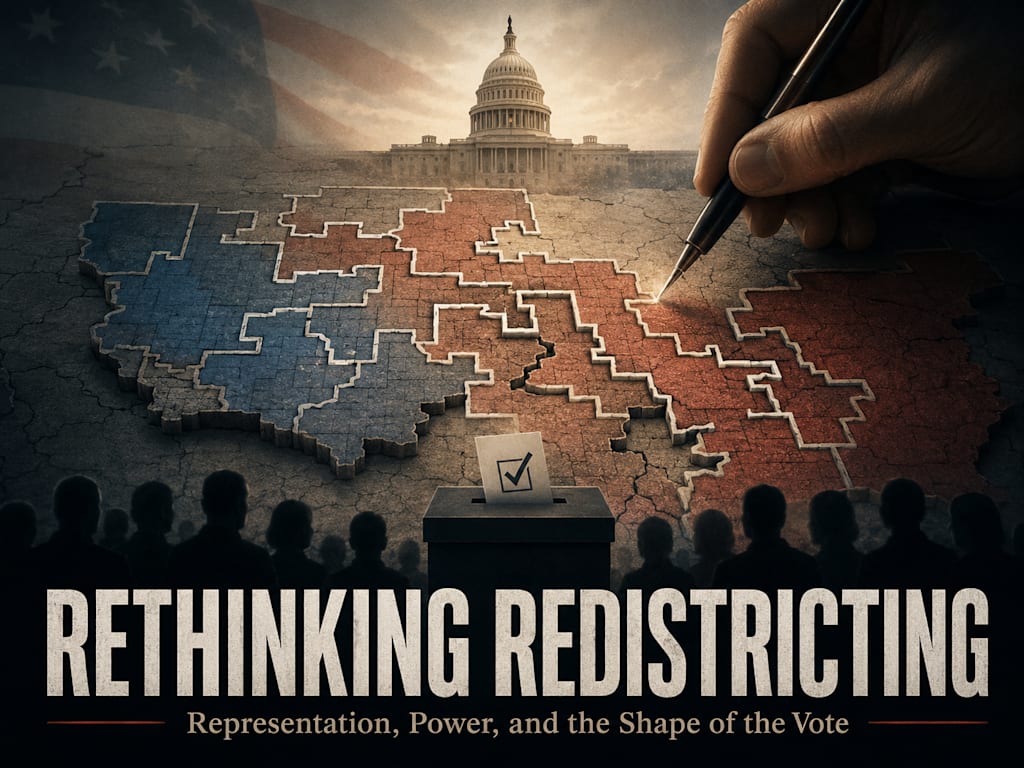
The current redistricting system is often treated as the normal starting point, while every alternative is treated as an experiment that must justify itself. That framing is backwards. The current system is already an experiment in political assignment. It already decides which voters belong together before they vote. It already gives enormous power to whoever controls the boundaries. It already allows voters to be packed, cracked, attached, diluted, concentrated, divided, or rearranged while still maintaining the appearance of legal process. The familiar system should not receive moral credit merely because people are used to it.
Ordinary redistricting has legitimate goals. Districts must account for population changes. Federal standards matter, including equal population and protections against unlawful discrimination. States may also apply criteria such as compactness, contiguity, political boundaries, and communities of interest. Those rules matter, but they do not remove the deeper problem: after the legal requirements are met, there are still many possible ways to arrange voters into districts. The person or institution holding the pen still has power over the political container.
That is why every alternative in this collection begins with the same insight. The vote does not happen in the abstract. It happens inside a district. The district is not neutral simply because it exists on a map. A voter may remain in the same home, hold the same values, and cast the same ballot, yet have the meaning of that vote changed because the district around that voter was redrawn. The failure of the current system begins before election day. It begins with assignment.
All the Alternatives Are Better in One Shared Way
The alternatives are not all better for the same reason. Some protect geography. Some protect values. Some protect voter choice. Some protect statistical equality. Some protect local culture. Some protect anti-manipulation. Some protect coherent representation. But they all improve on the current system in one shared way: they make the basis of representation more explicit.
The current system often hides political design behind geographic language. A district may be defended as equal in population, contiguous, or legally compliant while still serving a clear political purpose. Gerrymandering commonly works by arranging voters to favor a party or candidate, including through tactics often described as packing and cracking. The map may look official, technical, and lawful, but it can still be designed to control outcomes before the public casts a ballot.
Every proposed alternative forces the hidden question into the open. If the district is compact geographic, the system admits that place matters. If the district is epicenter-based, the system admits that density and urban coherence matter. If the district is voter-selected, the system admits that consent matters. If the district is ideological, the system admits that values matter. If the district is lottery-based, the system admits that procedural equality matters. If the system is hybrid, it admits that no single method can represent everything. That honesty alone is an improvement over a map that pretends to be neutral while functioning as a political instrument.
Compact Geographic Districts Are Better Because They Respect Place
Compact geographic districts are better than the current distorted system because they begin with recognizable places rather than strategic voter arrangement. They preserve cities, counties, municipalities, neighborhoods, suburbs, rural regions, and local economies where possible. They make the district easier for citizens to understand. They make manipulation more visible. They make it harder to justify long narrow corridors, city fragments, and rural attachments that exist mainly to alter the outcome.
This model is especially strong for local and state offices because local and state government often govern physical reality. Roads, bridges, potholes, schools, zoning, water, business corridors, farms, factories, police response, and municipal services all depend on place. A representative who serves a coherent geographic district can be judged by whether that place is being served. Voters can point to the bridge, the road, the school boundary, the factory closure, or the neglected neighborhood and demand accountability.
The weakness is that compact geography cannot guarantee value alignment. A district may be compact and still contain voters whose governing principles are sharply opposed. A voter may be geographically represented but ideologically misrepresented. That tradeoff is real. But compact districts are still better than manipulated geographic districts because they at least preserve the integrity of place. When the office governs place, that is not a small improvement. It is the basic requirement.
Epicenter Districts Are Better Because They Stop Treating Cities as Vote Reservoirs
The epicenter model is better than the urban-spoke model because it represents the city as a city before exporting its voters into surrounding territory. It begins with the dense urban core and expands outward until the district reaches the required population. Then it forms additional rings or adjacent population-based zones before rural and suburban regions are divided according to geography, culture, and local coherence.
This model prevents one of the most obvious abuses: slicing the city into long narrow tips that extend into surrounding rural districts. The city is not treated as a political reservoir. The rural region is not treated as empty space to be diluted. The suburbs are not treated as filler. Each area receives representation closer to its actual form: urban core, urban ring, suburban belt, exurban region, and rural area.
The weakness is that rings can become too mechanical. A city is not a perfect circle. Neighborhoods, rivers, highways, industrial zones, school areas, and municipal boundaries matter. But that weakness can be managed by rules. The core advantage remains: an epicenter model starts from real density instead of partisan outcome. It makes the city whole before it makes the countryside answer to the city.
Voter-Selected Districts Are Better Because They Begin With Consent
Voter-selected districts are better than the current system because they give the citizen a role in the first act of representation. Under ordinary districting, a voter is placed inside a political container by address. Under voter-selected districts, the voter chooses or ranks the constituency that best represents them, subject to equal population caps. That changes the moral structure. The voter is not only choosing a candidate after assignment. The voter helps choose the representative body itself.
This matters because political representation is not merely being counted. A voter can be counted in a district and still be misrepresented by the district’s dominant bloc. A rural voter attached to an urban slice, a conservative in a progressive district, a progressive in a conservative district, a libertarian in a two-party container, or an anti-war voter in an interventionist district may all be legally represented and practically unheard. Voter-selected districts create a path toward alignment.
The weakness is strategic sorting. Voters or groups may try to game district choice. But caps, wait-lists, ranked preferences, and registration windows make hostile takeover difficult. A voter who joins a district that does not share their values usually loses representation unless enough similar voters can enter, and the cap blocks mass entry. The system naturally pushes voters toward honest selection. That is better than a map system where the voter has no choice in the container at all.
Ranked-Preference Assignment Is Better Because It Respects Complexity
Ranked-preference district assignment is better than forced party or ideological sorting because it allows voters to express layered priorities. A person may be constitutionalist first, libertarian second, localist third, and nonaligned fourth. Another may be labor first, anti-war second, progressive third, and nonaligned fourth. Another may be religious conservative first, populist second, constitutionalist third, and localist fourth. That kind of ranking captures more reality than one party label or one geographic location.
This model is also better because it handles caps fairly. If a voter’s first-choice district is full, the system moves to the next available choice. That is more respectful than dumping the voter into a leftover category or forcing them into a district that does not represent them. It also reduces the pressure to game the system because voters can honestly list acceptable options.
The weakness is administrative complexity. Voters must understand the available districts. Overflow rules must be public. Wait-lists must be transparent. But complexity is not automatically a defect. The current system is already complex; much of that complexity is simply hidden inside mapmaking, litigation, consultants, data, and partisan strategy. Ranked assignment brings the complexity closer to the voter and makes representation more consent-based.
Named Ideological Districts Are Better Because They Stop Pretending Values Do Not Matter
Named ideological districts are better than the current system because they tell voters what kind of representation the district exists to provide. A Constitutionalist District, Libertarian District, Progressive District, Labor District, Localist District, Anti-War District, Religious Conservative District, Populist District, or Nonaligned District is more honest than a district whose political purpose is hidden behind a number and a boundary.
The current system often acts as if geographic placement is the only legitimate form of district identity. But voters do not only live somewhere. They hold beliefs about power, law, speech, war, family, taxation, liberty, authority, immigration, debt, labor, and government itself. A representative who shares a voter’s location but opposes that voter’s entire theory of government may not be meaningfully representative on national issues.
The weakness is label abuse. Names can become propaganda. Categories can be manipulated. One side can be split or stigmatized through wording. That is why labels must be stable, descriptive, public, and difficult to change. But honest labels are still better than hidden purposes. If ideology is already shaping representation, the public should be allowed to see it clearly.
Numbered Spectrums Are Better Because They Reduce Label Warfare
Numbered ideological districts are better than the current system in a different way. They may not capture every political dimension, but they reduce fights over emotionally loaded labels. A numbered spectrum can let voters identify broad political direction without forcing them to accept names designed by opponents, parties, or institutions. Low numbers could represent one side, high numbers another, and middle numbers mixed or moderate districts.
The benefit is simplicity. Voters can understand a scale more easily than a long list of ideological categories. The system can preserve equal population through caps while allowing voters to rank adjacent or preferred districts. It may function as a bridge away from geographic manipulation and toward more value-conscious representation.
The weakness is oversimplification. Politics is not one line. Anti-war conservatives, religious populists, civil-liberties progressives, localist independents, labor traditionalists, and institutional skeptics do not always fit neatly from left to right. But even a numbered spectrum is more honest than pretending geographic lines alone capture political representation. It admits that values matter and gives voters a way to place themselves.
Multi-Axis Value Districts Are Better Because Real Voters Are Not One-Dimensional
Multi-axis value districts are better than the current system because they recognize that voters are shaped by several political dimensions at once. Centralized power versus local control, liberty versus authority, war versus anti-war, globalism versus localism, market orientation versus labor orientation, progressive versus traditional moral order, institutional trust versus skepticism, and class security versus lived constraint all matter. A voter’s actual governing philosophy often emerges from the combination.
This model is more representative than geography alone for higher offices because national politics is not merely local. A voter’s position on war, debt, speech, privacy, federal power, religious liberty, labor, trade, and institutional trust may matter more than proximity to another voter. Multi-axis districts can reveal communities that the current system hides: labor-populists, localist constitutionalists, libertarian civil-liberties voters, anti-war voters, religious conservatives, progressive institutionalists, and nonaligned skeptics.
The weakness is that category design becomes powerful. Whoever chooses the axes can shape representation. That is why the strongest version keeps voter choice central. Multi-axis categories should guide voters, not trap them. The system is better than the current one because it sees more of the citizen, but it must never become a state-controlled identity machine.
Political Compass Tools Are Better Only When They Guide, Not Govern
A political compass or values assessment can be better than the current system when used as a voluntary guide. It can help voters understand where they fit among available districts. It can reveal that a person is not simply left, right, or center, but perhaps localist, anti-war, constitutionalist, libertarian, labor-oriented, religious conservative, progressive, institution-skeptical, or nonaligned. It can help voters rank districts more intelligently.
But this model becomes dangerous if mandatory. A required values test can become the new gerrymander. The questions can be loaded. The scoring can be hidden. The weights can manipulate outcomes. The state can create political belief profiles. The abuse moves from map lines to classification. That is not justice. That is administrative control under the appearance of precision.
The fair version is voluntary, transparent, private, and subordinate to voter choice. The test may advise. It should not command. Used that way, it is better than the current system because it helps voters find representation without forcing them into containers drawn by others.
Party-Affiliation Sorting Is Better Because It Is a Practical Bridge
Party-affiliation sorting is better than the current system because it uses existing political identity instead of manipulated geography. It is not perfect, but it is administratively understandable. Democrats can be sorted into left-aligned capped districts. Republicans can be sorted into right-aligned capped districts. Minor parties and independents can rank aligned, nonaligned, or issue-based districts. The mapmaker loses much of the power to decide political grouping through boundaries.
This model may reduce geographic gerrymandering quickly. Instead of fighting over whether a city should be sliced into rural districts, the system groups voters by declared affiliation or ranked political preference. It moves the debate away from hidden geographic engineering and toward visible political association.
The weakness is that party labels are crude. A Republican may be libertarian, constitutionalist, populist, religious conservative, business-oriented, nationalist, or anti-war. A Democrat may be progressive, labor-oriented, anti-war, environmentalist, institutionalist, or civil-liberties focused. Independents are not automatically moderate. Party sorting is better than manipulated maps, but it is not enough. It should be a bridge toward ranked value-based representation, not the final destination.
Random Lottery Districts Are Better Because No One Gets to Draw Advantage
Random lottery districts are better than the current system because they remove the mapmaker almost entirely. No one cracks a city. No one packs opponents. No one draws thin corridors. No one attaches rural areas to urban slices. Voters are assigned by a public, auditable process into equal-population districts. The assignment is not based on partisan usefulness.
This is the maximum procedural-equality model. It may be the cleanest anti-gerrymandering method because it prevents the political container from being engineered in advance. If the randomization process is trustworthy, the district cannot be drawn for party advantage because it is not drawn at all. Proportional and alternative representation systems are often discussed as ways to reduce winner-take-all distortions and give more voters a role in electing someone they support, which reflects the same concern that representation should not depend entirely on one-member geographic districts.
The weakness is that random districts may lack place, culture, and value coherence. They are fair in assignment but thin in community. That is why lottery systems should not replace local geographic representation. They are better than the current system as an anti-manipulation tool, especially for oversight bodies, citizen panels, or limited higher-level representation. But they are not enough as the whole system.
Hybrid Chambers Are Better Because They Stop Forcing One Method to Do Everything
The hybrid chamber model is better than the current system because it admits that people need more than one kind of representation. One body can represent place. Another can represent values. A geographic chamber protects roads, bridges, schools, farms, factories, counties, cities, neighborhoods, and municipalities. A values chamber protects constitutionalists, progressives, libertarians, labor voters, anti-war voters, religious conservatives, localists, populists, and nonaligned citizens.
This is stronger than forcing one district to represent both potholes and war, both municipal boundaries and constitutional limits, both local business corridors and federal surveillance, both school routes and national debt. Different offices govern different things. A layered system assigns the right method to the right function. Some electoral systems already attempt to combine local district representation with broader proportional or party-based representation; mixed-member proportional systems, for example, are designed to combine local single-seat representation with broader proportional representation.
The weakness is complexity. Voters would need to understand different types of representation. But the current system is not truly simple. It is only familiar. A hybrid system would be more honest because each chamber would have a defined job. One represents place. One represents principles. That is better than pretending one map can represent every human concern.
Competitive Districts Are Not Inherently More Representative
A central assumption behind the current system is that competitive districts are more democratic because either side can win. But a close race is not the same as meaningful representation. A district split 50.01 percent to 49.99 percent gives one side legal victory while nearly half the district may receive no real voice. The representative can claim the whole district while actually representing only the bare winning side.
Competitive districts may increase electoral uncertainty. They may improve accountability in some cases. But they are often weaker at coherent representation. A district that is internally divided almost exactly in half may not represent a people. It may represent a permanent battlefield. The question should not be whether either side can win. The question should be whether the district gives a real community a meaningful voice.
This matters because many alternatives may produce safer districts. Compact rural districts, urban epicenter districts, value-based districts, party-affinity districts, and voter-selected districts may produce stronger majorities. That is not automatically unfair. If the district reflects a real community, the majority is evidence of coherence, not necessarily manipulation. Competition is useful only when it serves representation. It is not the definition of representation.
Is Forced Mixture Really Justice?
The current system often treats forced mixture as fairness. If a district contains both sides in near-equal numbers, it is considered fair because each side has a chance. But is that really justice? Is a voter represented because they almost won? Is a rural community represented because it was attached to enough city voters to be competitive? Is an urban community represented because it was sliced into several districts and used to influence the surrounding region? Is a religious, labor, libertarian, anti-war, or constitutionalist voter represented because they were placed into a district where their values are always outnumbered?
A system can count a voter without representing that voter. That distinction is the heart of the entire collection. Equal numbers matter. Legal compliance matters. But representation is deeper than counting. It requires a channel through which real communities, places, values, interests, and citizens can speak.
Forced mixture may sometimes be healthy, especially locally where people share real physical communities. But forced mixture can also become dilution. A system that constantly tells voters they are represented by someone who rejects their core priorities is not necessarily fair. It may be orderly. It may be familiar. It may be legal. But justice requires more than the appearance of inclusion inside a district.
The Current System’s Worst Feature Is Hidden Control
The worst feature of the current system is not only that bad maps are possible. It is that control is hidden behind procedure. The public is told that redistricting is about equal population and legal lines. Those things are true, but incomplete. The deeper power is the power to decide which voters form a constituency before the election begins. Once that choice is made, every later choice is shaped by it.
A distorted map can be made to look technical. A manipulative district can be defended with demographic language. A city can be split in the name of balance. A rural region can be diluted in the name of equality. A community can be broken and then told the district is lawful. The voter is expected to accept the container and call the result representation.
All the alternatives are better to the degree that they expose or restrain that control. Compact districts restrain it through place. Epicenter districts restrain it through density logic. Voter-selected districts restrain it through consent. Ranked assignment restrains it through preference. Named districts restrain it through clarity. Multi-axis districts restrain it through complexity made visible. Lottery districts restrain it through chance. Hybrid systems restrain it by dividing the function of representation. None is perfect. All are more honest about what is being represented.
Better Does Not Mean Perfect
Each proposed system has weaknesses. Compact geography can trap value minorities. Epicenter districts can become mechanical. Voter-selected districts can be strategically gamed. Ranked assignment can be complex. Named districts can become propaganda. Numbered spectrums can oversimplify. Multi-axis categories can be manipulated. Political compass tools can become coercive. Party sorting can preserve party capture. Lottery districts can erase community. Hybrid systems can become complicated. There is no perfect design.
But the current system has weaknesses too, and they are not minor. It allows politicians or commissions to control the initial grouping of voters. It can hide political intent inside legal compliance. It can produce competitive districts that represent no coherent people. It can break cities, dilute rural voters, flatten suburbs, scatter ideological minorities, and treat voters as raw material. Familiarity should not be mistaken for fairness.
The question is not whether an alternative has tradeoffs. The question is whether the tradeoffs are visible, constrained, and morally cleaner than the current failure. A system with known weaknesses and strong safeguards may be better than a familiar system whose weaknesses are disguised as normal procedure.
The Better Standard Is Visible Tradeoff and Real Voice
The proper standard should be visible tradeoff and real voice. A system should state what it is trying to represent. If it represents place, say so. If it represents values, say so. If it represents party affiliation, say so. If it represents random equality, say so. If it represents a hybrid of place and values, say so. Then judge whether the system actually does that job.
The current system often fails this standard because it claims to represent geography while often functioning as partisan arrangement. A district may be called geographic while its real purpose is political control. That gap between stated purpose and actual effect is where distrust grows. A better system would narrow that gap. The public should know what the district is for and how abuse is prevented.
Real voice is the second standard. Does the district give a real community of place, value, interest, or function the ability to send someone who speaks for it? If not, the district may be legally valid but representationally thin. The goal is not merely to draw cleaner containers. The goal is to make the container answerable to the people inside it.
The Best System Is Not One Alternative, but a Stack of Safeguards
The final answer is probably not one replacement. It is a stack of methods and safeguards. Local offices should remain geographic because local government manages place. State offices should preserve compact geography and communities of interest while possibly allowing value-based representation in one chamber. Federal offices should be open to voter-selected, ranked, value-based, party-affinity, or hybrid forms because federal power governs national principles. Lottery methods can serve as anti-manipulation checks. Political compass tools can guide but not command. Party sorting can serve as a bridge but not a cage.
Every layer needs safeguards. Equal caps. Public labels. Stable categories. Transparent overflow rules. Wait-lists. Registration windows. Privacy protections. Auditable randomization. Clear appeals. Public evidence for communities of interest. No mid-cycle category manipulation. No hidden scoring. No secret assignment. No politician-controlled container without restraint.
That is how reform avoids becoming a new disguise for the old abuse. The system must always ask: where does the power move, and how is that power limited?
The Capstone Argument
Every proposed alternative is an admission that the current system is not the only possible way to represent people. Some alternatives preserve place better. Some preserve values better. Some preserve consent better. Some preserve equality better. Some preserve clarity better. Some preserve complexity better. Some preserve accountability better. All of them expose the current system’s false neutrality.
The current system says voters are represented because they live inside a district. The deeper answer is that voters are represented only when the district gives a real people a real voice. Sometimes that people is geographic. Sometimes it is cultural. Sometimes it is economic. Sometimes it is ideological. Sometimes it is nonaligned. Sometimes it is a random public sample for a specific anti-corruption purpose. A just system should know the difference.
That is why these alternatives are worth taking seriously even when they are imperfect. They force the real question into the open. Is representation about land, values, consent, equality, community, competition, or function? The answer is not one word. The answer depends on the office and the people being represented. What is not defensible is pretending the current map-based system already solves the problem simply because the lines have official approval.
Beyond Familiar Failure
The current redistricting system survives partly because it is familiar. People know what districts are supposed to look like. They know maps will be redrawn. They know lawsuits will follow. They know each side will accuse the other of manipulation. They know some districts will look strange and some communities will feel ignored. Familiar failure becomes normal.
But normal is not the same as just. A system that gives political actors control over the containers of representation should always be questioned. A system that counts voters while diluting their voice should be challenged. A system that praises 50.01 percent victories as fair representation should be examined. A system that treats city voters as exportable, rural voters as dilutable, independents as leftovers, and value minorities as unavoidable casualties should not be treated as the moral baseline.
The alternatives may be difficult. They may require new rules, new language, and new safeguards. But difficulty is not defeat. The first step is seeing the current system clearly. Redistricting is not merely a fight over lines. It is a fight over who gets to define representation before the vote is ever cast. Any system that makes that power more visible, more constrained, more consent-based, more community-rooted, or more honestly aligned with the office being filled is already asking a better question than the system we inherited.
About the Creator
Peter Thwing - Host of the FST Podcast
Peter unites intellect, wisdom, curiosity, and empathy —
Writing at the crossroads of faith, philosophy, and freedom —
Confronting confusion with clarity —
Guiding readers toward courage, conviction, and renewal —
With love, grace, and truth.
Enjoyed the story? Support the Creator.
Subscribe for free to receive all their stories in your feed.
Comments
There are no comments for this story
Be the first to respond and start the conversation.