Nature
Clean sea water
Title: The Importance of Clean Sea Water: Ensuring the Health of Our Oceans Introduction: Clean sea water is crucial for maintaining the health and vitality of our oceans, which are home to an incredible array of marine life and play a significant role in sustaining life on Earth. Unfortunately, pollution, climate change, and human activities have severely impacted the quality of sea water, posing numerous threats to marine ecosystems and the overall balance of our planet. This article explores the importance of clean sea water, its current challenges, and potential solutions to protect and restore the health of our oceans.
By METCALF CAITLIN3 years ago in Earth
Empowering Women: Key Catalysts for Climate Change Solutions
In a world where diverse perspectives are crucial to tackling the global challenge of climate change, empowering women emerges as a fundamental aspect of building a better future for both society and the environment. In this article, we will delve into four key ways in which empowering women can contribute significantly to solving climate change:
By Chela Kikwai3 years ago in Earth
Discover the Unbelievable: 10 Existent Places That Challenge Scientific Possibility
1. The Enigma of the Brule River: At a particular point along the Brule River, the water inexplicably splits into two directions. One branch continues its course towards Lake Superior, while the other branch disappears into an unknown destination. Despite numerous attempts to trace the missing flow, scientists have been left puzzled, with no definitive explanation for its mysterious disappearance.
By Kisaakye Daniel 3 years ago in Earth
Unveiling the Enigma of Rogue Waves: Nature's Unpredictable Fury
On December 7th, 1978, the MS München set sail on a routine voyage, only to disappear without a trace. The incident sparked curiosity and fear, as a force believed to occur once every 10,000 years was thought responsible. As researchers explored the mystery, they stumbled upon a phenomenon that had long been dismissed: rogue waves. These colossal and unpredictable waves, capable of wreaking havoc on the open sea, challenged scientific understanding. In this blog, we delve into the chilling tales of rogue waves, their historical significance, scientific exploration, and the ongoing efforts to predict and comprehend these mysterious forces of nature.
By Radha Rangasamy3 years ago in Earth
Facts About Our Earth
Earth is the planet where you reside. It is a part of the solar system, which includes the Moon. Although the Moon may seem close, at their farthest point, Earth and the Moon are 252,088 miles apart. Surprisingly, all planets in the solar system could fit within this distance. Jupiter's Great Red Spot is twice the size of Earth, while Saturn is nine times wider than Earth. Saturn's rings contain fragments as large as mountains. However, compared to the Sun, these planets are minuscule. The Sun is so immense that Earth would appear insignificant from its surface. The universe has an unfathomable number of stars, larger than the grains of sand on Earth's beaches. The largest star known, VY Canis Majoris, is about 2,000 times the diameter of our Sun. Despite its enormity, it is still smaller than some galaxies. NGC 674, for example, is twice as wide as the Milky Way and contains millions or billions of planets within it This post presents 15 lesser-known facts about Earth. Despite living on this planet, there are still things we don't know about it. For instance, Earth actually spins for 23 hours and 56 minutes per day, resulting in an extra four minutes each day. The Hudson Bay area in Canada has lower gravity due to the burden of gravity left by melted glaciers, but the change is so small that it's almost unnoticeable. The first photo of Earth was taken in 1946 by a camera strapped to a V2 missile, and the first full-color image was taken by the Dodge satellite in 1967. The salt in the ocean comes from rocks on the shore and rainwater. The rocks in the racetrack playa area of Death Valley move on their own due to ice melting and creating slick ground. Some scientists believe a smaller twin planet collided with Earth and created the moon. Earth's core is just as hot as the surface of the Sun, and if the Sun were permanently blocked, Earth would freeze. Cameroon's Lakes Nyos, Monoun, and Kivu are technically dams but are known as the exploding lakes. We have explored less than 10% of Earth's oceans and discovered 210,000 underwater speciesPlanet Earth moves in two ways: through rotation and revolution. Earth rotates counterclockwise on its axis, an imaginary line that runs through the planet's center passing through the North Pole and South Pole. It takes 24 hours for the Earth to complete one full spin on its axis, also known as a rotation. This rotation is what creates day and night. Early in the morning, the sun rises in the east. If you stand on a beach along the Atlantic Ocean at sunrise, you will see the sun appear on the horizon as though it is rising from the water. What is really happening is that Earth is rotating and exposing your location to the sun. When a region begins spinning away from the sun's light, the sun appears to set or fall slowly. If you stand on the same beach once the sun has set, you might notice the sky growing darker. This happens because the area where you're standing is rotating away from its light source. As Earth rotates, one half of the planet faces away from the sun for about 12 hours. Although Earth takes 24 hours to rotate on its axis, it moves in another way. Earth follows a slightly elliptical path around the sun at the same time. One full orbit around the sun is called a revolution, which takes nearly 365 days on Earth. The exact amount of time it takes for Earth to fully orbit the sun is actually 365 and 1/4 days. Because a part of the day cannot be calculated into the calendar, leap years were created. A leap year happens every four years, during which an extra day is added to the calendar. The day that is added every four years is always February 29th, so every four years, the month of February has 29 days instead of 28. This is a result of Earth's revolution around the sun. Both Earth's rotation and revolution are very important to humans. The planet's movement on its axis and movement around the sun are what create days, nights, and years, allowing humans to measure time. Earth's rotation and revolution result in lightness and darkness, the seasons, and the length of a day anywhere in the world.. The universe is vast, and we are only a small part of it. Remember that Earth is your home.
By Mohamed Mohsen3 years ago in Earth
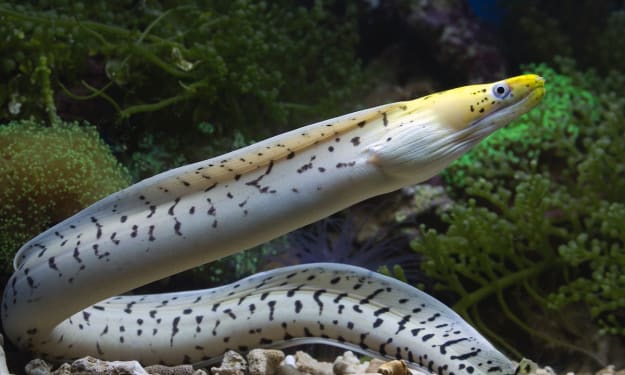
The Enigmatic Eels
The Enigmatic Eels: Unraveling the Mysteries of a Fascinating Aquatic Species. Introduction : Eels, with their sleek bodies and snakelike movements, have captivated human curiosity for centuries. Found in freshwater and saltwater habitats across the globe, these enigmatic creatures are shrouded in mystery. From their peculiar life cycle to their astonishing migration patterns, eels continue to baffle scientists and intrigue nature enthusiasts alike. This article delves into the world of eels, shedding light on their biology, behavior, and the ongoing scientific research that aims to unravel the secrets of these extraordinary aquatic inhabitants.
By Mr Royal Honey 3 years ago in Earth
Unearthing the Secrets:
Title: Unearthing the Secrets: Unveiling the Hidden World Beneath the Sands of the Sahara Desert Introduction: The Sahara Desert, renowned as one of the most inhospitable places on Earth, holds a captivating history beneath its vast expanse of sand. Beyond the majestic dunes lies a hidden world of ancient lost cities, forgotten civilizations, and valuable treasures. This article takes you on a journey through time as we delve into the mysteries concealed within the Sahara Desert, shedding light on its remarkable past and the remarkable civilizations that once thrived there.
By Raghav Prakash3 years ago in Earth
the new diseases in brazil
Unraveling the Mysteries of Amazon's Bats: A Potential Pandemic Threat? Introduction: The world has been grappling with the COVID-19 pandemic for the past two years, and just as we begin to see a glimmer of hope, another looming threat emerges from the depths of the Amazon rainforests. Scientists have recently discovered vast cave systems within the Amazon that are home to thousands of bats, raising concerns about the potential for future pandemics. With Brazil boasting the third-highest bat species diversity in the world, the focus on this region has intensified due to the alleged role bats played in the origin of COVID-19 and their remarkable ability to carry devastating viruses without showing any symptoms. As researchers strive to understand these enigmatic creatures and their immune systems, a lack of resources poses a significant challenge, leaving us vulnerable to the next viral outbreak.
By Raghav Prakash3 years ago in Earth
The Value Proposition of Gunite Pools
Gunite pools have gained a reputation for being luxurious and expensive, but there's more to these pools than just the upfront cost. In this article, we will delve into the value proposition of gunite pools, exploring the numerous benefits they offer that justify their price tag. From customization and durability to increased home value and long-term savings, gunite pools prove to be a wise investment for discerning homeowners.
By Kevin Smith3 years ago in Earth
Groundwater
Meteoric Groundwater: Groundwater can be describe as the amount of water that is used to saturate the parts of Earth and helps to fill all the available spaces. Set behind the others,the most common type of ground water is meteoric water. This is the type of groundwater that freely circulates as an important portion of the water cycle. This meteoric water is generally soaked deep down into the ground by the process of precipitation (rain water or droplets) or through streams and lakes. There it remains for sometimes and then comes up to the surface of the ground. At first, it was thought that the hard and porous ground have enough space to hold up all the meteoric water.
By Fatima Jamil3 years ago in Earth