
The Cursor Blinks
How We Are All Struggling to Complete a Happy Ending

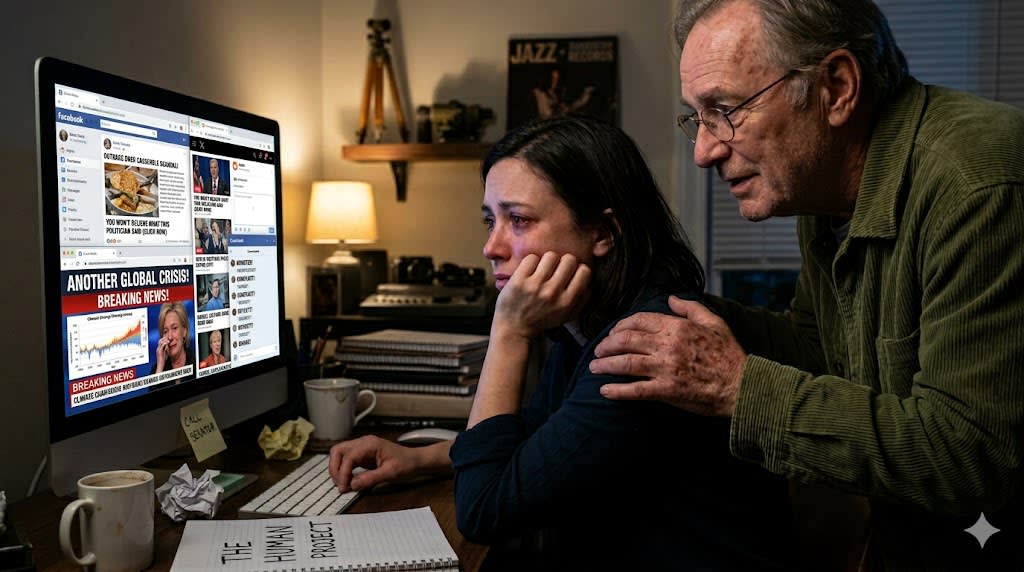
THE CURSER BLINKS
CHARACTERS
• MAY (30s): A freelance documentary editor. Her eyes are perpetually bloodshot from blue light. Her apartment is a graveyard of half-empty coffee cups and post-it notes that say things like "Call senator" and "Buy oat milk."
• LEO (70s): May’s grandfather. A retired surveyor. He remembers when the world felt big; now he watches it shrink through a five-inch smartphone screen.
• THE SCREEN: An atmospheric presence. The ambient glow of notifications, breaking news banners, and endless algorithmic scrolls that illuminate May’s face.
SCENE I: THE GLOW OF THE PRESENT
INT. MAY'S APARTMENT - NIGHT
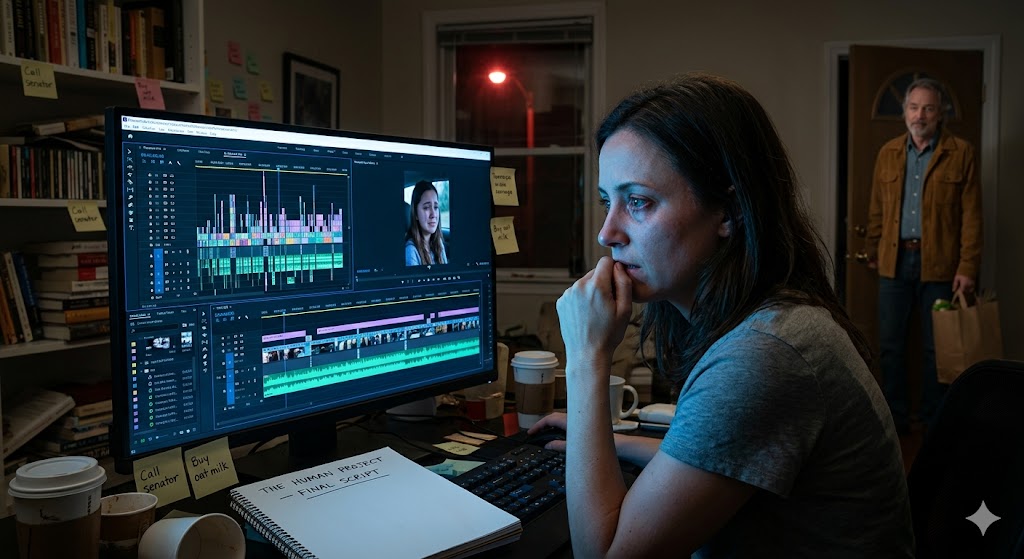
The room is dark except for the aggressive, cool-toned neon radiance of a 32-inch editing monitor.
On the screen, a timeline workspace is choked with hundreds of tiny, color-coded video clips. The audio waveform looks like a jagged mountain range of human noise—shouting, sirens, acoustic guitars, courtroom gavels, and the collective intake of breath.
MAY (30s) sits with her chin resting in her hand. Her thumb frantically rubs her index finger—a nervous tic. She hits the spacebar.
On the preview monitor, a montage plays:
• A smartphone video of a flooded city street where a man carries a dog on his shoulders.
• A high-definition broadcast of a politician speaking behind bulletproof glass.
• A vertical video of a teenage girl crying in her car because her rent went up forty percent.
• A satellite time-lapse of a rainforest turning brown.
May hits the spacebar again. The frame freezes on the teenage girl’s face, pixelated and raw.
May sighs, leans back, and looks at a physical notebook on her desk. Written at the top of a blank page in thick black marker: THE HUMAN PROJECT — FINAL SCRIPT.
Below it, the page is entirely blank.
The cursor on the monitor blinks. Blink. Blink. Blink. It feels accusatory.
The front door clicks open. LEO (70s) walks in carrying a grocery bag. He’s wearing a faded corduroy jacket and moves with the deliberate, careful grace of someone who knows his bones are fragile.
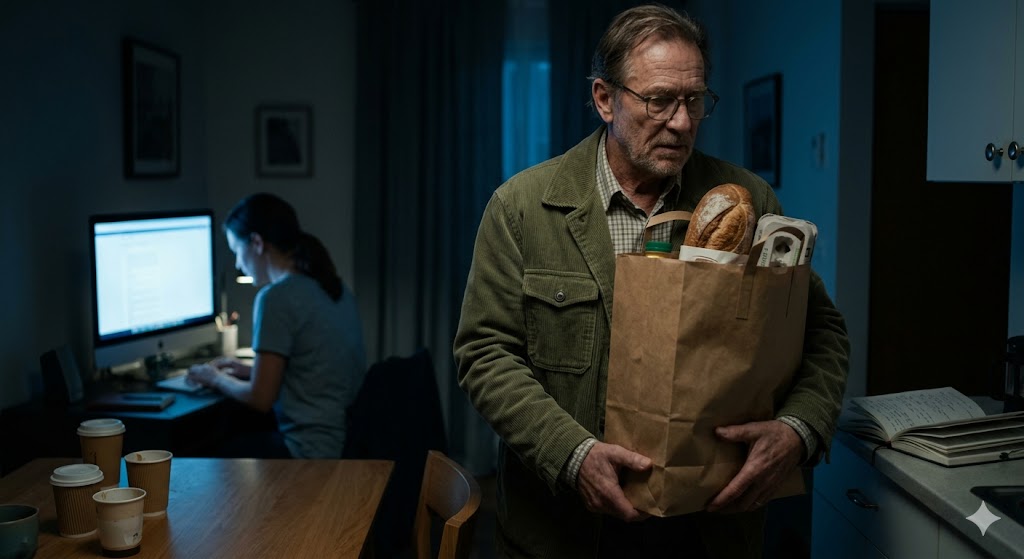
LEO You’re sitting in the dark again, Millie-bug. You’ll ruin your eyes.
MAY (Without looking up) My eyes are already ruined, Grandpa. The world broke them about three updates ago.
Leo sets the bag on the small kitchen counter. He pulls out a carton of eggs and a loaf of sourdough bread. He looks over at her, his expression soft, etched with the deep lines of someone who has lived through three recessions and a dozen forgotten crises.
LEO They had the good bread today. The one with the seeds on the crust you like. It was eight dollars. Eight dollars for flour and water, May. I think the bakery is charging for the atmosphere now.
MAY Everything is eight dollars now, Leo. Breathing is about four fifty a minute.
Leo walks over, standing just behind her shoulder, looking at the chaotic tapestry of the editing timeline.
LEO Where are we in the story? Did the good guys win yet?
MAY There are no good guys in this cut, Leo. Just tired people and loud machines.
LEO Well, how does it end? You’ve been staring at that same sequence since Tuesday.
May drops her head onto the edge of the desk, her forehead pressing against the wood.
MAY It doesn't. That’s the joke. It doesn’t end. I’m supposed to write a manifesto. A call to arms. A beautiful, sweeping monologue that makes people drop their phones, look out the window, and say, "Yes, we must change!" But I don’t know what the change is anymore. Every time I think I have a solution, three more problems sprout out of it like a hydra.
LEO So close the laptop. Come eat an egg.
MAY I can’t. If I close it, the chaos wins. If I keep typing, at least I’m trying to organize the noise.
SCENE II: THE ANATOMY OF OVERWHELM
INT. MAY'S APARTMENT - LIVING ROOM - LATER
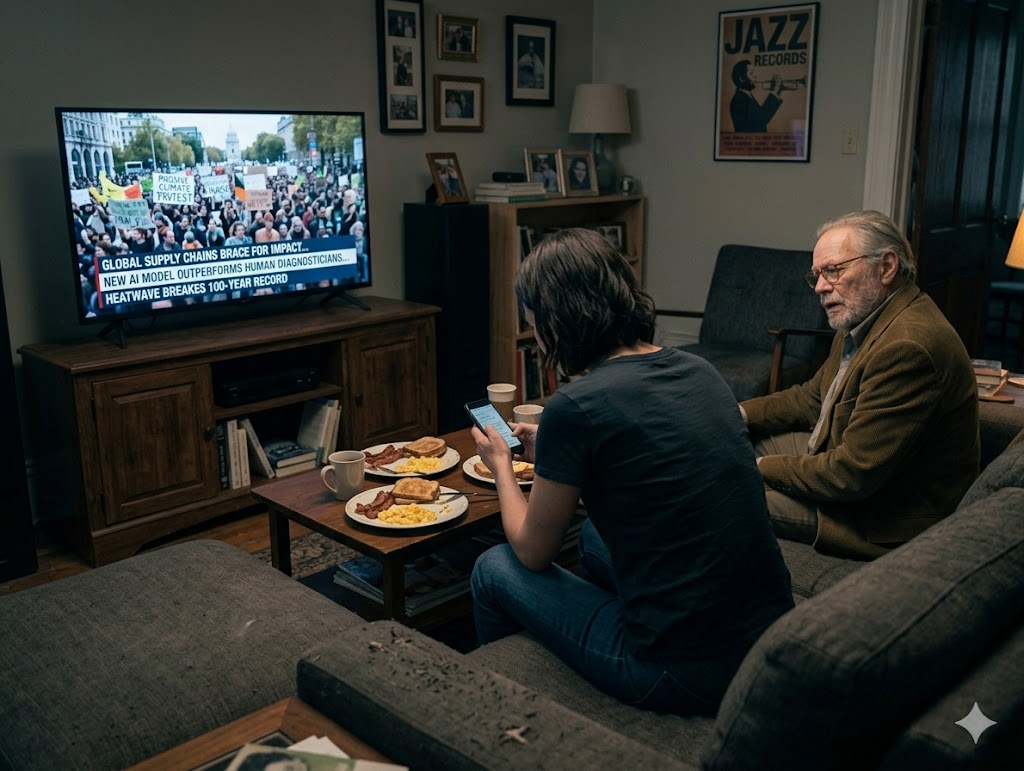
Two plates of scrambled eggs sit between them on the coffee table. The television in the corner is muted, but the chyron at the bottom of the screen flashes text: GLOBAL SUPPLY CHAINS BRACE FOR IMPACT followed by NEW AI MODEL OUTPERFORMS HUMAN DIAGNOSTICIANS followed by HEATWAVE BREAKS 100-YEAR RECORD.
May is scrolling on her phone with her left hand while holding a fork with her right.
LEO Put the rectangle down, May. It’s a dinner companion with terrible manners.
May drops the phone face down. It immediately vibrates twice. A small blue light pulses on its flank.
MAY I’m trying to understand. That’s all. I feel like if I stop looking, even for an hour, the world will morph into something completely unrecognizable and I’ll be left behind. Do you know what they’re doing now? They’re coding algorithms to predict what we’re going to say before we say it. They’re building bunkers in New Zealand. And out there, on the corner of 4th and Main, there’s a woman who has been living in a tent for two years, and yesterday someone threw a milkshake at her from a moving Tesla. How do I put that in a script? How do I tell people what to do about that?
LEO When I was a surveyor, we used to go out into the valleys before the suburbs were built. We had these transits—those telescopes on tripods. If you try to look at the whole mountain range through that little lens, you see nothing but a blur. You have to focus on one specific rock. One property line. One stake in the dirt.
MAY That worked when the world was made of dirt, Grandpa. Now the world is made of light and speed. If I focus on one rock, the rest of the mountain falls on my head.
She stands up, pacing the small room. The anxiety radiates off her like heat from a radiator.
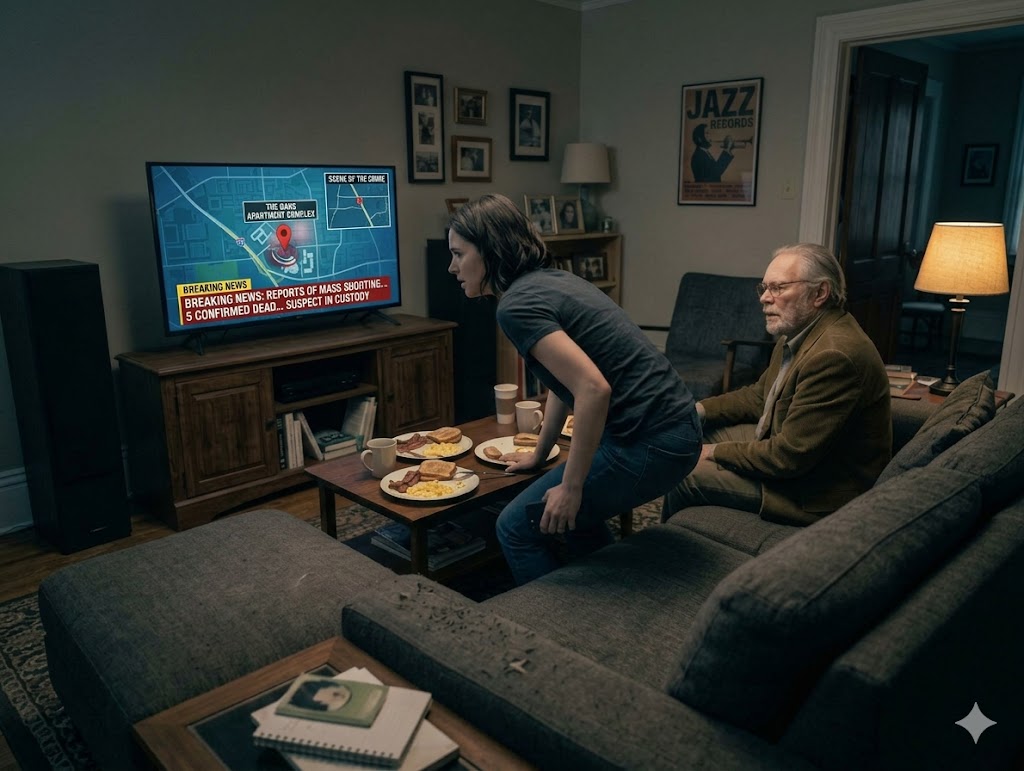
MAY (CONT'D) I want to call people to action. I really do. I want to say, "March!" But march where? To the statehouse? To the tech headquarters? To the grocery store to protest the eight-dollar bread? I want to say, "Vote!" But the choices feel like picking between a slow leak and a sudden explosion. I want to say, "Love your neighbor!" But my neighbor has a flag in his yard that basically says he wishes I didn't exist, and I don’t know how to bridge that gap with a casserole.
Leo watches her. He doesn't interrupt. He finishes his toast, chewing slowly.
LEO You’re trying to carry the sky, May. You’re small. Your arms aren't long enough.
MAY Then who is going to carry it? Look at the news! Nobody is at the wheel. The adults in the room are just teenagers who grew wrinkles. Everyone is grifting, or terrified, or numbing themselves with videos of cats doing backflips. I’m guilty of it too. I watched a video of a raccoon eating grapes for forty minutes last night because it was the only thing that didn’t make me want to cry.
LEO Raccoons are very neat eaters. Nothing wrong with that.
MAY (Voice cracking) It’s not funny, Leo. I feel like we’re the last generation that remembers what peace felt like, even if it was a fake peace. Now it’s just... permanent emergency. Every day is a historical event. I am so tired of living through historical events.
SCENE III: THE WEIGHT OF COMPASSION
INT. MAY'S APARTMENT - NIGHT (LATER)
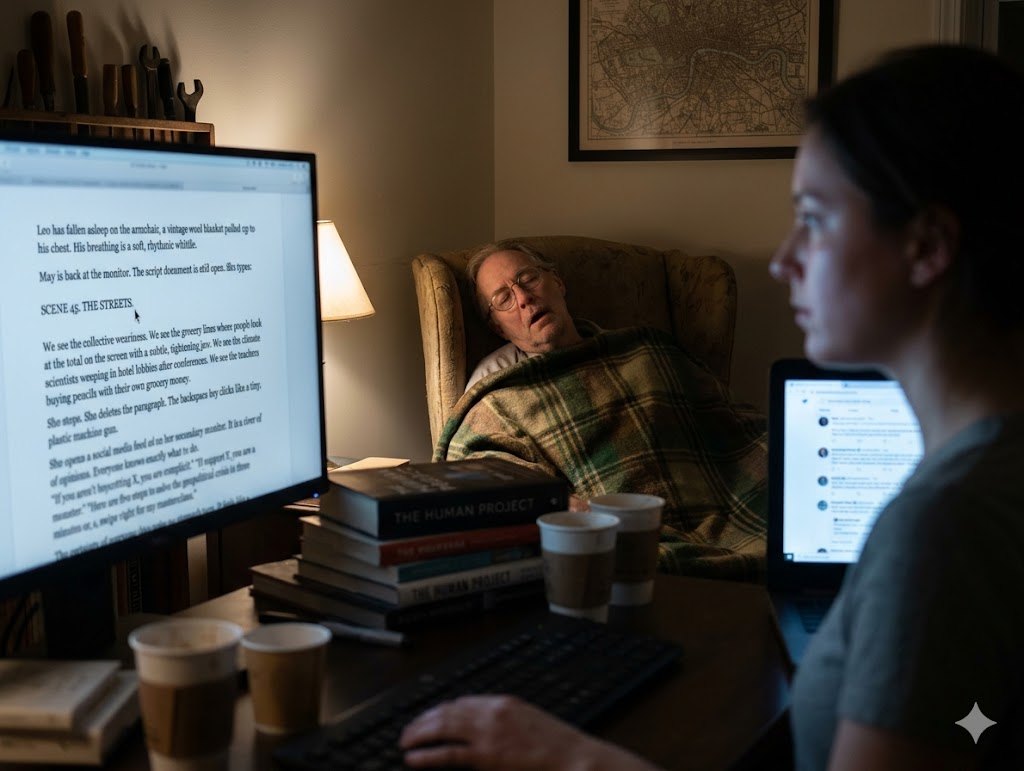
Leo has fallen asleep on the armchair, a vintage wool blanket pulled up to his chest. His breathing is a soft, rhythmic whistle.
May is back at the monitor. The script document is still open. She types:
SCENE 45. THE STREETS.
We see the collective weariness. We see the grocery lines where people look at the total on the screen with a subtle, tightening jaw. We see the climate scientists weeping in hotel lobbies after conferences. We see the teachers buying pencils with their own grocery money.
She stops. She deletes the paragraph. The backspace key clicks like a tiny, plastic machine gun.
She opens a social media feed on her secondary monitor. It is a river of opinions. Everyone knows exactly what to do.
"If you aren't boycotting X, you are complicit." "If you support Y, you are a monster." "Here are five steps to solve the geopolitical crisis in three minutes or less, swipe right for my masterclass."
The certainty of everyone else makes her stomach turn. It feels like a performance. A loud, desperate whistling in the dark to keep the monsters away.
She looks at her grandfather’s sleeping face. He looks so quiet. He doesn't have an avatar. He doesn't have a brand. He has a box of old transit tools in the closet and a collection of jazz records that smell like basement dust.
She sits down on the floor next to his chair and rests her head against his knee, the way she did when she was seven years old and scared of thunderstorms. Without opening his eyes, Leo places his rough, spotted hand on her hair.
LEO Still blank?
MAY Still blank.
LEO Good.
MAY Why is that good?
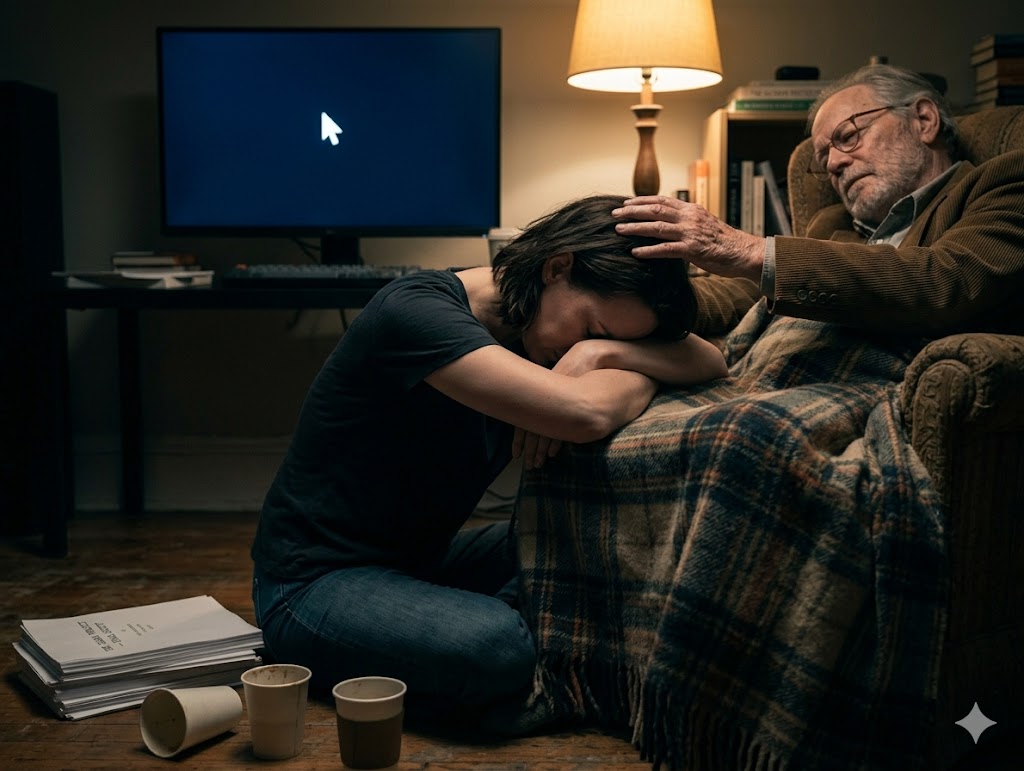
LEO Because anyone who has a clear answer right now is selling something, or they aren't paying attention. Confusion is an honest response to an dishonest time.
MAY But honesty doesn't fix the world, Grandpa. Action does.
LEO Maybe the first action is just admitting we’re lost. You can’t map a valley until you admit you don’t know where the river goes.
MAY I feel like I’m failing everyone by not knowing what to say. The client paid me a deposit. They want an inspirational video for the non-profit gala. They want people to write checks. They want hope.
LEO Show them the confusion.
MAY They don’t give grants for confusion, Leo. They give grants for "Synergy" and "Scalable Solutions."
LEO Then let them keep their money. Show them what’s real.
SCENE IV: THE TEXTURE OF RIGHT NOW
INT. MAY'S APARTMENT - DAWN
The sky outside the window turns a pale, bruised violet. The streetlights below flicker off.
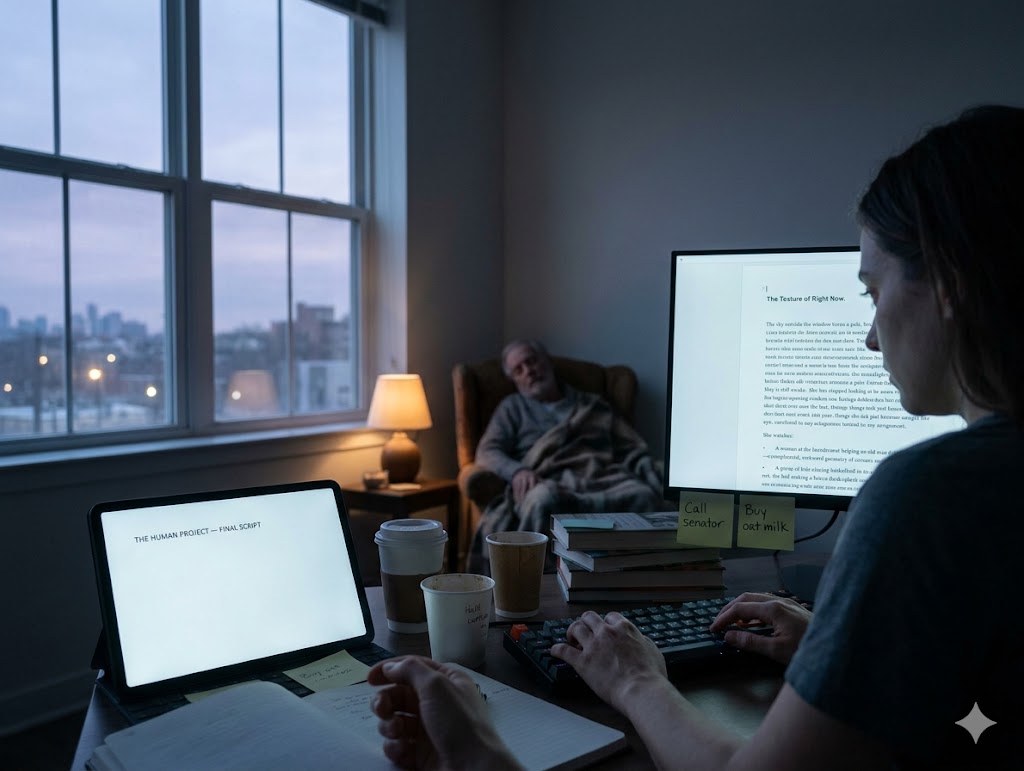
May is still awake. She has stopped looking at the news feeds. Instead, she begins opening random raw footage folders from her hard drives—clips she shot herself over the last year, things she took just because they caught her eye, unrelated to any assignment.
She watches:
• A woman at the laundromat helping an old man fold a fitted sheet—the complicated, awkward geometry of corners meeting corners.
• A group of kids playing basketball in the rain on a court with no net, the ball making a heavy thud-splash sound.
• A line of cars stopped on the highway because a family of ducks is crossing the asphalt, four lanes of angry commuters completely still, watching the tiny yellow puffs waddle over the yellow line.
• Her own reflection in the subway window, surrounded by twelve other people, every single one of them looking at a different screen, yet their shoulders gently swaying together in unison as the train hit a curve.
She starts dragging these clips into the timeline. She deletes the politicians. She deletes the talking heads. She deletes the charts showing the rise of ocean temperatures and the decline of purchasing power.
She keeps the noise of the world low in the audio mix—a distant, rumbling traffic hum—but brings up the sound of the fitted sheet snapping straight. The sound of the basketball hitting the rim. The sound of her grandfather’s soft, whistling snore.
She opens the script file. She positions her fingers over the keys. She doesn't write a grand conclusion. She doesn't write a call to march, or a policy proposal, or a ten-point plan for global harmony. She writes what she sees.
AUDIO (VOICEOVER): "This is the script for the middle of the storm. If you are listening to this, it means we haven't found land yet. It means the wind is still up, and the compass is spinning, and the people who claimed to be the captains have locked themselves in the cabin.
We are being asked to carry an impossible amount of information. We wake up to tragedies three oceans away and go to sleep with crises three blocks away. Our brains were built for villages, but we have been given the grief of an entire planet.
So if you are paralyzed, if you are angry, if you are looking at your hands wondering what small thing they could possibly do that would matter—you are right. You are seeing the scale of it accurately.
I don’t know where to tell you to go. I don’t know what lever to pull to make the machinery stop grinding us down. I don’t know how to fix the air, or the money, or the hearts of men who see columns of numbers where people used to be.
But I know that the bread is eight dollars, and yet we still feed each other. I know the rain is heavier now, but the kids still play under the hoop. I know that we are all so lonely, yet we are doing it together, side by side, in the same dark room, watching the same small lights."
SCENE V: THE UNFINISHED WORK
INT. MAY'S APARTMENT - MORNING
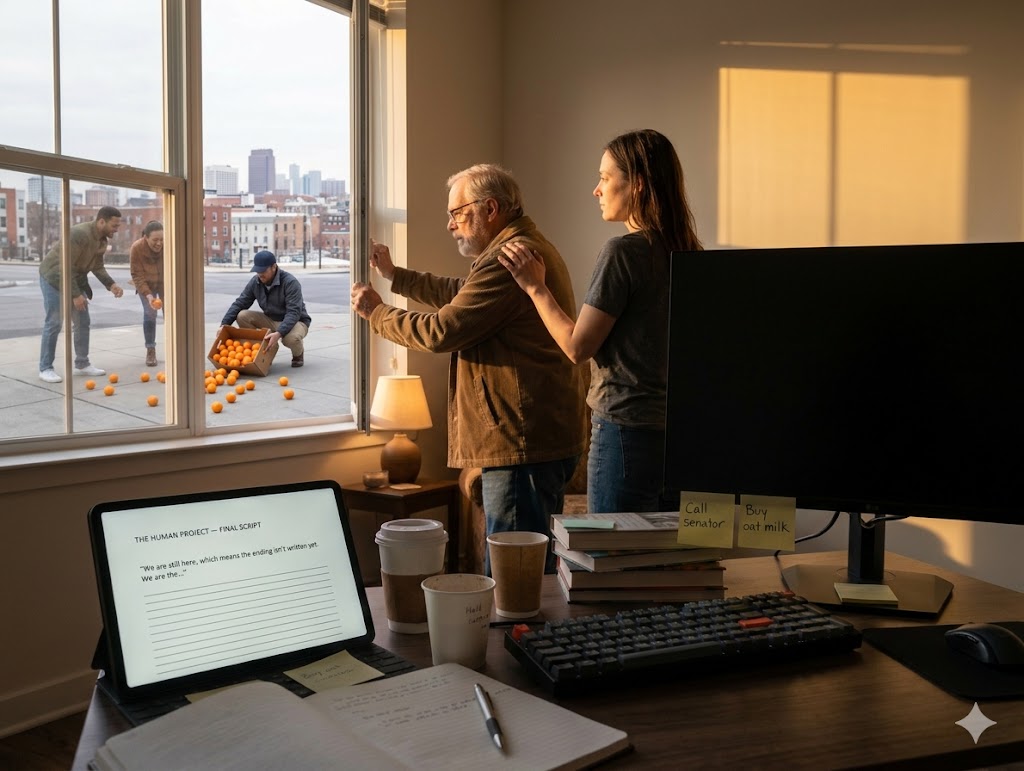
The sun is fully up now, casting long columns of dusty gold across the floor. May sits back. The timeline is still messy. The script ends mid-page. The last line she typed is:
“We are still here, which means the ending isn’t written yet. We are the...”
The sentence hangs there. An unfinished thought. A bridge built halfway across a canyon.
Leo wakes up with a little start. He blinks against the morning sun, adjusts his glasses, and looks over at her.
LEO Did you finish it?
MAY No.
LEO Are you going to send it anyway?
MAY I think I have to. If I wait until I know the answer, the file will just sit here until the hard drive dies.
Leo gets up, walks over to the window, and pushes it open. The sounds of the city flood the room—a distant siren, a car alarm, a delivery truck hiss, a neighbor yelling at a dog, someone laughing on the sidewalk. It is chaotic, stressful, terrifying, and completely, undeniably alive.
LEO Come look at this, May.
May gets up from her chair. Her joints pop. She walks to the window and stands beside him.
Down on the street, a delivery driver has dropped a box of oranges. They are rolling everywhere—bright orange spheres against the grey concrete. Two people waiting for the bus immediately drop their bags and start chasing the fruit, gathering them up in their shirts, laughing as they hand them back to the driver. One orange rolls into the gutter, lost. But twenty are saved.
May looks at the scene. She looks back at her computer monitor, where the cursor is still blinking at the end of her broken sentence. She doesn't go back to fix it. She just stands by the window, her hand resting on her grandfather’s shoulder, breathing the cold morning air, participating in the confusion of being alive.
The world right now is completely overwhelming, and it makes total sense that you feel paralyzed by the sheer volume of unrest and noise. It is okay not to have the blueprint for fixing humanity; sometimes, just witnessing the reality honestly without pretending to have the answers is the most profound action we can take.
TO BE CONTINUED...
I'm writing this story to mimic our reality. I've written it in a storyboard format with SCENES, as it will ultimately become a video I create on Pictory. Just like May is struggling to find the answer to her story, I too am wrestling with a final direction to take this story. Below are my ideas that I've been brainstorming to ultimately deliver the message that I'm emotionally searching for.
• Do I further develop the relationship between May and Leo to further to anchor the emotion of May relying on the wisdom of Leo try and make sense of what she can't make sense of?
• Should I focus on specific real-world imagery from this year that I can create metaphors of that will then be reflected in May's video timeline in the story?
• Or should I continue with the unfinished piece that May is working on, to use it as a metaphor for real life?
This poignant allegory captures the modern crisis of compassion fatigue and existential paralysis through the quiet intimacy of May’s apartment. May, drowning in a relentless 24-hour stream of sociopolitical catastrophes, represents a society completely overwhelmed by "permanent emergency." Her struggle to write a manifesto—or find a cohesive narrative arc—mirrors our own collective inability to orchestrate a clean, happy ending in a world fractured by algorithmic noise and deep institutional distrust. When the choice feels like picking between a slow leak and a sudden explosion, the natural instinct is to surrender to apathy, numbing ourselves just to survive the chaos.
However, the heart of the story lies in Leo’s grounding wisdom. By reminding May that "confusion is an honest response to an dishonest time," he shifts the burden from carrying the entire world to focusing on immediate, localized reality. The closing image of the spilled oranges serves as a vital metaphor: while grand political systems grind to a halt and people feel tempted to give up, individual human empathy remains reflexively alive. We inspire cooperation not through sweeping global grandiosity, but through the small, unglamorous acts of bending down together to gather what has fallen into the gutter.
With this altruistic ideal, the story may not have a happy ending but, rather a happy interlude where we work on bending down together to gather what has fallen in this new chaotic world.
About the Creator
Meko James
"We praise our leaders through echo chambers"
Enjoyed the story? Support the Creator.
Subscribe for free to receive all their stories in your feed. You could also become a paid subscriber, letting them know you appreciate their work.
Comments
There are no comments for this story
Be the first to respond and start the conversation.