
When Justice Becomes a Spectacle:
America’s Return to Public Execution

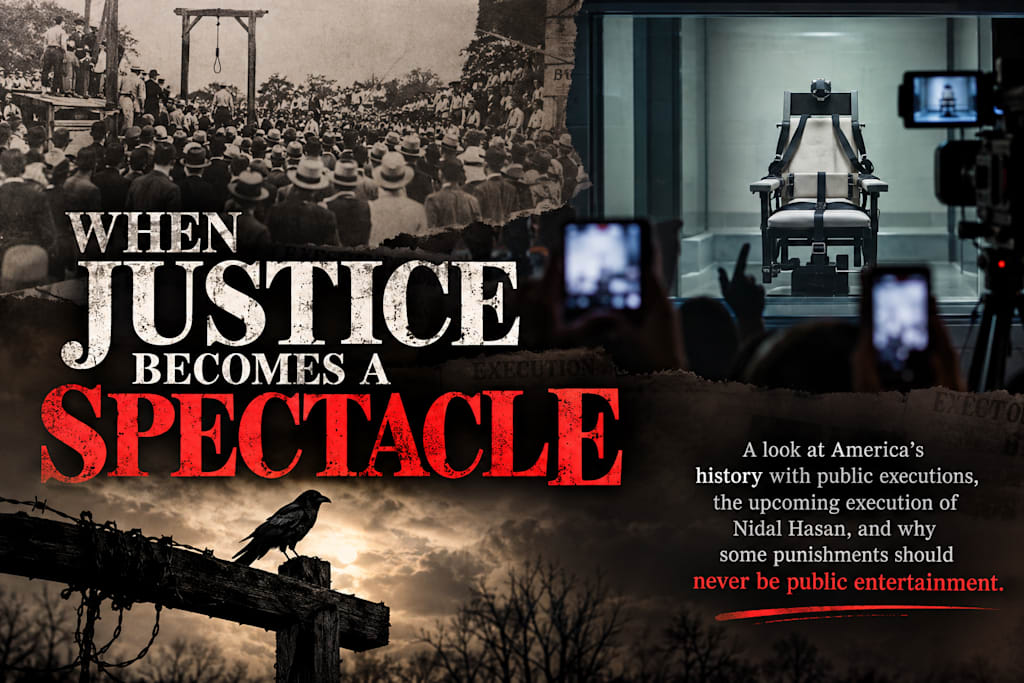
When Justice Becomes a Spectacle: America’s Return to Public Execution
We can believe in consequences for horrific crimes without turning death into a public performance.
There is something deeply disturbing about the idea that thousands of people might gather around their screens to watch the government execute a man.
Not because I believe every murderer deserves to live. Not because I dismiss the suffering of victims or the families whose lives have been shattered by violence. And not because I believe justice should come without consequences.
My objection is much more specific.
I do not believe an execution should become entertainment.
Yet that is precisely the direction America appears to be heading.
On December 3, 2026, the United States military has scheduled the execution of Nidal Malik Hasan, the former Army psychiatrist convicted of carrying out the 2009 Fort Hood mass shooting. The Trump administration has approved a firing squad, and Defense Secretary Pete Hegseth has announced plans to livestream the execution so the public can watch.
The stated justification is that people need to understand there are serious consequences for such crimes.
But I have a question.
Since when did demonstrating the consequences of violence require us to turn someone's death into a public event?
The Man at the Center of This Controversy
On November 5, 2009, Hasan opened fire inside the Soldier Readiness Processing Center at Fort Hood, Texas. Thirteen people were killed, and more than 30 others were wounded.
The victims included soldiers preparing for deployment and others serving their country. Their families were left to endure a kind of loss that no sentence, apology, or court proceeding could ever fully repair.
Hasan, an Army major and psychiatrist, was himself wounded by responding officers during the attack and left partially paralyzed. In 2013, a military jury convicted him of 13 counts of premeditated murder and 32 counts of attempted murder. He was sentenced to death.
The attack was devastating. The conviction was the result of a military trial. The sentence was severe, and the coming execution is intended to carry it out.
We do not need to minimize any of that to question what happens next.
Because the debate is no longer simply about whether Hasan should face the punishment imposed by the court. It is about whether the government should broadcast his death as a lesson to the public.
Those are two different questions, and they deserve to be treated that way.
We Have Been Down This Road Before
Public executions are not some new invention. They are a grim part of our history.
For centuries, executions in America were public events. Crowds gathered around gallows to watch condemned prisoners die. Officials often presented these events as warnings against crime, opportunities for religious instruction, and demonstrations of the state's authority.
The theory was straightforward: Let people witness the consequences, and perhaps they will be frightened into obedience.
Reality was considerably messier.
Executions could become spectacles filled with crowds, drinking, cheering, vendors, and celebrations. People sometimes traveled long distances to attend. The condemned person's death could become the day's entertainment rather than a solemn acknowledgment of a human life being taken.
One of America's most infamous examples was the 1936 public hanging of Rainey Bethea in Owensboro, Kentucky. Bethea, a Black man convicted of raping a white woman, was executed before a crowd estimated at thousands. The event attracted enormous public attention, commercial activity, and carnival-like behavior.
It is generally regarded as the last public execution in the United States, although another public hanging followed in Missouri the next year.
The practice did not disappear because America suddenly agreed on the morality of capital punishment. Public executions were increasingly moved behind prison walls because of concerns about disorder, spectacle, and the failure of these events to produce the orderly moral lessons officials claimed to want.
We gradually drew a boundary between punishment and entertainment.
Now, nearly a century later, we are discussing whether to erase it.
What Exactly Are We Teaching People?
I understand the argument that public executions might deter crime. I understand the desire to demonstrate that certain actions carry consequences that cannot be escaped.
But what message does a livestreamed execution actually send?
Does it teach respect for human life?
Does it encourage compassion for victims?
Does it help us understand the devastation caused by violence?
Or does it teach us that death becomes acceptable entertainment when the person dying has done something terrible enough?
I worry about the last possibility.
We live in a culture where tragedy is already packaged for consumption. Real suffering becomes breaking news, viral footage, reaction videos, memes, and online arguments. People watch horrific events from the safety of their homes, separated from the human reality by a screen.
A public execution takes that detachment one step further.
It invites us to witness a killing without having to confront its physical reality. We can watch, comment, argue, eat dinner, and scroll to the next video.
We can turn death into content.
And if we are going to use the language of consequences, we should consider the consequences of teaching an entire audience to treat state-sanctioned killing as a viewing event.
The Party Around the Punishment
One of the most troubling aspects of America's history with public executions is how easily they became social occasions.
People gathered. They drank. They celebrated. They treated the death of another human being as an event worth attending.
I am not suggesting that everyone who supports Hasan's execution intends to celebrate it. Nor am I suggesting that the grief and anger of the Fort Hood victims' families are somehow inappropriate.
Their pain deserves to be heard. Their loved ones deserve to be remembered. Their suffering should never be reduced to a debate about the condemned man's fate.
But there is a difference between gathering to honor victims and gathering to watch someone die.
There is a difference between demanding accountability and anticipating a spectacle.
When the government deliberately makes an execution available for public viewing, it creates the conditions for both solemn reflection and casual consumption. We cannot control how millions of people will respond once death becomes a broadcast.
Some will watch because they believe it represents justice. Some will watch out of curiosity. Some will watch because they want to see violence.
And some will inevitably treat it as entertainment.
That possibility should trouble us regardless of how we feel about the man on the screen.
There Is Nothing Modern About This
We like to think of ourselves as a society that has learned from history. We have moved many punishments out of public view because we recognize that the state can exercise authority without turning suffering into a performance.
Privacy does not mean pretending executions never happen. It does not mean concealing the existence of capital punishment or preventing the public from debating whether it is justified.
The public can examine court records. Journalists can report on the process. Officials can explain the sentence. Citizens can challenge the law, defend it, or demand changes to it.
Accountability does not require a front-row seat to someone's death.
And if the purpose is to make people understand that murder is devastating, we already have more than enough evidence of that. We have grieving parents, widows, widowers, children growing up without their loved ones, survivors carrying physical and psychological injuries, and communities forever changed by violence.
We do not need to manufacture another spectacle to prove that killing has consequences.
There is also a question of trauma. Publicly displaying a violent death risks exposing viewers, including people who never intended to see graphic material, to something deeply distressing. For survivors of violence and the families of victims, the broadcast could reopen wounds that have never properly healed.
A warning can become a wound of its own.
I Am Not Asking Anyone to Forget the Victims
Let me make this clear, because nuance often gets lost in arguments about crime and punishment.
I am not defending Hasan's actions. I am not minimizing the 13 people who died at Fort Hood or the many others who were injured. I am not asking the public to excuse what happened or pretend the consequences should be insignificant.
My argument is not about whether the victims mattered.
It is about whether their suffering should be used to justify turning an execution into a public spectacle.
We can remember the victims without celebrating a death. We can acknowledge the gravity of a crime without encouraging people to watch another human being die. We can believe in severe punishment while insisting that the state exercise that power with restraint and dignity.
Even people who support capital punishment should be able to ask what purpose a public broadcast serves beyond making the punishment visible.
If the answer is deterrence, then the claim deserves serious scrutiny. The existence of the death penalty has not established that broadcasting executions would make people less likely to commit murder. The certainty of being caught, the circumstances surrounding violent crime, and many other factors complicate any simple promise that a more visible punishment will make society safer.
A spectacle is not automatically a solution.
And brutality does not become wisdom simply because it is performed in the name of justice.
Justice Should Not Need an Audience
There is a reason public executions increasingly became a thing of the past. Their disappearance reflected a recognition that punishment and public entertainment are not the same thing.
We should be cautious about reversing that distinction.
When a government deliberately invites the public to watch a person die, it is doing more than carrying out a sentence. It is making a statement about what it believes the public should see, what it believes the public should learn, and how it believes the public should respond to violence.
I do not want a society that measures the seriousness of justice by how many people can watch someone die.
I do not want children stumbling across footage of an execution because it has become a major public broadcast.
I do not want the deaths of victims to become the justification for an event that encourages people to gather around a screen and anticipate another death.
And I do not want us to mistake the public display of power for proof of moral progress.
There is nothing weak about refusing to turn death into entertainment. There is nothing soft about insisting that even the most severe punishments should be carried out without the trappings of a public show.
We can take murder seriously. We can take victims seriously. We can take accountability seriously.
We can even disagree passionately about capital punishment itself.
But we should be able to agree that a government's power to take a life does not automatically give it a good reason to broadcast that death for an audience.
I am not arguing that executions should become invisible because we are ashamed to discuss them. I am arguing that they should not become visible because we are eager to watch.
Justice is supposed to be about the consequences of wrongdoing, not the entertainment value of suffering.
We have spent generations moving away from the gallows as a gathering place. Returning to that mindset, even through a screen, raises an uncomfortable question about how much progress we have actually made.
If our lesson is that killing is wrong, why are we turning a killing into an event?
And if the answer is that this particular death is justified, then we need to ask ourselves something even more uncomfortable:
When did justice stop being enough, and when did we decide we needed a show?
About the Creator
Lilithea Adasia
I dig where others look away. 🖤 True crime, paranormal mysteries, uncomfortable truths, and the beautifully broken human experience. I chase the stories others bury and ask the questions others avoid. Come curious. Leave questioning.
Enjoyed the story? Support the Creator.
Subscribe for free to receive all their stories in your feed.
Comments