
We Will Ask the Void Forever: Reflections on Death Scenes
Jack Huddleston, L.A.P.D., Sean Tejaratchi, and Katherine Dunn

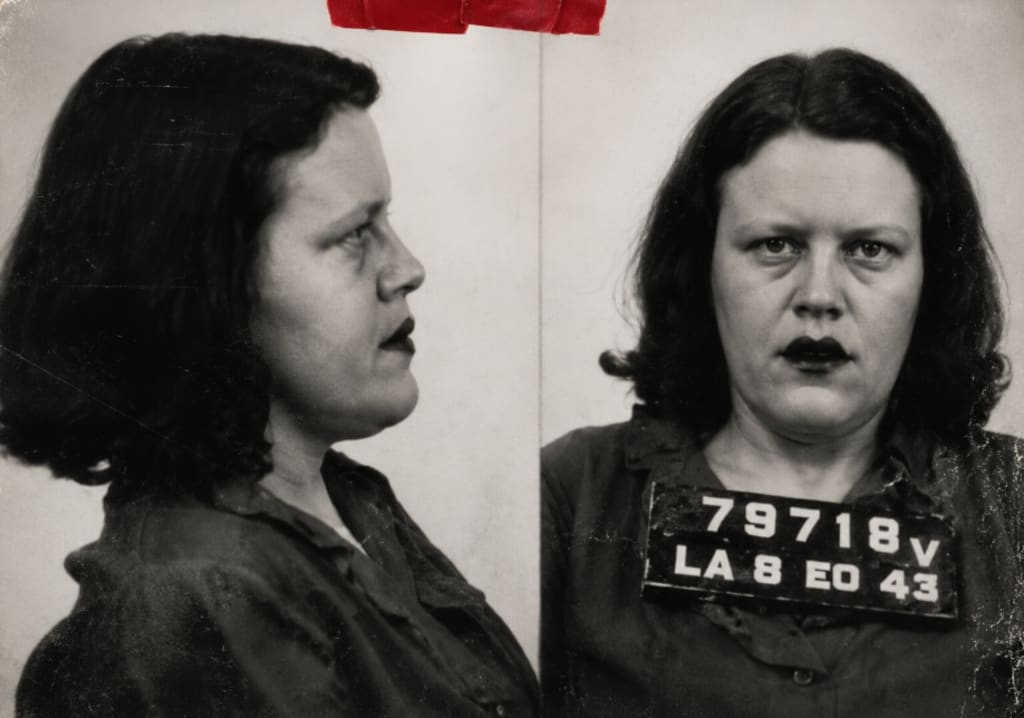
Note: I obviously can't post images from the book Death Scenes here, for various reasons. The above image is an AI knock-off. If you want to view Death Scenes, you can still obtain a copy. Original editions are expensive of course; this is a rare, and hideous beast. Also, Nick Bougas created the video documentary Death Scenes, narrated by Anton LaVey, which is based on the book. Be forewarned: NO CHILD or sensitive adult should be exposed to this material, nor is any of it suitable for work.
A man lies nude in his hotel room. Suicide. Discovered by the maid. He died a lonely, forgotten death. What were his final thoughts?
"Death endeth all for every man, for every 'son of thunder'".
Human beings take themselves far, far too seriously.
Actually, they value themselves so highly they immerse themselves in a "real world" that can and will, quite literally, vanish into the black in the twinkling of an eye.
One might smile at their self-deluded state of beingness. Nothing has any permanence, not even the assurance of another day, or another moment. Instantly, the respiration stops, the heart ceases to function, and a veil of darkness is thrust upon you, and that is the brutal finality of human existence. (And if you want to really go out on a philosophic limb, take on the idea that everything, every sight, sound, smell, sensation, what-have-you, is experienced solely by YOU and none of the other incarnate beings you assume are really anything more than simple walking phantasms of your own mind--they call it the "solipsist" argument; i.e., what can constitute "reality" when all experience is filtered through one consciousness; i.e., we're all, essentially, "alone in our own skulls.")
Death Scenes is a forgotten scrapbook of L.A. homicide photos collected by a detective named Jack Huddleston, who was a veteran officer employed from the 1930s to the early Fifties or thereabouts, and who obsessively and methodically saved and pasted the grisly photos into his own private scrapbook, curating his own collection of images so hideous they sometimes boggle the mind.
A moralizing and editorializing master collector, his photos do not always simply linger over the twisted outcome of human passion and the desire for violent revenge; some document the sickening result of obscure disease, hydrophobia (rabies), immense swollen genitals, filthy beggars that literally died from being dirty.
Old-time criminals and short cons, tattooed miscreants, drunken vagrants that died in alleyways and doorways, attracting swarms of blue bottle flies and emitting the noxious stink of putrescent flesh, rotting in the hot California sun. Petty larceny, exposing themselves; one man had his pants cut out in the front or back. Flashed himself to all takers, one supposes, for profit. A drunken sailor with a body adorned in pornographic tattoos (which might not bat an eyelash nearly a hundred years later) --and then the violent fights, knives sticking out of heads, the aftermath of brawls paying testament to the animalistic, beast nature of Man (non-generative), the deadliest hirsute beast ever to walk upright on two legs.
Two kids find a stack of dynamite under a bridge. Handling it, it explodes in their hands. The boy and girl are now lumps of putrid flesh, like sacks of raw, blistered meat spilling out of their clothing. Caught in an act of play eternally, the girl looks serene, almost. Never another birthday.
A man whose car was overturned on a deserted California road. His severed head is seemingly emerging from the compacted dirt of the road, as if his body were immersed beneath the earth. Behind him, his body lies chest-down on the earth. Huddleston, Jack, has made an annotation in the margins here, something to the effect that you can see an image of the screaming head in the glistening wet flesh of the neck. Officer Huddleston apparently loved his Ripley's.
A woman named Kay Pengra (that name sticks out sufficiently in our mind to note), murdered by her husband, and then laid out with a jade amulet on her chest, looking as beautiful as if she were simply sleeping, waiting for the day of resurrection.
Mug shots. One of them a prostitute named Eve "Chuckie" Dasparro. Later we will see Chuckie in her final, grim repose, laid out and splayed out on a lawn, killed by a client. Did this one get a lifer at San Quentin?
Steve the Killer (Huddleston notes, in the margins, a "Jack the Ripper") is pictured, looking like any other common jerk. His victim is a huge, centerpiece crime scene photo of butchered rage made manifest, a hunk of human beef where only the leg and torso are identifiable remains. Steve-o died in the gas chamber at San Quentin. (And Huddleston offers us a pic of the same chamber.)
The mug shots remind us, "These portraits are NOT by Rembrandt," and reflect the sociological sludge of the era: hookers, pimps, forgers, drunks, carrying concealed weapons; bunco. Huddleston notes, in wildly politically incorrect fashion but reflecting his era, "lesbians." He annotates with his own prejudices, "Stink Bombs."
One boy lying forevermore fifteen, a gun fallen from his right hand. Self-inflicted. Huddleston notes, "He died of a broken home, and a broken heart."
People hang from the rafters, their tongues lolling out from the ends of nooses. "Having a little throat trouble." Ol' Jack sure was one for grim humor.
Otto Sanhuber, the "Phantom of the Attic" murderer, who lived in his lover's upstairs attic for FOUR YEARS, emerging only when her abusive husband threatened to kill her. Dispatching the man, he later escaped punishment. He looked like a common desk clerk.
Betty Short, "Black Dahlia," an eternal grim smile carved across her face as she lies like the mannequin a little girl and her mother initially thought her to be--bisected savagely, tortured, mutilated, and then cleaned, her hair carefully washed. Perpetrator unknown. Was it the Cleveland Torso Killer come to L.A.? Betty, like the five canonical victims of Gentle Jack, was sold to history and crime buffs for cheap thrills.
Infants laid up on countertops...and I could go on and on with the grim retinue, the diabolical roll call. But is it so? Or is it simply the natural order of disorder, the unraveling of the illusion of life, the tableaux of our own imposed meaning ripped as violently away as a slice of hanging, glistening wet skin. What lies beneath the surface of our minutes, hours, days? A young couple, facing the world of 1943 boldly; the young man quite fashionable, his girlfriend undoubtedly conventionally pretty. He comes home, exhausted from a day of hustling money. Something breaks, something snaps in the Divine and Moral Order of the universe. He kills her, blows her away; then turns the gun on himself. His face had disappeared in the bloody, fresh flesh of his black tears.
What? What? What is the meaning of such things? That life was a ticking, momentary perturbation, before. These are not staged scenes; these corpses had their lives that unspooled in the hours leading up to that grim, final moment. I discovered Death Scenes in 1999, at the Bracken Library on the Ball State campus. It was a doorway to Hell, a grim gateway to the final moments when we become unalive, and cross over, in those "Last Seconds of Life" (to borrow the title from an old mondo documentary film), into being one of those stiff, waxen, immobile, decaying, and strange alien "things" that we both revere and fear in equal measure.
But what of the hours and the minutes of each of these seemingly posed cadavers? They lived and breathed for one moment in the sun. Just as suddenly gone? What does it all mean? What? What?
We are searching for the answer to a question we cannot properly even define. Because the world is a dream, and life is a ghost. And death is eternally the final, culminating, captured scene in the sad, meaningless, soon-forgotten drama in which we all star.
Shoveled over. Forgotten. Buried. "Ashes to ashes..."
Soon replaced.
What does it mean?
We will ask the Void forever.
...Amen.
About the Creator
Tom Baker
Author of Haunted Indianapolis, Indiana Ghost Folklore, Midwest Maniacs, Midwest UFOs and Beyond, Scary Urban Legends, 50 Famous Fables and Folk Tales, and Notorious Crimes of the Upper Midwest.: http://tombakerbooks.weebly.com
Enjoyed the story? Support the Creator.
Subscribe for free to receive all their stories in your feed. You could also become a paid subscriber, letting them know you appreciate their work.
Comments
There are no comments for this story
Be the first to respond and start the conversation.