
Three Meetings, One Gamble: The Warning Myanmar’s Four Great Families Ignored
Chinese officials told them three times to shut down the scam parks. They looked at each other, ran the numbers, and waited to see who would blink first.
Three Meetings, One Gamble
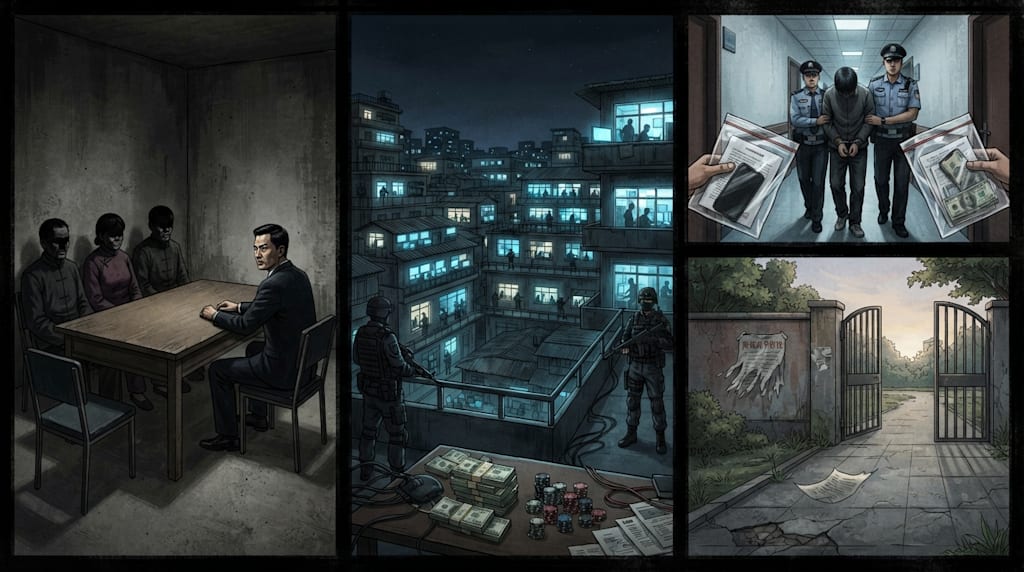
In 2023, in Kokang, northern Myanmar, in a small room on one side of the border, a Chinese working group sat across from representatives of Kokang’s “Four Great Families” for the third time. No documents on the table. No tea. The Chinese official repeated the same sentence: eliminate the fraud, unconditionally. Members of the Bai Suocheng family, the Wei Chaoren family, the Liu Zhengxiang family, and the Liu Guoxi family were all there. Ming Xuechang said: “If we don’t do it, we won’t have anything to eat. If we don’t do it, what are we going to eat?” The meeting ended. Everyone went back. The parks opened as usual. The sound of keyboards continued until dawn.
Three meetings. Very little effect.
Before his execution, Bai Yingcang said: “I didn’t know until September 2023 that China was really serious. It was because Chinese officials came to the border to meet with us and told us we must eliminate the fraud, unconditionally eliminate it. We also held three meetings.” Then he added: “At first we thought we’d see what the other families did. If the others handed people over, we’d hand people over. If the others didn’t, we wouldn’t either.”
They understood the warning. They did the math. They chose to gamble.
1. If we don’t do fraud, what do we eat?
Bai Yingcang once served as commander of the Kokang Autonomous Zone militia brigade and deputy director of the Finance Bureau. He led the establishment of multiple telecom fraud parks. The Bai family criminal group developed and built 41 large gambling and fraud parks. The task force later determined that the Bai family was involved in more than 31,000 fraud cases, with more than 10.6 billion yuan in fraud funds, more than 18 billion yuan in gambling funds, and about 11 tons of drugs manufactured and sold.
The Bai family led the creation of a so-called “Entertainment Management Committee,” issuing unified promotion permits to gambling and fraud parks, collecting rent, headcount fees, and security fees. Inside the parks, keyboards clattered from morning to night. When a financier came in, he first paid money, then received a permit, then recruited people. Bai Yingcang said: “The temptation of fraud, I feel, is too great. Very few people can control it. A random capital pool can bring in over a billion or two billion.”
The Wei family took another path. Wei Huiren controlled a border defense battalion and had 2,000 armed men. The Wei family was the first to “create” a model of armed violent control over fraud parks. On the surface, they received government salaries and guarded the border. Privately, they used state machinery to protect family interests. The Wei family was deeply involved in running fraud groups, binding together border defense troops and private armed forces to protect the parks.
Ming Xuechang was describing the local economy. Fraud and related black and gray industries supported the economic lifeline of local forces in northern Myanmar at the time. Bai Yingcang said: “These abnormal industries are supporting the entire economy of northern Myanmar. This generation is doing it, and the next generation follows in the previous generation’s footsteps, so more and more people are doing it, and they get bolder and bolder.” He also described a kind of culture: “If you don’t do fraud, it means you have nothing to do.”
Eliminating fraud meant making this economic chain go to zero overnight. The Four Great Families were unwilling.
2. If you don’t hand them over, we won’t either
The Chinese working group met them three times. The Four Great Families went back and held meetings three times. The meetings ended. The parks continued as before.
In Bai Yingcang’s account, their strategy was hidden in plain sight: watch what the other families do. If the others handed people over, they would hand people over. If the others did not, they would not either. The Four Great Families each acted for themselves, but under external pressure they formed a kind of tacit agreement. No one wanted to move first. No one wanted to bear the loss first.
First, they bet that China would continue to show restraint. Until then, China had been talking, urging, persuading. The Four Great Families were used to surviving by “playing the edge” in the borderlands. China’s restraint looked to them like room to maneuver.
Second, they bet that the Four Great Families could stand together against pressure. As long as all four acted in unison, China would find it hard to break them one by one.
Third, they bet that fraud was already embedded in the local web of interests. One move would affect the whole body. If China truly wanted to eliminate it completely, it would inevitably touch the complex network of local armed forces, economics, and politics, and might not pursue it all the way.
One thing went unconsidered: the word “unconditional” left no room to negotiate. The Four Great Families treated an ultimatum as an opening bid.
3. Guns and bullet holes in a skull
The Four Great Families’ confidence came from the guns in their hands.
Wei Huiren’s nephew, Chen Dawei, was groomed as a key second-generation family member. Before his arrest, Wei Huiren had almost completed Chen Dawei’s “political paving.” Chen Dawei became sworn brothers with a financier and needed a loyalty pledge. A task force police officer asked: “Why kill someone as a sacrifice to heaven for a sworn brotherhood?” Chen Dawei answered: “To make a loyalty pledge. It’s quite unique.” The officer asked: “How did you choose the target?” Chen Dawei said: “I told my men to find a stranger. Anywhere.”
The unfortunate “stranger” chosen was being held in a dark room because he had refused to obey the park’s discipline. He was randomly pushed by Chen Dawei onto the so-called “sacrificial platform.” From one darkness, he fell into another.
Because of a dispute with a financier from another family’s park, Chen Dawei had long been resentful. In the second half of 2022, a guard captain under Chen Dawei caught one of that financier’s subordinates on the street and brought him back to the security team for detention. A month later, Chen Dawei ordered his men to take the victim, who refused to bow his head, directly to the execution site.
Huang Yuanfeng, head of the Criminal Investigation Brigade of Nan’an Public Security Bureau in Quanzhou, Fujian Province, said: “The victim’s skull had seven bullet holes. He was kneeling, face down, hands tied behind his back. The scene was indescribable. It was simply death by a hail of bullets.”
On August 5, 2023, more than 20 Chinese fraud workers, unable to endure the violent control, tried to escape together. Myanmar armed personnel from the park intercepted them and opened fire on the fleeing crowd with AK-47s on automatic. Six died, eight were injured. A task force police officer said: “Some of the fraud workers’ bodies were broken apart. They treated Chinese fraud workers like they were not human. Kill when they say kill, bury when they say bury.”
On October 20, 2023, a shooting occurred in the old streets of Kokang. The Ming family criminal group, long entrenched there, together with fraud group “financiers,” organized armed forces to transfer Chinese fraud suspects in batches. The escaping workers were intercepted and shot at. This case became the turning point of the entire operation.
4. Cannot go out, cannot strike, cannot bring them back
In the early stage of the operation, Chinese law enforcement faced obstacles that were almost impossible to overcome.
Zhang Jun, then director of the Telecom and Online Fraud Investigation Division of the Criminal Investigation Bureau of the Ministry of Public Security, said: “As police officers handling cases, we had no way to go out and enforce the law… The result was a dead knot: cannot go out, cannot strike, cannot bring them back.”
Zhao Nanfang, then head of the Criminal Investigation Corps of the Yunnan Provincial Public Security Department, described it more concretely: “We Yunnan police stood right on the border. We could see the fraud crimes, but could not reach them. We could look but not obtain. We could not even reach out to grab them.”
The national border formed a natural barrier. The two countries’ different legal systems and judicial rules built layer upon layer of walls. The Four Great Families knew this well. Border junction areas are weak points of governance, and ideal hiding places.
They were betting on that line.
5. Ten minutes
After the October 20 shooting, the forward command decided to abandon negotiation and open the way with force.
If we cannot go out to fight, we arrest them inside our borders.
On the evening of September 26, 2023, public security organs successfully arrested Bao Junfeng, deputy commander of the United Wa State Army, and members of his group in Kunming. In the early hours of October 1 of the same year, when important members of the “Four Great Families,” including Wei Qingtao and Liu Zhengqi, entered Chinese territory, the special action team closed the net. The entire process lasted only ten minutes.
Those ten minutes broke the pattern. Chinese police had been unable to reach across the border. Now key figures were in custody on Chinese soil.
Using the October 20 shooting as a breakthrough, Chinese and Myanmar police established a joint investigation team. For the first time, Chinese police were permitted to enter fraud parks in Kokang, northern Myanmar, to conduct on-site inspections. As fighting continued in Kokang, task force police risked fighter jets passing overhead and searched abandoned farms and burial sites for the bodies of Chinese citizens.
Chen Chen, director of the Telecom and Online Fraud Investigation Division of the Criminal Investigation Bureau of the Ministry of Public Security, said: “We organized five forward investigative trips. I remember on the first forward trip, we found several bodies. At that time, we were not sure whether the bodies could be brought back. Everyone used the most primitive methods to protect the bodies and collect DNA evidence, so that there would be enough evidence to prove that these homicides had occurred.”
Qiu Xin, then head of the Criminal Investigation Detachment of the Quanzhou Public Security Bureau in Fujian Province, said: “We not only excavated the remains from the two homicide cases we wanted, but also excavated two more. DNA identification confirmed they were also Chinese remains, also buried in their original state, also with postural characteristics of brutal violence. Chinese people were killed, buried, and burned on the territory of Lao Cai. The goal of obtaining this evidence is to build an ironclad case. A blood debt must be paid in blood.”
Biological samples, bullets, and blood samples were transported back to China one by one.
6. Handover
On January 30, 2024, Myanmar police handed over to Chinese public security organs six important leaders of the Kokang telecom fraud criminal groups: Bai Suocheng, Bai Yingcang, Wei Huiren, Liu Zhengxiang, Liu Zhengmao, and Xu Laofa, along with four other major criminal suspects.
Through police law enforcement cooperation and a series of crackdown operations, China and Myanmar arrested more than 57,000 Chinese fraud suspects. The “Four Great Families” criminal groups in Kokang, northern Myanmar, lost their leaders, their parks, and their protection.
On February 2, 2026, Bai Yingcang was executed according to law.
Before his execution, Bai Yingcang said: “I want to apologize, on behalf of my whole family, to the Chinese people and the Chinese government. Because our family’s actions caused harm to tens of thousands of Chinese people. I am truly sorry.”
Bailiffs took him away. The door closed.
In the old streets of Kokang, the iron gate of a park was half open. A promotion permit on the wall had been torn in half. Wind blew a piece of paper to the roadside. The sound of keyboards had stopped.
About the Creator
Jin
Writer of reamstories
https://reamstories.com/jin
Enjoyed the story? Support the Creator.
Subscribe for free to receive all their stories in your feed. You could also become a paid subscriber, letting them know you appreciate their work.
Comments
There are no comments for this story
Be the first to respond and start the conversation.