
They Buried the Bodies. Then They Rebuilt the Scam Compounds.
A new documentary exposes the arrests, the executions, and the satellite images that show Myanmar’s fraud empire never really left.
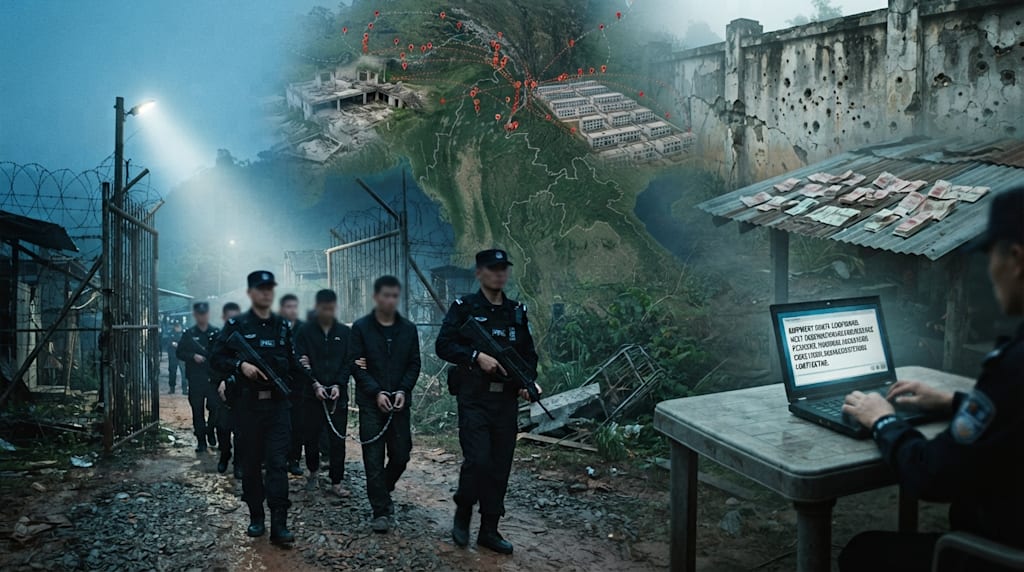
On the evening of October 5, 2026, the three-part documentary The Downfall of Northern Myanmar’s Telecom Fraud Empire premiered on CCTV’s main channel. The Ministry of Public Security and China Media Group co-produced it. The team spent 10 months filming in 10 Chinese provinces, 18 cities, and Kokang in northern Myanmar.
When the documentary aired, satellite images were already circulating online. In the Thitkate area on the outskirts of Myawaddy, the land was empty in June 2026. By August, rows of buildings stood there. More than 9,300 recruitment advertisements for telecom fraud had appeared on overseas social platforms. Of those, 83.7% explicitly targeted American victims.
The documentary showed the downfall of the “Four Families.” It also showed the fraud industry rebuilding itself.
I
The first images in the documentary came from the scene of a shooting.
On August 5, 2023, more than 20 Chinese nationals fled a scam compound in northern Myanmar. Myanmar armed personnel fired AK-47s at close range. Some had their bodies broken. Six died. Eight were injured.
From January to July 2024, six Myanmar armed personnel who had fired and buried bodies were arrested, along with the compound’s financier, Lin Jian.
Another lead pointed to Wohu Villa, controlled by the Ming Xuechang family in Kokang. On October 20, 2023, the Ming family was moving fraud workers. Some tried to escape. Armed personnel opened fire. Four Chinese citizens died. Four others were injured.
Ming Zhenzhen, a core member of the family, said in the documentary: “Since they were already dead, we arranged for them to be buried.”
After the China-Myanmar joint law enforcement task force was established, Chinese police entered a telecom fraud compound in Kokang for the first time. The task force found the burial site. They dug into the soil and saw three highly decomposed bodies stacked together.
Myanmar initially refused to return the bodies to China. After overnight negotiations by the forward command, the team brought the three bodies back the next day. Forensic examination found that all had died from gunshot wounds. Two still had bullets in their remains.
On November 12, 2023, Chinese police issued wanted notices for Ming Xuechang, Ming Guoping, Ming Julan, and Ming Zhenzhen. Four days later, Ming Guoping, Ming Julan, and Ming Zhenzhen were captured and handed over to China. Ming Xuechang killed himself.
In a hotel near Nansan Port in Lincang, Yunnan, a special operations team moved. Wei Qingtao, Liu Zhengqi, and other important members of the “Four Families” had entered China. The entire arrest lasted 10 minutes.
Earlier, on September 26, 2023, Bao Junfeng was arrested in Kunming. He was deputy commander of the United Wa State Army in northern Myanmar. Police seized jewelry, luxury watches, and cars from his home. Zhang Qingxing, then director of the Lincang Public Security Bureau in Yunnan, said in the film that the arrest “ripped open a hole” in the situation in northern Myanmar.
The documentary also showed an underground execution site inside Wohu Villa. The walls were covered with bullet holes. Police said in the film that to “establish dominance,” guards beat people to death in public. To cover up the killings, they strafed with machine guns or fired more shots.
Tang Moufeng, a repatriated worker, described what happened to him. After poor performance, he was forced to sign an IOU for 70,000 yuan. He was resold among compounds and beaten daily. His wounds rotted so badly that he could not walk. The fraud company then proposed that he sell a kidney to pay off the debt.
II
Fraud compounds survived in northern Myanmar for years because local armed groups protected them.
In Kokang, the “Four Families” criminal groups were led by Bai Suocheng, Ming Xuechang, Wei Huairen, and Liu Zhengxiang. They provided armed protection for telecom fraud. These families spanned the military, political, and business worlds. They controlled Kokang’s mining, real estate, and other profitable industries. The Wei and Liu families brought “financiers” into their fraud compounds by building armed forces. They used force to control low-level fraud workers. The compound financiers and fraud bosses sent illegal profits back to the criminal groups.
In the “Wa State” area, former county head Bao Yanban had so much cash at home that it grew mold. He often dried money on his roof and in his courtyard. A member of his group testified that a guard once stole 10 million yuan and Bao did not know.
This system has deep roots. The Golden Triangle once relied on drugs. After drug crackdowns, it turned to casinos. After casinos were targeted, telecom fraud became the new income source. The local economy feeds on these trades. When one line fails, the next one opens.
Crackdowns are therefore often campaign-style. During concentrated operations, the show of force is large. But operations end. The people running the compounds know the rhythm. You fight your way. I hide my way. When the pressure passes, they return at lower cost and in more concealed forms.
III
By the time the documentary aired, the judicial reckoning for the “Four Families” was nearly complete.
On September 29, 2025, the Wenzhou Intermediate People’s Court in Zhejiang announced the first-instance verdict in the Ming family case. Ming Guoping, Ming Zhenzhen, and 11 others were sentenced to death. Five received a death sentence with a two-year reprieve. Another 11 received life imprisonment. Twelve received fixed-term imprisonment. The court found that since 2015, the Ming family had set up multiple gambling and fraud compounds in Kokang, including Wohu Villa, Louis International, and Yuxiang International Group. The case involved more than 10 billion yuan in gambling and fraud funds and the killing of 14 fraud workers.
In November 2025, the Shenzhen Intermediate People’s Court in Guangdong announced the first-instance verdict in the Bai family case. Bai Suocheng, Bai Yingcang, and five other defendants were sentenced to death. The Bai family’s operation was larger than the Ming family’s. It involved more than 20 billion yuan in gambling and fraud funds. Six Chinese citizens died. Multiple others were injured.
On January 29, 2026, with approval from the Supreme People’s Court, 11 criminals in the Ming family case were executed. All cases involving the “Four Families” in Kokang have entered judicial proceedings. The Ming and Bai cases have completed all trial procedures. Sixteen people have been sentenced to immediate execution. The Wei and Liu family cases have been publicly prosecuted. The procuratorate has filed charges against 109 people from the Wei and Liu families.
IV
The reality at the time of the documentary’s broadcast undercut optimistic expectations.
In early 2025, China, Myanmar, and Thailand set up a ministerial-level coordination mechanism for joint crackdowns on telecom fraud. They carried out concentrated operations in Myawaddy and conducted 10 joint repatriation operations. All 630-plus buildings in KK Park were demolished. By February 2026, the trilateral operation had repatriated more than 1,500 criminal suspects from KK Park. All 77 illegal buildings in Shwe Kokko were demolished by July 26, 2026.
Less than a year later, satellite images showed the same Myawaddy area. The suspected new Thitkate site had gone from empty land to rows of buildings in two months. That was only part of what was visible.
The new compounds differ from the old ones. The old compounds sat on the Thai-Myanmar border. They were large and easy to bomb. The new generation is moving away from the border, deep into the mountains of central Myanmar. Some groups no longer build large buildings. They rent hotels, inns, and small guesthouses. They hide people separately.
Myanmar political analysts said the military government and armed groups that profit from the multibillion-dollar fraud trade are using “show” crackdowns as political cover.
The fraud industry is also changing targets. China has kept up high-pressure crackdowns. Anti-fraud publicity is widespread. Transfers trigger warnings. “Two-card” and card-breaking campaigns have tightened the system. The risk and cost of defrauding Chinese citizens have risen. Fraud groups are looking across the ocean. Of more than 9,300 recruitment ads posted overseas, 83.7% target Americans. The job title is “American chat.” The monthly salary is 20,000 Thai baht. The pig-butchering script used on Chinese victims is being copied in English.
American victims are generally wealthier. The value of a single victim is higher. Payments are in US dollars. After a successful fraud, cryptocurrency makes laundering easier. The United States has offered up to $10 million for ringleaders. Beyond bounties and sanctions, it has no more effective response right now.
V
On November 14, 2025, a ministerial-level meeting on joint crackdowns against telecom and online fraud was held in Kunming, Yunnan. China, Cambodia, Laos, Myanmar, Thailand, and Vietnam took part. China, Myanmar, and Thailand established a trilateral coordination mechanism. Myanmar has repatriated more than 5,500 criminal suspects to China.
On September 10, 2026, the International Alliance for Combating Telecom and Online Fraud was established in Lianyungang, Jiangsu. Representatives from 46 founding countries, 34 observer countries, the United Nations, Interpol, and two other international organizations attended. The Chinese government initiated the organization. It is an intergovernmental platform meant to coordinate law enforcement agencies across countries against transnational telecom and online fraud.
From China-Myanmar bilateral cooperation in 2023, to China-Myanmar-Thailand trilateral coordination, to the 46-country alliance, the cooperation mechanism moved from “point-to-point” to “network coverage” in three years.
VI
At the end of the third episode, the camera returns to northern Myanmar. Weeds have grown on the ruins of a demolished compound.
The camera does not linger.
About the Creator
Jin
Writer of reamstories
https://reamstories.com/jin
Enjoyed the story? Support the Creator.
Subscribe for free to receive all their stories in your feed. You could also become a paid subscriber, letting them know you appreciate their work.
Comments
There are no comments for this story
Be the first to respond and start the conversation.