
The Springfield Three: The Disappearance That Left an Empty House and a Thousand Questions
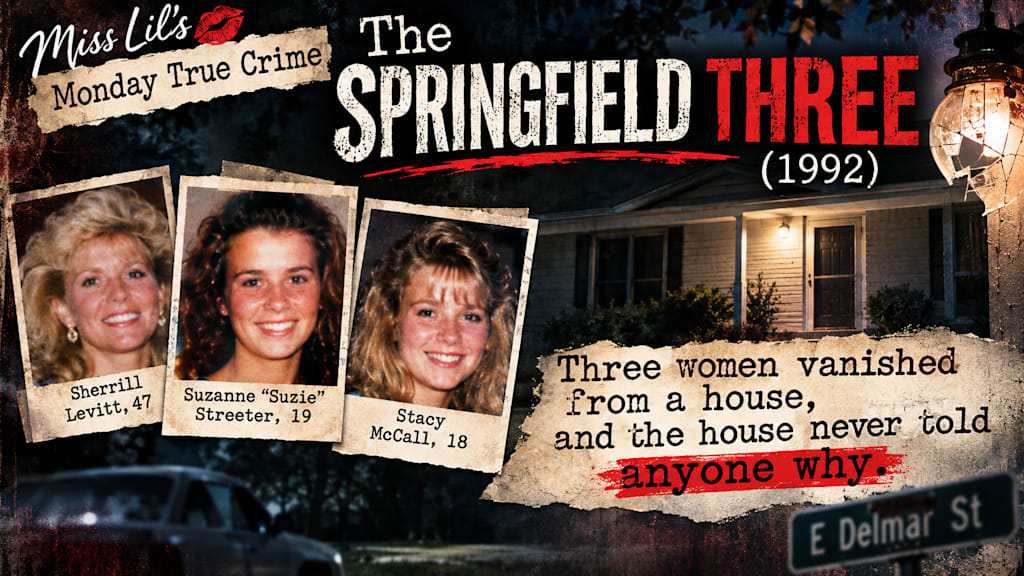
Three women vanished from a Missouri home, and the house never told anyone why.

The Springfield Three: The Disappearance That Left an Empty House and a Thousand Questions
In June 1992, a mother, her daughter, and a young friend disappeared from a Springfield, Missouri, home. Their cars and personal belongings remained behind. More than three decades later, their families are still waiting for answers.
There are mysteries that capture our attention because of what investigators find. A discarded piece of clothing. A vehicle abandoned along a country road. A telephone call that doesn't quite make sense.
Then there are cases like the Springfield Three.
In this case, what stands out isn't what was found. It's what was left behind.
Three women disappeared from a home in Springfield, Missouri, during the early morning hours of June 7, 1992. Their vehicles remained outside. Their personal belongings were still inside. There was no obvious indication of a violent struggle, no clear explanation for their absence, and no confirmed sighting of any of them afterward.
It has been more than three decades.
Three families have spent those years wondering what happened to the people they loved. Investigators have followed leads, conducted searches, and revisited possibilities. Yet Sherrill Levitt, Suzanne Streeter, and Stacy McCall have never been found.
I've covered plenty of unsettling cases at my tea table, but there's something particularly difficult about this one. These women weren't traveling through some remote stretch of wilderness or living under assumed identities. They were at home.
And then they weren't.
So, let's go back to Springfield in the summer of 1992. There are some details worth examining, a few leads that deserve a closer look, and questions that have never received satisfactory answers.
A Graduation Celebration
June 6, 1992, was supposed to be a happy day.
Suzanne "Suzie" Streeter, 19, and her friend Stacy McCall, 18, had graduated from Kickapoo High School. Like countless young people celebrating the end of high school, they spent the evening attending graduation parties and visiting friends.
Suzie lived with her mother, Sherrill Elizabeth Levitt, who was 47 years old. Sherrill was a cosmetologist and had attended her daughter's graduation.
The girls had plans for the following day. They intended to meet up with friends and spend time at White Water, a water park in Branson.
Their overnight arrangements changed during the evening. They had initially planned to stay at the home of their friend Janelle Kirby, but the house was crowded with visiting relatives. Instead, Suzie and Stacy decided to spend the night at Suzie's home on East Delmar Street.
The two young women were last seen leaving a graduation party at approximately 2:00 a.m. on June 7. They were believed to have arrived at Sherrill's home shortly afterward.
Sherrill had spoken with a friend by telephone around 11:15 p.m. the previous evening. Nothing about that conversation suggested that anything was wrong.
It would become the last known contact with her.
There was no reason for anyone to think that morning would be remembered for anything other than a graduation celebration.
Unfortunately, it would become the beginning of a mystery that has outlived an entire generation.
The Morning After
By the following morning, friends were expecting Suzie and Stacy to meet them for their planned outing.
When the girls failed to arrive, Janelle Kirby and her boyfriend, Mike Henson, went to the Delmar Street residence.
What they found was unusual, although it didn't immediately set off the alarm bells one might expect today.
The front door was unlocked. The vehicles belonging to all three women were still at the house. Nobody answered when they called or looked around.
There was also a broken glass globe covering the porch light. The bulb itself was reportedly intact.
Mike swept up the broken glass, apparently not realizing that the small chore might later become significant to an investigation.
The couple entered the home but found no sign of the three women.
There was another unsettling detail. While inside, Janelle received obscene telephone calls from an unidentified male caller. Those calls were later discussed as part of the broader investigation, although there has never been a confirmed connection between them and the disappearances.
At that point, the situation was strange, but the full extent of what had happened wasn't yet understood.
Stacy's mother, Janis McCall, would later visit the home herself after becoming increasingly concerned about her daughter's absence.
She found personal belongings still inside, including the women's purses. The house did not look as though three people had packed their things and departed for an extended trip.
The women were simply missing.
And nobody could explain why.
What Was Left Behind?
This is one of the reasons the Springfield Three case continues to attract attention.
The circumstances inside the home were difficult to reconcile with an ordinary departure.
The women's vehicles remained at the residence. Their purses and other personal belongings were left behind. Sherrill's dog, Cinnamon, was still there.
There was no obvious evidence of a major struggle.
The broken porch light was one of the few physical details that stood out, but investigators could not establish when or why it had been damaged.
Another detail involved the home's answering machine.
Janis McCall encountered a recorded message while looking for her daughter. She described the message as strange, but it was accidentally erased before investigators could preserve or examine it.
What did it say?
Who had left it?
Was it connected to the disappearance, or was it unrelated?
Those questions remain unanswered.
One of the difficulties with the early investigation was that several friends and family members had entered the residence before police could fully secure it as a potential crime scene.
Understandably, people were worried and trying to help. Nobody walking into that house that morning could have known that three women had vanished under circumstances that would remain unexplained for decades.
But the result was that investigators were left with a scene that may already have been disturbed.
It's a reminder of how quickly an ordinary morning can become something else entirely.
Following the Leads
The Springfield Police Department, with assistance from the FBI, Missouri State Highway Patrol, and other agencies, pursued an extensive investigation.
Tips came in from across the country. Searches were conducted, witnesses were interviewed, and investigators explored numerous possibilities.
One lead that repeatedly surfaced involved a green van.
Witnesses reportedly remembered seeing a light moss-green Dodge panel van in the area around the time of the disappearances. Investigators publicized the vehicle description and hoped someone might recognize it.
The van became one of the most discussed elements of the case.
But a vehicle description, even one that attracts considerable attention, isn't proof that the vehicle was involved.
Investigators continued following information connected to the possibility.
In 2002, authorities searched property belonging to a concrete company in Webster County after receiving information about men associated with a green van. Cadaver dogs alerted investigators to several areas, and bones were recovered.
Unfortunately, testing determined that the remains were too old to belong to Sherrill, Suzie, or Stacy.
In April 2003, another tip led investigators to farmland south of Cassville, Missouri. Heavy equipment was used during the search.
Investigators located material that appeared potentially significant, including a section of a green vehicle and possible blood evidence.
The suspected blood was submitted for specialized testing, but the results were inconclusive.
Once again, there was no breakthrough.
The green van remained a lead, not an answer.
And the women were still missing.
A Name That Continued to Surface: Robert Craig Cox
One individual whose name became associated with the investigation was Robert Craig Cox.
Cox had previously been convicted of murder in Florida and had been in Springfield around the time of the women's disappearance. Authorities questioned him, but he was never charged in connection with the Springfield Three.
In 1996, KY3 investigative reporter Dennis Graves traveled to Texas to interview Cox while he was incarcerated.
During the interview, Cox made a particularly unsettling statement. He said he knew the women were dead.
That statement naturally attracted attention.
Graves' interview was later subpoenaed and presented to a grand jury investigating the case. The grand jury did not return charges.
It's important to separate what Cox actually said from what has been suggested about his involvement over the years.
He did not provide a verified explanation of what happened to the women, and his statements did not establish that he was responsible for their disappearance.
There is no conviction connecting him to the case.
Still, his presence in Springfield, his criminal history, and his comments ensured that his name would remain part of the public discussion.
Did he know something?
Was he attempting to insert himself into an investigation that had already attracted considerable attention?
Or was there another explanation?
We don't have the evidence to answer those questions.
And that brings us back to the central frustration of this case: there are leads, statements, and theories, but no definitive explanation.
The Parking Garage Theory
Over the years, another theory attracted attention involving the parking garage at Cox South Hospital in Springfield.
Some people speculated that the women might have been buried beneath the structure.
In 2007, a local writer arranged for ground-penetrating radar to be used at the site. The person operating the equipment reported detecting three distinct objects.
Naturally, this led to renewed speculation.
Three objects beneath a parking garage. Three missing women.
It was an intriguing possibility, but there was no evidence establishing that the objects were human remains.
Police investigated the information and did not consider the theory credible. The garage was not excavated.
It's worth discussing because it illustrates just how difficult this investigation has been. When families have spent years without answers, even the smallest possibility can become a source of hope.
But hope and evidence aren't interchangeable.
The parking garage theory remains unproven, and it should not be presented as an established discovery.
What Happened Inside That House?
This is where I want to slow down a little.
It's tempting to build a theory around every unusual detail in a case like this. A broken light, an unlocked door, an unanswered telephone call, or a suspicious vehicle can become the foundation for an elaborate explanation.
But we need to be careful.
There are several broad possibilities that have been discussed over the years.
Perhaps someone entered the home and took the women against their will. Perhaps the perpetrator was someone they recognized and trusted. It's also possible that one woman was the intended target and the others became involved in whatever happened.
Each possibility raises more questions than it answers.
If someone entered the home, how did they manage to remove three women without leaving behind clearer evidence?
Were all three women taken at the same time?
Did the person responsible know the household's routines?
Was the broken porch light related to the disappearance, or was it simply an unfortunate coincidence?
And what happened to them afterward?
There is also the possibility that some important detail was overlooked during the early investigation. After all, the home was not immediately treated as a secured crime scene, and potential evidence may have been lost.
What I find most difficult is that we don't have enough confirmed information to responsibly settle on one explanation.
We can speculate. We can examine the available evidence. We can question the circumstances.
But we cannot turn a theory into a fact simply because it makes for a compelling story.
Three People, Not Just Three Names
Something that can get lost in the retelling of older cases is the passage of time.
In 1992, Suzie was nineteen. Stacy was eighteen. Sherrill was forty-seven.
Today, the people who were their ages then have grown older. Some have children and grandchildren. Some have retired. A whole generation has come and gone without knowing what happened to these women.
Sherrill was a mother who attended her daughter's graduation.
Suzie and Stacy were young friends celebrating an important milestone in their lives.
They had plans for the next day. They had people waiting for them. They had ordinary responsibilities that suddenly went unfinished.
Their disappearance didn't just leave an empty house. It left families with birthdays, holidays, anniversaries, and years of unanswered questions.
I think that's worth remembering whenever we discuss an unsolved case.
The mystery is important, certainly. But the people at its center are more important.
A Case Still Waiting for an Answer
The Springfield Three remain missing.
The FBI continues to list the case, and the Springfield Police Department continues to seek information.
There has been no confirmed discovery of the women's remains and no conviction connected to their disappearance.
The investigation has endured for decades, but time has not made the questions disappear.
Someone may remember a vehicle they saw that weekend. Someone may have heard something they dismissed at the time. A person who was once afraid to speak may now have information that could help.
Even a detail that seems insignificant could matter.
The official FBI case listing provides information about the three women and directs anyone with relevant information toward law enforcement.
You can find it here: The Springfield Three, FBI Missing Persons.
I keep returning to that ordinary summer morning. Friends were expecting two young women to show up for a day at the water park. A mother was waiting to hear from her daughter. A home stood with its belongings untouched.
And somewhere between the early hours of June 7 and the morning that followed, three lives were interrupted.
We don't know who was responsible. We don't know exactly what happened. We don't know where the women are.
What we do know is that three families have spent decades waiting for answers.
And they deserve them.
Until those answers come, Sherrill Levitt, Suzanne Streeter, and Stacy McCall deserve to be remembered as more than an unsolved mystery.
A Note Before You Go
I've spent quite a bit of time with this case, and I suspect I'll be thinking about it long after I've finished writing.
If you have thoughts about the Springfield Three, I'd genuinely like to hear them. What do you think happened? Is there a lead you believe deserves another look?
You can also find me over in Lily Writes, where we can continue the conversation and explore the cases that keep us asking questions.
Thank you for spending a little of your time at my tea table.
Until next time, keep questioning, keep looking, and never forget the people behind the headlines.
Miss Lil ☕
About the Creator
Lilithea Adasia
I dig where others look away. 🖤 True crime, paranormal mysteries, uncomfortable truths, and the beautifully broken human experience. I chase the stories others bury and ask the questions others avoid. Come curious. Leave questioning.
Enjoyed the story? Support the Creator.
Subscribe for free to receive all their stories in your feed. You could also become a paid subscriber, letting them know you appreciate their work.
Comments
There are no comments for this story
Be the first to respond and start the conversation.
This comment has been deleted