
The Killer Who Left Everything Behind
The Setagaya Family Murders

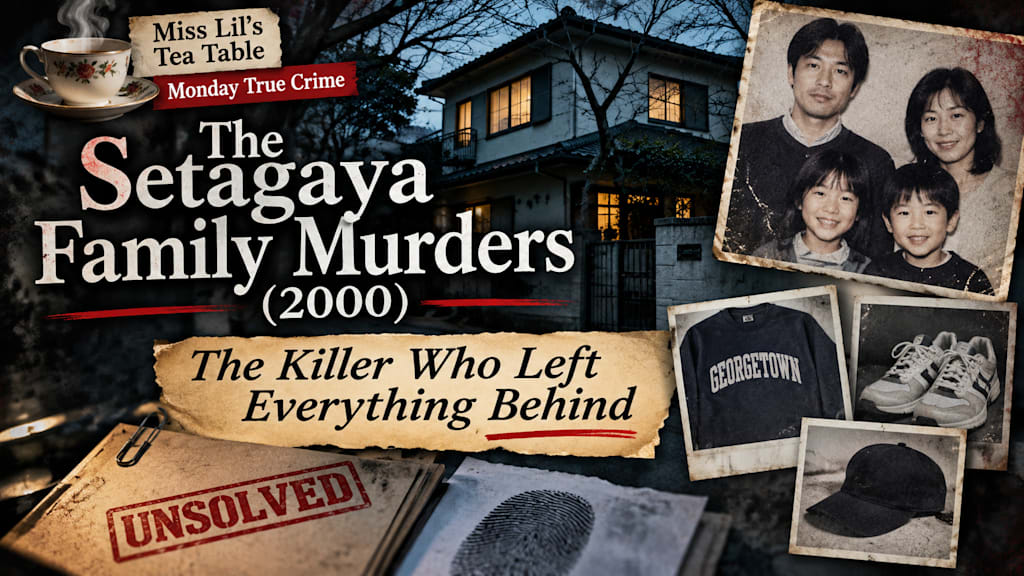
The Setagaya Family Murders: The Killer Who Left Everything Behind
Miss Lil's Tea Table | Monday True Crime
Four lives were taken. A family home became a crime scene. And somewhere in the darkness, a killer walked away carrying a secret that has survived for more than a quarter of a century.
Pour yourself something warm, settle in, and let's talk about a murder case that leaves me with one particularly uncomfortable question.
How does someone leave behind nearly everything that could identify them, and still manage to disappear?
There are murderers who spend hours cleaning a crime scene. Others go to extraordinary lengths to destroy evidence, conceal their identities, and make sure investigators have as little as possible to work with.
Then there is the killer in the Setagaya family murders.
This person left behind blood. Fingerprints. DNA. Clothing. Personal belongings. Even the weapon believed to have been used in the killings.
And then, according to investigators, this person did something almost incomprehensible.
They stayed.
They remained inside the home for hours after murdering an entire family. They ate food from the refrigerator, used the family computer, and left behind a trail of evidence that would make most investigators believe identification was only a matter of time.
Twenty-six years later, that name is still missing.
And four people who should have been celebrating the arrival of a new year never got the chance.
Let's open the file.
A Family's Last Christmas Season
The Miyazawa family lived in Kamisoshigaya, in Tokyo's Setagaya Ward. It was a residential neighborhood, the kind of place where families went about their everyday lives without expecting their homes to become the setting of something unimaginable.
Mikio Miyazawa was 44 years old. His wife, Yasuko, was 41. Their daughter, Niina, was eight, and their little boy, Rei, was just six.
They were a family of four.
A husband. A wife. A little girl. A little boy.
By all appearances, they were living an ordinary family life. Their home stood beside an area that would become part of Soshigaya Park, and the family was preparing to welcome another year.
There was nothing about December 30, 2000, that suggested it would be their last night together.
But somewhere during the late evening hours, an intruder entered their home.
Investigators would eventually piece together a horrifying sequence of events. The family had been attacked inside their own residence, and all four were dead by the time anyone discovered what had happened.
Mikio, Yasuko, and Niina had been stabbed. Rei had been strangled.
The youngest member of the family was only six years old.
Think about that for a moment.
Four people, all in the place where they should have felt safest, were robbed of their lives. And whoever did it did not simply vanish after the violence.
The strangest part of this case was only beginning.
The House That Became a Crime Scene
The investigation suggested that the intruder entered through a second-floor bathroom window at the rear of the house. The property was near Soshigaya Park, and the surrounding area was unusual. Much of the neighboring land had been acquired for a planned park expansion, leaving relatively few homes nearby.
It was a location that offered opportunity.
And the killer apparently knew how to use it.
The attack was believed to have taken place sometime between approximately 11 p.m. on December 30 and the early hours of December 31.
But what happened afterward is what makes this case so difficult to put down.
Most killers want distance between themselves and the scene of a murder. They want to get out, get rid of anything connecting them to the crime, and disappear before anyone realizes something has happened.
This killer behaved differently.
The physical evidence suggested that the intruder remained in the Miyazawa home for hours.
Think about the sheer audacity of that.
Four members of the household had been murdered, yet the person responsible apparently felt comfortable enough to stay in their home, surrounded by the evidence of what had just happened.
The family refrigerator became a source of food. The intruder reportedly ate ice cream and drank beverages belonging to the victims.
The family computer was used.
The bathroom was used.
Personal belongings and documents were disturbed, and some papers were found discarded in the bathtub.
Investigators also found evidence suggesting the intruder had treated an injury using supplies from the home.
This was not someone who simply entered, attacked, and fled in a blind panic.
Whatever was going through this person's mind, they had enough time to remain in that house and behave with a disturbing degree of familiarity.
And then they left.
Not before leaving investigators an extraordinary collection of clues.
The Evidence Was Practically Handed to Investigators
This is where the case becomes almost maddening.
In many murder investigations, detectives spend years searching for a single usable fingerprint or a tiny biological sample. Sometimes the killer leaves nothing behind that can be tested.
Not here.
The Setagaya killer left behind an astonishing amount of physical evidence.
Among the items recovered were:
Blood belonging to the perpetrator, indicating an injury sustained during the attack.
Fingerprints left inside the home.
DNA evidence that investigators could examine.
Clothing believed to have been worn by the killer.
A hat, jacket, scarf, gloves, and other personal belongings.
A hip bag and handkerchiefs.
The knife believed to have been used in the murders.
Let that sink in.
The person responsible left clothing and personal possessions in the very house where four people had just been killed.
Investigators were able to establish that the offender had injured a hand during the attack. Blood left at the scene provided a biological trail, and police identified the blood type as A.
The clothing was particularly interesting. Police traced the distinctive sweatshirt to a limited number of sales. According to the Tokyo Metropolitan Police Department's investigation materials, only 130 examples of that particular type had been sold throughout Japan by the time of the murders.
That is an extraordinarily specific lead.
Imagine being the person who bought one of those sweatshirts. Imagine recognizing it in a police photograph years later. Imagine remembering someone who suddenly stopped wearing it, discarded it, or offered an explanation that never quite made sense.
And yet, no one has come forward with the information needed to identify the killer.
The police also recovered fingerprints and DNA. These are not vague impressions or eyewitness guesses. They are physical evidence directly connected to the crime.
So why hasn't this been solved?
That question has haunted investigators for decades.
The Hours After the Murders
Perhaps the most disturbing aspect of this entire case is the time the killer spent inside the home.
The family was dead, but the intruder apparently had no immediate urgency to leave.
Investigators found indications that the computer had been accessed during the early morning hours. The activity occurred after the estimated time of the murders.
The killer also consumed food from the refrigerator, including ice cream.
There is something particularly unsettling about that detail.
Somewhere in that house, a family had been destroyed. Their ordinary belongings were still where they had left them. Their food was still in the refrigerator. Their computer was still on its desk.
And someone who had just committed an unspeakable act was helping themselves to the contents of their kitchen.
It is easy to get caught up in the bizarre behavior and forget the human tragedy behind it.
That refrigerator belonged to a family. Those ordinary household items were part of their everyday lives. They were never supposed to become evidence in one of Japan's most infamous murder investigations.
We can speculate about the killer's state of mind, but we cannot know why they behaved this way. Perhaps they felt they had enough time. Perhaps they believed no one would discover the bodies immediately. Perhaps there was another explanation entirely.
What we do know is that the killer's actions left investigators with more questions than answers.
Who Was This Person?
Police developed a profile from the physical evidence, but a profile is not a name.
The blood evidence established characteristics of the perpetrator, including blood type. Investigators also examined the clothing, footwear, and other objects left behind.
Some of the details were unusual enough to attract international attention.
The killer's footwear was identified as a pair of Slazenger sports shoes, size 28 centimeters, a brand and style that provided another avenue for investigators.
The handkerchiefs and other belongings were also examined for clues about where the offender might have lived, shopped, or spent time.
There were questions about the materials and origins of the clothing, the distinctive footwear, and even traces of sand recovered during the investigation.
The possibility that the offender had connections outside Japan was also explored.
But none of those leads produced an arrest.
And here is something worth remembering: a DNA profile does not automatically reveal someone's identity. Investigators need a suitable comparison, a database match, or another way to connect that profile to a particular individual.
The killer's DNA could be sitting in an evidence file, perfectly preserved, waiting for the right comparison.
The fingerprints could be just as valuable.
But evidence without an identity is still a mystery.
The Investigation That Refused to Die
The Tokyo Metropolitan Police Department has continued to investigate the murders, even as the years have turned into decades.
The scale of the investigation is staggering. Thousands of investigators have been involved over the years, and the case has generated an enormous amount of public attention.
And the family has not been forgotten.
Police continue to appeal to the public for information. They have even recreated aspects of the crime scene to help people understand the surroundings and perhaps remember something they witnessed.
The investigation remains open.
There is currently a reward of up to 20 million yen for information that helps lead to an arrest or resolve the case. The reward period listed by police runs through December 15, 2026.
More than a quarter of a century has passed.
The children would be adults today. Niina would be in her thirties. Rei would be approaching his thirties.
Their parents would have grown older. Their lives would have continued. They should have had birthdays, holidays, arguments over ordinary household things, and all the little moments that make up a family.
Instead, their names remain attached to a crime that Japan has never been able to solve.
The Questions That Still Keep Me at the Tea Table
I keep coming back to the same uncomfortable questions.
Who was this person?
Was the killer someone who lived nearby? Someone who knew the family's routine? Someone who had been watching the house?
Was the attack planned, or did something happen that night that turned an intruder into a murderer?
Why stay in the house for hours afterward?
Why leave behind so many personal belongings?
And perhaps the question that bothers me most: How can someone leave behind blood, DNA, fingerprints, clothing, and a murder weapon, yet walk away without ever being identified?
Somewhere, there may be someone who remembers a friend, acquaintance, coworker, or family member who suddenly had an unexplained injury around the end of December 2000.
Someone may remember an unusual story about a sweatshirt, a missing bag, or a pair of shoes.
Someone may have heard something years ago that seemed insignificant at the time.
And perhaps that person has never realized how important that little detail might be.
I don't believe we should turn the victims into background characters in a fascinating mystery. Mikio, Yasuko, Niina, and Rei were real people. They had a home, a family, and futures that were stolen from them.
Their story deserves more than fascination with the person who killed them.
It deserves an answer.
One Last Sip Before We Close the File
There are unsolved murders where investigators are left with almost nothing.
Then there is Setagaya.
A killer left behind enough evidence to fill an investigative warehouse, yet somehow managed to remain a ghost.
No name. No arrest. No explanation.
Just four victims, a house full of unanswered questions, and evidence that has been waiting for someone to recognize it for more than 25 years.
So, my question for you today:
Do you believe this killer was simply incredibly lucky, or do you think someone knows exactly who committed these murders and has spent all these years keeping that secret?
And if the evidence is this extensive, what do you think investigators are missing?
Until next time, keep your eyes open, your questions sharp, and your tea strong.
Miss Lil ☕
Because sometimes the most disturbing thing about a murder isn't what the killer took with them. It's what they left behind.
Sources & Further Reading
Tokyo Metropolitan Police Department: Official Setagaya Murder Investigation.
ABC News: The Killer Without a Face.
The Japan Times: Despite a Raft of Clues, Prints, Family Slaying Still Unsolved.
The Japan Times: Police Continue Searching for Killer 25 Years On.
Editorial note: This case remains officially unsolved. The killer's identity, motive, and precise reasons for remaining inside the home have not been established. This article distinguishes investigative findings from unanswered questions.
About the Creator
Lilithea Adasia
I dig where others look away. 🖤 True crime, paranormal mysteries, uncomfortable truths, and the beautifully broken human experience. I chase the stories others bury and ask the questions others avoid. Come curious. Leave questioning.
Enjoyed the story? Support the Creator.
Subscribe for free to receive all their stories in your feed. You could also become a paid subscriber, letting them know you appreciate their work.
Comments
There are no comments for this story
Be the first to respond and start the conversation.