
THE DEATH THEY CALLED A SUICIDE
Sandra Birchmore, the investigation that failed her, and the murder trial that changed everything

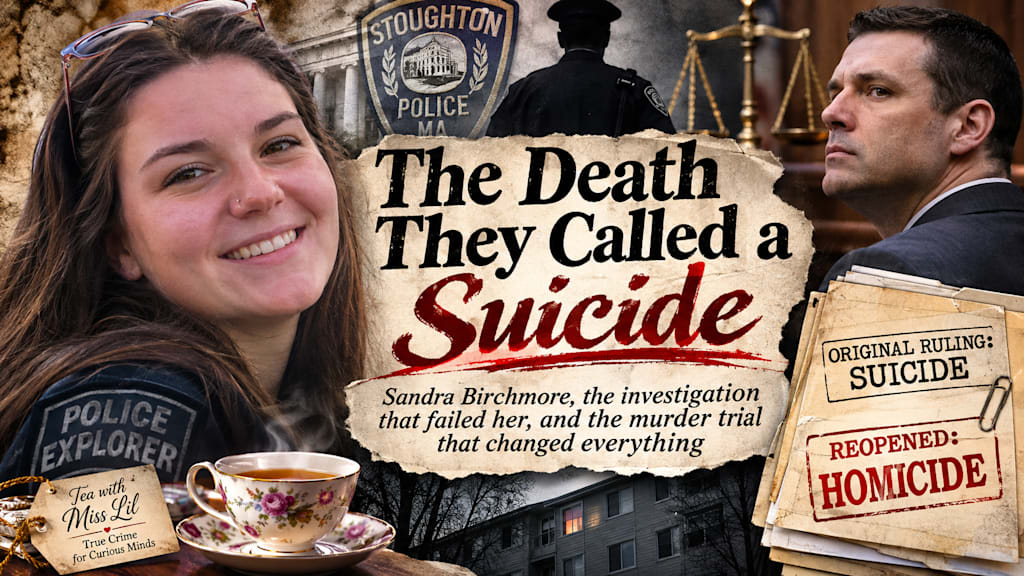
THE DEATH THEY CALLED A SUICIDE
Sandra Birchmore, the investigation that failed her, and the murder trial that changed everything
Miss Lil's Tea Table | True Crime
Pull up a chair, sweetheart. Put the kettle on, because today's story is one of those that leaves you staring into your cup long after the tea has gone cold.
There are cases that make you angry.
There are cases that make you question everything you thought you understood about the people entrusted to protect us.
And then there are cases like Sandra Birchmore's.
A young woman is found dead in her apartment. The death is initially classified as a suicide. The investigation moves forward under that conclusion.
Years later, federal investigators take another look.
Suddenly, the story is no longer simply about a young woman's death. It becomes a murder prosecution involving a former police detective, allegations of sexual exploitation beginning when Sandra was a teenager, questions about the original investigation, and a courtroom where experts are now debating the evidence that may determine whether a man spends the rest of his life behind bars.
The defendant is Matthew Farwell, a former Stoughton, Massachusetts, police detective.
The woman at the center of this case is Sandra Birchmore.
And the question that brought us to this tea table is one that deserves to be examined carefully:
How did a death initially classified as suicide become the subject of a federal murder prosecution?
Because, darling, when the investigation itself becomes part of the story, we have a great deal more to discuss than what happened inside one apartment.
We have to look at what happened before.
And what happened afterward.
A YOUNG WOMAN WHO WANTED TO BELONG
Sandra Birchmore was 23 years old when she died in February 2021.
She had participated in the Stoughton Police Explorers program, a youth program associated with law enforcement. The program was supposed to offer young people an opportunity to learn about policing, develop discipline, and explore a possible future in public service.
For a teenager interested in law enforcement, that kind of opportunity could mean a great deal.
There were adults in positions of authority. There were uniforms, training, mentorship, and the promise of belonging to something bigger than yourself.
But prosecutors allege that the relationship between Sandra and Matthew Farwell began in circumstances that were anything but appropriate.
According to the federal indictment, Farwell used his position and access through the Explorers program to groom and sexually exploit Sandra beginning when she was 15 years old.
Farwell was an adult police officer.
Sandra was a teenager.
That distinction matters.
A young person participating in a program connected to law enforcement should be able to trust the adults responsible for supervising and guiding them.
Prosecutors allege that Farwell abused that trust.
They further allege that the sexual relationship continued for years, including after Sandra reached adulthood.
These are allegations that must be evaluated through the evidence presented in court. Farwell has pleaded not guilty and is presumed innocent unless proven guilty beyond a reasonable doubt.
But the allegations themselves raise a disturbing question about the environment in which Sandra was placed.
When an adult occupies a position of authority over a teenager, the responsibility to maintain appropriate boundaries belongs to the adult.
It is not the teenager's responsibility to understand the full consequences of a relationship with someone who holds power over them.
And it is certainly not the teenager's responsibility to protect the reputation of the institution that adult represents.
That is where this story begins.
Not with a body.
Not with a crime scene.
But with a young woman who prosecutors say was placed in a deeply inappropriate relationship with someone who was supposed to represent authority, safety, and guidance.
THE RELATIONSHIP THAT BECAME A FEDERAL CASE
According to prosecutors, Sandra and Farwell maintained a sexual relationship for years.
The federal case alleges that the relationship began when Sandra was 15 and continued into adulthood.
Investigators have examined thousands of messages exchanged between the two.
Those communications have become an important part of the prosecution's case because they may help establish the nature of the relationship, the dynamics between them, and what happened in the months leading up to Sandra's death.
Prosecutors have alleged that Farwell feared Sandra would disclose information about his conduct.
They argue that this fear ultimately became a motive for murder.
The indictment alleges that Farwell killed Sandra to prevent her from revealing his alleged sexual exploitation of her and other potential federal offenses.
The prosecution's theory is that the murder was not an isolated act.
It was the culmination of a relationship involving alleged grooming, abuse of authority, and a growing fear that the truth would come out.
The defense tells a very different story.
Farwell's attorneys maintain that Sandra died by suicide and that he did not kill her.
They have challenged the prosecution's interpretation of the evidence, including the forensic findings and the circumstances surrounding Sandra's death.
And that brings us to the pregnancy.
Because the final months of Sandra's life are central to the prosecution's theory of what happened.
THE PREGNANCY AND THE ALLEGED MOTIVE
In late 2020, Sandra became pregnant.
According to federal prosecutors, she told Farwell about the pregnancy and expressed excitement about the possibility of having a child.
The indictment alleges that Farwell and Sandra had discussed the possibility of pregnancy and that Sandra was making plans for prenatal care and the arrival of a baby.
Prosecutors have pointed to messages and other evidence concerning pregnancy appointments, ultrasounds, genetic testing, and preparations for the child.
They argue that Farwell became angry and feared that Sandra would expose their relationship.
The government alleges that he killed her because he wanted to prevent her from revealing his alleged misconduct.
The indictment also alleges that Sandra was approximately eight to ten weeks pregnant when she died.
There is an important detail here that deserves clarification.
DNA testing later established that Farwell was not the biological father of Sandra's unborn child.
The child's biological father was identified as Jason Pickard, an Army recruiter.
That finding does not erase the prosecution's allegations concerning Farwell's relationship with Sandra.
It does, however, distinguish the pregnancy from the alleged motive in the way the case has sometimes been discussed online.
The prosecution alleges that Farwell believed Sandra's pregnancy and her potential disclosures threatened him.
That is the government's theory.
The defense disputes the murder allegations and maintains that Sandra died by suicide.
The jury must decide whether the evidence supports the prosecution's account beyond a reasonable doubt.
And that distinction is important because a motive, even one that appears compelling, is not proof of murder by itself.
The prosecution must establish what happened.
Not simply why it believes something happened.
FEBRUARY 2021: THE DEATH
Sandra Birchmore was found dead in her Canton, Massachusetts, apartment in February 2021.
She was 23 years old.
Her body was discovered in a seated position, with a strap around her neck connected to a closet doorknob.
The scene was initially treated as a suicide.
The medical examiner's original determination was that Sandra died from asphyxia by hanging.
At that point, the investigation did not produce a murder prosecution.
The death was classified as suicide.
And for a time, that was the conclusion surrounding Sandra's final hours.
But the case would not remain there.
Questions about the circumstances of her death, the investigation, and Farwell's relationship with Sandra eventually brought federal investigators into the picture.
The FBI reopened the investigation in 2023.
That renewed investigation led to Farwell's arrest and federal indictment in August 2024.
The prosecution now alleges that Sandra was strangled and that the scene was staged to make her death appear to be a suicide.
Farwell has denied killing her.
The medical evidence has become one of the most contested parts of the case.
And that is where we need to slow down.
Because a death initially classified as suicide does not automatically mean the original conclusion was correct.
But a later murder allegation does not automatically mean the original conclusion was wrong, either.
The evidence has to be examined.
The investigation has to be examined.
And the conclusions must be supported by facts.
WHEN THE INVESTIGATION BECAME PART OF THE STORY
One of the most troubling aspects of Sandra's case is the scrutiny surrounding the initial investigation.
The death was investigated locally.
Farwell was a police officer.
And investigators eventually had to examine the possibility that someone within law enforcement had been involved.
That creates an obvious concern.
When the person suspected of wrongdoing is connected to the institution conducting the investigation, the public has a legitimate interest in understanding how the investigation was handled.
Were potential conflicts of interest identified?
Were all relevant witnesses interviewed?
Was the evidence collected and preserved appropriately?
Were investigators willing to consider the possibility that the initial classification could be wrong?
These are not questions that should be answered through speculation.
They are questions that require documentation, testimony, and careful examination of the investigative record.
Federal investigators ultimately took over the case.
The FBI's involvement led to the murder indictment.
And the prosecution has presented evidence that it says supports a different explanation for Sandra's death.
The case has also raised broader concerns about accountability within police departments and youth programs.
Those concerns are not unique to this case.
Whenever an institution places adults in positions of authority over young people, it has a responsibility to establish safeguards.
Those safeguards should not depend on whether someone eventually comes forward with an allegation.
They should exist before anything happens.
Because prevention is supposed to be the point.
WHAT THE PROSECUTION SAYS HAPPENED
The federal prosecution has built its case around several major areas of evidence.
First, there is the alleged relationship between Sandra and Farwell.
Prosecutors have presented messages and other communications that they say demonstrate the nature of the relationship and the circumstances leading up to Sandra's death.
Second, there is the timeline.
Surveillance footage and digital evidence have become important to the government's reconstruction of Sandra's final hours.
According to testimony reported by CBS Boston, Farwell entered Sandra's apartment building at approximately 9:14 p.m. on the night she died.
Sandra's phone recorded its final activity later that evening.
Farwell was seen leaving the building approximately two minutes after the final recorded phone activity.
Prosecutors argue that the timing is significant.
They have suggested that Sandra's phone activity stopping while Farwell was with her supports their theory that he killed her.
The defense has challenged the government's conclusions.
Third, there is the forensic evidence.
Prosecutors have presented expert testimony concerning Sandra's injuries and the circumstances of her death.
Their experts have argued that certain findings are more consistent with strangulation than suicide.
The defense has called its own experts to challenge those conclusions.
And fourth, there is the alleged motive.
The prosecution argues that Farwell feared Sandra would reveal information about his alleged abuse and exploitation.
The government has presented the pregnancy and the communications between Sandra and Farwell as part of that narrative.
Taken together, prosecutors argue that the evidence establishes a murder committed to prevent Sandra from exposing alleged criminal conduct.
The defense disputes that interpretation.
And the jury will have to determine whether the government's evidence proves the charges beyond a reasonable doubt.
THE MEDICAL EVIDENCE: WHAT DOES THE BODY TELL US?
This is where the case becomes particularly complicated.
The prosecution has argued that Sandra's injuries support a homicide conclusion.
One of the central issues involves a fracture of the hyoid bone, a small bone in the neck.
Prosecution experts have testified that the injury is significant in the circumstances of Sandra's death.
The defense has challenged that interpretation.
On November 2, a forensic anthropology expert called by Farwell's defense testified that the fracture alone could not establish whether Sandra died by suicide or homicide.
The expert argued that such fractures are variable and that the available studies did not allow a definitive conclusion in Sandra's circumstances.
The prosecution challenged the limitations of that research during cross-examination.
The defense also called other experts who questioned aspects of the autopsy findings and the interpretation of photographs.
Some of those opinions were inconclusive.
This matters because forensic evidence can be powerful.
But it is not magic.
A fracture does not automatically tell investigators who caused it.
A mark on the body does not automatically establish when it occurred.
And the interpretation of an injury must be considered alongside the rest of the evidence.
The medical examiner initially classified Sandra's death as suicide.
After the federal investigation and additional review, the death certificate was amended to list the manner of death as undetermined.
That change is significant.
It means the medical examiner no longer considered the original suicide classification sufficiently established.
But an undetermined manner of death is not itself a finding of homicide.
It means the medical evidence did not establish a definitive manner of death.
The prosecution is attempting to prove murder through the totality of the evidence.
The defense is attempting to demonstrate that the evidence leaves reasonable doubt.
And the jury must decide what the evidence actually establishes.
THE DNA QUESTION
The DNA evidence has become another major battleground.
A strap found around Sandra's neck was examined by forensic investigators.
The prosecution's DNA analyst testified that Farwell's DNA was identified as a major contributor to a mixture on a portion of the strap.
The defense has challenged how that evidence was collected, packaged, and interpreted.
A defense DNA expert testified that contamination was possible because the strap had been in contact with the apartment carpet.
The expert also questioned whether the item had been packaged appropriately.
The defense has argued that the presence of DNA does not establish when it was deposited or how it arrived on the strap.
That is an important forensic distinction.
DNA can establish a connection between a person and an object.
It does not necessarily establish when that connection occurred.
The defense has also raised the fact that Farwell has a fraternal twin who testified that he visited Sandra's apartment.
The defense expert argued that the possibility of related individuals contributing DNA to a mixture requires careful interpretation.
The prosecution disputes the defense's characterization of the DNA evidence.
The jury must evaluate the laboratory findings, the expert testimony, and the circumstances in which the evidence was collected.
The question is not simply whether Farwell's DNA was present.
The question is what that evidence means in the context of the alleged crime.
And that is precisely why forensic evidence must be interpreted carefully.
THE DEFENSE: SUICIDE REMAINS THEIR ARGUMENT
Farwell's defense has maintained that Sandra died by suicide.
The defense does not have to prove that conclusion.
In a criminal trial, the prosecution bears the burden of proving guilt beyond a reasonable doubt.
The defense can challenge the government's evidence and argue that the prosecution has not eliminated reasonable doubt.
That distinction is especially important in this case.
The defense has presented testimony concerning Sandra's past mental health struggles and alleged suicidal behavior.
A witness from Sandra's former college testified that she had previously disclosed suicidal behavior and had sought additional tutoring hours because she needed to leave her home.
The defense has also called medical and forensic experts who have questioned the prosecution's conclusions about her injuries.
The defense argues that the forensic evidence does not conclusively establish homicide.
And it maintains that suicide remains a reasonable explanation for Sandra's death.
The prosecution, meanwhile, argues that the circumstances surrounding Sandra's death, the alleged relationship, the timeline, and the forensic evidence support murder.
This is the central conflict of the trial.
The government must prove its theory.
The defense must demonstrate why the jury should not accept it beyond a reasonable doubt.
And neither side's argument should be mistaken for the verdict.
THE SECOND CHARGE: SANDRA'S UNBORN CHILD
The case also includes a federal charge concerning the death of Sandra's unborn child.
In October 2025, Farwell was indicted on an additional charge alleging that his actions caused the death of Sandra's unborn baby.
The indictment alleges that Sandra was pregnant when she was killed and that the killing resulted in the death of the unborn child.
The charge carries a mandatory life sentence if Farwell is convicted under the applicable federal statute.
The government has argued that the pregnancy is part of the circumstances surrounding Sandra's death.
The defense has denied the murder allegations.
The child was not born.
The DNA testing identified Jason Pickard as the biological father.
That finding is relevant to the factual record, but it does not resolve the separate question of whether Farwell killed Sandra.
The jury must consider the evidence supporting each charge.
And the legal consequences of a conviction are substantial.
THE TRIAL: WHAT IS HAPPENING NOW?
As of November 3, 2026, Matthew Farwell's federal trial is still underway.
The prosecution rested its case on October 28.
The defense began presenting witnesses shortly afterward.
The defense has called medical and forensic experts who challenge the government's interpretation of Sandra's injuries and the evidence collected at the scene.
On November 2, defense witnesses questioned whether the medical findings conclusively established homicide.
The defense has also challenged aspects of the DNA evidence.
The prosecution has disputed those arguments.
The trial is now approaching its final stages.
The judge and attorneys have been discussing jury instructions, which will guide jurors in evaluating the charges and evidence.
The jury has not yet reached a verdict.
That means we need to be careful about how we describe the case.
Farwell has been accused of murder.
He has not been convicted.
The prosecution has presented its theory.
The defense has challenged it.
And the final determination belongs to the jury.
THE QUESTIONS THAT REMAIN
There are several questions that deserve continued attention as this case moves toward its conclusion.
1. What did the original investigation miss?
The initial classification of Sandra's death as suicide is one of the most important parts of this story.
The federal investigation ultimately produced a murder indictment.
That raises questions about the original investigative process.
What evidence was available at the time?
What conclusions were reached?
Were those conclusions adequately supported?
And what changed when federal investigators reviewed the case?
Those questions should be answered through the investigative record, not assumptions.
2. Were the appropriate safeguards in place?
Sandra participated in a program connected to law enforcement.
Prosecutors allege that Farwell used his position to groom and sexually exploit her.
That raises serious questions about supervision, boundaries, and institutional responsibility.
What policies governed adult interactions with teenage participants?
Were those policies enforced?
Were concerns reported?
And what mechanisms existed to protect young people from abuse of authority?
Those are questions worth examining regardless of the verdict.
3. What does the forensic evidence actually establish?
The prosecution and defense have presented competing interpretations of Sandra's injuries.
The DNA evidence has also been challenged.
The jury must determine whether the evidence establishes homicide or leaves reasonable doubt.
That determination cannot be made through a headline.
It requires careful consideration of the expert testimony and the totality of the evidence.
4. What accountability follows?
If the prosecution proves its case, Farwell could face a life sentence.
But the broader questions about the initial investigation and the institutions involved will not necessarily disappear with a verdict.
A criminal conviction can establish responsibility for a crime.
It does not automatically answer every question about how the circumstances surrounding that crime were allowed to develop.
And if the jury finds the prosecution has not proven its case, that does not mean every concern about the investigation becomes irrelevant.
The evidence and the institutional questions must be considered separately.
MISS LIL'S TEA TABLE
Now, sweetheart, this is where I want to put the cup down for a moment.
Because the most troubling part of Sandra Birchmore's story is not simply that a young woman died.
It is the allegation that someone who held a position of authority over her used that position to exploit her.
It is the fact that her death was initially classified as suicide.
And it is the years of investigation that followed before federal prosecutors brought a murder case.
There is a reason this case has attracted so much attention.
People want to know whether Sandra was protected.
They want to know whether the investigation was thorough.
They want to know whether the evidence was handled appropriately.
And they want to know whether someone who allegedly abused his position will be held accountable.
Those are legitimate questions.
But we must also remember that a courtroom is not a place where we get to decide guilt based on how disturbing an allegation sounds.
The prosecution has to prove the charges.
The defense has the right to challenge the evidence.
And the jury must evaluate the facts.
That is how justice is supposed to work.
Still, the larger lesson remains.
When someone in a position of authority is accused of abusing that authority, the investigation must be beyond reproach.
Not because the accused is automatically guilty.
Because the public deserves to know that the investigation was conducted fairly, thoroughly, and without favoritism.
Sandra Birchmore was 23 years old when she died.
She should not be reduced to a courtroom exhibit.
She should not be reduced to a headline.
And she should not be remembered only as the woman whose death became a murder trial.
She was a person.
A young woman whose life ended under circumstances that remain deeply contested.
And whatever the jury ultimately decides, the questions surrounding the alleged abuse of authority and the initial investigation deserve serious examination.
Because when the people entrusted with protecting someone are accused of failing them, the questions do not stop at the courtroom door.
They reach into the institutions that are supposed to keep people safe.
And that, my friends, is a conversation worth having.
THE LAST SIP
As this trial continues, we will have to wait for the jury to decide what the evidence proves.
We cannot declare Matthew Farwell guilty before that verdict.
We cannot claim the initial investigation was deliberately compromised without evidence establishing that.
And we cannot assume that every forensic disagreement means investigators were wrong.
But we can ask questions.
We can examine the evidence.
We can look at the allegations of abuse of authority.
And we can remember Sandra Birchmore as more than the circumstances of her death.
Because the title of this article is not a verdict.
It is a question about the investigation.
The Death They Called a Suicide.
How did that conclusion come about?
What changed?
And what does this case tell us about the responsibility institutions have when the people accused of wrongdoing are among their own?
Those are the questions I will be watching as the trial moves toward its conclusion.
Until then, keep your tea warm, your eyes open, and your questions honest.
Miss Lil will be right here at the table.
Sources and case documents consulted:
U.S. Department of Justice, District of Massachusetts, October 28, 2025 indictment announcement.
Federal trial coverage from CBS Boston, October 28, 2026.
Boston.com case primer, October 6, 2026.
NBC Boston trial recap, November 2, 2026.
Boston Globe trial reporting, November 3, 2026.
Boston 25 News trial reporting, November 2, 2026.
This article reflects the status of the case as of November 3, 2026. Matthew Farwell has pleaded not guilty and is presumed innocent unless proven guilty beyond a reasonable doubt. The trial remains ongoing, and the jury has not reached a verdict.
About the Creator
Lilithea Adasia
I dig where others look away. 🖤 True crime, paranormal mysteries, uncomfortable truths, and the beautifully broken human experience. I chase the stories others bury and ask the questions others avoid. Come curious. Leave questioning.
Enjoyed the story? Support the Creator.
Subscribe for free to receive all their stories in your feed. You could also become a paid subscriber, letting them know you appreciate their work.
Comments
There are no comments for this story
Be the first to respond and start the conversation.