investigation
Whodunnit, and why? All about criminal investigations and the forensic methods used to search for clues and collect evidence to get to the bottom of the crime.
Explained 911 mysterry
Here's the revised transcript: --- It’s Ben Sliney’s first day as National Operations Manager at the Federal Aviation Administration. "I can recall the morning of 9/11 quite clearly. It was forecast to be an absolutely brilliant day on the East Coast, which is crucial to air traffic control and the running of aircraft without delay." The perfect weather means American Airlines Flight 11 departs Boston on time. But 25 minutes after takeoff, air traffic control is alarmed to hear foreign voices in the cockpit. "The supervisor told me there was a potential hijacking in effect." It soon becomes clear this is no ordinary hijack when news bulletins report the North Tower of the World Trade Center has been hit by a plane. "I did not know it was American 11 at that juncture, but I feared the worst." Next, Sliney witnesses the second tower being hit live on TV. "There was a collective gasp in that room that I can still hear in my ear today, followed by an incredible silence." "To see an aircraft loaded with passengers and crew crash violently and suddenly like that, it’s the most stunning sight I’ve ever seen in my entire career in aviation. I could not get my head around the notion that the hijackers could force a pilot to fly the plane into the building." What Sliney doesn't know is the planes are not being flown by pilots, but by terrorists. And there are two more on their way to hit targets with potentially even greater consequences. The third hijacked plane, American Airlines Flight 77, took off from Washington Dulles Airport and will later impact the Pentagon. The fourth hijacked plane is also on a deadly course for Washington D.C., with jihadist Ziad Jarrah at the controls. But the passengers and crew of United 93 are not letting the plane go down without a fight. "They were not going to be stopped. They were trying to get that airplane back in control and kill or subdue those that had taken the aircraft over." But the passengers would never have made it into the cockpit had the terrorists not delayed their mission. This is what the movie doesn't explore. What follows is the real story of Ziad Jarrah. The tale begins in Beirut, Lebanon, with an ordinary young man. Ziad Jarrah grew up in an affluent family of secular Muslims and didn’t go to mosque. "He was a party boy. He had a good time. He didn’t live a strict religious life." At 20 years old, he’s celebrating his acceptance into a junior college in Germany, but college life in the German city of Greifswald is not as exciting as Jarrah imagined. "I don’t know what he expected to find at Greifswald, but what was there wasn’t it. The town is dreary, not hip in any way. It’s cold, it’s dark, and for a guy from the shores of the Mediterranean, it had to be a shock physically." Jarrah initially struggles to make friends, and at this point, two new influences enter his life that will tear him in opposite directions. The first is a radical Muslim student from Yemen who is vocal about his contempt for Western life, the pseudo preacher Abdulrahman. "I think he came to Germany and was appalled by what he found. He saw these young Muslim men and felt it was his responsibility to keep them on a truer path, not become Westernized, not become corrupt like the West, not to fall away from Islam." Abdulrahman calls Jarrah a weak Muslim who doesn't know how to say his prayers. "So now here’s somebody in his face about not being devout enough, not being pious." Abdulrahman invites Jarrah to attend his student prayer group. "I hope we will see you there." The second big influence he meets is dentistry student Aysel Senguin. "Aysel is quite pretty, very gregarious, very outgoing, and very popular." Aysel makes fun of Abdulrahman’s reputation as a self-appointed enforcer of Muslim doctrine. When Jarrah starts dating Aysel, his life in Germany seems to get better and he makes plans to study dentistry. "They made a striking couple. Ziad was a handsome young man and they were the center of attention at parties." But there's an ongoing conflict because Jarrah is also being influenced by the Yemeni’s extreme views of Islam. Against Aysel’s wishes, Jarrah has been attending Abdulrahman’s prayer group. "She objected to his association with Abdulrahman and they fought about that. They broke up, they got back together. It was a fraught relationship." Despite Aysel’s best efforts, she’s losing the man she loves to extremism. "He wasn’t the happy-go-lucky guy they had all known. He had a demeanor, wanted her to wear a veil, wear different clothes, he wanted to choose her friends." She objected to the new belief system he was beginning to espouse. "She thought it was a dangerous way to go and it made no sense in the modern world." Aysel's fears are confirmed when Jarrah follows Abdulrahman and his radical friends and moves to Hamburg. Jarrah abruptly quits his plan to study dentistry and switches to aircraft engineering. Abdulrahman introduces Jarrah to Al Quds, a mosque in the city’s red light district. "The depravity of the area offends the devout Muslims. When you walk down Steindamm, you experience the worst of the West. If you needed evidence, you didn’t have to go very far. It’s not theoretical. There’s an Albanian hooker shooting up on the corner. And so, when you walk into the mosque, it’s an escape from the horror of the West, and that horror reinforces everything you’re being told about it being the wrong path." Jarrah has entered the most radical mosque in Europe. He’s welcomed as a brother and offered solace. "The clubhouse was a place where young men mainly gathered. It was a real companionable aspect to it. A place for people who are away from home, where they could have some part of home or some community of their own." But appearances are deceptive. The men here practice a version of Sunni Islam that is particularly harsh, fundamentalist, and militant. "The rhetoric would peel the paint off the walls. I mean, it’s just horrifying. The preachers would tell these young guys that their duty was to go and be a soldier of Islam, to be a soldier of Allah, and to be vicious about it. The preacher says it’s too bad that we have to kill the young children, but we have to. It’s our duty, and the West made us do this." The young men soak up the extreme rhetoric. "If you’re 19 or 20 years old, you’re looking for something to believe in. You get this; it can be pretty powerful." Jarrah’s new friends from the mosque invite him to the house of the followers, an apartment on Marienstrasse. "They may seem like any group of young outsiders, but these men will one day be known to U.S. intelligence as the Hamburg terror cell." "It became sort of the second clubhouse, and they hosted large numbers of their other friends from the mosque there. They would recruit other people to come and learn Islam. They would pray and watch videos and chant and talk about devoting their lives to jihad." The young men discuss a way to express their devotion to Islam. "They talked endlessly about this, and they would argue about it. We should just go have families. We should raise our children the right way. They thought they were pious men. They found a path they thought was righteous. They were trying to find a way to act in a world they saw gone wrong." They turn their focus to the unrest in the Middle East. "They were watching videos from battlefields of Islamic radicals, reading about Osama bin Laden. Everything was coalescing right there. Their anger, their fury was building up toward the West, toward the United States. Eventually, they decided that what they were called upon to do as devout young men was to go fight on behalf of their beliefs." "To say that they were wrong is to state the obvious. These guys wanted to do more than just sit around in an apartment in Hamburg and spew Islamic chants. They wanted to put their plans into action, and they thought going to Afghanistan would do that." Jarrah, Ramzi bin al-Shibh, and Mohamed Atta volunteer to train with Al-Qaeda in Afghanistan. "It’s the first step on an evil journey that will change the world forever." By December 1999, the Hamburg cell has arrived at an Al-Qaeda training camp near Kandahar in Afghanistan. With their fluency in English and familiarity with life in the West, the Hamburg cell stands out as a valuable asset to Al-Qaeda. "Fairly early on, the leadership saw that these guys were to be used for a different reason. Very quickly, they were elevated to a different class." The four are selected to meet the leader, a man who will one day be the most wanted terrorist in the world: Osama bin Laden. "Bin Laden assessed them very quickly and saw that they were people who could live in the Western society." Bin Laden reveals a chilling plot to bring the world’s greatest superpower to its knees. "They were asked if they would accept this mission for what Bin Laden called the planes operation. You’re going to learn to fly airplanes into buildings and kill thousands of people." And they said yes immediately. "I don’t understand that. Would you not pause? None of these guys are recruited; they’re volunteers offering themselves at just the time that Khalid Sheikh Mohammed and bin Laden were looking for pilots. They just happened to walk in the door. It must have seemed like a gift from Allah, you know. I mean, it’s just
By Samuel maina2 years ago in Criminal
Shadows of Doubt: Controversy Surrounds Zhang Murder-for-Hire Conviction
On Tuesday, October 10, 2023, a Brooklyn jury returned a guilty verdict in the United States District Court for the Eastern District of New York, convicting both Qing Ming Yu (Allen Yu) and Zhe Zhang (Zack Zhang) of murder-for-hire for the shooting of Xin Chris Gu outside a KTV club on the evening of February 12, 2019, in Flushing, New York.
By VocalMedia Editor's2 years ago in Criminal
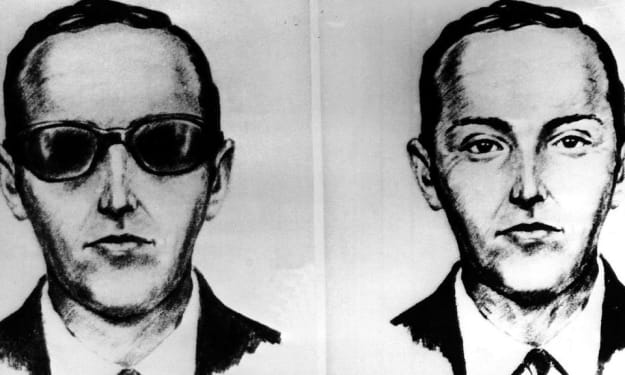
Who Is D.B. Cooper?
D.B. Cooper is one of the most infamous and enduring mysteries in American criminal history. On November 24, 1971, a man using the alias Dan Cooper hijacked a Boeing 727 aircraft, extorted $200,000 in ransom, and parachuted into the dense forests of the Pacific Northwest, never to be seen again. Despite an extensive manhunt and decades of investigation, his identity and fate remain unknown, captivating the public and inspiring numerous theories and cultural references.
By Angelina Reen2 years ago in Criminal
The Betrayal of Friendship: A True Crime Story
Have you ever had a friend? Have you ever loved someone deeply? Have you ever allowed someone into your life, never suspecting they would be the one to end it? Have you ever questioned whether your friends truly love you?
By yousef salman2 years ago in Criminal
The Case of Hardister: A Tale of Repeated Offenses and Legal Encounters
The story of Hardister is a complex one, marked by a series of encounters with the law that span several years. This pattern of criminal behavior raises important questions about the criminal justice system, rehabilitation, and the factors that lead individuals to repeatedly offend. Hardister's journey through the legal system provides a window into the challenges of addressing recidivism and highlights the need for comprehensive solutions to break the cycle of crime. Early Offenses and Incarceration Hardister's documented interactions with the law began in 2012 when he was incarcerated for nine months for stealing a vehicle. This initial offense set the stage for a series of criminal activities that would follow. Vehicle theft, often driven by a combination of economic desperation, thrill-seeking, or substance abuse issues, is a serious crime that can have significant consequences for both the victim and the perpetrator. After serving his sentence, Hardister's troubles with the law were far from over. On February 15, 2013, he was arrested again, this time by a Tequesta police officer for an outstanding warrant from another jurisdiction. Warrants can be issued for a variety of reasons, including failure to appear in court, non-compliance with probation terms, or committing new offenses. Hardister's arrest for an outstanding warrant suggests a failure to comply with legal obligations, further complicating his legal standing and illustrating a disregard for the law. A String of Burglaries and Violations Just two days after his arrest in February 2013, Hardister was apprehended once more, this time on multiple charges, including burglary. Burglary, defined as unlawful entry into a building with intent to commit a crime, is a serious offense that can carry significant penalties. This incident marked the beginning of a troubling pattern of behavior that would see Hardister in and out of custody. In July 2013, Hardister was arrested for violating his probation. Probation violations can occur for numerous reasons, such as failing to meet with a probation officer, not attending mandated programs, or committing new crimes. Violating probation is a serious matter that often results in additional penalties and can extend the period of supervision or incarceration. Hardister's inability to adhere to the terms of his probation highlighted the challenges he faced in complying with legal and behavioral expectations. Approximately two months later, on September 23, Hardister found himself in trouble once more. Law enforcement officers took him into custody when they found him asleep in a pickup truck, believed to be stolen, parked in a Walmart lot. This incident is particularly telling, as it underscores a pattern of criminal behavior and a lack of stable, lawful conduct. The repeated involvement in vehicle theft points to deeper issues that need to be addressed to prevent future offenses. The Challenges of Recidivism Hardister's repeated offenses and interactions with the law highlight the broader issue of recidivism. Recidivism, or the tendency of a convicted criminal to reoffend, is a significant concern within the criminal justice system. Various factors contribute to recidivism, including socioeconomic conditions, lack of education or employment opportunities, substance abuse, and mental health issues. Addressing recidivism requires a multifaceted approach that goes beyond punitive measures. While incarceration may temporarily remove offenders from society, it does little to address the underlying causes of criminal behavior. Comprehensive rehabilitation programs, access to mental health and substance abuse treatment, educational and vocational training, and support systems for reintegration into society are crucial components in reducing recidivism rates. The Role of Rehabilitation Rehabilitation is a key element in preventing repeated criminal behavior. Effective rehabilitation programs aim to address the root causes of criminal activity and equip individuals with the skills and resources needed to lead law-abiding lives. For individuals like Hardister, who have demonstrated a pattern of offending, targeted interventions are essential. Substance abuse treatment programs can play a significant role in rehabilitation, particularly if addiction is a driving factor behind criminal behavior. Mental health services are equally important, as untreated mental health issues can contribute to a cycle of crime and incarceration. Additionally, educational and vocational training can provide individuals with the skills needed to secure stable employment, reducing the economic pressures that may lead to criminal activity. Community and Societal Support Breaking the cycle of recidivism also requires strong community and societal support. Communities can play a vital role in the reintegration process by offering support networks, mentorship programs, and opportunities for meaningful engagement. Societal attitudes towards former offenders must shift from punishment to rehabilitation, recognizing the potential for individuals to change and contribute positively to society. Employers, too, have a role to play in providing opportunities for individuals with criminal records. Offering fair hiring practices and providing support for employees in their reintegration efforts can make a significant difference in reducing recidivism rates. Employment provides not only financial stability but also a sense of purpose and belonging, which are critical for successful reintegration. Conclusion: The Path Forward The case of Hardister is a stark reminder of the challenges associated with repeated criminal behavior and the need for a comprehensive approach to addressing recidivism. While punitive measures are necessary to uphold the law and protect society, they must be balanced with efforts to rehabilitate offenders and address the underlying causes of their behavior. Investing in rehabilitation programs, mental health and substance abuse treatment, educational and vocational training, and community support can create pathways for individuals like Hardister to break free from the cycle of crime. By shifting the focus from punishment to rehabilitation and support, we can create a more just and effective criminal justice system that not only holds individuals accountable for their actions but also provides them with the tools and opportunities to lead productive, law-abiding lives. In the end, reducing recidivism benefits everyone—individuals, families, communities, and society as a whole. The story of Hardister, while troubling, serves as a call to action for a more compassionate and comprehensive approach to criminal justice, one that recognizes the potential for change and the importance of support in achieving it.
By Deji Akomolafe2 years ago in Criminal