
She Sold Six-Yuan Fried Potatoes. Then the Internet Killed Her.
A bad review became a mob. Inside the Yibin tragedy and the platform failures that let online harassment become a death sentence.
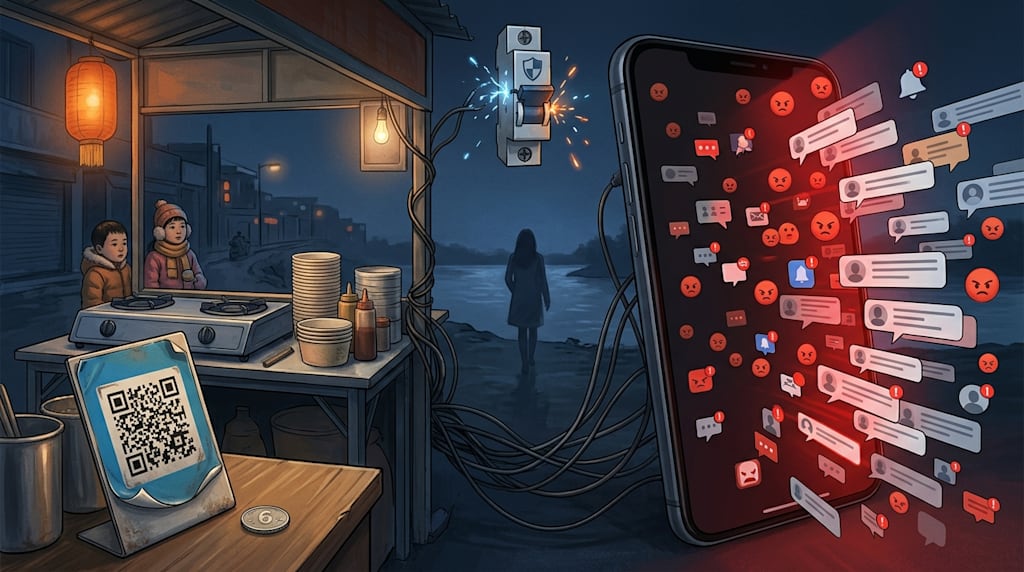
How many potatoes go into a paper bowl should have been something a single sentence could settle: “Give me a little more next time.”
On September 6, in Gaoxian County, Yibin, a vendor selling fried potatoes was swept into online harassment after a customer posted an “avoid this place” video. She left a suicide note and jumped into a river. She had two children and had been selling from a stall for more than four years. Details are subject to investigation. But some things do not need an investigation. A person at a stall, facing hundreds or thousands of accounts, had nowhere to retreat.
I. Criticism is fine. Hunting is not.
Does a customer have the right to review? Yes.
Six yuan of fried potatoes, a small portion. She could complain, leave a bad review, not buy again. That is market feedback. If a small stall is to last, it should hear different voices.
Between a review and a hunt lies a human life.
To criticize the thing is criticism: small portion, high price, average taste. To attack the person is attack: black-hearted, liar, go die, your whole family. Criticism of the thing can be public. Once an attack against the person is paired with the stall’s name, address, face, QR code, and a call to “avoid this place,” drawing strangers to insult, mock, harass by phone, and gather offline, its nature changes. This stops being consumer feedback. It becomes a public execution.
Online harassment has several features: group behavior, persistence, no exit, dehumanization, intrusion into real life.
One person says one sentence. Hundreds or thousands of accounts pour in from all directions. They finish today and come again in a few days. Block one, and another appears. Close comments, and they switch accounts. Shut the stall for a few days, and the livelihood is cut off.
Criticism targets the thing. Online harassment targets the person. Criticism can be accepted. Online harassment must be held accountable.
II. “Too thin-skinned” is the coldest misreading.
Whenever a cyberbullying tragedy happens, there is always a voice:
“Wasn’t it just a few words?”
“Her mental resilience was too weak.”
“If you go online, you should be prepared.”
This way of speaking pushes a systematic hunt onto the victim’s psychological quality.
Online harassment is not “a few words.” If you have ever been an admin in a livestream room, you know. Block hundreds, and there are hundreds more. Mute a batch, and another batch comes. You think it is over, and a few days later there is another wave. The livestream room cannot function normally. The comment section is full of mocking images, ugly photos, insults. It lasts a month. The streamer’s mentality collapses.
And that is only a small dispute in a livestream room.
What if the person’s phone number, address, and stall are exposed? What if she still has to set up her stall every day and face pointing and whispering offline? What if she has two children to raise, and closing the stall cuts off income?
A stall vendor has no PR team, no legal department, no psychologist, no fan club. She has one cart, one pot, one pair of hands.
The harassers can change accounts. She cannot change her life. The harassers can turn off their phones. She cannot close her stall.
This is a hunt. Blaming the tragedy on “being too thin-skinned” is a second injury to the dead and an excuse for the harassers.
III. Platforms need a cyberbullying circuit breaker.
Online harassment does not appear from nothing. It is a chain, and every link adds force.
Platform algorithms like controversy. Controversy brings dwell time. Conflict brings shares. “Avoid this place” posts, flame wars, reversals: these easily get recommended. A platform cannot eat the traffic of controversy while leaving the person to carry it alone.
Algorithms have no malice. But if the objective function only pursues dwell time and interaction, it will do evil.
Platforms have the technical ability. They should build a cyberbullying circuit breaker.
When an account, within a short time, is mentioned negatively, private-messaged, or commented on en masse, protection should trigger automatically. Close private messages from strangers. Review comments before posting. Filter keywords. Hide attacking comments. Pause recommendations. Pop up a notice: “You may be experiencing online harassment.”
For “avoid this place” content involving a specific small business, do not push it blindly. Add a “do not dox or harass” notice. Limit recommendation. Close or curate comments. Require blurring. Take down clearly inciting content first.
Provide one-click evidence collection, one-click reporting, one-click transfer to a human, and one-click reporting to police. Punish attacking accounts by level: warning, mute, downranking, ban, and transfer of leads.
A platform manages a public square. It cannot act like a neutral pipe. When someone is being surrounded in the square, the manager cannot pretend not to see.
Traffic has a price. Human life does not.
IV. The law must catch up with the keyboard.
Online harassers are scattered, anonymous, and cross-regional. The cost for an individual to defend their rights is extremely high. Asking a stall vendor to sue hundreds of accounts is unrealistic.
The law must be faster and harder.
Police should intervene quickly in doxxing, threats, phone bombing, and offline harassment. They cannot muddle through by calling it a civil dispute.
Platforms should provide real-name information according to law.
Civil Code personality-rights injunctions should stop the harm in time.
The Personal Information Protection Law, the Public Security Administration Punishments Law, and the Criminal Law provisions on insult, defamation, picking quarrels and provoking trouble, and infringing citizens’ personal information should be used when applicable.
The Supreme People’s Court, the Supreme People’s Procuratorate, and the Ministry of Public Security have issued guiding opinions on punishing online violence. The key is implementation.
For organizers and main perpetrators, procuratorates may initiate public prosecution.
Legal aid for small and micro business operators must keep up.
The law cannot wait until someone is dead to start. Preventive protection is more important than accountability afterward.
V. Do not fight online harassment with online harassment.
After the tragedy, some people went to harass the customer who posted the bad review. She is pregnant, and her body and mind have been affected.
If she bears responsibility, handle it according to law. If not, stop attacking.
Meeting violence with violence replicates online harassment. If you use vigilante justice against her today, tomorrow another person will be subjected to vigilante justice.
Justice cannot rely on mobbing. Anger cannot rely on doxxing. We need rules. Vigilante revenge only repeats the harm.
VI. Catch the next person who might collapse.
If you are experiencing online harassment:
Survival first. Do not argue. Do not fall into proving yourself. Screenshot and screen-record. Save accounts, links, times. Close private messages and comments. Turn on platform anti-harassment. Call the police at 110. Report to 12377 and 12321. Tell family and friends. Do not be alone. In a mental-health crisis, call 12356 or your local psychological assistance hotline. If necessary, call 110 or 120.
If you are family or a friend:
Do not say, “Just ignore them.” Stay with them. Take over the phone. Help collect evidence. Seek professional help. One person cannot hold off a crowd of accounts. A group of people can catch one person.
If you are a community, market manager, Women’s Federation, or legal-aid institution:
Pay attention to small and micro business operators. They are economically fragile. They have little voice. They have low risk resistance. One online harassment campaign can destroy a family. A temporary stall, psychological support, legal consultation: any of these can be a lifeline.
If you are a school or society:
Treat digital literacy as common sense. Criticize the thing, not the person. Posting someone publicly may be illegal. Before forwarding, think. On the other side of the screen is a living person.
VII. The stall is empty.
The stall is empty.
The stove is cold.
Paper bowls are stacked in the corner. Plastic bags are blown to the roadside.
The QR code is still pasted on the wooden board. Its corner is curled up.
The children are still waiting.
No uplift. No summary. Only these.
About the Creator
Jin
Writer of reamstories
https://reamstories.com/jin
Enjoyed the story? Support the Creator.
Subscribe for free to receive all their stories in your feed. You could also become a paid subscriber, letting them know you appreciate their work.
Comments
There are no comments for this story
Be the first to respond and start the conversation.