
Myanmar Said No Chinese Died. Chinese Police Dug Up Three Bodies.
Inside the “10/20” massacre, the fight to bring evidence home, and the 16 deaths that still have no grave.
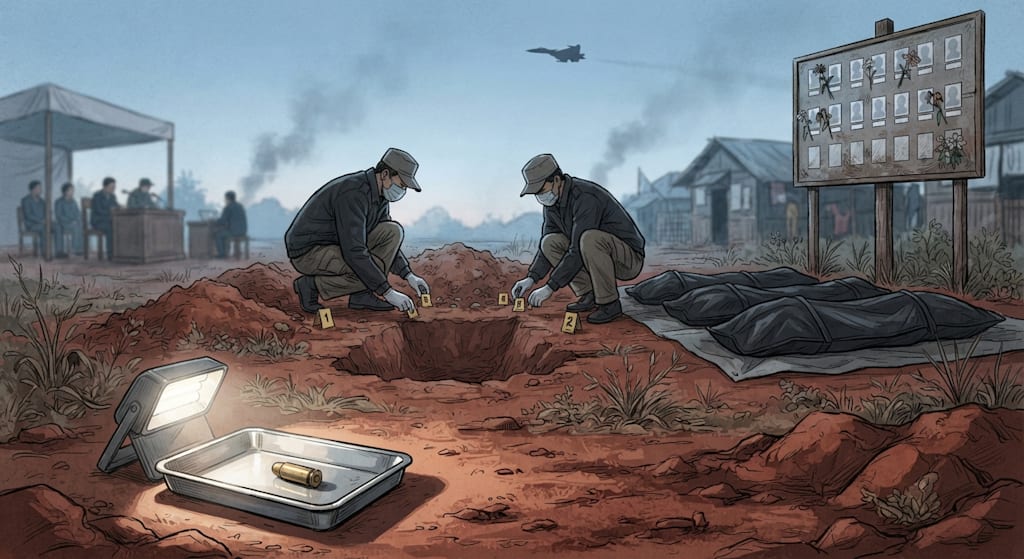
December 2023, Laukkai, Kokang, northern Myanmar. Fighter jets flew overhead. Explosions sent smoke up from positions in the distance.
A team of Chinese police officers dug in a patch of wasteland. Shovels broke the soil. Three badly decomposed bodies lay piled together.
Not long before, Myanmar had repeatedly told China: no Chinese had died.
Na Xin, a first-class senior police chief with the Criminal Investigation Detachment of the Kunming Public Security Bureau in Yunnan, later recalled the instruction he received. It was one sentence: “If you find the bodies, even if you cannot bring them back, you must bring back the biological samples.”
Before the team left, the command headquarters had already weighed the problem. Myanmar’s border and its separate judicial system blocked normal access. Miss the window for evidence collection abroad, and the homicide evidence could be gone.
Digging out the bodies was only the first step. Myanmar initially refused to let China take them back. The task force split in two. One group negotiated with Myanmar. The other extracted biological samples from the three dead and sent them to the border. At the same time, they guarded the bodies so they would not be damaged.
After negotiations through the night, the next day the team was allowed to bring the three bodies back to China.
Forensic examination found that all the victims died from gunshot wounds. Bullets remained inside two sets of remains.
Those two bullets carried the case.
If only biological samples had been brought back, the “10/20” shooting case would have been much harder to define in legal terms. The bullets inside the bodies proved the victims died from gunshots. They ruled out accident or natural death.
Chen Chen, director of the Telecom and Network Fraud Crime Investigation Division of the Criminal Investigation Bureau of the Ministry of Public Security, said in the documentary: “We organized five rounds of forward investigation and evidence collection. During the first forward collection, we found several bodies. At that point we still could not be sure whether the bodies could be brought back. Everyone used the most primitive methods to protect the bodies and obtain DNA evidence.”
Qiu Xin, then head of the Criminal Investigation Detachment of the Quanzhou Public Security Bureau in Fujian Province, put it more directly: “Not only did we excavate the remains for the two homicide cases we wanted, we also excavated two more. DNA testing confirmed they were also Chinese remains, also in the original state of burial, also with postural characteristics of having suffered brutal violence. Chinese people were killed, buried, and burned on the soil of Laukkai. Our goal in obtaining this evidence is to build an ironclad case. Blood debt must be repaid in blood!”
The “10/20” shooting case happened in the early hours of October 20, 2023. To evade inspection, the Ming family criminal group moved people out of the Wohu Villa compound in batches overnight. Armed guards took them to a designated location. The workers realized the Ming family was not sending them back to China. Some tried to run. The militia opened fire.
Four Chinese nationals involved in the scam operations were killed. Four were injured.
After the shooting, Ming Zhenzhen, a principal member of the Ming family criminal group, spoke in an interview before her execution: “Of course we could not let the matter ferment. We had to suppress it as much as possible. Since they were already dead, we arranged for them to be buried.”
On October 31, 2023, then Chairman of Myanmar’s State Administration Council Min Aung Hlaing met in Naypyidaw with State Councilor and Minister of Public Security Wang Xiaohong. During the visit, Wang Xiaohong raised the “10/20” shooting case with Myanmar’s Minister of Home Affairs. He pushed for a China-Myanmar joint law enforcement working group.
Zhang Jun, then director of the Telecom and Network Fraud Crime Investigation Division of the Criminal Investigation Bureau of the Ministry of Public Security, said: “The ‘10/20’ shooting case seriously challenges China’s red line and bottom line. Since this is such a vicious crime committed against ordinary Chinese people, all suspects and perpetrators must be arrested and brought to justice.”
Under the China-Myanmar law enforcement and security cooperation mechanism, the two countries’ police set up a joint investigation team. Chinese police entered telecom fraud compounds in Kokang, northern Myanmar, for the first time. They inspected Wohu Villa, the “Red House,” Donghu Villa, and other locations.
The Ministry of Public Security moved its command from Kunming to the border. Then fighting broke out in Kokang.
Na Xin recalled: “The fighting was intense at the time. Myanmar’s fighter jets even flew over our heads and dropped bombs on the positions. But as police officers, the only thing in our minds was one thing—do not let the evidence be destroyed by the war.”
The dangers at the evidence site went beyond fighter jets. The task force’s forward inspection covered a wide area. It included landmines and dud shells.
Yang Guoqiang, deputy head of the Criminal Investigation Detachment of the Wenzhou Public Security Bureau, later recalled: “But we did not overthink these danger factors. On the question of going or not going, we did not treat it as a multiple-choice question. We simply had to go. Even if we never returned, other comrades would continue forward.”
On November 12, 2023, Chinese police issued wanted notices for Ming Xuechang, Ming Guoping, Ming Julan, and Ming Zhenzhen. Four days later, Ming Guoping, Ming Julan, and Ming Zhenzhen were captured and handed over to China. Ming Xuechang killed himself.
On December 30, 2024, the Wenzhou Municipal People’s Procuratorate in Zhejiang Province filed a public prosecution against 39 defendants in the main case of the Ming family criminal group. The evidence included 1,110 case files, nearly 15,000 items of documentary and physical evidence, more than 50 TB of electronic data, and more than 500 opinions on evidence collection and supplementation. The evidentiary foundation weighed two tons.
Zheng Jiajia, chief procurator of the Yongjia County People’s Procuratorate in Zhejiang Province, said the review faced challenges in applying the law: “For example, determining jurisdiction, ascertaining foreign law, determining nationality, determining the validity of overseas evidence, and the proof standard for evidence in homicide cases without bodies.”
On September 29, 2025, the Wenzhou Intermediate People’s Court announced the first-instance judgment. The court found that the Ming family criminal group carried out cross-border telecom and network fraud, intentional homicide, intentional injury, unlawful detention, running casinos, drug trafficking, organizing prostitution, and other crimes. The group handled more than 10 billion yuan in gambling and fraud funds. Its crimes caused the deaths of 14 Chinese citizens and injury to 6 Chinese citizens.
The judgment ran 310 pages, about 180,000 Chinese characters. Reading only the core facts in court took about two and a half hours. Eleven defendants, including Ming Guoping and Ming Zhenzhen, were sentenced to death. Five received death sentences with a two-year reprieve. Eleven received life imprisonment.
On January 29, 2026, after approval by the Supreme People’s Court, the 11 criminals were executed.
Fang Yong, then chief judge of the Criminal Trial Division of the Wenzhou Intermediate People’s Court in Zhejiang Province, explained the standard: “We insisted on the strictest standards. In determining the victims’ identities, the perpetrators, the process of the crime, the consequences of the crime, and whether the victims died, we required the evidence to be interlocking and conclusive, and the conclusion to be unique. This represents the solemn judgment of Chinese law upon them.”
The Ming family criminal group was involved in 12 homicide cases and caused 16 deaths. The crimes happened abroad. Some victims’ bodies were destroyed to erase traces. Zhejiang and Yunnan police recovered only 5 bodies and 1 portion of ashes in northern Myanmar.
As of June 2026, Myanmar had handed over 58,000 fraud suspects to China. Large-scale telecom fraud compounds in northern Myanmar had been cleared.
Those three bodies and two bullets were the truth dug out of the soil. The gap between 16 and 5 is the names still buried in a foreign country, with no grave at home.
About the Creator
Jin
Writer of reamstories
https://reamstories.com/jin
Enjoyed the story? Support the Creator.
Subscribe for free to receive all their stories in your feed. You could also become a paid subscriber, letting them know you appreciate their work.
Comments
There are no comments for this story
Be the first to respond and start the conversation.