Latest Stories
Most recently published stories in Criminal.
Oil at War: The Strait of Hormuz Crisis and the Rising Iran–Israel–US Conflict
Oil at War: The Strait of Hormuz Crisis and the Rising Iran–Israel–US Conflict The Middle East has once again become the center of global attention as tensions between Iran, Israel, and the United States intensify. At the heart of this crisis lies one of the world’s most strategic waterways: the Strait of Hormuz. This narrow maritime corridor carries a huge portion of the world’s oil supply, and any disruption here has the power to shake the global economy.
By Wings of Time 6 months ago in Criminal
The Gracie Spinks Murder
She loved horses, had a smile that warmed the room, and dreamed of a future stolen from her, not by fate, but by failure. Gracie Spinks was only 23 years old when she was murdered by a man she feared and reported. A man who stalked her. A man the system should have protected her from.
By J.B. Miller6 months ago in Criminal
The Truth About Benjamin Netanyahu Assassination Rumors
The Truth About Benjamin Netanyahu Assassination Rumors **Fact-Checking the Recent Social Media Claims Regarding the Israeli Prime Minister** In an era characterized by the rapid and often unchecked dissemination of information, the spread of unverified news and rumors has become a significant challenge for the global community. Recently, a wave of intense speculation regarding the alleged assassination of Israeli Prime Minister Benjamin Netanyahu swept across various digital platforms, including X, Facebook, and Telegram. These claims, which were frequently sensationalized and lacked any credible supporting evidence, caused a notable degree of confusion and concern among the public. This article aims to meticulously dissect these rumors, present the factual reality of the situation, and provide a comprehensive understanding of the mechanisms behind such widespread misinformation in today's digital landscape. **Is Benjamin Netanyahu Dead or Alive?** To unequivocally and directly address the most pressing question on the minds of many: Benjamin Netanyahu is alive and well. He continues to serve as the Prime Minister of Israel, actively and visibly engaged in his official duties, cabinet meetings, and various public appearances. Any reports or claims suggesting his death or assassination are entirely unfounded and have been categorically refuted by his official office and numerous reputable international news organizations. The Prime Minister's Office has consistently issued formal statements confirming his health and safety, emphasizing that these rumors are nothing more than malicious falsehoods designed to create instability and public anxiety. His ongoing presence in the public sphere, which includes recent televised addresses, diplomatic meetings with foreign dignitaries, and visits to various sites within Israel, provides clear and undeniable evidence against these fabricated narratives. **What is the Truth Behind the Assassination Rumors?** The truth of the matter is straightforward and unambiguous: there has been no assassination attempt or successful assassination of Benjamin Netanyahu. The rumors are a direct product of deliberate misinformation and the rapid, often automated, spread of content on social media. These false narratives typically originate from unverified or anonymous accounts, manipulated videos, or speculative posts that quickly gain traction due to their shocking and sensational nature. In many instances, these rumors are strategically amplified during periods of heightened regional tension or geopolitical conflict, where a climate of uncertainty and fear makes populations more susceptible to believing extraordinary claims without the necessary critical examination. The complete absence of any official confirmation from Israeli security services, government authorities, or major global news outlets, combined with the explicit and direct denials from the Prime Minister's office itself, underscores the entirely fabricated nature of these reports. It is essential to recognize that these are not merely accidental or mistaken reports but are often part of calculated efforts to spread disinformation for various political or social motives. **What Caused the Rumors to Spread So Rapidly?** The exceptionally fast dissemination of these assassination rumors can be attributed to a confluence of several factors that are inherent to the modern digital and social media environment. Firstly, the current volatile and sensitive geopolitical situation in the Middle East provides a highly fertile ground for conspiracy theories and unverified claims to take root and grow. During times of conflict or political instability, public anxiety is naturally high, which can make individuals more prone to accepting and sharing information that aligns with their existing fears, biases, or expectations. Secondly, the fundamental architecture of modern social media platforms, which are designed to prioritize quick sharing and viral content, inadvertently facilitates the rapid spread of misinformation. The algorithms used by these platforms often favor high engagement, meaning that sensational but false stories can achieve massive reach and visibility long before professional fact-checkers or official government sources have the opportunity to intervene and provide corrections. Furthermore, the rapid advancement and accessibility of deepfake technology and other AI-generated content have made it increasingly difficult for the average internet user to distinguish between authentic media and sophisticated fabrications. For example, some of the rumors were significantly fueled by digitally manipulated videos, including one that purportedly showed the Prime Minister with an anomalous number of fingers, a detail that was quickly debunked but had already contributed to the viral spread of the false narrative. The sheer, overwhelming volume of information available online also makes it extremely challenging for users to consistently discern credible, verified sources from unreliable ones, often leading to an echo chamber effect where false narratives are continuously reinforced and validated within certain online communities. **How Can Individuals Verify Information in the Digital Age?** In an online environment that is increasingly rife with misinformation and deliberate disinformation, the development of strong critical information literacy skills is absolutely paramount for every individual. There are several proactive and effective steps that people can take to verify the accuracy of information before they accept it as truth or choose to share it with others. Firstly, it is crucial to always consider the source of the information. Is it a well-known, reputable news organization with a long history of accurate and ethical reporting, or is it an anonymous or unverified social media account with no track record? Secondly, individuals should always cross-reference any significant news with multiple independent and credible sources. If a major event of global importance, such as the assassination of a prominent world leader, had actually occurred, it would be immediately and extensively reported by every major news agency and outlet around the world. Thirdly, it is important to be highly skeptical of sensationalist headlines or content that is clearly designed to evoke a strong emotional response, as these are very often indicators of clickbait or propaganda. Fourthly, one should always examine the date, context, and original source of the information; it is common for old news stories or out-of-context images to be repurposed and misrepresented to create entirely false narratives. Finally, making use of established fact-checking websites and digital tools that are specifically designed to investigate and debunk misinformation can be incredibly helpful. By adopting a consistently skeptical, analytical, and cautious approach to all online content, individuals can significantly reduce their personal susceptibility to disinformation campaigns and contribute to a more informed, rational, and truthful public discourse. In conclusion, all available and credible evidence confirms that the reports and rumors surrounding the assassination of Israeli Prime Minister Benjamin Netanyahu are completely false and without merit. These claims serve as a powerful and stark reminder of the significant challenges posed by the spread of misinformation in our modern digital age, particularly when exacerbated by regional geopolitical tensions and the rapid, unchecked sharing capabilities of social media platforms. It is more important than ever for the public to rely exclusively on official government statements and verified, professional news sources to distinguish fact from fiction and to actively work against the spread of harmful disinformation.
By America today 6 months ago in Criminal
The Shocking Case of Brian Stewart: . Content Warning.
The Shocking Case of Brian Stewart: When a Father Injected His Own Son with HIV In 1992, the quiet city of St. Charles County, Missouri, became the backdrop for one of the most chilling and unsettling crimes in modern medical history. Brian Stewart, a trained phlebotomist, used his knowledge and access to medical resources to deliberately harm his infant son. The case is not only a tragic story of parental betrayal but also a cautionary tale about the vulnerabilities inherent in medical access, the motivations that drive horrifying decisions, and the resilience of the human spirit. Background of Brian Stewart and His Son Brian Stewart was a phlebotomist, someone trained to draw blood, handle samples, and work in hospital laboratories. In 1992, he had a young son, who at the time was just 11 months old. According to court records and investigative reports, Stewart’s relationship with the mother of his child was strained, primarily over financial issues, including child support obligations. The infant was hospitalized for a respiratory illness, with doctors treating him for asthma complications and pneumonia. Hospital records indicate that the boy was otherwise healthy apart from these acute issues. It was during this hospitalization that Stewart allegedly committed the act that would change the course of his son's life forever. The Crime Investigators later determined that Brian Stewart deliberately infected his son with HIV. The virus, which causes AIDS, is not casually transmitted and requires direct exposure to infected bodily fluids. Stewart had access to HIV-positive blood through his work as a phlebotomist. Prosecutors argued that he used this access to intentionally draw and inject infected blood into his infant son during a moment when he was alone with the child at the hospital. This act was not random or accidental. Evidence presented at trial showed a clear line of intent. Witnesses testified that Stewart had made ominous statements regarding child support, suggesting that his son would not live long enough for the mother to collect any financial assistance. These statements became a pivotal element of the prosecution’s case, highlighting motive and premeditation. Discovery and Medical Investigation Shortly after the hospital stay, the child began showing symptoms inconsistent with typical infant illnesses. He developed immune deficiencies and other complications that eventually led doctors to test for HIV. The results shocked both the family and the medical team: the child was HIV-positive. This diagnosis raised immediate questions. The mother had tested negative for HIV, and the child had never received a blood transfusion or any other medical procedure that would have explained the infection. Medical professionals, puzzled by the anomaly, reported the case to law enforcement, initiating a criminal investigation into the source of the infection. Police Investigation Investigators quickly focused on Brian Stewart due to his access to HIV-positive blood and his presence in the hospital with the child. The investigation included extensive interviews, analysis of hospital procedures, and tracing of blood samples that Stewart had access to. While there was no direct eyewitness testimony of the injection, circumstantial evidence, including Stewart’s prior statements and opportunity, formed a compelling narrative for prosecutors. Authorities also examined Stewart’s professional conduct and history in hospital settings. Records indicated he had unrestricted access to blood samples, some of which were infected with HIV. Investigators believed he used this access intentionally to harm his son, a violation not only of trust but of the fundamental ethical standards of medical practice. Arrest and Charges In 1998, Brian Stewart was arrested and charged with first-degree assault for deliberately infecting his son with HIV. The case garnered national media attention due to the shocking nature of the crime, the medical knowledge involved, and the age of the victim. The indictment detailed the events leading up to the crime, Stewart’s access to HIV-positive blood, and the statements he made to the child’s mother. Prosecutors argued that Stewart’s actions were premeditated and motivated by financial considerations, including a desire to avoid child support payments. The Trial The trial began later in 1998 in St. Charles County. The prosecution relied heavily on circumstantial evidence, medical testimony, and statements made by Stewart prior to the incident. Expert witnesses testified about how HIV could not have been contracted through casual contact, emphasizing that only a deliberate injection could have caused the child’s infection. The defense attempted to argue that the infection could have occurred through other means, but medical evidence and the circumstances surrounding Stewart’s access to infected blood made these arguments unconvincing. After approximately eight hours of deliberation, the jury returned a guilty verdict. Sentencing On January 9, 1999, Brian Stewart was sentenced to life in prison. During sentencing, the judge condemned the act as among the most egregious crimes he had encountered. The life sentence reflected both the severity of the crime and the lasting impact on the victim. Stewart became eligible for parole in later years but has consistently been denied release due to the nature of the offense. The Victim’s Journey Despite the dire prognosis following his HIV diagnosis, the child survived. He later changed his name to Brryan Jackson to distance himself from the trauma inflicted by his father. Doctors once believed the child might not live through childhood, yet he reached adolescence and adulthood, surviving the challenges of living with HIV. Brryan Jackson has become an advocate for HIV awareness and has spoken publicly about the emotional and physical challenges he faced growing up. He has addressed the stigma surrounding HIV, the societal perceptions of the disease, and the unique difficulties of surviving a crime perpetrated by a parent. In interviews, Brryan has described both his trauma and resilience, emphasizing the importance of education and awareness about HIV transmission and prevention. Public Reaction The case received national attention not only because of the nature of the crime but also because it involved medical knowledge and the betrayal of parental trust. News outlets highlighted the shocking motive and the child’s remarkable survival. The story served as a wake-up call regarding hospital security, access to medical samples, and ethical responsibilities of healthcare professionals. Lessons and Legacy This case is often cited in discussions about medical ethics, child safety, and criminal behavior involving children. It underscores several key lessons: 1. Vigilance in Medical Settings: Healthcare facilities must maintain strict protocols regarding access to potentially dangerous biological materials. 2. The Importance of Investigation: Even when evidence is circumstantial, thorough investigation and medical expertise can lead to justice. 3. Resilience of Victims: Despite unimaginable trauma, victims can survive and become advocates for change. Brryan Jackson’s story continues to inspire awareness campaigns and public discussions about HIV, medical ethics, and child protection. Reflections The deliberate infection of a child by a parent is one of the most disturbing forms of abuse. The Brian Stewart case remains a stark reminder of the vulnerabilities inherent in situations where personal malice intersects with professional knowledge and access. The story also offers a rare perspective on survival and resilience. Brryan Jackson not only survived a life-threatening virus but has become a public voice, educating others about the disease, the stigma surrounding it, and the need for vigilance and care in protecting children. For journalists, advocates, and the public, this case is a testament to both the potential for human cruelty and the extraordinary capacity of survivors to endure and thrive despite trauma.
By Dakota Denise 6 months ago in Criminal
Vanished Without a Trace
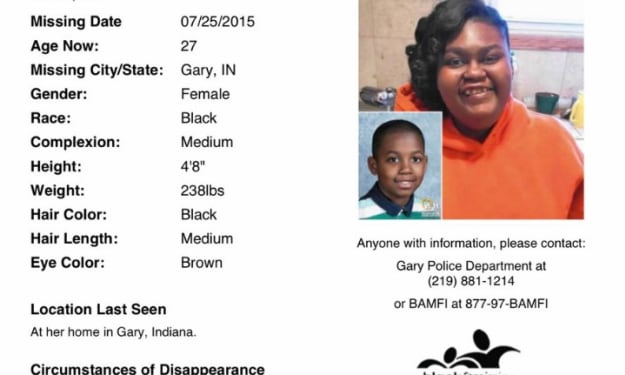
Vanished Without a Trace: The Disappearance of Diamond Bynum and King Walker On the morning of July 25, 2015, a quiet block on Matthews Street in Gary, Indiana became the center of a mystery that still haunts investigators, family members, and the surrounding community nearly a decade later. Twenty-one-year-old Diamond Bynum and her two-year-old nephew King Walker vanished sometime between mid-morning and late morning from the home where Diamond lived with her father and stepmother. Despite search operations, national alerts, reported sightings, and years of investigation, authorities have never located the pair or identified anyone responsible for their disappearance. The case is unusual not only because two people disappeared at the same time, but because both were extremely vulnerable: a young woman with a developmental disability and a toddler who depended entirely on the adults around him. Their disappearance has produced theories ranging from wandering accidents to abduction, yet almost every path investigators followed eventually ran into the same problem—there was almost no physical evidence to guide them. Nearly ten years later, the questions remain: What happened during that short window of time on a summer morning in Gary? Did Diamond leave the house voluntarily? Did someone encounter them after they stepped outside? Or did something happen nearby that investigators simply have never discovered? To understand why this case remains unresolved, it is necessary to look closely at who Diamond and King were, what investigators know about the day they disappeared, and why the search for answers has proven so difficult. The Victims Diamond Bynum Diamond Bynum was 21 years old at the time of her disappearance. She lived in Gary, Indiana with her father, Eugene Bynum Jr., and her stepmother, Suzanne Bynum. The family had moved to the area from Illinois only months earlier. Diamond had been diagnosed with Prader-Willi syndrome, a rare genetic disorder that affects physical growth, cognitive ability, and appetite regulation. Individuals with the condition often experience developmental delays and intellectual disabilities, along with an intense, constant feeling of hunger. Family members and investigators said Diamond’s cognitive functioning was similar to that of a young child. Physically, Diamond was distinctive and easy to recognize. She stood approximately 4 feet 8 inches tall and weighed around 230 to 240 pounds. She walked with a noticeable limp due to a bowed leg and had distinctive dental alignment. These characteristics made her someone people in the neighborhood would likely remember seeing. Family members said Diamond sometimes wandered short distances around the neighborhood in search of food. Because of her condition, she frequently felt hungry and was known to ask people for something to eat. However, relatives said she rarely traveled far and typically stayed within a few blocks of home. Those who knew her described her as friendly and trusting. That trust, investigators later noted, could also make her vulnerable to strangers. King Walker King Walker was just two years old when he disappeared. He had dreadlocks and weighed about 34 pounds. Like most toddlers his age, he was energetic and curious. Family members described him as playful and active. King lived primarily with his mother but spent time with relatives, including Diamond and his grandparents. On the day he disappeared, he had been dropped off at the Bynum home earlier that morning. Because of his age, investigators believed King would not have been capable of traveling far on his own. The Neighborhood The disappearance occurred in the 500 block of Matthews Street in Gary, Indiana. Gary, once a thriving steel industry city, has struggled with economic decline for decades. Many neighborhoods contain vacant lots and abandoned houses left behind after residents moved away. At the time of the disappearance, the surrounding area included: - residential homes - vacant lots - abandoned buildings - railroad tracks - nearby gas stations and fast-food restaurants Investigators would later acknowledge that Gary’s large number of abandoned structures posed a major challenge. Searching every building thoroughly was extremely difficult and sometimes dangerous. Timeline of July 25, 2015 Early Morning On the morning of July 25, King’s mother dropped him off at the Bynum home before heading to a class in Chicago. Inside the home at the time were: - Diamond Bynum - Suzanne Bynum (Diamond’s stepmother) - King Walker Nothing unusual was reported during the early part of the morning. Around 10:20 a.m. Diamond and King were last confirmed seen inside the house. Exactly what happened next remains unclear. Between 10:20 a.m. and 11:00 a.m. Suzanne Bynum went to lie down for a nap. During this window of time, Diamond and King apparently left the house. It is not known whether Diamond intended to take King outside for a short walk or whether the toddler followed her out of the house. Around 11:00 a.m. Suzanne woke up and noticed that both Diamond and King were gone. Initially, the family believed Diamond might have taken King to a nearby store or restaurant. Because Diamond sometimes wandered short distances looking for food, this seemed possible. But when the pair did not return, concern grew. Eventually the family contacted authorities, and police began searching the area. The Initial Police Response Gary police began canvassing the neighborhood shortly after receiving the report that Diamond and King were missing. Because Diamond had a developmental disability, authorities issued a Silver Alert. Silver Alerts are used to help locate missing adults with mental impairments or cognitive conditions. Local residents were asked to watch for a short woman with a limp walking with a toddler. Officers knocked on doors and spoke with neighbors, hoping someone had seen the pair leave the house or walk down the street. No one reported witnessing them leave. K-9 Tracking Evidence One of the most significant clues in the case came from tracking dogs. K-9 units followed the scent believed to belong to Diamond and King from the house down Matthews Street. The dogs continued tracking the scent toward a nearby gas station and the railroad tracks located not far from the home. Then the scent abruptly stopped. For investigators, this raised an important possibility: Diamond and King may have entered a vehicle at that location. However, scent trails can also disappear due to environmental factors such as weather conditions, foot traffic, or contamination from other scents. Because no witnesses reported seeing a vehicle pick them up, investigators were left with more questions than answers. Large Search Operations In the days following the disappearance, search efforts expanded significantly. Authorities searched: - nearby streets - empty lots - abandoned homes - wooded areas - railroad corridors - local businesses Volunteers joined police officers to help comb through the neighborhood. Search teams covered roughly two dozen city blocks surrounding the home. Despite the extensive effort, nothing was found. No clothing, no personal belongings, and no signs of where the pair might have gone. Witness Sightings Several individuals later reported seeing someone matching Diamond’s description with a young child. However, none of these sightings were confirmed. Bus Stop Report One witness said they saw Diamond at a bus stop asking for food. The person claimed they gave her fifty dollars. However, the report did not clearly confirm whether King was with her. Investigators could not verify the sighting. McDonald’s Tip A worker at a McDonald’s believed they saw Diamond and a small child resembling King. Police investigated the tip but could not confirm the sighting. Chicago Checkers Sighting One of the most widely discussed reports came from Chicago. Witnesses claimed they saw Diamond and King eating at a Checkers restaurant in the Roseland neighborhood. According to the report, they were accompanied by an unidentified woman. Roseland is more than twenty miles from Gary. Investigators attempted to verify the sighting but were unable to confirm it. Investigative Challenges Several factors complicated the investigation. First was the lack of physical evidence. No surveillance footage showed the pair leaving the home or walking through the neighborhood. Second was Diamond’s disability. While it meant she might have wandered without understanding the danger, it also meant traveling long distances would likely have been difficult. Third was the environment. Gary’s abandoned buildings created countless places where someone could disappear without being easily discovered. Individuals Investigated During the investigation, police questioned at least one registered sex offender living in the area. Authorities later said the individual was no longer considered a suspect. No arrests have ever been made in connection with the case. Theories About What Happened Over the years, several theories have emerged. Wandering Accident Some believe Diamond left the house with King and became disoriented while walking through the neighborhood. However, search teams covered a large area and found no trace of them. Abandoned Building Accident Because Gary has so many vacant structures, investigators considered the possibility that the pair entered an abandoned house and suffered an accident. Such buildings can contain unstable floors, debris, and other hazards. Vehicle Pickup The K-9 scent trail ending near the gas station raised the possibility that someone picked them up in a vehicle. Whether that person intended to help or harm them remains unknown. Abduction Another possibility is that someone encountered Diamond and King and took advantage of their vulnerability. But no evidence has surfaced to confirm this theory. Years Without Answers Over time investigators continued receiving tips, some suggesting sightings in other states including Florida. None were confirmed. The National Center for Missing and Exploited Children later released an age-progression image showing what King might look like as he grew older. Where the Case Stands Today The disappearance of Diamond Bynum and King Walker remains unsolved. If they are alive today, King would now be around twelve years old and Diamond would be in her early thirties. Gary police continue to ask anyone with information to come forward. For the families involved, the uncertainty remains painful. Without answers, they are left wondering what happened during that brief period of time on a summer morning when two vulnerable people stepped outside and never returned. Nearly a decade later, the mystery of Diamond Bynum and King Walker remains one of Indiana’s most troubling unsolved disappearances.
By Dakota Denise 6 months ago in Criminal
Nuclear Firestorm
When a modern nuclear weapon explodes, the world inside its blast zone changes in a matter of seconds. The moment the weapon detonates, a blinding flash of light brighter than the sun fills the sky. Temperatures at the center of the explosion can reach millions of degrees, hotter than the surface of the sun. Everything close to the explosion—buildings, trees, vehicles, and living creatures—is instantly vaporized.
By imtiazalam6 months ago in Criminal
Inside the Mind of a White-Collar Criminal: How I Embezzled Three Million Dollars Without Anyone Noticing. Content Warning.
The first time I stole from the company I worked for, I took exactly four hundred and seventy-three dollars, a sum so small and insignificant in the context of a corporation generating hundreds of millions in annual revenue that it barely registered as a rounding error in the quarterly financial reports, and I did it not because I needed the money desperately or had fallen into dire financial circumstances, but because I wanted to see if I could, because I had spent five years working as a senior accountant at Morrison Financial Services watching inefficiencies and oversights in our internal controls, and I had gradually realized that our system had vulnerabilities that someone with my knowledge and access could exploit almost effortlessly. That first theft was a test, an experiment to determine whether the safeguards I was supposed to help maintain were actually functional or merely performative, and when weeks passed with no detection, no audit flags, no concerned emails from supervisors, I understood that I had stumbled upon an opportunity that most people in my position would never recognize, much less have the audacity to pursue.
By The Curious Writer6 months ago in Criminal
A Story of Wounds—and Witness
Was slavery a failure of faith? The question echoes down centuries: Where was God when millions were chained, shipped across oceans, and sold like cargo? It is a question born in the belly of ships, in the fields of cane and cotton, and in the quiet spaces where prayers were whispered so softly they would not be heard by the overseer. To face it honestly, we must hold two truths together: faith was twisted to sanctify oppression—and faith was reclaimed to resist it. Between those poles lies the human story of conscience, courage, and the struggle to live up to what we say we believe.
By Press Release 6 months ago in Criminal