
The Weight of Water
A washed-up private investigator takes one final case and discovers that some secrets are buried so deep they have become part of the city's infrastructure

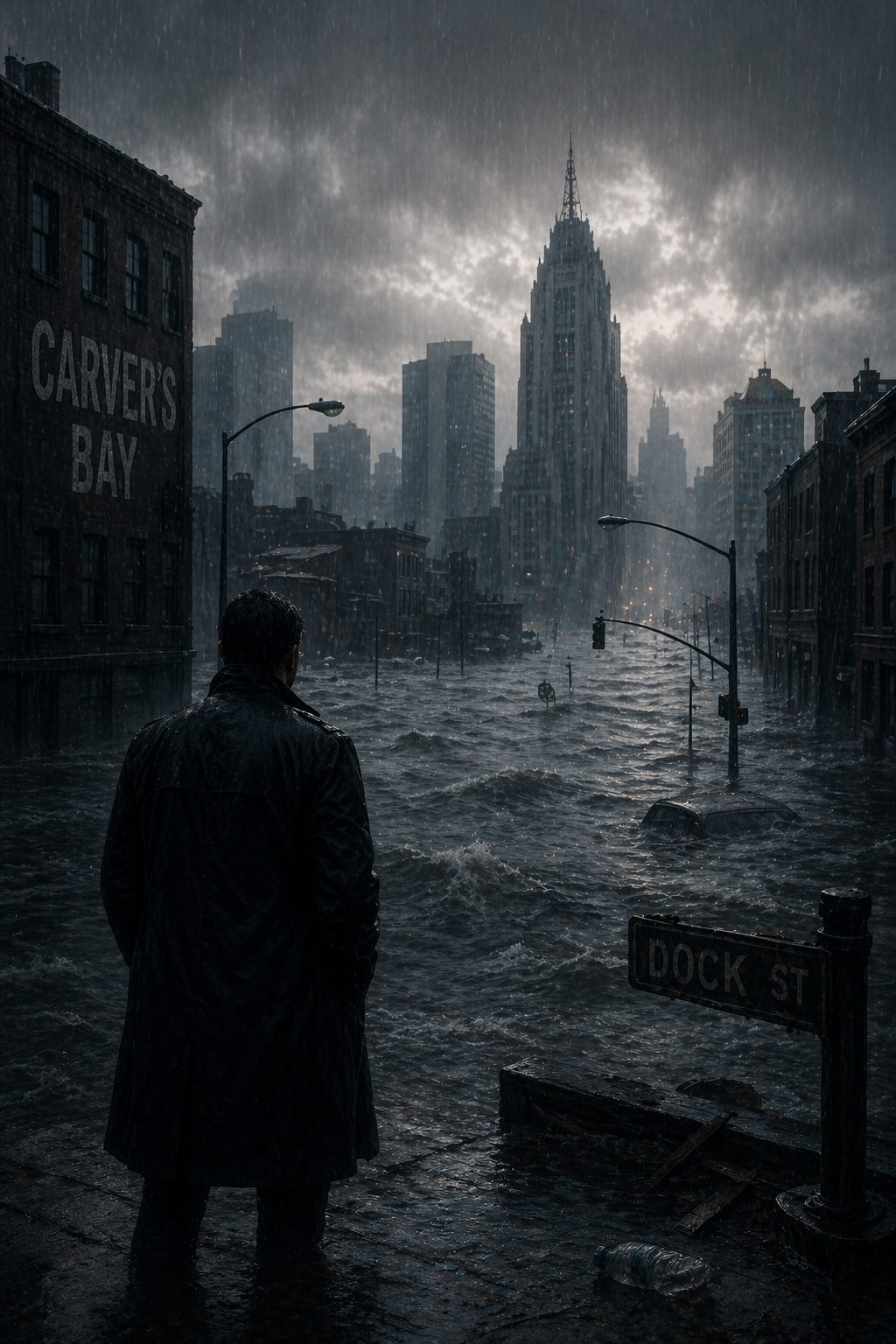
The Drowning City
The rain had not stopped in Carver's Bay for seventeen days. It fell in sheets, in curtains, in a kind of liquid siege that made the city look less like a place of human habitation and more like a ruin at the bottom of an ocean. The streets flooded in increments—first the gutters, then the sidewalks, then the lower stories of the older buildings, which gradually surrendered their ground floors to the water and became monuments to inundation.
Thomas Brennan stood under the awning of his office building on Dock Street and watched the rain. He had been standing there for approximately forty minutes, waiting for his 3 p.m. appointment. It was now 3:47. The appointment had not arrived.
This was typical of his life these days. People who called asking for his services usually did so from a position of desperation or inebriation or both. By the time they sobered up or the desperation faded, they often decided that hiring a detective with a drinking problem and a record of spectacular failures was not actually the wisest use of their remaining resources.
Thomas had learned not to take it personally.
He was about to abandon the street corner when a car pulled up—a vintage Cadillac, the kind that had been out of production for twenty years but that wealthy people sometimes maintained as a kind of affectation. The window rolled down, and a woman's face appeared: middle-aged, expensive cheekbones, the kind of beauty that had been maintained through discipline and money.
"Mr. Brennan?" she asked.
"That's me."
"I'm Eleanor Voss. I apologize for being late. The roads are becoming increasingly impassable." She glanced at the flooded street. "May we speak somewhere dry?"
His office was on the third floor—a single room with a desk, two chairs, and a filing cabinet that contained the names of people he had either helped or failed to help, depending on one's perspective of what constituted success. Eleanor Voss looked around the space with the careful neutrality of someone pricing property.
"I need you to find someone," she said, settling into the chair across from his desk. "A man named David Chen. He disappeared three days ago. He worked in municipal planning for the city—nothing glamorous, just infrastructure development. Water systems, drainage systems, that kind of thing."
"Why come to me?" Thomas asked. "You could hire any number of—"
"I came to you," Eleanor interrupted, "because I was told that you ask difficult questions. That you don't accept convenient answers. That you are, in your way, honest."
Thomas laughed. It was a short, bitter sound. "Honest. That's a generous interpretation of my record. I've made every mistake available to a detective in this city. Missed obvious leads, followed false ones, and on two memorable occasions, solved the case so thoroughly that my client ended up in prison."
"Yes," Eleanor said. "I'm aware of your history. I also know that you never took bribes. That you never buried evidence to help a paying client. That on those occasions when you discovered something that implicated your client's opponent, you reported it anyway. In a city like Carver's Bay, that kind of stubborn morality is rarer than honest police work, which is to say, nearly nonexistent."
She opened her purse and removed a photograph: a man in his early forties, Asian features, ordinary face, the kind of person you would forget within seconds of meeting. "David was my partner. Professionally and personally. He became concerned about something he'd discovered in his work—patterns in the city's water drainage system that didn't match the official records. He began investigating on his own time, cross-referencing old plans with new ones. And then he disappeared."
"Have you contacted the police?"
"Of course. They filed a missing person's report and then shelved it. David had some outstanding traffic violations. Apparently, that makes him the kind of person who disappears of his own volition." Eleanor's voice remained steady, but something in her eyes had hardened. "I don't believe he disappeared voluntarily. I believe someone took him because of what he was investigating."
Thomas took the photograph. He had been a detective long enough to recognize when someone was telling him a truth they had already discovered to be catastrophic. Eleanor Voss believed her partner was dead. She was simply being polite enough not to say so.
"I'll look into it," he said.
The Architecture of Concealment
It took Thomas a week to understand that Eleanor Voss had not told him everything.
He started with the conventional approach: interviewed colleagues, reviewed David Chen's work history, checked the usual locations where missing persons ended up (hospitals, jails, psychiatric facilities, unmarked graves in the marshland outside the city). Nothing. David Chen had left work on a Tuesday, driven home, parked his car, and then ceased to exist in any detectable way.
But the drainage system obsession was real. Thomas found David's apartment and discovered notebooks full of sketches and calculations. The official maps of Carver's Bay's water infrastructure showed a straightforward system: rain fell, water flowed downhill through various channels and pipes, and ultimately drained into the harbor. But David's notes showed something different.
There were sections of pipe that appeared on city records but that David had marked with question marks. There were volumes of water that didn't correspond to any known drainage outlet. There were notations in David's handwriting that simply read: "Where?" and "This is wrong" and, more ominously, "Someone is hiding something very large."
Thomas took these observations to one of his few remaining contacts in the city—Marcus Webb, a city planner who had known David Chen and who owed Thomas a favor from a case five years prior. They met in a bar in the warehouse district, one of the few establishments that remained open despite the flooding.
"You're looking for trouble," Marcus said without preamble. "You understand that, yes? You're asking questions about things that people in this city have chosen not to look at."
"I'm looking for a missing person."
"Then don't look at the water system. Look at the harbor. Look at boat records, shipping manifests, harbor master logs. David was a meticulous man, but he became obsessed with something in those drainage patterns, and that obsession made him dangerous."
"Dangerous to whom?"
Marcus ordered another drink before answering. "To everyone. The city is sinking, Thomas. Have you noticed? We're three feet lower than we were fifty years ago. The subsidence is accelerating. The water table is rising. The whole island that Carver's Bay is built on is essentially in the process of liquefying and returning to the sea it came from."
"So flood control is more important than—"
"Flood control is a fiction," Marcus interrupted. "The water system in this city isn't designed to control floods. It's designed to hide them. To route them. To move them from public view to somewhere that doesn't exist in public records. Decades ago, the city discovered that it was sinking. Rather than evacuate—which would have been economically catastrophic—the government decided to simply not acknowledge it. They built secret systems to handle the water, to move it, to manage it. And anyone who started asking too many questions about those systems..."
"Disappeared," Thomas finished.
"Or was persuaded very thoroughly to stop caring," Marcus said. He finished his drink and left money on the counter. "I suggest you do the same. Some secrets have gotten so deep into the city's infrastructure that they've become indistinguishable from the city itself. Question them, and you're questioning whether the city should exist at all."
The Submerged Records
Thomas knew he should stop. He had learned early in his career that some cases were shaped like rabbit holes, and that falling into them was not a path toward solving anything but rather toward becoming part of the problem. Eleanor Voss would pay him his fee, fire him, and hire someone more pragmatic. Everyone would move on. The city would continue sinking. The rain would continue falling.
But he had spent the last ten years of his life learning to live with a particular kind of shame—the shame of compromise, of knowing the right questions and choosing not to ask them. And Eleanor had specifically hired him because she believed he was the kind of person who couldn't live with that.
She had been right.
Thomas spent a week cross-referencing historical records from the city archives. What he found was a narrative of gradual collapse deliberately obscured by bureaucratic language. In 1987, the first geological survey had noted "accelerated subsidence in the downtown area." By 1995, a follow-up survey reported "concerns regarding long-term structural integrity of the city's infrastructure." By 2005, the language had become almost poetic in its vagueness: "Adaptive management protocols recommended for aquatic systems."
The reports had become progressively more hidden. By the most recent years, they had essentially disappeared from public archives entirely, though Thomas found references to them in the footnotes of other documents, acknowledged but not elaborated upon.
But there was a paper trail, if you knew where to look. There were budget allocations for "emergency water management systems." There were construction permits for projects that had no names, locations that were marked only as grid coordinates, materials lists that included supplies for building in conditions of chronic wetness: stainless steel fittings, waterproof concrete, pumps rated for continuous operation.
Someone had built something very large underneath Carver's Bay.
Thomas had discovered about forty percent of the story when Eleanor Voss came to see him.
She entered his office without knocking, and she was no longer alone. There were two men with her—large men with the particular quality of musculature that suggested either professional athletics or professional violence. Eleanor's face had changed. The careful neutrality was gone. What remained was something colder, something that bore no relationship to the woman who had sat in his office two weeks prior.
"You've asked enough questions," Eleanor said simply.
Thomas understood then that she had been testing him. That hiring him had been an experiment in whether a person of his particular moral rigidity could be maintained in ignorance, or whether he would inevitably dig toward the truth. He had failed that test, or passed it, depending on the perspective.
"Where's David Chen?" he asked.
"Dead," Eleanor said. "Killed three days after he started investigating the water system. It wasn't personal. It was logistics. He knew things that couldn't be unknown. His death was a mercy compared to what happens to people who try to dismantle the system."
"What system? What are you protecting?"
"Not protecting," Eleanor corrected. "Maintaining. The city is sinking. The only thing keeping it from sinking faster is the system we've built beneath it. Massive pumps, billions of gallons moved from the subsurface daily, pressure maintained through concrete and engineering and money. David wanted to make it public. He wanted to evacuate the city, to let it sink, to start over. That would have killed more people than it saved."
"So you killed him instead."
"We solved the problem," Eleanor said. "The city continues. People continue. That's what matters."
Thomas understood the logic. He understood that Eleanor was not a villain in her own narrative—she was a pragmatist, a person who had made the calculation that certain deaths were acceptable in exchange for the survival of a city. And he understood that in approximately sixty seconds, he would become one of those acceptable deaths.
The men moved toward him.
The Drowning
What happened next was not heroic. Thomas did not overcome his attackers through superior martial arts or clever tactics. Instead, he ran. He fled his office, descended the stairs, and burst into the street just as the rain intensified to something almost biblical—not falling water but a horizontal deluge that reduced visibility to approximately ten feet.
He ran through the flooded streets of Carver's Bay, and the city itself seemed to shift around him. The water was everywhere now, rising, pouring from storm drains and seeping through foundations. The very ground beneath his feet felt unstable, as if the city's solid infrastructure was a fiction that had finally given up pretending to be reliable.
He found himself at the docks, where the harbor churned with grey-white turbulence. The water was literally rising before his eyes—inches per minute, as if something massive beneath the earth had shifted and was now releasing everything it had contained.
Thomas understood then what Eleanor had meant about the system. It wasn't designed to prevent flooding. It was designed to delay it, to buy time, to maintain the fiction of a city that was slowly, inexorably, returning to the sea. And somewhere in his pursuit, in his digging, in his questions, he had triggered something—a pressure release, a rupture in the containment, an end to the postponement.
The city was drowning.
Sirens erupted across Carver's Bay. Thomas watched as the controlled chaos he had uncovered became uncontrolled, public, impossible to hide. The water rose. The streets filled. The terrible secret at the city's foundation was exposed to daylight, to weather, to the indifferent observation of eight hundred thousand people who had been living above it unknowingly.
He never did find Eleanor Voss or the two men who had tried to kill him. They were likely somewhere in the city as it surrendered to the water—managing the last logistics of a sinking enterprise, trying to salvage what could be salvaged, protecting until the last moment the lie that had held Carver's Bay upright.
Thomas himself was rescued by a coast guard cutter approximately two hours later, clinging to a piece of driftwood that had once been a street sign.
In the weeks that followed, there was an investigation. The system beneath the city was exposed, documented, analyzed. The scale of the concealment was staggering—years of deliberate deception, millions of gallons moved daily through hidden channels, the entire infrastructure of a city maintained through mechanisms that had never been acknowledged.
The city would be rebuilt, relocated, reinhabited. Carver's Bay would become a cautionary tale about the dangers of prioritizing stability over truth, about how the weight of water, if you try to hide it long enough, will eventually become too heavy to hold.
And Thomas Brennan, having finally asked the right questions, was left with the uncomfortable knowledge that sometimes the answer to a mystery is a catastrophe. That truth, when concealed long enough, returns with the force of a flood.
He never took another case. He moved inland, to a place where the ground didn't shift, where the rain fell and drained away simply, where nothing was hidden beneath the streets because there was nothing worth hiding.
But he never forgot the weight of water.
About the Creator
Alpha Cortex
As Alpha Cortex, I live for the rhythm of language and the magic of story. I chase tales that linger long after the last line, from raw emotion to boundless imagination. Let's get lost in stories worth remembering.
Enjoyed the story? Support the Creator.
Subscribe for free to receive all their stories in your feed.
Comments
There are no comments for this story
Be the first to respond and start the conversation.