
I Woke Up a Trillionaire: What Happened When a Glitch Gave Me the World, and the Law Took It Back
The Legal Price of Digital Greed
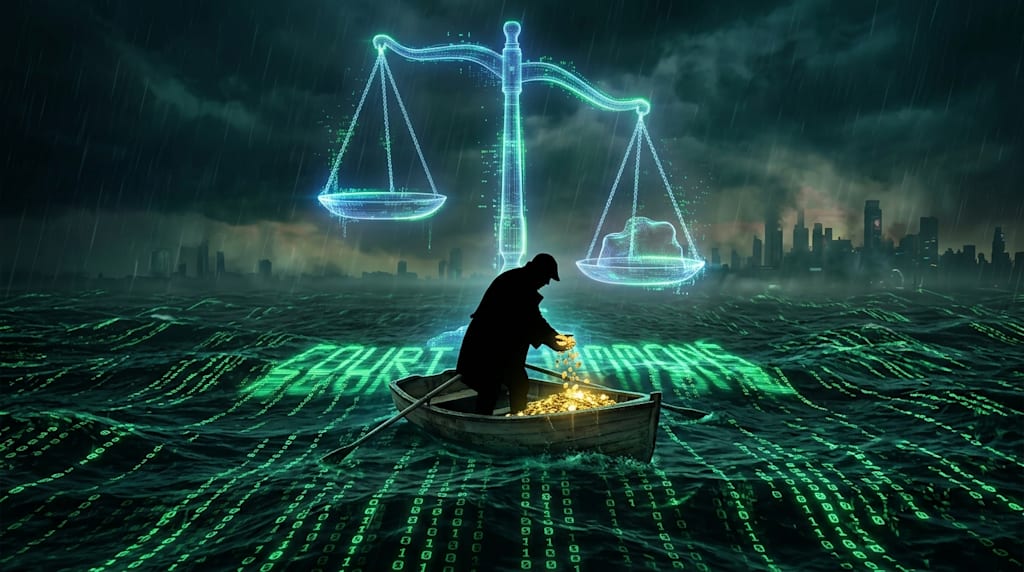
Shanghai, September 27, 2025.
Li Mou transferred 1,000 yuan to his platform account to buy promotional services. It was a routine transaction—he paid, the platform credited the amount, fair and clear, no explanation needed.
But the backend operator pasted the wrong number into the input field. That number was not an amount; it was another user's account ID: 2641993383745792.
So that 1,000-yuan top‑up became a deposit of 26,419,933,837,457,920 yuan.
In an instant, Li's account balance exceeded the GDP of most countries on Earth.
He did not call customer service. He opened the platform and started spending.
Three weeks later, the platform discovered the error, froze his account, clawed back the remaining balance, terminated the services he had not yet consumed, and sent him a formal letter demanding the return of the excess funds.
Li did not reply.
In 2026, the court judgment arrived: he must return 252,281.31 yuan—the amount he had actually spent.
The legal ground: unjust enrichment.
I. What "unjust enrichment" actually means
Article 985 of the Civil Code is clear: a person who obtains unjustified benefits without legal basis shall return them.
In plain language, it is even simpler: what belongs to someone else, you give back.
The platform made the mistake—that was their fault. But the law does not look at who made the first error; it looks at whether you have a legitimate reason to hold on to the money.
Li received that sum neither because he provided equivalent service, nor because the platform gave it to him as a gift. It came purely from a clerical slip. From the very first second it appeared in his account, that money had no foundation of legality.
The court did not find him "guilty." It found him "obligated to return."
The difference: the first is punishment; the second is restitution. The law's job is to reset a system that has been accidentally knocked off balance.
II. Why he did not go to prison
Many commenters asked: isn't this embezzlement? Why wasn't he arrested?
The answer lies in the clear boundary between civil and criminal law.
The crime of embezzlement does exist. Article 270 of the Criminal Code says that anyone who unlawfully takes possession of another's lost property or buried property, in a relatively large amount, and refuses to return it, may be criminally liable.
But criminal law is the last door. It opens only where civil law cannot reach.
In this case, Li spent 250,000 yuan, but the platform clawed back most of the funds through technical means. The money was still there, the loss was measurable, and the dispute never escalated to a point of total breakdown. More importantly, his "refusal" was passive: he simply did not respond to the demand letter. He did not liquidate the funds, transfer them offshore, or disappear.
The court showed restraint here: if you can repay, you don't go to jail.
That is not indulgence. It is proportionality. The severity of criminal punishment must match the harm of the act. Using criminal liability to handle a civil debt dispute is like turning a fire hose on a potted plant—possible, but unnecessary.
III. A business scenario that could never succeed
Someone proposed a bolder thought experiment:
If mistaken top‑ups can be recovered, why doesn't the platform just credit 26 trillion to every user, let them spend, then sue them all one by one? Wouldn't that boost the economy?
It sounds like a cunning business loop—but it holds only at the level of conspiracy theory.
At the legal level, it collapses from the start.
Unjust enrichment has a hidden premise: no legal basis. If the platform makes an accidental error, that is a mistake and can be reversed. But if the platform intentionally and actively credits the amounts, the nature changes to gift. A gift is a lawful act of transfer; once given, you cannot take it back. A court would never support a plaintiff who deliberately created a loss and then sued to recover it, because that violates the principle of good faith that underpins all civil activities.
And deeper still: if a platform actually tried this, its problem would not be "can we get the money back"—it would be "can we stay in business." Malicious litigation, abuse of judicial resources, artificially creating false claims—any one of these labels would be enough to drive a company out of the market.
The real flaw in that script is not its logic but its premise: it assumes the law can be tricked by technicalities. But the legal system is not a piece of code that can be injected with malicious instructions. It has an underlying protocol called good faith.
IV. The bigger question is not about the account balance. It is about us.
Looking at the whole story, the question worth asking is not really "should Li pay?" It is another one:
If your account suddenly received more money than you could spend in a lifetime, what would you do?
This is not a moral quiz. It is a stress test. It tests not whether you know the law, but whether, when the temptation is huge and the cost of enforcement seems distant, you can still remember a simple fact: this money is not mine.
Li's choice was: spend first, deal with it later.
He did not think about what that 14‑digit number actually meant, nor about how the platform would come looking for it three weeks later. He saw a string of zeros, and clicked "confirm payment."
Those zeros later translated into a specific number: 252,281.31 yuan.
That was what he actually spent. And that was what he eventually had to pay out of his own pocket.
After the verdict, the judge remarked—plain, almost casual, but worth pasting above every digital account login page:
"Citizens should uphold the principle of good faith and promptly return any money that does not belong to them."
No exclamation mark. No profound reflection. No "this makes us think." Just a statement of fact.
V. Ending on one single action
Picture the scene:
On the evening of September 27, 2025, Li closed his laptop, picked up his phone, and saw that long string of digits in his account balance.
How long did he stare at the screen? Three seconds? Ten?
Then he moved the mouse over the "confirm payment" button and clicked.
That click, by itself, is the whole answer.
Not greed. Not opportunism. Not "the platform deserved it." It was an ordinary click—the kind we make dozens of times a day. The only difference was that behind that day's number, there were 14 extra zeros.
And those 14 zeros eventually turned into a court summons and a 250,000‑yuan bill.
The story ends here.
No elevation. Just an account, a sum, a click, and a letter that was never answered.
About the Creator
Jin
Writer of reamstories
https://reamstories.com/jin
Enjoyed the story? Support the Creator.
Subscribe for free to receive all their stories in your feed. You could also become a paid subscriber, letting them know you appreciate their work.
Comments
There are no comments for this story
Be the first to respond and start the conversation.