
Hwaseong Serial Murders Explained: The Shocking True Crime Story of South Korea’s Most Notorious Serial Killer
The chilling story of Lee Chun-jae, the “Devil of Hwaseong,” and how DNA evidence finally exposed a killer decades after his crimes.

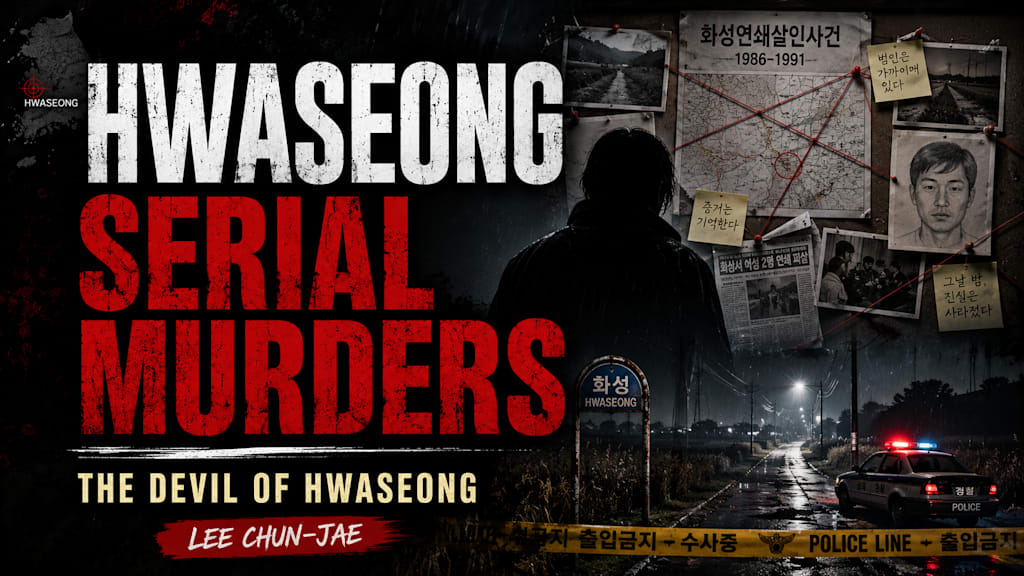
Content Warning: This article discusses murder and sexual violence.
For decades, the Hwaseong serial murders were considered one of South Korea’s most disturbing unsolved criminal mysteries. Between 1986 and 1991, a series of murders in Hwaseong, Gyeonggi Province, terrified the country and triggered a massive police investigation.
Yet despite years of questioning suspects and examining evidence, investigators failed to identify the killer.
More than three decades later, advances in DNA technology finally revealed his identity: Lee Chun-jae, a convicted murderer who was already serving a life sentence for another crime.
The Hwaseong Serial Murder Case
The original Hwaseong investigation focused on 10 murders of women and girls between 1986 and 1991. The victims ranged widely in age, and the crimes created fear throughout the rural area south of Seoul.
The investigation became one of the largest and most famous in South Korean criminal history. Thousands of people were questioned, but the technology available during the 1980s and early 1990s could not provide investigators with the breakthrough they desperately needed.
For years, it appeared that the killer had escaped justice completely.
Who Was Lee Chun-jae?
Lee Chun-jae was not a free man when police finally connected him to the murders.
He was already serving a life sentence for the rape and murder of his sister-in-law in 1994.
In 2019, investigators reopened the old Hwaseong evidence and used improved forensic techniques to examine DNA samples preserved from the crime scenes.
The results changed the case forever.
DNA recovered from old evidence matched Lee Chun-jae, giving police their first major scientific link to the mysterious serial killer they had been searching for decades earlier.
Lee Chun-jae Confesses to 14 Murders
After investigators confronted Lee, the case became even bigger than previously believed.
Lee confessed to 14 murders and numerous sexual crimes.
When police completed their reinvestigation in 2020, they concluded that Lee was responsible for all 10 killings traditionally known as the Hwaseong serial murders as well as four additional murders.
Police also confirmed nine additional rape-related crimes through evidence during their investigation.
Lee later appeared in court and publicly admitted that he had murdered 14 women and girls.
An Innocent Man Spent 20 Years in Prison
One of the most disturbing parts of the Hwaseong case was the wrongful conviction of Yoon Seong-yeo.
Yoon had been convicted in connection with the 1988 murder of a 13-year-old girl, a crime considered part of the Hwaseong series.
He spent about 20 years in prison.
After Lee Chun-jae admitted committing the murder, Yoon received a retrial. In December 2020, the Suwon District Court overturned his conviction and declared him not guilty.
The court also apologized for the wrongful conviction and failures connected to the original investigation.
The revelation showed that the Hwaseong story was not only about a serial killer who escaped identification for decades—it was also about an innocent person losing a huge part of his life for a crime he did not commit.
Why Lee Chun-jae Was Not Prosecuted for the Hwaseong Murders
Although police eventually identified Lee as the killer, another shocking problem remained.
The statute of limitations had expired for the old crimes.
As a result, Lee could not be newly prosecuted for the Hwaseong murders even after investigators concluded that he was responsible.
However, he remained imprisoned because he was already serving a life sentence for the 1994 murder of his sister-in-law.
The Case That Inspired Memories of Murder
The Hwaseong serial murders became internationally famous partly because they inspired director Bong Joon-ho’s 2003 film Memories of Murder.
The film presented a fictionalized version of detectives struggling to solve the murders at a time when modern forensic technology was unavailable.
For years after the movie was released, the identity of the real killer remained unknown.
Then, in 2019, reality finally provided the answer the investigation had failed to find decades earlier.
How DNA Solved a Decades-Old Cold Case
Perhaps the most important part of the Hwaseong investigation is what it demonstrates about forensic science.
Evidence that could not identify a suspect in the 1980s became incredibly valuable decades later.
Improved DNA analysis allowed investigators to revisit preserved material and connect it to Lee Chun-jae.
A case once believed to be almost impossible to solve suddenly had a name attached to it.
Final Thoughts
The story of Lee Chun-jae and the Hwaseong serial murders remains one of the most haunting true crime cases in South Korean history.
For decades, families waited for answers while investigators struggled to identify the person responsible.
Then science caught up with the evidence.
The case also remains a warning about the devastating consequences of investigative failures. One innocent man spent around two decades behind bars while the real killer remained unidentified.
Lee Chun-jae may have avoided a new prosecution for the Hwaseong murders because the statute of limitations had expired, but he did not remain anonymous forever.
More than thirty years after the crimes began, South Korea finally learned the identity of the man behind one of its darkest criminal mysteries.
About the Creator
parwinder singh
🎬 Movie & Entertainment Writer sharing reviews, ending explanations, story breakdowns, plot twists and hidden details from Bollywood, Hollywood, South Indian cinema, Korean dramas and OTT releases.
Enjoyed the story? Support the Creator.
Subscribe for free to receive all their stories in your feed.
Comments
There are no comments for this story
Be the first to respond and start the conversation.