
He Drank, Sped, and Drove With His Lights Off. The Report Still Blamed the Dead Couple.
On a dark Shanxi highway, two elderly pedestrians were killed. The accident finding says they failed to “confirm safety.” Their family wants to know how.
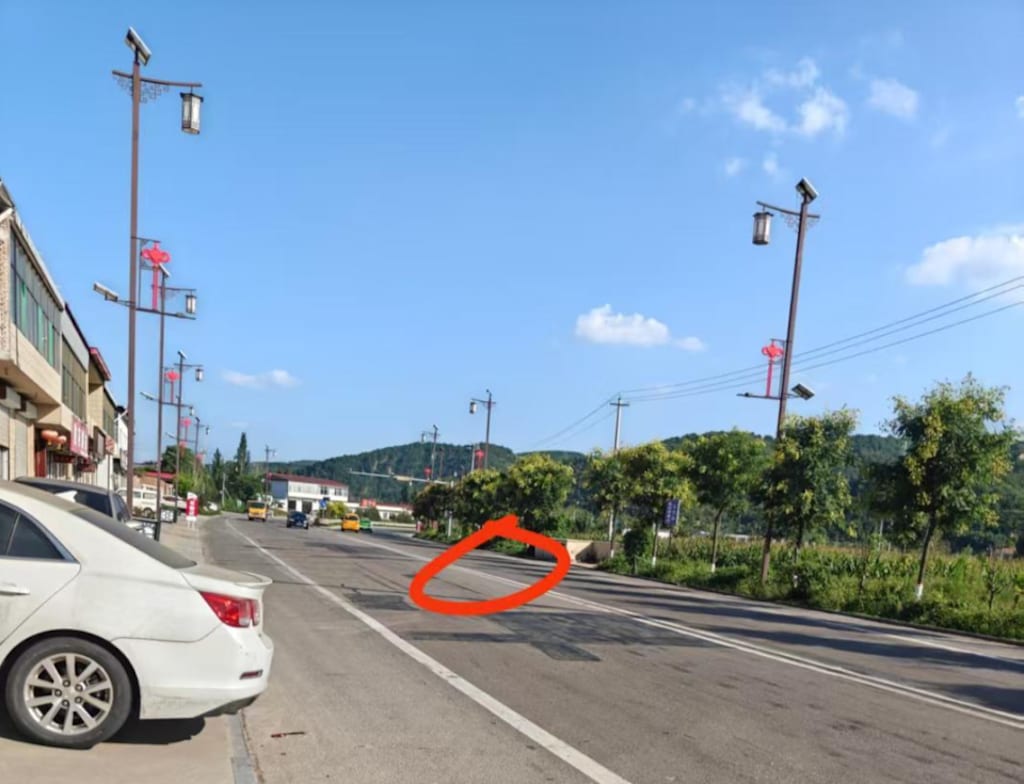
A dark night on the national road: drunk driving, no headlights, and a finding of “secondary responsibility”
1. The crash
August 13, 2026, 10 p.m. National Highway 520, east entrance of Xueguan Village, Pu County, Linfen, Shanxi.
No streetlights. Zhang, 57, pushed a handcart. His wife, Guo, 53, walked beside him. They were crossing the road.
A white sedan approached from behind. Its lights were off. When it struck them, the brake lights flashed once. Two seconds later, the brake lights went out. The car left the surveillance frame.
Guo died at the scene. Zhang was rushed to hospital but did not survive.
The driver, Du, was a principal staff member of the Xueguan Town Government. His blood alcohol content was 147.01 mg/100 ml. The speed limit was 40 km/h; he was driving at 52 km/h. He had not turned on his headlights.
2. The finding
On August 22, the Pu County Public Security Bureau Traffic Management Brigade issued an accident determination.
Du bore primary responsibility. Zhang and Guo bore secondary responsibility.
The determination cited Article 62 of the Road Traffic Safety Law: when pedestrians cross a road at an intersection without traffic signals or a crosswalk, or at a section without crossing facilities, they “shall confirm safety before crossing.”
The traffic police found that the couple had failed to confirm safety and therefore bore fault.
The family rejected this. On September 12, the Pu County Public Security Bureau issued a notice confirming that the family had submitted a written application for review to the Linfen Municipal Public Security Bureau Traffic Management Detachment. The detachment accepted the application and started review proceedings.
3. The problem with “confirm safety”
Article 62 reads: “Pedestrians crossing a road at an intersection or otherwise shall use a pedestrian crosswalk or crossing facility; where there are traffic signal lights at a pedestrian crosswalk, they shall pass according to the signal indications; where there are no traffic signal lights or pedestrian crosswalks at an intersection, or where there are no crossing facilities on a road section, they shall confirm safety before crossing.”
The provision itself is not the problem. The problem is that confirming safety requires conditions for observation.
At night, crossing a national highway, pedestrians judge whether a vehicle is approaching by headlights and engine sound. Du had not turned on his lights. A car without lights, approaching from behind at 52 km/h (about 14.4 meters per second), was bearing down on a 57-year-old and a 53-year-old with a handcart on a national highway. They had no way to confirm its existence or distance.
Causation runs in one direction. The pedestrian’s failure to confirm safety is the result; the elimination of the conditions for observation is the cause. The cause comes first, the result after. To attribute the result to the pedestrian is to say they failed to confirm something that was objectively impossible to confirm.
The legislative intent of Article 62 is to urge pedestrians to exercise reasonable care. The standard of reasonable care should presuppose that the pedestrian can observe effectively. When the motor vehicle party’s unlawful conduct directly negates that presupposition, assigning fault to the pedestrian for failure to confirm safety does not hold up under causation analysis.
4. How responsibility is divided
Article 60 of the Provisions on the Procedures for Handling Road Traffic Accidents states that traffic police departments shall determine responsibility based on the role each party’s conduct played in causing the accident and the severity of each party’s fault.
The standard is causal force and degree of fault, not a count of violations.
Du’s faults: drunk driving, 147.01 mg/100 ml; speeding, 52 in a 40 zone; and failure to use headlights at night. All three actively created risk. Drunk driving reduces reaction capacity, speeding shortens reaction time, and driving without lights eliminates the possibility of being observed. Combined, the accident was almost inevitable.
Zhang and Guo’s fault: crossing a national highway without a crosswalk. But crossing itself is not unlawful. Article 62 permits crossing at sections without crossing facilities, on the condition that safety is confirmed. The question returns to the previous section: whether the premise for confirming safety existed.
If the premise did not exist, the alleged fault loses its attributability.
Article 76 of the Road Traffic Safety Law sets out the logic: between a motor vehicle and a pedestrian, if the pedestrian is not at fault, the motor vehicle bears full liability; if the pedestrian is at fault, the motor vehicle’s liability is “appropriately reduced” according to the degree of fault. The operative phrase is “appropriately reduced.” Even if the pedestrian is at fault, the reduction should match the degree of fault. Where the motor vehicle party has committed three serious violations, drunk driving, speeding, and driving without lights, the causal force of the pedestrian’s alleged fault is almost negligible compared with the motor vehicle party’s conduct.
5. Review and civil litigation
The review process has begun. The Linfen Municipal Public Security Bureau Traffic Management Detachment is reviewing the scene investigation, forensic examinations, evidence, and the basis for the original determination.
Review is not the only path. An accident determination is evidence, not a final ruling. Even if the review upholds the original finding, the family can, in later civil litigation, raise objections and ask the court to re-divide fault ratios based on all the evidence. The court can independently determine the degree of fault and the proportion of compensation liability.
The responsibility division in the accident determination does not determine the final proportion of civil compensation.
6. Criminal liability and “secondary crushing”
Du drove drunk and caused two deaths while bearing primary responsibility. He is suspected of the crime of causing a traffic accident.
Article 133 of the Criminal Law and the Supreme People’s Court interpretation on traffic accident cases provide that where two or more people die and the perpetrator bears all or primary responsibility, the case constitutes “other especially serious circumstances,” punishable by three to seven years in prison. Drunk driving is an aggravating circumstance.
But the surveillance video provided by the family shows that after the impact, the brake lights came on and then went out. Two seconds later, the vehicle left the frame. The family suspects a “secondary crushing,” that the vehicle ran over the victims again. The accident determination does not mention this.
This issue has separate legal consequences.
The crime of causing a traffic accident is a negligent offense. Intentionally running over a victim a second time and causing death can constitute intentional homicide. The former carries a maximum of seven years, or seven to fifteen years if death results from escape. The latter can carry the death penalty, life imprisonment, or more than ten years in prison.
Subjective intent is decisive. The question is whether, after the first impact, the driver knew that the victim was under or beside the vehicle and still continued driving or reversed. This requires judgment based on the vehicle’s trajectory, brake light status, the driver’s statements, autopsy reports, and other evidence. These facts have not yet been established. The criminal investigation should focus on them.
7. Public official discipline
Du is a principal staff member of the Xueguan Town Government and oversaw work safety, among other duties.
Article 14 of the Law on Administrative Discipline of Public Officials provides that a public official who intentionally commits a crime and is sentenced to criminal punishment shall be dismissed from public office; one who commits a negligent crime and is sentenced to fixed-term imprisonment of more than three years shall generally also be dismissed.
The Regulations on Disciplinary Action of the Communist Party of China provide that a Party member who intentionally commits a crime and is sentenced to criminal punishment shall be expelled from the Party; one who commits a negligent crime and is sentenced to three or more years in prison shall generally be expelled.
Drunk driving causing death is a negligent crime, but the circumstances are especially serious. Du will most likely face dismissal from public office and expulsion from the Party.
8. The family
Zhang Peng is the son of Zhang and Guo. On September 13, he told Red Star News that his parents’ remains were still in the funeral home. The perpetrator’s side had not come to apologize.
He and his family went to the town government. There were multiple negotiations, but no agreement was reached on compensation. After the accident determination was issued, he applied for review and received notice that it had been accepted. The review result has not yet come out.
He has watched the surveillance video many times. At 51 seconds, his parents appear in the right foreground. At 1 minute 25 seconds, they reach the middle of the road, and the light goes out. At 1 minute 49 seconds, a police car passes by without stopping. At 2 minutes 3 seconds, a white sedan appears at the top of the frame, lights off, approaching from behind his parents. At 2 minutes 9 seconds, the vehicle jolts. The brake lights come on. It does not stop. Two seconds later, the brake lights go out.
Zhang Peng says that the brake lights coming on and then going out suggests a possible secondary crushing.
The accident determination does not contain those words.
9. Official statements
The Pu County Public Security Bureau notice states: Du has been criminally detained. The family objects to the road traffic accident determination and has submitted a written application for review. The Linfen Municipal Public Security Bureau Traffic Management Detachment has accepted it in accordance with law and started review proceedings, reviewing the scene investigation, forensic examinations, evidence, and the basis for the original responsibility determination.
The notice does not mention “secondary crushing.”
A staff member at the Xueguan Town Government said Du had not come to work since the incident and that further information would follow official notices.
Zhang Peng is waiting for the review result. His parents’ remains are still in the funeral home. He said: “There must be an explanation.”
About the Creator
Jin
Writer of reamstories
https://reamstories.com/jin
Enjoyed the story? Support the Creator.
Subscribe for free to receive all their stories in your feed. You could also become a paid subscriber, letting them know you appreciate their work.
Comments
There are no comments for this story
Be the first to respond and start the conversation.