
Charles Ponzi Scam Explained: The True Crime Story Behind the World’s Most Famous Ponzi Scheme
How one charming con man convinced thousands of people to hand over their savings and turned his name into a permanent warning in the world of finance.

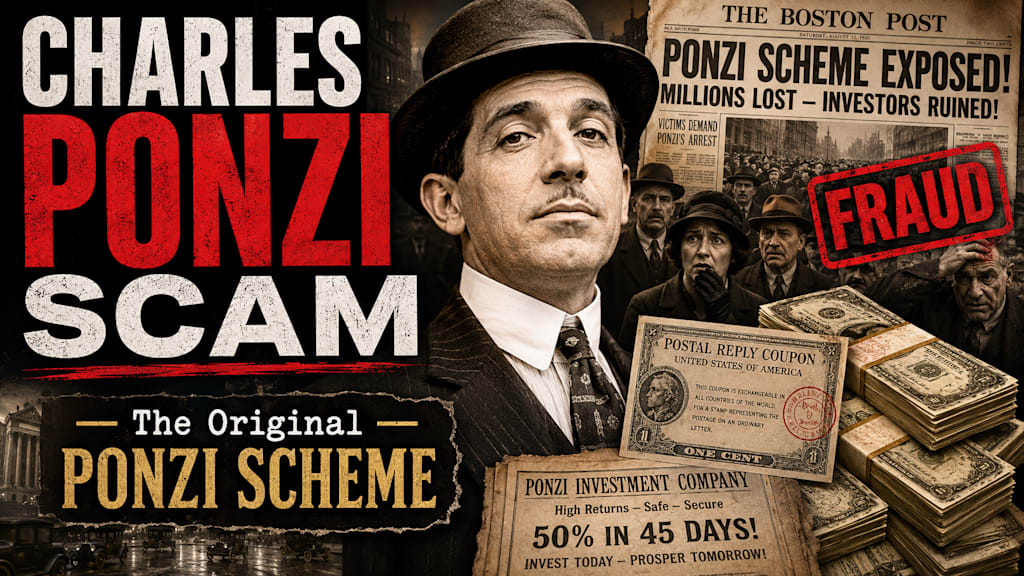
More than a century after his spectacular rise and fall, the name Charles Ponzi is still associated with one of the most notorious forms of investment fraud.
Whenever authorities expose a scheme in which money from new investors is secretly used to pay earlier investors, it is usually described as a Ponzi scheme. But who was Charles Ponzi, and how did his scam become so famous?
His story is a fascinating piece of financial crime history involving ambition, unbelievable promises, public obsession and a system that could survive only while new money continued to arrive.
Who Was Charles Ponzi?
Charles Ponzi was an Italian immigrant who arrived in the United States in the early 20th century hoping to build a better life.
According to historical accounts, Ponzi arrived in Boston in 1903 with very little money. Before becoming famous, his life included financial struggles and previous encounters with the law.
But in 1919 and 1920, Ponzi discovered an idea that would eventually make him one of America's most famous con men.
The idea involved International Reply Coupons, commonly known as IRCs.
These postal coupons could be purchased in one country and exchanged for postage stamps in another. Because currency values differed between countries, Ponzi claimed there was an opportunity to make enormous profits by purchasing coupons cheaply overseas and redeeming them in the United States.
The concept sounded complicated enough to appear believable.
And Ponzi knew how to sell it.
Charles Ponzi's Incredible Investment Promise
Ponzi created the Securities Exchange Company and began asking people to invest in his postal coupon business.
His promise was extraordinary.
Investors were reportedly offered around 50% profit in only 45 days, with even larger returns promised over longer periods.
For ordinary people, the offer sounded like an opportunity to become wealthy almost overnight.
At first, investors actually received their promised returns.
That created trust.
People told their friends and relatives about Ponzi. More investors arrived. Some people even reinvested their supposed profits instead of withdrawing them.
Soon, enormous amounts of money were flowing into Ponzi's operation.
How the Ponzi Scheme Really Worked
The secret was much simpler than Ponzi's complicated explanation about international postal coupons.
There was not enough legitimate profit from postal coupons to generate the returns he promised.
Instead, money received from new investors was used to pay earlier investors.
That created the illusion that the investment was successful.
When early customers received their money, they became powerful advertisements for the scheme. Their success encouraged other people to invest.
This is the basic structure that today is known as a Ponzi scheme. According to the U.S. Securities and Exchange Commission's Investor.gov website, such schemes survive only while enough new money continues entering the system.
Eventually, every system like this faces the same problem.
It needs an endless supply of new investors.
And an endless supply of investors does not exist.
How Big Did Charles Ponzi's Scam Become?
Ponzi's operation expanded at an astonishing speed.
Smithsonian reports that he collected an estimated $15 million in around eight months, attracting tens of thousands of investors. At one point, approximately 40,000 people had reportedly joined the investment frenzy.
Ponzi suddenly lived like a wealthy financial genius.
He purchased an expensive home, automobiles and other symbols of success.
His luxurious lifestyle strengthened his reputation.
To many people, his wealth seemed like proof that his investment system worked.
But behind the image of success, the financial structure was collapsing.
The Investigation That Destroyed Charles Ponzi
As Ponzi became increasingly famous, journalists and government officials started asking uncomfortable questions.
Could postal coupons really generate enough money to support the extraordinary returns he was promising?
An examination of his finances revealed enormous problems.
Historical accounts describe Ponzi's company as millions of dollars in debt when investigators examined its books. Smithsonian notes that an audit initially found him approximately $3 million in the red, a figure later revised upward.
Investor confidence began disappearing.
People rushed to withdraw their money.
Once large numbers of investors demanded repayment, the system could no longer survive.
Ponzi was arrested in 1920 and charged with using the mail as part of a scheme to defraud investors. He later pleaded guilty and received a prison sentence.
His financial empire had collapsed almost as quickly as it had appeared.
What Happened to Charles Ponzi After the Scam?
Prison did not completely end Ponzi's involvement in questionable financial ventures.
After facing additional legal problems, he eventually went to Florida and became involved in another scheme connected to selling land.
He was later returned to Massachusetts to serve additional prison time.
After his release, Ponzi was deported to Italy in 1934.
He eventually moved to Brazil, where he died in 1949.
The fortune and glamorous lifestyle that had once made him famous were long gone.
But his name survived.
Why Is It Called a Ponzi Scheme?
Charles Ponzi did not invent the basic idea of paying old investors with money collected from new ones.
Similar scams had existed before him.
However, his 1920 operation became so famous that his surname became permanently associated with this type of investment fraud.
Today, regulators around the world continue to use the term Ponzi scheme.
The formula remains surprisingly similar:
Someone promises unusually high or consistent returns.
Early investors are paid.
Those investors tell others about their success.
More money enters the operation.
Eventually, new investments slow down or too many investors request withdrawals.
Then the entire system collapses.
The Real Lesson Behind the Charles Ponzi Story
The Charles Ponzi scam happened more than 100 years ago, but the psychology behind it remains relevant.
People naturally want financial security and opportunities to improve their lives.
Fraudsters understand that desire.
Promises of extremely high returns with little or no risk should therefore be treated cautiously. Investor.gov identifies unusually high guaranteed returns as one of the major warning signs associated with Ponzi schemes.
Charles Ponzi's greatest skill was not discovering a revolutionary financial system.
It was convincing thousands of people that he had.
And that is why, more than a century later, his name remains one of the most famous warnings in financial history.
About the Creator
parwinder singh
🎬 Movie & Entertainment Writer sharing reviews, ending explanations, story breakdowns, plot twists and hidden details from Bollywood, Hollywood, South Indian cinema, Korean dramas and OTT releases.
Enjoyed the story? Support the Creator.
Subscribe for free to receive all their stories in your feed.
Comments
There are no comments for this story
Be the first to respond and start the conversation.