
CABIN 28:
Four Victims, A Missing Girl, A Vanishing Tape, And A Confession Nobody Can Prove

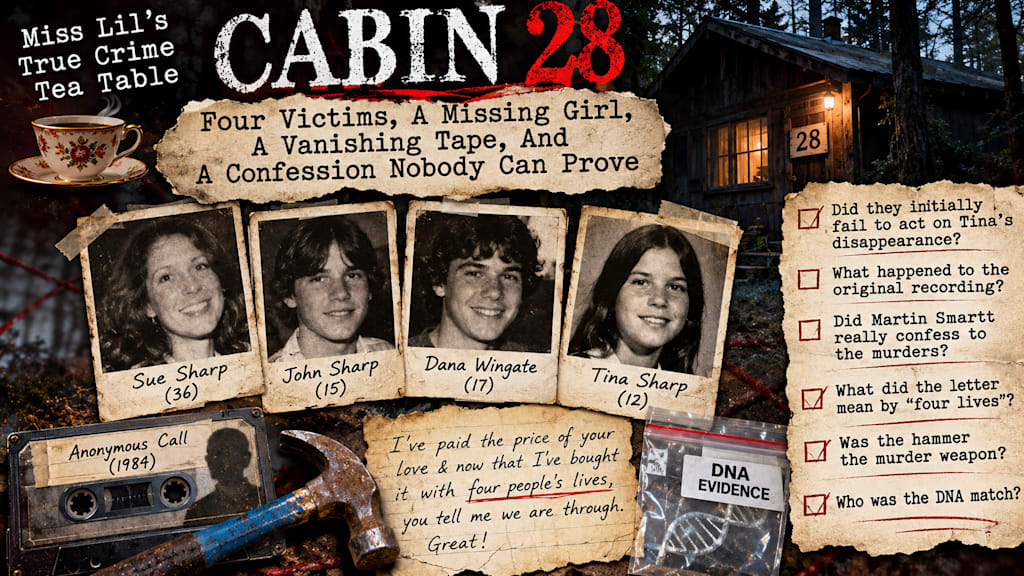
CABIN 28: Four Victims, A Missing Girl, A Vanishing Tape, And A Confession Nobody Can Prove
Miss Lil's True Crime Tea Table
Well, pull up a chair, put the kettle on, and maybe lock the front door. Today's case has enough unanswered questions to make even Miss Lil put down her coffee and reach for something stronger. And no, we're not talking about the good stuff in the liquor cabinet.
Today we're heading to Keddie, California, a small mountain community where a quiet Saturday night in April 1981 turned into one of the most disturbing unsolved murder cases in the state's history.
Four people dead. A twelve-year-old girl missing. An investigation plagued by overlooked evidence, questionable decisions, and a recording that apparently spent decades sitting in an evidence envelope without anyone listening to it.
Then there's the handwritten letter, the alleged confession to a mental health professional, and a hammer pulled from a pond years after the murders.
And somehow, after more than four decades, nobody has been convicted.
Miss Lil has her tea, her notebook, and a whole lot of questions. Let's open this file.
APRIL 11-12, 1981: WHAT HAPPENED AT CABIN 28?
The Sharp family lived at Cabin 28 in the Keddie Resort, a small community in Plumas County, California.
Glenna Susan "Sue" Sharp, 36, had moved there from Connecticut with her five children after separating from her husband.
On April 11, 1981, Sue and her fourteen-year-old daughter Sheila traveled to Quincy, where they picked up Sue's fifteen-year-old son John and his seventeen-year-old friend Dana Wingate.
That evening, the family members went their separate ways.
Sheila went to spend the night at the neighboring Seabolt family's cabin. John and Dana returned to Cabin 28. Sue remained home with twelve-year-old Tina, ten-year-old Rick, and five-year-old Greg. A neighborhood boy, Justin Eason, was also staying overnight.
Sometime during the night, something absolutely horrific happened.
Neighbors reported hearing muffled screaming from the direction of Cabin 28 at approximately 1:15 a.m.
The following morning, Sheila returned home.
What she found would change her family's lives forever.
Her mother, Sue, her brother John, and Dana were dead in the living room.
All three had been bound with electrical cord and medical tape. They had suffered brutal injuries involving stabbing, strangulation, and blunt-force trauma.
The three younger boys, Rick, Greg, and Justin, were found alive in a bedroom.
But Tina was nowhere to be found.
And that brings us to our first uncomfortable question.
THE MISSING GIRL: DID ANYONE REALIZE TINA WAS GONE?
Let's establish something important before we get into the questions surrounding the investigation.
Twelve-year-old Tina Sharp was not found among the victims at Cabin 28. She had disappeared sometime during the attack.
Sheila was the person who discovered the bodies. She had been sleeping at the neighboring Seabolt residence and returned the following morning.
The surviving boys had been asleep in another bedroom.
There have been conflicting accounts over the years concerning what Justin Eason witnessed and what he told investigators. Later accounts of his statements, including information reportedly obtained during hypnosis sessions, described Tina waking up, seeing what was happening, and being carried out of the cabin by a man.
That is a particularly disturbing detail.
However, we need to distinguish those later accounts from what was actually established at the crime scene. There is no reliable basis for stating as fact that Justin immediately told responding officers Tina had been abducted and that they simply ignored him.
What is clear is that Tina was missing, and her disappearance became a separate and urgent part of the investigation.
Her remains would not be discovered until April 1984, approximately three years later, near Feather Falls in Butte County, roughly fifty miles from Keddie.
The remains were identified as Tina through forensic examination, including dental records.
Three years.
Think about that. A twelve-year-old girl disappeared from a home where three people had been murdered, and her family had to live with not knowing what had happened to her.
Miss Lil has a hard time wrapping her head around that one.
Who took Tina? Why was she taken? And what happened to her during those three years?
Those questions remain central to this case.
THE AUDIO RECORDING THAT APPARENTLY WENT NOWHERE
Now we're getting to the part that makes Miss Lil's eyebrows climb toward her hairline.
In April 1984, a man searching for bottles near Feather Falls discovered human remains. The discovery included part of a skull and additional skeletal material.
On May 30, 1984, an anonymous man called the Butte County Sheriff's Office.
The caller was watching news coverage about the discovery and asked whether investigators had considered a connection to the Keddie murders, specifically mentioning the twelve-year-old girl who had never been found.
Now, here's what makes this interesting.
The remains had not yet been officially identified as Tina Sharp.
Yet this caller was making the connection.
Who was he? How did he know enough to make that connection? Was he someone familiar with the crime? Did he have information that had never been shared publicly?
We don't know.
And then there's the recording itself.
For years, the whereabouts of the original recording and copies of that call were a source of confusion. Accounts of the investigation indicated that law enforcement agencies did not have the recording when investigators went looking for it.
But in 2016, retired Plumas County investigator Mike Gamberg discovered something remarkable while reviewing old case files.
An envelope containing a cassette recording of the anonymous call had apparently never been opened.
Let that sink in.
A recording connected to a quadruple homicide and the disappearance of a twelve-year-old girl had been sitting in an evidence file, apparently untouched, for decades.
Gamberg eventually shared the contents of the recording with reporters. Investigators also pursued voice comparisons with recordings of individuals connected to the case.
Now, I want to be precise here. The recovered cassette is documented. The full history of the original recording and its copies is less clear. We cannot simply assume the unopened cassette was the missing original or that every reported copy was accounted for.
But the bigger question remains.
How does something this important sit in an evidence envelope for decades without being properly examined?
And who was that anonymous caller?
Because somebody apparently knew enough to make that connection three years after Tina disappeared.
That's some rather interesting tea.
ENTER MARTIN "MARTY" SMARTT
Let's introduce another name that repeatedly appears in this investigation.
Martin "Marty" Smartt lived in a neighboring cabin with his wife, Marilyn, and his stepson, Justin Eason.
Another man, John "Bo" Boubede, was also associated with the household.
Both Smartt and Boubede were investigated as persons of interest. Neither was ever charged with the murders.
There were several reasons their names attracted attention, including their proximity to Cabin 28 and information gathered during the investigation.
Smartt's marriage was reportedly troubled, and Sue Sharp had allegedly encouraged Marilyn to leave him.
That detail became particularly important when investigators began examining a possible motive.
But the most disturbing allegation involving Smartt came from a mental health professional who later said Smartt had confessed to him.
THE ALLEGED CONFESSION
According to the account later provided by a counselor who had treated Smartt, the two had spoken about the murders not long after they occurred.
The counselor reportedly said Smartt admitted killing Sue and Tina while denying involvement in the deaths of John and Dana.
The statement attributed to Smartt was:
"I killed the woman and her daughter, but I didn't have anything to do with the other two."
Read that again.
If accurately reported, this would mean Smartt was allegedly admitting responsibility for two of the four victims while claiming he had nothing to do with the other two.
The counselor also reportedly described Smartt discussing Tina as a witness who could not be allowed to survive.
And there's the alleged motive.
Smartt reportedly resented Sue's involvement in his marriage and believed she was encouraging Marilyn to leave him.
But here's where things become complicated.
The confession was not recorded. There was no publicly available signed confession. The account came from the counselor years after the murders.
There have also been conflicting accounts concerning when the counselor first reported the information and what investigators knew at the time.
Smartt was never charged, and the allegation was never tested in court.
So, did he really confess?
It's one of the most important unanswered questions in the case.
THE LETTER THAT MENTIONS FOUR LIVES
And just when you think this case couldn't get any more uncomfortable, there's a handwritten letter.
Investigators later located a letter attributed to Smartt and addressed to his estranged wife, Marilyn. It was reportedly written only weeks after the murders.
One passage read:
"I've paid the price of your love & now that I've bought it with four people's lives, you tell me we are through. Great! What else do you want?"
Excuse me?
FOUR PEOPLE'S LIVES?
Now, the letter was described by retired investigator Mike Gamberg as being so incriminating that, in his opinion, it came awfully close to a confession.
But let's not confuse a disturbing statement with a proven admission of murder.
The wording is open to interpretation. Smartt did not explicitly identify the four people or explain what he meant.
His estranged wife reportedly did not recall receiving the letter, although she recognized the handwriting.
Still, the letter raises an enormous question.
What exactly was Smartt referring to when he wrote about buying his wife's love with four people's lives?
Was it an expression of guilt? A bizarre attempt at emotional manipulation? Something else entirely?
Whatever the intended meaning, it is certainly not an ordinary love letter.
THE HAMMER IN THE POND
Now let's move forward to 2016.
A man using a metal detector discovered a blue-handled claw hammer in a pond near Keddie.
Why is that important?
Because Smartt had reportedly told investigators that he had lost a hammer shortly before the murders.
The recovered hammer reportedly matched the description of the missing tool.
Investigators wanted it examined for possible blood and trace DNA evidence.
Could it have been connected to the murders?
Possibly.
Was it conclusively identified as the murder weapon?
No.
The discovery was significant enough to warrant forensic examination, but a similar appearance does not establish that the hammer was used to kill anyone.
Still, let's put this into perspective.
We have a person of interest who reportedly lost a hammer. Years later, a hammer matching that description is recovered from a nearby pond.
That's certainly worth investigating.
And I would imagine more than a few people wanted to know what those forensic tests revealed.
THE DNA ANNOUNCEMENT
As if this case needed another mystery, there was also a DNA announcement in 2018.
Retired investigator Mike Gamberg publicly discussed DNA evidence recovered from medical tape associated with the crime scene.
He reported that the DNA matched a living person of interest known to investigators.
The individual's identity was not publicly disclosed.
The announcement generated considerable attention, but there was no arrest, no publicly released forensic report establishing the identity, and no criminal charges.
It's important to understand that this was a claim made by an investigator, not a finding presented and tested in court.
We still don't have a publicly established explanation of exactly what that DNA evidence proved or what role the individual might have played.
Another loose thread.
Another unanswered question.
FOUR VICTIMS. ONE CABIN. DECADES OF QUESTIONS.
Let's take a breath and look at what we have.
Four people lost their lives:
Glenna "Sue" Sharp, 36.
John Sharp, 15.
Dana Wingate, 17.
Tina Sharp, 12.
Three were discovered inside Cabin 28.
Tina was missing and her remains were discovered three years later.
The investigation produced a collection of troubling leads and unanswered questions:
The surviving children and what they witnessed or remembered.
The circumstances surrounding Tina's disappearance.
The anonymous caller who connected the Feather Falls remains to the Keddie murders.
The cassette recording recovered in 2016.
The alleged confession attributed to Martin Smartt.
The handwritten letter mentioning four lives.
The hammer recovered from a pond.
The reported DNA match announced in 2018.
Smartt and Boubede were never charged. Both are now deceased.
And the murders remain unsolved.
MISS LIL'S FINAL THOUGHTS: SOMEBODY KNOWS SOMETHING.
Four lives were taken.
Sue Sharp was a mother. John was a teenager. Dana was a young man with his whole life ahead of him. Tina was a twelve-year-old girl who should have been worrying about school, friends, and whatever twelve-year-old girls worried about in 1981.
Instead, their names became attached to one of California's most troubling unsolved murder cases.
And Sheila Sharp came home from a sleepover to discover that her family had been destroyed.
I keep coming back to that anonymous phone call.
Who was that man? How did he make the connection between those remains and Tina before her identity had been officially confirmed?
Then there's the counselor's account of Smartt's alleged confession. The letter. The hammer. The DNA announcement.
There are certainly reasons investigators spent so much time examining Smartt and Boubede, but there is a difference between having reasons for suspicion and having enough evidence to establish guilt.
We still don't have the complete picture.
And I think that's what makes Cabin 28 such a haunting case.
Not just the brutality of what happened, but the number of opportunities there may have been to uncover the truth that somehow never brought this investigation to a conclusion.
Four people deserve more than an unsolved case file.
Their surviving family members deserve answers.
And the public deserves to know what happened to the evidence, what investigators discovered, and why this case has remained unresolved for so long.
Cabin 28 wasn't just a crime scene. It became a graveyard of unanswered questions.
And Miss Lil isn't putting this file away just yet.
Until next time, keep your tea hot, your eyes open, and remember: sometimes the most important question isn't who did it. It's who knew what happened and never said a word.
☕ Miss Lil
About the Creator
Lilithea Adasia
I dig where others look away. 🖤 True crime, paranormal mysteries, uncomfortable truths, and the beautifully broken human experience. I chase the stories others bury and ask the questions others avoid. Come curious. Leave questioning.
Enjoyed the story? Support the Creator.
Subscribe for free to receive all their stories in your feed. You could also become a paid subscriber, letting them know you appreciate their work.
Comments
There are no comments for this story
Be the first to respond and start the conversation.