
Aadesh Khamra Serial Killer Case Explained: A Shocking True Crime Story of Truck Drivers on NH-44
How an ordinary tailor allegedly became one of India’s most notorious highway killers, targeting truck drivers and helpers for money.

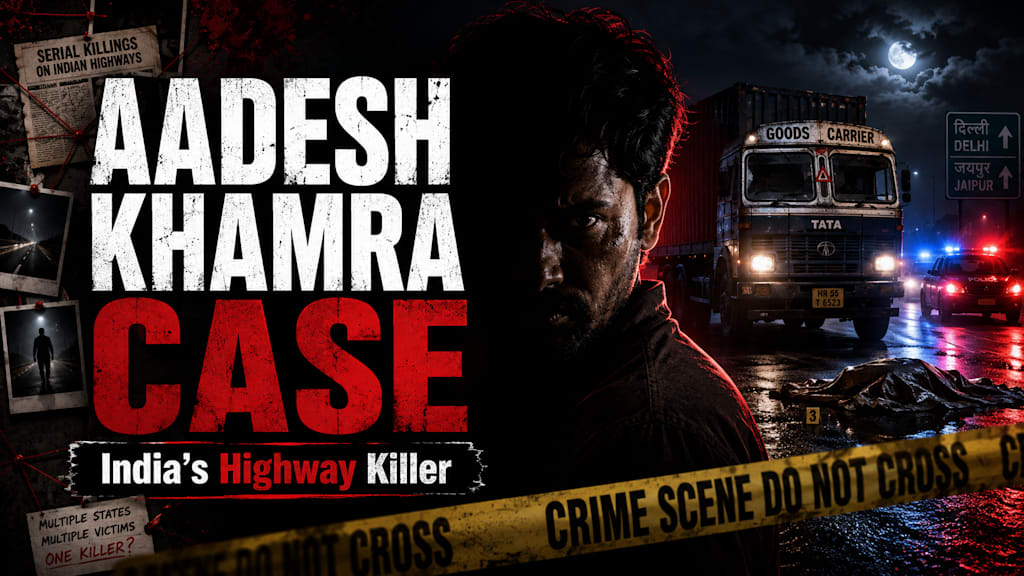
India has witnessed many disturbing true crime cases, but the story of Aadesh Khamra, a tailor from Madhya Pradesh who was accused of targeting truck drivers across several states, remains particularly chilling.
For years, Khamra appeared to live an ordinary life. Behind that seemingly normal identity, however, police alleged that he was connected to dozens of murders involving truck drivers and their helpers. His victims were often travelling long distances on highways, making them especially vulnerable to someone who knew how to gain their trust.
According to investigators, Khamra was eventually linked to more than 30 killings, with reports at the time citing as many as 33 or 34 alleged victims.
From Tailor to Alleged Serial Killer
Khamra lived in Mandideep, an industrial town near Bhopal in Madhya Pradesh, and worked as a tailor. His life reportedly began changing after he became involved with criminals who robbed trucks.
Initially, members of the group allegedly stole trucks and goods without killing the drivers. Police said Khamra later pushed the operation in a much darker direction: eliminating drivers and helpers so that there would be fewer witnesses.
Investigators traced his first alleged killing to 2008, when a truck driver was targeted near Udaypura in Madhya Pradesh. The stolen goods were then sold and the money divided among members of the gang.
How Truck Drivers Were Trapped
One of the most disturbing aspects of the case was the method allegedly used to approach victims.
Instead of always violently stopping trucks, Khamra reportedly learned to gain the confidence of drivers. He would approach truckers, start friendly conversations and sometimes promise them opportunities to transport goods during otherwise empty return journeys.
Police alleged that drinks such as tea or lassi were then mixed with sedatives. Once the victims became weak or unconscious, they could be overpowered and killed.
Their trucks, cargo and other valuables were allegedly stolen and sold through criminal networks. Bodies were sometimes dumped in isolated forests, gorges or beneath bridges, making identification difficult.
The NH-44 Attack That Went Wrong
One important incident took place on August 24, 2017, on an isolated stretch of National Highway 44 in Madhya Pradesh.
Truck driver Iqbal Khan and his cleaner Shahadat Ali were travelling between Hyderabad and Lucknow when their truck was intercepted. They were attacked and sedatives were allegedly forced on them.
However, the truck reportedly ran out of fuel before the attackers could complete their plan.
The two men were beaten and left for dead. Remarkably, Khan survived. His survival later became important because he could remember the attackers’ faces.
Why the Crimes Remained Unconnected for Years
The crimes were difficult to link because they occurred across different locations and states.
When trucks disappeared along with their drivers, owners sometimes initially suspected that the drivers themselves had stolen the vehicles or cargo. Meanwhile, unidentified bodies discovered far away could remain disconnected from the missing-truck investigations.
Khamra was also arrested in connection with earlier crimes but was reportedly viewed as one participant among larger groups rather than the centre of a widespread pattern.
This allowed the bigger picture to remain hidden.
The Investigation That Finally Exposed the Pattern
The case began to unravel in 2018 after the murder of a truck driver and cleaner near Bhopal.
Police formed a special investigation team after noticing a disturbing pattern involving truckers. Investigators examined CCTV footage and arrested several suspects, including Jaikaran Prajapati, who had allegedly worked with Khamra.
Information obtained during the investigation eventually led officers to Khamra.
He was arrested in September 2018, after which investigators began connecting him to numerous previously unsolved killings involving truck drivers and cleaners.
A Crime Story Driven by Money
Police investigating the case said financial gain appeared to be the primary motive.
The victims were not allegedly chosen because of personal disputes. They were targeted because killing them made it easier to steal trucks, cargo and other valuables without leaving witnesses behind.
That makes the Aadesh Khamra case different from many serial-killer stories centred on psychological obsession or personal revenge. Investigators portrayed it instead as an organised criminal operation in which repeated killings became part of a method for making money.
Why the Aadesh Khamra Case Still Stands Out
The case is frightening because of how ordinary Khamra reportedly appeared to people around him.
A tailor living a seemingly normal life was accused of operating across highways and targeting people whose profession already required them to spend long nights travelling through isolated areas.
It also demonstrates how crimes committed across multiple jurisdictions can remain disconnected for years when victims, vehicles and bodies are discovered in different places.
The Aadesh Khamra case remains one of India’s most unsettling highway crime stories—a reminder that some of the country’s most disturbing criminal investigations have begun only after police realised that several apparently unrelated cases were actually connected.
About the Creator
parwinder singh
🎬 Movie & Entertainment Writer sharing reviews, ending explanations, story breakdowns, plot twists and hidden details from Bollywood, Hollywood, South Indian cinema, Korean dramas and OTT releases.
Enjoyed the story? Support the Creator.
Subscribe for free to receive all their stories in your feed.
Comments
There are no comments for this story
Be the first to respond and start the conversation.