
A Grouper’s Eye, a Cut Ribbon, and the Three Taps That Ended an Empire
Xu Jiayin built China’s biggest property machine with teapots, cold jellyfish, and a hand on an elbow. When it all collapsed, the story was already written in the details nobody thought to photograph.
He met Chen Rugui for the first time in a private room of a Chaoshan restaurant in Guangzhou. The air conditioning was set so low that beads of water had formed on the cold jellyfish salad. Xu Jiayin stood to pour the tea, his thumb pressing the teapot lid, the spout aimed at Chen Rugui’s cup—not a drop spilled. Chen Rugui said nothing; he merely turned the cup half a circle so the handle faced himself. That year, Evergrande had just found its footing in Guangzhou. The old-redevelopment land parcels were like frozen meat that hadn’t thawed—whoever seized them survived. Xu Jiayin wore a white shirt that day, the cufflinks silver, no logo. After the meal, he saw Chen Rugui to the car. Before the door closed, he reached out and covered the door frame—a gesture so light it was like shielding a lamp. They didn’t shake hands. Chen Rugui nodded inside the car. The driver later stated in his deposition that there had been an extra brown paper bag on the back seat that afternoon. Xu Jiayin never mentioned it the whole time. The boss didn’t ask either.
That was their “first contact.” The investigation report would later call it “the beginning of the benefit transfer.” But at the time, it was just a cup of tea in an air-conditioned room and a hand covering a door frame.
After that, the land parcels were approved quickly. In his office by the Pearl River, Xu Jiayin signed the first land grant contract, the nib pausing on the paper for one second. He tore open a fresh pack of cigarettes, bit the filter slightly before lighting it. Through the smoke, he handed the contract to Pan Darong. “File it carefully.” Pan Darong took it, his fingers not touching Xu’s. Outside the window, a crane was turning. Evergrande’s orange-red logo had just been hoisted onto the tower crane.
That counted as the first emotional peak. He didn’t smile, but at lunch he ordered an extra portion of Longjiang braised pork knuckle rice and gnawed the bones very clean.
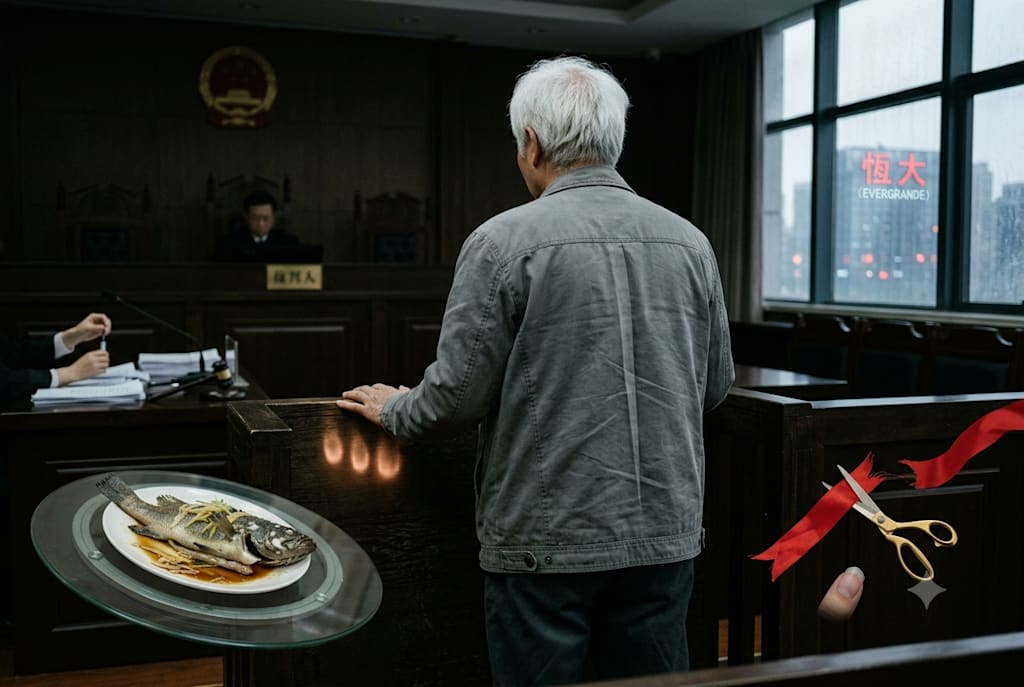
In the summer of 2017, Evergrande’s headquarters moved from Guangzhou to Shenzhen. On the day the sign was unveiled, Chen Rugui attended the ribbon-cutting as mayor. Before the red silk fell, Xu Jiayin stepped back half a pace, yielding the center to Chen Rugui. The scissors were gold. Chen Rugui squeezed twice before the ribbon cut. Xu Jiayin immediately reached out, caught the severed ribbon, folded it, and placed it in the inside pocket of his suit jacket. A journalist on the scene photographed that moment. Later, the photo was marked as Exhibit 037 in the trial evidence. The prosecutor said, “This was a ritualized confirmation of interests.” But at the time, it was simply the act of catching a ribbon, with people still applauding below the stage.
That evening, Xu Jiayin hosted a dinner in Shenzhen Bay. There was no shark fin on the menu—only poached prawns and claypot congee. During the meal, Chen Rugui took a phone call and walked out onto the terrace. Xu Jiayin didn’t follow. Using the serving chopsticks, he turned over the remaining half of a grouper on the lazy Susan, revealing the intact flesh on the other side. Then he gently nudged the lazy Susan back to its original position. The grouper’s eye faced Chen Rugui’s empty seat. When Chen returned, he glanced at the fish, sat down, and took a spoonful of congee.
That was the second peak. No clinking glasses, no toast. But the grouper’s eye remembered that position.
The winter Shengjing Bank’s funds came in, Shenyang was minus twenty degrees. Tang Yijun finished meeting Xu Jiayin at the provincial government building. As they walked side by side down the steps, Tang Yijun’s leather shoes slipped on the icy stone. Xu Jiayin immediately steadied him by the elbow—just enough force to keep him upright, not so much that it looked like he was being propped up. Tang Yijun steadied himself and said, “The ground’s slippery.” Xu Jiayin let go, sliding his hands back into his overcoat pockets. The coat was black, the cuffs slightly faded. Without looking at the other man, he lowered his gaze to the steps and said, “Liaoning’s cold is a dry cold.”
That credit line of a hundred billion was later proven to be the blood transfusion tube for Evergrande’s high-leverage expansion. But on those steps, it was just a steadying hand, a “the ground’s slippery,” and a silhouette looking down at the path. Tang Yijun later admitted at the detention center that it was that steadying gesture that made him feel “this man was reliable.”
The third peak came late the night Shengjing Bank’s capital pool was fully drawn down and credited for the first time. Xu Jiayin sat alone in his top-floor office at the Shenzhen headquarters, the screen of his phone lit with a credit alert. He read the message three times, then locked the screen and placed the phone face down on the desk. He stood, walked to the floor-to-ceiling window, and pressed his forehead against the glass. Outside the glass was the Shenzhen nightscape. Evergrande’s building lights cast “EVERGRANDE” onto the curtain wall of the opposite tower, throwing back a blurred red reflection. He held that pose for about two minutes, then returned to his desk, picked up the landline, and called Xia Haijun. “Meeting tomorrow morning. Get the Shen Shen Fang materials reorganized again.”
The restructuring of Shen Shen Fang was the “lips” he most wanted to kiss in those years, a backdoor A-share listing. If it worked, all the hidden funding landmines would be buried under the listed P/E ratio. The proposal was revised more than a dozen times. Xia Haijun’s team flew countless trips between Beijing and Shenzhen. The pricing of the private placement, the path of asset injection—the people at the CSRC said it was “fine in principle.” Xu Jiayin even had a new signing room renovated at the Shenzhen headquarters: a long table, leather chairs, a white wall with the national flag and the company flag already hung.
The night before the scheduled signing, he sat alone in the signing room for a while. He opened and closed the cover of the guest book, tested the pen—ink was full. He placed the pen back in its slot, the nib facing the direction the signatory would stand.
The next morning, an urgent call came from Beijing: a sudden policy shift, backdoor listings for property developers were suspended. Ke Peng took the call. His face went pale after the first sentence. He turned to look at Xu Jiayin, his lips moved, but no sound came out. Xu Jiayin was adjusting his cufflinks. His fingers paused for an instant, then continued fastening the cufflink. He picked up the pen from the table, slipped it into his own jacket pocket, and said, “Call it off.” The national flag in the signing room hadn’t been hung yet; it was still leaning in the corner.
That was the moment of the “almost-kiss interrupted.” No throwing things, no cursing. Only a pen slipped back into a pocket, and a flag leaning against the wall, never raised.
After this, he started doing two things: extending his tentacles deeper into the system of officials, and at the same time accelerating Xia Haijun’s overseas cash-out. He grew even more fixated on “control”—the board of Shengjing Bank, he had to control it. Evergrande Life’s premiums, he had to control. Evergrande Wealth’s funding pool, he had to control. Even the cash flow handled by his son Xu Tenghe—he needed a daily summary text. One day, Du Liang was reporting redemption pressures during an Evergrande Wealth internal meeting. Xu Jiayin cut him off: “First, tell me how much my son transferred today.” Du Liang’s hands froze on the keyboard. The entire meeting room heard only the hum of the central air conditioning.
That was the moment his character flaw was inscribed into the everyday. Not the word “greed,” but the way he asked “how much my son transferred”—in any crisis meeting, the first thing out of his mouth was blood.
September 2021, Du Liang was taken from his office by the police. Xu Jiayin was playing golf. His phone buzzed once. A text from Ke Peng, three characters: “Du Liang in trouble.” He read it, handed the phone to the caddie, and finished the putt. The ball dropped in. He peeled off his gloves, one finger at a time, folded them inside out, and put them in his trouser pocket. Then he walked to the golf cart, sat down, and rested the unopened bottle of mineral water on his knees. The water sloshed inside; he didn’t drink.
The dark moment arrived. He started cutting ties. Du Liang’s arrest was only the trigger.
He signed the dismissal of Xia Haijun. By the time the dismissal paper reached Xia Haijun’s hands, Xia had already booked his outbound flight. The two men brushed past each other in the corridor. Xu Jiayin didn’t look at him, only watched the red floor numbers flashing above the elevator door. The sound of Xia Haijun’s leather shoes echoed from the 11th floor all the way to the parking lot. Xu Jiayin stood where he was until the elevator doors opened with a “ding”—empty inside. He didn’t step in. He turned, went back to his office, locked the door, and drew the curtains. Later, the cleaner said that in the wastebasket that afternoon there was a bitten-off piece of fingernail.
This was the struggle before the rupture—the stress-induced push away of the person closest to him, like a drowning man shoving the lifebuoy underwater. He thought that by cutting off Xia Haijun, Zhu Jialin, Ke Peng, he could save himself. He had Pan Darong polish the financial reports even “cleaner.” He urged Xu Tenghe to accelerate the repatriation of overseas funds. He even began proactively reaching out to people on the investigation team, trying to gauge where the red line lay. But every time he probed, the only reply that came back was an expressionless face and the words: “Follow the procedures.”
On the morning of September 28, 2023, the day the compulsory measures were executed, he was still on a conference call. The call ended, and the case officers walked in. He stood, buttoned his suit jacket. On the desk was a freshly brewed cup of green tea, the leaves not yet fully settled at the bottom. He glanced at the tea, then locked his phone, handed it to the person beside him. He said nothing.
He lost seven jin that month. The lights in the detention center cell never went out for twenty-four hours. When he slept, he folded the pillow towel into a long strip and laid it over his eyes. During daily exercise time, he would line up his shoes at the door in a line absolutely parallel to the doorframe. The guard wrote in a conversation log: “Inmate Xu arranges his utensils in order of use after meals.”
In the hollowed-out daily routine, arranging cutlery became the only thing he could fully control.
April 2026, the Shenzhen Intermediate Court convened. He walked into the dock wearing a gray jacket, his hair completely white but neatly combed. After the prosecutor read the indictment, the presiding judge asked if he pleaded guilty. There was a brief crackle of static over the microphone. He leaned forward, lips near the mic, and uttered two words: “I plead guilty.” No explanation, no plea for leniency, no glance at the gallery. He placed both hands flat on the dock’s panel, fingers spread, then slowly clenched them into fists, and relaxed them again. After relaxing, his right ring finger tapped lightly three times on the wooden panel.
Those three taps, light as knocking on a door that hadn’t been answered in years.
At that moment, the court clerk lowered her head and changed a pen refill. The refill made a faint scraping sound as it was pulled from the plastic tube, like the dying whir of an old electrical appliance. No one spoke. The draft from the air conditioning vent lifted a corner of a page on the prosecutor’s desk; he reached out and pressed it down.
Outside the courtroom, it was raining in the Shenzhen spring. Those who had once pushed the lazy Susan toward each other, steadied an elbow on icy steps, received the cut ribbon at a ceremony—they now sat in the interrogation rooms of different detention centers, eating with their own chopsticks, spitting bones onto different stainless steel trays. Chen Rugui’s tray was always wiped the cleanest. The guard said he used his steamed bun to wipe the tray, cleaned off the grease, then ate the bun. Sun Zhigang, in a detention facility in the west, performed a set of self-made calisthenics by the window every dawn, his movements small, as if measuring an invisible office. Tang Yijun’s prison shoes had the left sole worn down on the outer edge, and when he walked, his shoulder tilted slightly left, still today.
If you ask whether Xu Jiayin regrets it, the answer can’t be read on his face. He simply ate, drank, steadied where steadiness was due, nudged where nudging was due, caught the silk ribbon that was due, bit the fingernail that had to be bitten. In the end, he tapped the panel three times in court, and the person next to him changed a pen refill.
Then the bailiffs led him away. On the back of his gray jacket, there was a crease the iron had missed, running from his right shoulder blade all the way down to the waist. With each stride, it opened and closed—like some worn-out organ, still breathing in vain.
About the Creator
Jin
Writer of reamstories
https://reamstories.com/jin
Enjoyed the story? Support the Creator.
Subscribe for free to receive all their stories in your feed. You could also become a paid subscriber, letting them know you appreciate their work.
Comments
There are no comments for this story
Be the first to respond and start the conversation.