
When Your Old Job Feels Like a Broken‑In Sofa
A recruiter offered more money; a napkin sketch showed what he’d actually lose.
Mike was thirty-two when the recruiter’s email arrived. He was in the Starbucks on Union Street, helping his daughter clean up a spilled hot chocolate. Four-year-old Ella sat in the high chair, both hands covered in chocolate-colored liquid, as if she were wearing a pair of wet gloves. He used the last napkin to wipe her fingers, one by one, and his phone buzzed in his pocket.
The subject line read: “Opportunity — 20% salary increase, well-known tech company.” He crumpled the napkin, tossed it onto the tray, and opened the email with one hand. The job description was full of words he knew: data-driven, empowering the business, cross-functional collaboration. The last time he had seen those words was at twenty-six, when he moved from one ad agency to another — the title changed, the work was more or less the same, and he got an 18% raise. That year he had just finished paying off his student loans and believed that a higher salary was progress.
This time, he placed the phone face down on the table and went back to wiping Ella’s ten fingers clean.
It wasn’t that he wasn’t tempted. It was that he had started asking himself a different question.
At twenty-six he had asked, “How much will this company pay me?” At thirty-two, he was asking, “Three years from now, what will I have that no other company can take away?”
The recruiter’s email didn’t answer that. It talked about salary, benefits, the name of the company, but it said nothing about the person he would become three years down the line. He could guess, of course, but he knew most people guessed wrong. They looked at the 20% increase and imagined the same life with a few thousand dollars more in the bank. Few people asked: along with those few thousand dollars, am I losing something else?
He moved the email into a folder he had named “Opportunity Assessment.” The folder already held seven similar messages. He hadn’t replied to any of them since the start of the year.
Ella pushed her empty cup toward him. A puddle of melted chocolate still sat at the bottom. “Daddy, it’s gone,” she said.
“I know,” he said. “Should we go get another one?”
She shook her head and reached out to be picked up. He lifted her out of the high chair and caught the scent of cocoa in her hair. In that moment he thought that if he took that job, he would have more money to buy Ella things, but probably less time to smell the cocoa in her hair. It wasn’t a noble reason, just a practical piece of arithmetic.
On Wednesday afternoon, he met his former colleague Caroline at the Mexican food truck in Union Square. Caroline was two years older than him and had left a unicorn startup three months ago. She was now on a break whose length she hadn’t bothered to define.
She had arrived first and bought two burritos. She sat on a bench at the edge of the square, sunlight filtering through the sycamore leaves onto her face. She looked thinner than the last time he’d seen her, but the darkness under her eyes had faded.
“What do you do every day now?” Mike took his burrito and sat down beside her.
“Gym in the morning,” Caroline said. “Make my own lunch. Afternoons, I go to the library and read whatever catches my eye. Evenings, I watch an old movie. Some days I don’t look at my phone at all.”
“Sounds like a vacation.”
“It’s a detox.” She bit into her burrito, and a streak of sauce landed on her cuff. She glanced down at it and didn’t wipe it. “Remember when we were doing data analysis back at Acton? I spent two years getting so good at Excel and SQL I could write queries with my eyes closed. Then I jumped three times, and every single time the first question the interviewer asked me was still ‘Are you strong in SQL?’”
Mike picked the green peppers out of his burrito and lined them up on the edge of the foil. He remembered those years. Caroline had been the fastest SQL writer in the entire department — so fast that while you were still framing the question, she was already typing.
“Didn’t that get to you?” he asked.
“It got to me.” She took another bite and stared into the distance while she chewed. “Then I went to that unicorn. My title was Senior Data Manager. Sounds like something, right? But do you know what they had me do? Run numbers. Just faster. Bigger meeting rooms. More expensive screens for the presentations. At the core, I was still the same person who wrote SQL back at Acton. Just with the word ‘Senior’ in front.”
Mike didn’t say anything. He thought about his own last job, where his title had been “Product Operations Specialist.” The word “Specialist” had gotten him more private messages on LinkedIn. But every day he did work that was essentially no different from an operations associate who had been there for two years. He had been turning inside the same process for three years. He could do it with his eyes closed: the report due every Tuesday at four, exactly what each person would say in the Thursday cross-department meeting, the set phrases that went into the Friday recap email.
That kind of familiarity was like a deeply comfortable old sofa. You didn’t notice any problem while you were sitting in it, until one day you stood up and your back hurt so much you couldn’t straighten up.
“So I quit,” Caroline said, pushing the last bite of burrito into her mouth. “Because one day I was in a meeting — my name was on the PowerPoint, I was the one presenting — but those numbers and conclusions, I could have produced them three years earlier. I was repeating myself. The company was paying me more money to buy my time, not to buy my growth.”
“But you still have to pay rent,” Mike said.
“True. So I gave myself three months.” She crumpled the foil into a ball and threw it neatly into a trash can three meters away. “Three months to figure out one thing: next time, I’m not just looking for a hole that pays more. I’m looking for a job that scares me.”
“Scares you?”
“The kind where, in your first month, you lie in bed every night thinking, ‘Can I actually pull this off?’ The kind that makes you feel like a beginner all over again.”
Mike looked out across the square. Someone was feeding pigeons. Someone held up a phone to film a street musician playing saxophone. Someone pushed a stroller hurriedly through the crowd. “That kind of job sounds exhausting,” he said.
“It is. But a job that isn’t exhausting gets even more exhausting when you’re thirty-five.” Caroline stood up and brushed the crumbs off her trousers. “I have to go. Dentist appointment this afternoon.”
“Did you drive here?”
“Walking. I walk a lot these days.”
She headed east, her figure growing smaller, dissolving into the light and shadow of the sycamore trees. Mike stayed on the bench and finished the second half of his burrito. Pigeons paced at his feet, waiting for falling crumbs.
That night, after Ella was asleep and his wife Sarah was in the living room reading a book about gardening, Mike sat at the dining table and opened his laptop. The recruiter’s email was still in that folder. He opened it once more, read through it, then closed it. He created a new blank document. The cursor blinked on the white page.
He wasn’t the type to keep a journal, but some things, if he didn’t pin them down in words, would turn into a vague cloud of feelings in his head and then get washed away by the daily routine.
He typed three lines:
“1. Will this job let me do something I can’t do now? Not ‘something I’m not yet fluent in but can manage,’ but something I have truly never done.”
“2. Three years from now, what qualitative leap will my transferable skills have made? Not ‘more proficient,’ but ‘able to do a different kind of work.’”
“3. After I leave this company, will its name and the relationships I built there open the next door for me? Not another door on the same floor, but a door on the next floor up.”
He didn’t bold the text. He didn’t use exclamation points. The glow of the screen lit his face. The curtains were open; outside the window, the bathroom light on the second floor of the neighbor’s house was still on.
He needed to digest the logic of those three lines himself. The first question meant he couldn’t take another copy-paste job. The second meant he couldn’t look only at the salary increase — he had to look at the slope of his skill curve, whether it was flat or climbing. The third was the hardest to answer, because it wasn’t asking “Do I have connections?” but rather “Are those connections built on the foundation of things I’ve actually accomplished?” Knowing a lot of people was useless. Having accomplished things together with a lot of people — that was what mattered.
He remembered what Caroline had said: “I’m looking for a job that scares me.” He felt he wasn’t quite ready to face that level of fear yet, but at the very least he could start asking himself these questions.
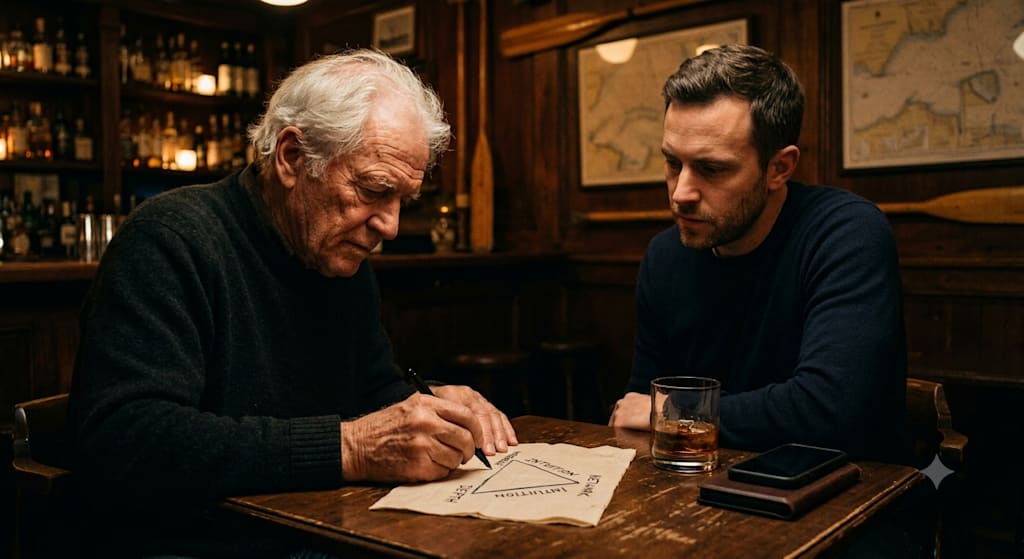
Thursday night, he met his old college mentor Frank at a bar in the marina district. Frank was in his sixties, his hair completely white, but his shoulders were still as broad as they had been when he was young. He had spent twenty years as an executive in Silicon Valley, then at fifty-five quit his job and opened a woodworking shop in Vermont, making handmade furniture. Mike saw him twice a year, and each time Frank seemed more like an old tree — quiet, solid, unmoved by the wind.
The bar was not crowded. Old oars and yellowed nautical charts hung on the walls. Frank was already there, seated in a corner booth, a glass of bourbon in front of him. The amber liquid caught the dim light like a piece of folded old silk.
“What’ll you have?” Frank asked him.
“Same as you.”
Frank raised a hand toward the bar, held up two fingers. The bartender nodded.
Mike sat down and placed his phone on the table, screen facing down. “I’ve been thinking lately about whether to change jobs,” he said.
“Someone reached out?”
“A recruiter. Twenty percent raise.” When he said the number out loud, he found it strange himself — it was not a small sum, but he felt no excitement delivering the words.
Frank took a sip of bourbon and waited for him to go on.
“But I started asking myself, what will I be able to take with me three years from now?” Mike said. “Not the experience listed on my résumé — what will I actually have gained, here inside? You know Caroline too. She quit. She said her last job was just her repeating herself.”
“Caroline is a smart person.” Frank set his glass down and ran a finger along the rim. “You’ve finally stopped asking ‘How much are they going to pay me?’”
“I still ask that.”
Frank let out a laugh, the sound rising from deep in his chest like wind over old wood. “Of course you do. But that’s no longer the only thing you ask. That’s the point. Most people, by your age, are still only asking that.”
He took a pen from beside the coaster and drew a triangle on the back of a napkin. At the three corners he wrote, in capital letters: DEPTH, INTUITION, NETWORK.
“Technical depth.” He tapped the bottom-left corner with the pen tip. “After all these years, you should have your own hard-won toolkit. Not just knowing how to use tools — knowing when to use which tool and when not to use it. Being able, when you face a new problem, to judge within ten minutes what its skeleton looks like.”
The pen moved to the top corner. “Industry intuition. That term sounds vague, but it comes down to whether you can see things other people don’t see. The data is there; everyone can see it. But some people look at the data and know what’s going to happen over the next three months. Others only realize it after it has already happened. What’s the difference? The first kind of person has digested the data by steeping it inside the industry.”
The pen moved to the bottom-right corner. “Trust network. This isn’t the number of your LinkedIn connections. It’s the people who’ve been in the trenches with you — people who’ve raced a deadline with you, who’ve carried a failed project with you, who’ve revised a proposal with you at three in the morning. These people know what the quality of your work looks like, and they’re willing to vouch for it.”
Frank connected the three dots, forming a triangle. The pen point poked a tiny hole in the napkin, leaving a small blank space at the center.
“Those three questions you’re asking yourself,” Frank said, “are essentially investments you’re making in these three corners. Most people, after thirty, keep pouring time into the first corner — getting certifications, learning new tools, chasing new technologies. The second and third corners stay empty. The moment the industry hits a bump, they can’t keep their footing.”
Mike thought about the product director on his own team who had just been let go — Greg, forty-one years old, who wrote better technical documentation than anyone. But beyond his own product line, nobody in the entire building could name a single cross-department project he had worked on. The day the layoff notice was sent, there were quiet murmurs in the break room, but not one person went to say goodbye to him. It wasn’t that people were heartless. It was that in five years, he had never once stepped into anyone else’s trench.
Frank’s finger tapped the center of the triangle. “These three corners can’t be empty. At least two of them have to be solid. If all you have is technique, you’re a very useful screwdriver. A screwdriver can always be replaced by another screwdriver. But if you also understand the industry, then you’re no longer the screwdriver — you’re the person choosing which screwdriver to use. And if people also trust you, then you’re the person deciding where to drill.”
The drinks arrived. Mike picked up his glass. The smell of bourbon rushed into his nose, carrying notes of caramel and oak. He took a sip, let the liquor rest on his tongue for two seconds, then swallowed.
“So what should I ask during an interview?” he said. “‘Will this role help me improve my industry intuition?’ That sounds stupid.”
Frank laid the pen on the table. “Don’t ask what you need to do. Ask who you’ll be making decisions with.”
Mike looked at him.
“When you ask ‘What do I need to do,’ they hand you a list of tasks. When you ask ‘Who will I be making decisions with,’ they tell you about the company’s power structure and the rhythm of its decision-making. If they can’t give you concrete names and meeting titles, then you’re an executor, not a participant.”
Mike typed the sentence into his phone’s notes app. He typed slowly, double-checking every word for spelling: “Who will I be making decisions with?” He looked up at Frank. “Where did you learn that?”
“I worked it out myself.” Frank lifted his glass and finished the last sip of bourbon. “I’ve interviewed hundreds of people in Silicon Valley and hired more than a hundred. When a person asks ‘Who will I be making decisions with,’ the tone of their voice is completely different from the person who asks ‘What do I need to do.’ The first person’s eyes are looking at the structure of the company. The second person’s eyes are looking at their own cubicle.”
Mike set his phone down. “If my current company has never let me take part in decision-making, how do I put that on my résumé?”
“You don’t put it on your résumé. You put it in your questions. An interview isn’t a one-way judgment; it’s a two-way negotiation. They’re assessing whether you can do the job. You’re assessing whether they’ll let you into the decisions. If you don’t assess that, six months after you start, you’ll be in the break room complaining to a colleague that you feel like a screw. And that screw position — you’re the one who failed to ask about it during the interview.”
Frank stood up and pulled two bills from his wallet, tucking them under his glass. “I have to go. I’ve got a batch of oak boards to sand tomorrow morning.”
“You’re still making furniture?”
“Built a dining table for an old friend in Boston.” Frank put on his coat and wrapped a scarf once around his neck. “Making tables is simpler than being an executive. Wood doesn’t lie, and it doesn’t call pointless meetings.”
Mike smiled. He watched Frank walk toward the door. When the door swung open, the wind from outside rushed in, carrying the briny smell of the marina. The triangle on the napkin was still on the table. Mike folded it and put it in his coat pocket.
Over the next two months, he didn’t rush to send out his résumé. He started filtering opportunities in a new way.
When a recruiter sent a job description, he no longer looked at the salary line first. He looked at the specific items under responsibilities, searching for things he didn’t know how to do. If he could tick every box on the list, he crossed the whole thing out — it meant he would only be repeating himself.
There were two opportunities he almost fell for. One was a social media platform offering a huge sum, but by the second round of interviews he realized they wanted him to transplant his experience from his last company wholesale, without changing a thing. Another was a startup whose founder was very charismatic. They talked for two hours in a café, but afterward, when Mike replayed the conversation in his mind, the founder had said “move fast and iterate” more than twenty times and hadn’t mentioned “budget planning” or “decision-making structure” even once.
He turned both down politely. Each refusal felt like turning down a sum of money, and the feeling wasn’t comfortable. But he thought of Caroline’s word — “detox.” It was about breaking the addiction to “a higher salary equals progress.” She had given herself three months. He didn’t yet know how long he would need.
In the third week, he noticed a position at a mid-sized healthcare data company. The company was called Oakwood Health Data — the name sounded like a research institute on the outskirts of some small town. The role was Director of Strategic Analytics. The salary was 3% lower than the recruiter’s offer. But one line in the job description made Mike stop: “This position will work closely with the Chief Operating Officer and the Budget Committee, participating in annual strategic planning and resource allocation.”
He read that sentence three times.
The first time, he saw “Chief Operating Officer.”
The second time, he saw “Budget Committee.”
The third time, he saw “participating” — not “supporting,” not “assisting,” not “providing data for.” “Participating” meant he would be in the room, with his hands on the table.
The interview was scheduled for a Wednesday morning. The company was in an unremarkable four-story brick building. The number “3” on the elevator button had been pressed so many times the paint had worn off. While Mike waited in the hallway, he noticed that the walls were not hung with posters of company values. Instead, there was a row of hand-drawn medical diagrams — nineteenth-century surgical instruments, the human circulatory system, a sketch of a gray-haired doctor performing surgery in a field tent. Beneath each drawing, a line of small text gave the year and location of some medical milestone.
A woman in her fifties named Margaret, the COO’s assistant, greeted him. She didn’t use the standard script about “Please wait, he’ll be with you shortly.” She handed him a glass of water and said, “Mr. Douglas is on a call, probably about five more minutes. The restroom is at the end of the hall on the left — help yourself if you need it.”
He didn’t need the restroom, but he made a mental note of the phrase “help yourself.”
The COO’s office was not large. Outside the window stood an old oak tree, its branches reaching almost to the glass. Douglas looked about fifty, wore a gray suit with no tie, and had his sleeves rolled up to his forearms, exposing arms that had seen the sun. His handshake was firm but brief; he didn’t press for an extra half-second.
“I’ve read your résumé,” Douglas said after sitting down, without picking up any printed documents. “The things you did at your last two companies are described clearly. But I want to know one thing: beyond those descriptions, what decisions have you made on your own?”
Mike paused. Before the interview, he had prepared plenty of answers — about data analysis, cross-departmental collaboration, project management. No one had ever asked him, “What decisions have you made on your own?”
He thought for a moment, then gave an example. It wasn’t the kind of packaged answer that went, “I led the team to achieve such-and-such a goal.” It was a specific decision: he had once vetoed a marketing proposal whose numbers looked excellent, because buried in the data he had found one anomalous segmentation metric. The better course indicated by that metric had not been written up in any formal report. He chose the path without the report. It turned out to be the right call, but his boss at the time had been extremely unhappy.
“Why did you choose to tell that particular example?” Douglas asked, leaning forward slightly.
“Because that decision was not authorized,” Mike said. “If it had been wrong, I would have had to bear all the consequences alone. And after it turned out to be right, I realized something: data can tell you an enormous amount, but deciding what to do and what not to do — that step cannot be handed over to the data.”
Douglas leaned back in his chair, his fingers tapping the armrest twice in a measured rhythm. He didn’t offer an evaluative word like “good” or “interesting.” He simply nodded toward a document. “Let’s go over the actual role — you would report directly to me. The Budget Committee meets every Tuesday morning. You would need to attend the full meeting, not as an observer, but as a participant in the discussion.”
“Who else is on the Budget Committee?”
“Myself, the CFO, two business line heads, and at some point next year — you, provided you can propose adjustments worth discussing.”
Mike stored the information in his head. He remembered the line Frank had taught him, but he didn’t need to ask “Who will I be making decisions with?” outright. Douglas had already answered it.
As the interview was winding down, he asked a second question: “If I stay at this company for three years, in what area do you think I would improve the most?”
Douglas thought for ten seconds. During those ten seconds, sunlight leaked through the leaves of the old oak and fell onto the corner of the desk. He didn’t give a packaged answer. He said, “You’ll learn how to make trade-offs with limited resources. We’re not a large company — the budget is never enough. For every recommendation you make, you’ll have to make clear what the project you’re recommending also means giving up. That way of thinking — you probably can’t learn it in a place with ample budgets.”
Mike said, “Thank you. That answer is more concrete than I expected.”
Douglas stood up to see him out. “You asked a good question. Most people ask me, ‘What’s the company culture like?’”
Mike smiled. He realized he used to be one of those “most people” too.
When he left the building, it was raining outside. The clouds hung low. The rain was washing the accumulated dust off the brick walls, and the air smelled of damp earth. He had no umbrella. He stood under the portico and sent Caroline a message: “Just finished the interview. They want me to sit on the Budget Committee.”
A few seconds later, Caroline replied: “That’s worth more than 15%.”
He stared at the line for a few seconds, then typed two words: “It’s done.”
Caroline sent a string of clapping emojis, then asked: “Are you scared?”
He thought about it and replied: “A little.”
“That’s the right response.”
He put the phone in his pocket and zipped up his jacket. The rain hadn’t let up, but he stepped out into it. The rain quickly soaked his hair and his shoulders. He didn’t walk fast. With each step, his shoes landed in the puddles on the sidewalk, kicking up small splashes.
In his first week on the job, there was hardly any time for nerves. The Budget Committee meeting was on Tuesday at nine. He arrived at the conference room at twenty to nine. Margaret was already there, setting up the projector. She placed a printed agenda at each seat. Mike’s spot was the second chair to Douglas’s right — not the farthest, not the closest. He liked the distance.
There were no green plants on the meeting table, no mugs printed with company slogans. The table was scattered with scribbled sticky notes and several well-thumbed financial reports. The air held the smell of old coffee and a faint varnish from some wooden piece of furniture.
The CFO was a tall, thin man named Ronald, who had a habit of pushing his glasses up with his middle finger. The two business line heads came from different backgrounds — one from emergency care systems, the other from chronic disease management. Their tone during discussion wasn’t the overly polite kind. They interrupted each other. They drew contradictory numerical models on the whiteboard. When they reached an impasse, they both looked toward Douglas.
Mike made no proposals in his first week. He took four pages of notes and drew five diagrams in different colored pens. In the second week, he pointed out an overlooked assumption: the impact of the two projects under discussion on user retention might be overestimated, because the data model had used an old-version sample.
Ronald pushed his glasses up. “That assumption was set before you joined the company.”
“I know,” Mike said. “But the time window for the sample should be adjusted.”
The conference room went quiet for five seconds. In those five seconds, he heard his own heartbeat and the sound of the old oak’s branches scraping the window glass. Then Douglas said, “Can I have an adjustment proposal by Wednesday?”
“Yes.”
After that sentence was spoken, Mike knew he was no longer sitting at the same old table.
One Wednesday afternoon half a year later, Mike was in the break room making himself a cup of black tea. Outside the window, the leaves of the old oak were turning yellow. He stood at the water dispenser, watching the hot water pour into the cup, the tag of the tea bag dangling over the rim. A new junior analyst walked in — a twenty-four-year-old named Liam, fresh out of university, with that light still in his eyes that believes every question has a standard answer.
Liam poured himself a glass of water and stood beside Mike. He hesitated for a few seconds, then spoke: “Mike, can I ask you something?”
“Go ahead.”
“What do you think is the most important thing to figure out when you change jobs after thirty?”
Mike didn’t answer right away. He wrapped the string of the tea bag once around his finger, then let it go. The tea slowly deepened to a reddish brown, like an oak leaf fallen on the ground in autumn.
He thought for ten seconds. Not about how to answer, but about the fact that he himself had only truly figured this out half a year ago. He thought of the spilled hot chocolate in Starbucks, the burrito sauce on Caroline’s cuff, the triangle Frank had drawn on a napkin, and the sunlight cut into pieces by the oak leaves in Douglas’s office.
He said, “Don’t let your next job be just a repeat of your last one.”
Liam waited for him to continue.
“The title can be the same. The skills can be the same. Even what you do every day can look the same.” Mike lifted his cup; the steam fogged his glasses. “But the seat you sit in in the meeting room — that has to be different. If every time you change jobs, you just sit down in the same chair in the same room — no matter how comfortable that chair is, it’s still an old chair.”
Liam nodded, as if he understood something, and also as if he still needed to digest it.
Mike carried his cup toward his desk. At the door, he stopped and looked back. “One more thing.”
“What’s that?”
“In an interview, don’t ask ‘What’s the company culture like?’ Ask ‘Who will I be making decisions with?’”
He walked out. The tea in his cup was still very hot. On both sides of the hallway, the yellowed medical illustrations hung quietly, recording the critical decisions people in another century had made at certain moments. One was a diagram of a doctor using obstetric forceps; the year printed beneath it was 1848. Every time he passed it, he thought: before 1848, how many people knew such a tool was possible, but only one person actually made it.
He walked back to his desk, sat down, and opened the next dataset that needed analyzing. On the screen, a simulation of resource allocation for three competing projects in the first quarter of next year jumped into view. He scrolled, and beside the first row of numbers he made a red mark. Outside the window, a leaf drifted down, landed on the sill, and was blown away by the wind.
About the Creator
Jin
Writer of reamstories
https://reamstories.com/jin
Enjoyed the story? Support the Creator.
Subscribe for free to receive all their stories in your feed. You could also become a paid subscriber, letting them know you appreciate their work.
Comments
There are no comments for this story
Be the first to respond and start the conversation.