
When a Doctor’s Hand Meets a German Official: A Story of Education That Could Not Overcome Dogma
The story of a Lebanese doctor who, after many successful years working in German hospitals, lost the chance to obtain German citizenship raises a much deeper social issue. It is not simply a question of an ordinary social gesture such as shaking hands when greeting someone. This case reveals a much more serious contradiction: how can a man with the highest level of university education, whose entire professional life is supposed to be about helping people without distinction, become trapped in such a rigid way of thinking?
A Brilliant Career and Perfect Results
The man came to Germany from Lebanon in 2002. He worked hard, completed medical school and gradually climbed the German healthcare system. Eventually, he became a senior doctor at a German clinic, which reflected his considerable professional qualifications.
In 2012, he applied for German citizenship. At first, everything seemed almost routine. He had fulfilled the legal requirements, signed a declaration recognizing the German constitution and rejecting all forms of extremism. He also passed the citizenship test, which covered German history, culture and law.
His result was remarkable. He scored full marks, showing that he knew the German system extremely well.
The Moment Everything Changed at the Official Ceremony
The real test, however, did not come in the form of a written examination. It came during a brief moment of human contact.
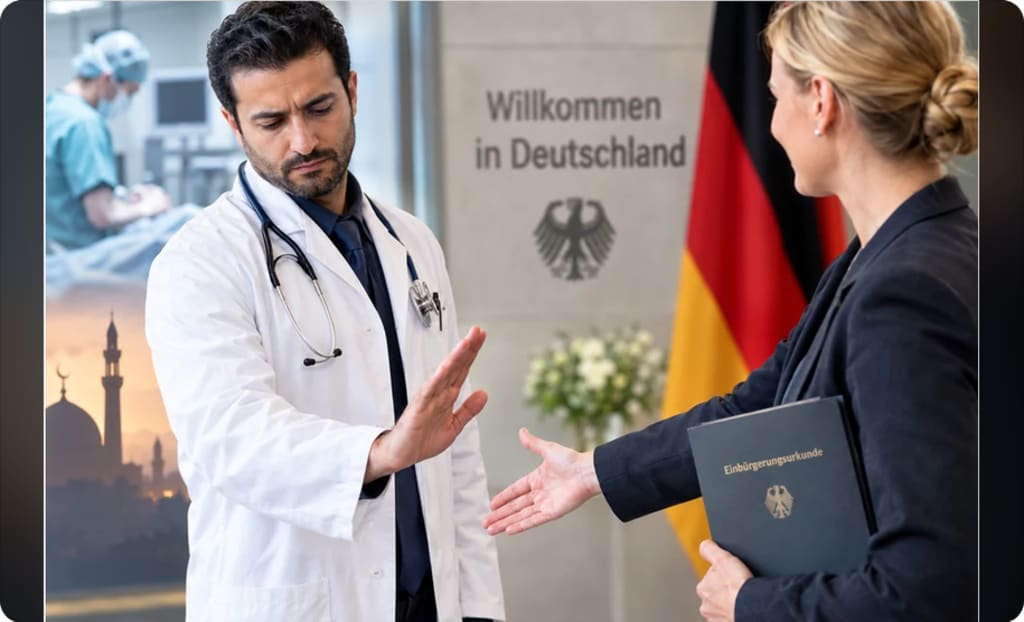
In 2015, the doctor attended the ceremony where he was supposed to receive his German citizenship certificate. The female official conducting the ceremony handed him the document and extended her hand to congratulate him.

The doctor suddenly pulled his hand away and refused the handshake.
He explained that his religious beliefs prohibited physical contact with women. There was also a personal reason. According to his explanation, he had promised his wife, who was of Syrian origin, that he would never touch another woman.
The official refused to continue the ceremony. The citizenship document was not handed over, and the authorities subsequently rejected his application for German citizenship.
The Court Battle and the Change of Strategy
The doctor refused to accept the decision and took the matter to court. After losing at a lower level, he continued his legal battle before the Higher Administrative Court.
During the proceedings, further details about his behavior emerged.
Once the doctor realized that his refusal to shake hands with women was causing a problem, he changed his strategy. From the beginning of 2018, he stopped shaking hands with anyone — including men.
His argument was that he had therefore treated both sexes equally and could not be accused of discrimination against women.
The judges did not accept this argument.
In its final decision in 2020, the court regarded his decision to stop shaking hands with everyone as a tactical move intended to remove the obstacle to obtaining German citizenship.
The court also emphasized the social significance of the handshake in Germany and in Western society more generally. It is not merely a physical gesture. It can represent equality, mutual respect and the willingness to interact with another person on equal terms.
The judges considered his original refusal to shake hands with women because of his religious beliefs incompatible with the constitutional principle of equality between men and women and with successful integration into German society.
Professional Blindness and the Question of Patients
The legal battle ended with the applicant losing his case. But the professional dimension of the story raises other questions.
Medicine is, by its very nature, based on physical contact. Doctors examine people, operate on them and have to overcome the natural boundaries of the human body. They treat both men and women.
The doctor's representatives argued that he had no problem with physical contact with female patients or colleagues in his professional life. According to them, his religious rules applied only to private social gestures such as handshakes.
But this distinction inevitably raises questions.
How can a doctor regard physical contact with a woman's body as completely normal when he is treating her as a patient, yet consider the same woman inappropriate to touch in an ordinary social situation?

And what happens in a genuine emergency? If a woman arrives at a hospital in a life-threatening condition, will there ever be a moment of hesitation between professional duty and personal religious rules?
These are difficult questions, even if the court did not establish that the doctor's professional conduct toward female patients was inadequate.
For a doctor, treating patients differently simply because of their sex would be deeply problematic. The medical profession is built on the principle that patients deserve respect and proper care regardless of who they are.
Education as a Coat, Not an Inner Change
The entire case illustrates an uncomfortable truth about the modern world: years of education, academic degrees and a successful professional career do not automatically mean that a person has internally adopted the values of the society in which they live.
This Lebanese doctor was able to study the German system, fulfill its formal requirements and achieve an impressive professional career. He passed the citizenship examination with perfect results.
Yet when confronted with one very simple social expectation, he refused to compromise.
True integration into a new country cannot be measured only by professional success, academic qualifications or money earned. It also involves accepting the basic principles of the society in which a person wants to become a citizen — including equality between men and women.
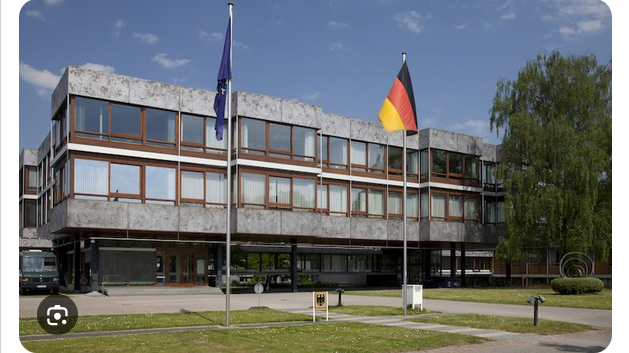
The German court's decision sent a clear message: citizenship is not simply a document obtained after passing a test. It also represents acceptance of the fundamental values of the society whose citizenship a person seeks.
Sources for verification
Decision of the Higher Administrative Court of Baden-Württemberg, concerning the citizenship case of the Lebanese doctor, 2020.
German, British and Czech media reports published in connection with the court decision, including coverage by Deutsche Welle, iDnes and Novinky.
About the Creator
Enjoyed the story? Support the Creator.
Subscribe for free to receive all their stories in your feed.
Comments
There are no comments for this story
Be the first to respond and start the conversation.