
Type and Stars
This is not a story about a hero. It's about a man who picked up a blind fiddler's hat instead of a roll of banknotes—and the narrative machinery that makes that choice land harder than any speech.
William Grant sat through the night under the gaslight. The typewriter ribbon had gone pale; when he struck the letter T, it left a small gap, like a leaf eaten through by a worm. He typed the numbers three times, and each time he cleaned his glasses with his cuff. The lenses were smudged with ink, growing blurrier with every wipe.
An hour before dawn, he pulled the sheet from the roller. On the page were sixteen names. The youngest was Albert Finch, seven years old, who had lost three fingers to the carding belt at the Winsington textile mill and died of infection in a basement corner. William had been to that corner. Half a potato still lay on the floor, furred with green mould.
The door opened. Horace Blake, the editor, did not knock. He set a whisky on the corner of the desk and slid a cheque under the glass. The sum would cover three months of back rent, and a proper doctor for Emily. The child had coughed through the winter, and sometimes there were specks of blood on her pillow.
"Change the numbers," Blake said. He was looking out the window, at fog so thick you could see nothing. "Lose three. No one counts."
William did not look at the cheque. He folded the manuscript — once, then again, sharpening the crease with his thumbnail — pulled open the drawer, and laid it inside. The lock was rusted; the key required a hard twist. He gave it a turn, and the bolt snapped shut with a soft click that hung in the quiet newsroom. As he drew back his hand, the rusted edge cut his finger. A smear of blood caught the corner of the page. He did not wipe it. He slipped the key into his waistcoat pocket, where a mended thread from years ago sat at the bottom, and rubbed it with his thumb.
Blake watched him. His eyes moved from the finger to the drawer, then back to his face. "You know what this means."
"I know," William said.
Blake picked up the whisky and drank it himself. He set the glass down on the desk, and a wet ring bled into the cheque. "Don't come in tomorrow."
William stood and pushed the chair he had sat in for three years under the desk. The legs scraped the bare floor with a brief, sharp cry. He took the last clean sheet from the typewriter, tucked it under his arm, and walked out of the building.
The London fog was thick as watered milk. At the street corner he stopped, put his bleeding finger into his mouth. Iron and salt mingled on his tongue, leaving a slight numbness. Across the road, an old man selling chestnuts was packing up his brazier. The coals, dampened by the fog, trailed a thin white smoke. William remembered he still had a halfpenny in his coat, but he did not cross. He rolled the blank page into a tube, slipped it inside his overcoat, against his chest.
In the first week without work, he pawned what he could. First his pocket watch, then his wife's silver comb, and finally the heavy wool overcoat. The pawnbroker, a Jew named Solomon Goldstein with grey whiskers down his cheeks, took the coat and weighed it in his hands. "One pound three shillings." William did not haggle. He pocketed the coins. As he stepped out, he saw a boy standing across the street — one arm missing, the left sleeve pinned flat at the shoulder. Tommy, the paperboy from his report, the mill child who had lost his right hand to the belt.
Tommy was watching him too. Through the rain, neither moved. William looked away first. He did not want a child to see him coming out of a pawnshop. He walked home with his head down, a hole worn through his sole, the rainwater seeping in, his toes cold.
On the Wednesday of the third week, Emily coughed all night. At daybreak she fell asleep, her lips pale, her forehead beaded with sweat. William fed the last lumps of coal into the stove and added a handful of rice to the pot. The rice was on credit from the grocer, who had drawn a fifth tally mark in his ledger and said it was the last.
That evening, someone pushed a paper bag under the door. Not a knock — a sliding sound, soft as a cat dropping from a windowsill to the floor. William opened the door. The corridor was empty. Only the gas lamp on the stair landing pulsed with a small, fluttering jump. He bent and picked up the bag. Potatoes, and a small piece of bacon, wrapped in old newspaper. The masthead of The Times, dated three days before, had rubbed its ink onto a potato skin in a dark streak.
He stood in the doorway a long time, long enough for the lamp on the landing to pulse four times. Then he carried the bag inside and laid the potatoes one by one into the cupboard. Five potatoes. One had a small sprout. He cut it out with a knife.
Emily was awake, propped on her pillow, watching him. "Who was it?"
"A friend." He sliced the bacon thin and dropped it into the pot. The fat spread across the surface of the rice water and burst one tiny bubble.
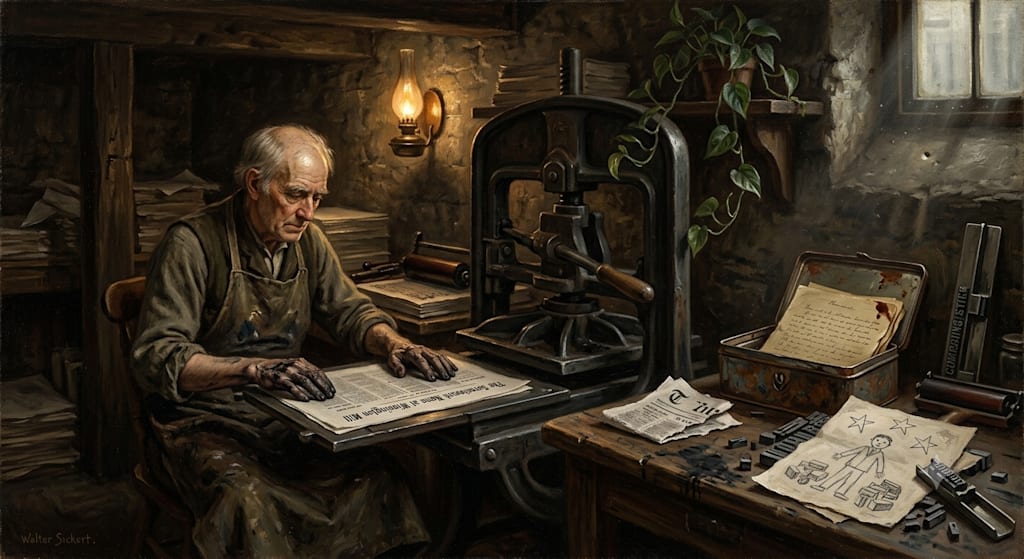
When spring came, William rented half a cellar behind Fleet Street. Seven shillings a month, with a water stain on the wall shaped like an unfinished map. With the last of his savings he bought a second-hand printing press. The rubber on the roller had hardened; sometimes the letters came out with a missing corner. He bought paper by the pound from a scrap dealer — some sheets still carried expired advertisements on the back, for liver pills and hair tonic.
The first issue of his little paper ran one hundred copies. The headline: The Seventeenth Name at Winsington Mill. He pressed his finger onto the wet ink of the front page, and a fingerprint stayed beneath the headline, like a private seal.
On the day of distribution, Charles Winslow stopped him on the flagstones of Fleet Street.
Winslow wore a charcoal woollen coat and shoes polished to a mirror. Behind him stood a secretary holding a furled umbrella, though the day was clear. Winslow did not shout. He even kept a curl at the corner of his mouth as he drew a roll of banknotes from his inside pocket and dropped them into a puddle at William's feet.
The puddle held half the sky. The notes shattered the reflection. A few passers-by stopped to watch; a flower girl pulled her basket closer to her chest.
"Pick it up," Winslow said. His voice was low, as if he were giving an order to a servant. "Pick it up, and that's your daughter's medicine."
William bent down.
He did not touch the money. Nearby, a blind fiddler sat on the steps. The wind had knocked his hat to the ground, and the old man was reaching into the air, feeling for it. William picked up the hat and placed it gently on the man's lap. A sycamore leaf from the puddle was stuck to the brim; he plucked it off without a thought.
The blind man reached out and touched his cufflink. "Thank you," he said. His fingers rested on the link a moment longer than necessary. It was an old cufflink, copper, engraved with a faint letter G.
William straightened up and walked through the puddle. Muddy water splashed his trouser cuffs and bloomed in dark stains on the cloth. He did not turn around.
Winslow's smile did not change, but his knuckles went white around the handle of his walking stick. The secretary stepped forward, and Winslow blocked him with the cane. He watched William's back for a moment, then brought the stick down hard on the stone, turned, and walked away. His heel landed at the edge of the puddle and threw up a small spray of water.
That afternoon, Emily asked him why his trousers were muddy. He said the thaw was running in the spring streets. She handed him a drawing: a man standing in a pile of type, with three crooked stars above his head. The type was scribbled dark in pencil, as dark as the cellar she had once seen.
He slipped the drawing into the composing stick. The metal type pressed against the paper and left a tiny dent.
Over the next two years, Winslow secured the municipal bridge contract. On the day of the signing, the front page carried a photograph of him shaking hands with the alderman, his smile baring a clean row of teeth. William bought that issue from the scrap dealer; a rat-poison advertisement was printed on the back. He cut the paper apart and set the next edition's type on the blank side.
The little paper kept printing in the cellar. The run grew from one hundred to one hundred and fifty copies, read mostly by dockworkers, washerwomen, and a few retired schoolmasters who passed by every week. Someone advised him to write something lighter, something that would make money. He was sitting at the composing stone, peeling a boiled egg. Flecks of white fell into the gaps between the type, and he bent over, carefully picking them out with the tip of his fingernail.
"This letter will be printed," he said, without looking up. "It stays here."
Emily sat in the corner, folding the printed sheets one by one. She folded them neatly, pressing every crease flat with her finger. Her cough had eased, but sometimes she still woke at night to the sound of her father working the press pedal in the cellar. Creak. Creak. Creak. Like a pendulum that never stopped.
In the autumn of the bridge's completion, it fell.
The news came in the early morning, while William was lifting a stack of printed papers from the press. The ink was still damp, gleaming with a wet light. Tommy came running down the cellar stairs, his one-armed body tilting as he ran, bumping the wall at the corner so that his empty sleeve swung behind his back.
"The bridge collapsed!" he said, breathing hard. "The one Winslow built. It's down!"
William set the papers down. He wiped his ink-stained hands on his apron twice, and paused on the third wipe. He looked at the old manuscript from two years ago, lying on the table. The brown bloodstain on its edge had faded until it was almost invisible.
"How many?" he asked.
"They don't know yet. They say whole iron spans fell into the river." Tommy's voice dropped. "There were carriages on it."
William nodded. He carried the stack of fresh papers to the table and flipped to the second page. It was a notice for the parish Sunday charity sale. He looked at it for a moment, then turned the whole stack over and began setting new type.
He set type all night. By dawn, a new issue was printed. The lead story carried a set of figures, not a single digit changed, exactly the ones he had locked in his drawer two years before.
The news of Winslow's arrest came on a rainy day. Someone ran down the cellar steps, shoes slipping on the wet treads, almost falling. William was holding Tommy's hand, teaching him to write. The boy gripped the pencil with his only hand, tracing the letter J on a margin of old newsprint. He pressed so hard the point punched a small hole through the paper.
William listened to the news and nodded. He took Tommy's hand again and guided him through the last hook of the J. As the final stroke lifted, a tiny scrap of paper clung to the pencil tip. Tommy's fingers were smeared with ink. William wiped them with the corner of his apron — left side, then right side, even though there was only one hand.
"What's this letter called?" William asked.
"J," Tommy said.
"What word does it start?"
The boy thought. "Justice."
William said nothing. He placed the pencil back in Tommy's hand, the wood still warm from both their grips.
Many years later, William's hair had turned completely white. Not a stately silver, but the grey-white of old cotton washed too many times. The little paper had long ceased. He worked as a proofreader at a printing house on Fleet Street. Every day he checked the lines of set type on the galley proofs, circled errors in red pencil, and sent the corrected sheets back to the composing room. He sat by the window at an old desk. On the desk stood a pothos plant that Emily had brought from her school. Its leaves trailed over the edge and sometimes covered a line on the proof; he would gently push them aside with the back of his finger.
Emily had grown up and become a teacher at a board school in East London, teaching children their letters and sums. Tommy ran a newsstand at the corner of Fleet Street. A corner of the stall was permanently reserved for small booklets tied with twine — the stories William had written over the years, with no covers, no price, their edges worn soft by countless hands.
One day, a young journalist came to find him.
His name was James Cartwright. He had been at the Chronicle less than half a year, and his collar was starched so stiff it had rubbed his chin raw. He said he wanted to write a book about William. He said someone had told him there was once a man on Fleet Street who lost his job rather than change a set of numbers.
William listened, his fingers rubbing a yellowing tip on one of the pothos leaves. He pinched the dead tip off and dropped it into the ashtray. The ashtray held no ash, only a few dried leaves.
"There's no book." He rose from his chair, his knee giving a small crack. He walked to the corner, pulled open a drawer in a metal cabinet, and took out a tin box.
The box was rusted, the lid stubborn. Inside were three things: a yellowed manuscript with a brown bloodstain on its edge; a torn piece of the bacon wrapper, its Times masthead faded to half a T; and a pencil drawing, the type and the stars, the lines rubbed a little blurry.
He placed the box in front of the young man.
"Look at these," he said. "Then go write your own words."
James Cartwright unfolded the manuscript. Beneath the sixteen names was a line of pencil, not in William's hand. The strokes were thinner, harder, like someone not yet used to writing. The tip of the final stroke in the word continue dragged out into a shallow hook.
"Who wrote this?" he asked.
William did not answer. He sat back down by the window and neatened the stack of corrected proofs. The evening sun fell through the narrow Fleet Street sky and lit the type tray, stretching long shadows from every letter. One piece of type, the letter T, lay on its side. He reached out and righted it. Then he saw a speck of dust caught in the groove of the letter H beside it. He wiped the dust away, slowly, as gently as he had once blown the egg white from the type.
To the empty room he said, "See you tomorrow."
Outside, the London bells struck seven. The chime came from St Paul's, crossing the rooftops and chimneys, and by the time it reached this small room it had dulled, like a pebble falling into a thick carpet. The pothos leaf trembled once in the sound. Inside the tin box, the drawing — the type and the stars — caught the last of the light. The crooked man on the page still stood among the letters, the stars above his head so faint they were almost gone. But still there.
Tommy, closing the stand for the day, called up from under the window. William took his hat and walked to the door. He glanced back at the pothos on the desk. The soil was dry. He poured a little water from his glass and watched it sink in, tiny bubbles rising to the surface. Then he turned off the light and went down the stairs.
The gas lamp at the landing was still pulsing with that small, fluttering jump, exactly as it had on a night many years before.
About the Creator
Jin
Writer of reamstories
https://reamstories.com/jin
Enjoyed the story? Support the Creator.
Subscribe for free to receive all their stories in your feed. You could also become a paid subscriber, letting them know you appreciate their work.
Comments
There are no comments for this story
Be the first to respond and start the conversation.