
The Three Seconds After “Sorry”
A proposal, a cardboard box, and what restaurants train people to care about
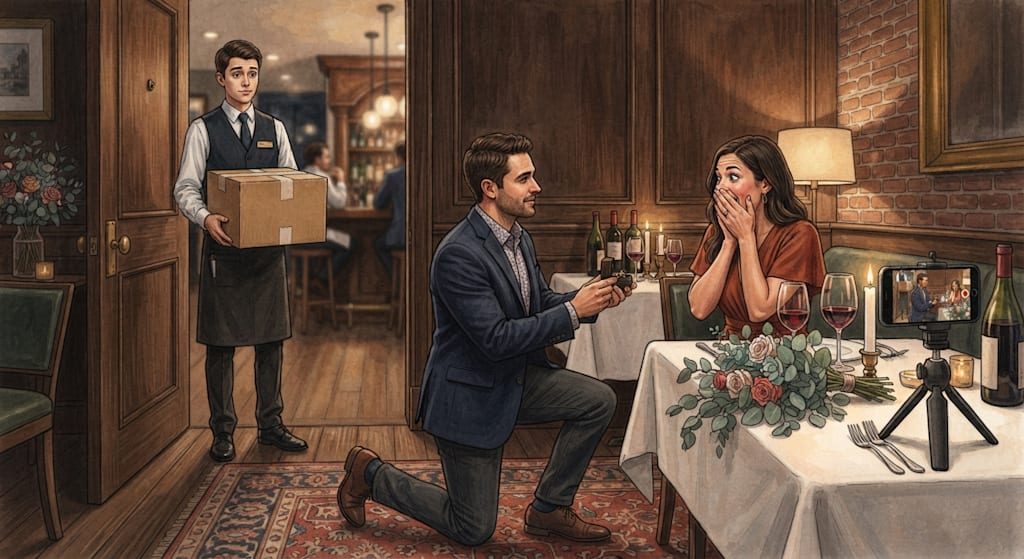
The door opens during the ring. A man is on one knee. Someone is holding a phone, maybe filming. The room has been arranged for a proposal. Then a staff member steps in, sees what is happening, says “sorry,” and does not leave.
That pause matters more than the apology. She has seen the scene. She knows the room is in the middle of something. A server with service on her mind would back out, pull the door shut, and deal with the cardboard box later. She stays. She asks about the box. The customer tells her to wait. Only then does she leave.
The restaurant later explained that she thought they had already interrupted the couple, so she wanted to mention the box once and be done with it. The phrase “once” gives away the logic. It treats the interruption as a cost already paid, so the sensible move is to finish the errand in the same visit. From a task perspective, that is efficient. From the customer’s side, it is absurd. The proposal is the event. The box is the chore. She reversed them.
I keep calling her a task worker, not because I want a new insult for restaurant staff, but because the phrase describes the behavior. A task worker carries a checklist. The box is on it. The proposal is not. When the two meet, the checklist wins. She said sorry. She may have been polite. Politeness is cheap and easy to train. Service is harder. Service means understanding which wish in the room has to be protected right now, even if it is not on your list.
The bill made the gap clearer. The meal cost 3,249 yuan. The restaurant offered to waive 49 yuan. That number tells you what they thought they were compensating. They looked at their own ledger. They did not look at the couple’s ledger. On one side is a small discount. On the other is a recorded moment that now has a stranger in it, asking about a box. Those two things do not share a unit. You cannot subtract 49 yuan from a ruined proposal and call the account settled.
None of this means the employee is a villain. She was probably doing what her job rewards. Restaurants count table turns, cleaning, closing tasks. The proposal is not a metric. If no one tells her that a closed door matters more than a finished box, she will behave exactly as she did. The failure sits above her. It sits in training, in staffing, in the belief that atmosphere is something you decorate rather than something you protect.
The odd part is that the restaurant had agreed to help with the proposal setup. They knew the room was for a proposal. They sold the setup. They did not brief the staff on the one rule that mattered: once the door closes, stay out.
Could the couple sue? They could try. The law is not built to price a second. A breach claim might return part of the service fee. Emotional damages for an interrupted proposal are hard to prove and harder to win. A court may note that the meal was eaten, the ring was eventually worn, the room was eventually used. The law can see the dinner. It cannot see the three seconds when the room changed temperature. That is a limit, not a loophole. Courts handle measurable losses. A proposal is not a measurable loss until it becomes a memory with a defect in it.
The restaurant’s defense had the same shape as the original mistake. They thought in tasks. They had already disturbed the guests, so they might as well finish the disturbance. They had already caused a problem, so they offered a small credit. Each step is reasonable inside a workflow. None of it answers the customer’s question: why did your employee stay in the room after she saw the ring?
This is where many businesses fail. They train people to smile, to use polite phrases, to say “sorry” when something goes wrong. They do not train them to read a room and give up the script. A script can produce a polite intrusion. It can produce a worker who says the right word and then keeps standing there. The word “sorry” becomes a door she can walk through, not a door she closes behind her.
The couple will remember the box. That is the detail that will survive. Not the 3,249 yuan, not the 49 yuan discount, not the explanation about wanting to mention it once. The box. A cardboard box in the middle of a proposal. It is funny in the retelling and awful in the moment. The restaurant sold the room, the mood, the arrangement. It did not sell the one thing that would have kept the mood intact: a worker who knows when to disappear.
A good server can be replaced by a polite robot with a checklist. A task worker can be replaced by a delivery app. The difference shows up at the door. One person sees a proposal and leaves. The other sees a proposal and remembers the box. The first person protects the moment. The second person finishes the errand. The bill can be adjusted. The moment cannot.
About the Creator
Jin
Writer of reamstories
https://reamstories.com/jin
Enjoyed the story? Support the Creator.
Subscribe for free to receive all their stories in your feed. You could also become a paid subscriber or give them a one-off tip, letting them know you appreciate their work.
Comments
There are no comments for this story
Be the first to respond and start the conversation.