Humanity
Is God a man?
Although my faith has been renowned. I still believe that many of us can follow the teachings of Christ and his righteousness. Doesn’t mean that my righteousness views are going to be the same as everyone else’s. We are all different and view things differently. It doesn’t make sense to me that if a god is loving and so vast in his creation that he would create each of us the with the same perspective. So, although I believe we should have high value and be righteous towards god. Being one that follows the same views as another is not agreeable to me. If one church is saying the Bible says we are all sinners. You must know that. I think deep down it may be true for that era of time that they were all sinners. They did very wrong things apart from gods righteousness. I think we can all agree though that most people make mistakes and don’t know god and who god really is to us. That is the most important questions because god is so vast and moving and shows up in different ways. It’s important to recognize that he may not be the same god as another. Just because we don’t agree that my god and your god are the same doesn’t mean we are wrong and should go to hell for it. Why people get so mixed in this idea is beyond me and not sustainable for human lives and culture. One thing does remain and brings us in unity as the ideology that there is a god of creation.
By Cerina Galvan12 months ago in Confessions
The Things We Do in the Dark. Content Warning.
October 12th I saw him again today. It’s stupid, really. The way my body reacts. A full-system reboot from a thirty-second interaction in a coffee line. It’s not even about the words. It’s about the space between them.
By Chahat12 months ago in Confessions
You Chased Her Secret, but the Truth Broke You💔
You stand by the window, the gray dusk swallowing the last light of day. Your heart thumps, heavy with a question you can’t shake. Her suitcase clicks shut behind you. “I’m off for my night shift,” she says, her voice flat, like a stranger’s. The woman you once loved more than life itself brushes past, leaving only the faint scent of her perfume. Years ago, she was your everything—her smile lit up your world, her touch grounded you. You built a life together, two kids, a home filled with laughter. But now? Something’s wrong. The late-night shifts, the cold silences, the way she avoids your eyes—it’s eating at you. Tonight, you decide to follow her, to uncover the truth, no matter how much it might shatter the life you’ve built.
By zinat12 months ago in Confessions
The Prize Hunter and the Junkyard Trick
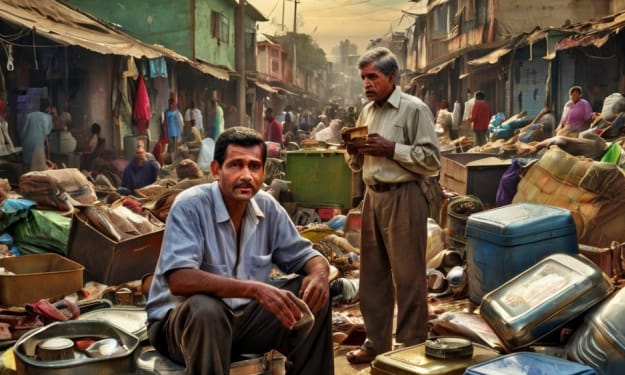
The Prize Hunter and the Junkyard Lesson BY:Khan Bashir Ahmed Bhatti, my old friend, has an unusual obsession. He is always chasing after prize schemes. Over the years, he has won several items through lucky draws—small and big prizes alike. A washing machine, a motorcycle, household appliances—he has collected them all, free of cost. The secret of his winnings lies not in luck alone but in his peculiar habit. He never throws away wrappers. Soap wrappers, tea packets, biscuit covers—even empty cigarette packs—he hoards them all in his house like a treasure trove. Whenever a company announces prizes through a lucky draw, he is the first one to pull out a stack of wrappers, scribble his name, ID card number, and mobile phone on them, and drop them into the entry boxes. Most people buy the products just to participate in the scheme, but my friend never spends a dime. He scavenges wrappers from wherever he can find them—at shops, in trash heaps, or even in the junkyard. For him, every wrapper is a lottery ticket, and the more entries he sends, the better his chances of winning. And indeed, his tactic often pays off. The companies, of course, are not blind to this trickery. They know many participants send in wrappers without purchasing the products. But since a wrapper carries no proof of whether it was bought or found, they are forced to honor the winner. A currency note works the same way: whether earned through hard work or picked up from the street, it holds its value everywhere. Similarly, a wrapper is valid as long as it isn’t torn or soiled. Still, some companies have become smarter. They now mark new products with a golden star, insisting that only star-marked wrappers qualify for the draw. Others insert coupons inside the packaging, forcing customers to purchase the item to participate. These innovations have reduced the tricks of people like my friend, but his passion remains undimmed. One pleasant afternoon, with cool breezes sweeping the city, my friend and I were strolling down a busy street. As we neared the bazaar, rows of junk shops came into view. On one side of the road stood two warehouses, and on the other, three more yards buzzing with business. Pushcart vendors were weighing scrap paper, bottles, and broken goods while the junk dealers, dressed in shabby clothes, sat lazily on their chairs, paying cash and recording tallies. Among the piles of junk, my friend’s sharp eyes caught sight of something—a shiny, almost brand-new tea tin lying on top of a mound of scrap. Its retail price would have been around 190 rupees. To him, it wasn’t just an empty container—it was a golden ticket. Without hesitation, he stepped forward, picked it up, and examined it with delight. But his small act didn’t go unnoticed. The junk dealer, sitting nearby, shouted in a harsh tone, “Uncle, please put that back. It’s not yours.” The words struck like a whip. My friend froze. All eyes turned toward him. The other junk dealers, sensing a moment of drama, began staring, eager to watch him squirm. The tin itself was worthless, but his mistake was in picking it up without permission. The dealer’s voice had exposed him, and embarrassment is heavier than any burden. For a moment, my friend looked shaken, but being clever and quick-witted, he recovered instantly. Saving face was now more important than saving the tin. He beckoned the junk dealer over with a mysterious smile. Curious, the man walked up. I, too, drew closer, wondering what trick my friend would pull this time. Holding the tea tin, my friend pointed at the printed word “Supreme.” “What does this say?” he asked. The dealer, who was literate enough, replied, “It says Supreme.” “Good,” said my friend. “Now tell me, if you remove the letters ‘Sup,’ what remains?” “Then it becomes ‘reme’—or rather ‘reme,’” the dealer answered hesitantly. “And if we add the letter K before it, what word do we get?” The dealer thought for a second. “That would make it ‘Kreme’—or ‘Cream.’” My friend leaned in dramatically. “Exactly. And cream sounds like ‘Kareem.’ Tell me, Kareem and Raheem—what are these names?” The dealer chuckled. “Kareem was my father’s name. Raheem was my uncle’s.” “Wrong!” my friend declared firmly. “No ordinary human is named Kareem or Raheem on their own. These are sacred names—attributes of Allah Himself. That is why our parents always prefix them with ‘Abdul,’ making them Abdul Kareem, Abdul Raheem. Without ‘Abdul,’ they belong only to God.” The dealer scratched his back nervously. “Yes… yes, you are right. My father’s real name was Abdul Kareem, and my uncle was Abdul Raheem.” My friend pounced on the moment. “So you see, this word on the tin—‘Supreme’—contains the sacred letters that form the word Kareem. And here you are, letting it lie in the dirt among scrap and filth. Do you realize what a grave sin that is? Words connected to the divine should be kept in a clean, elevated place, not tossed onto a junk heap.” The dealer’s eyes widened. He folded his hands apologetically. “You are absolutely right. I have made a big mistake. Please, take this tin and place it somewhere respectful. I don’t want to be guilty of disrespect again.” My friend nodded gravely. “Good. Learn from this. Never let sacred words fall into dishonor again.” He shook the dealer’s hand, tucked the tin under his arm, and walked away with me. Once we were at a distance, I turned to him and asked, half amused, half amazed, “What was that all about? You turned a scolding into a sermon and walked away with the prize.” He grinned slyly. “If I had simply put the tin back, I would have lost face. The dealer wanted to embarrass me, but I outsmarted him. And besides,” he winked, “I didn’t lie. Respect for sacred words is indeed our duty.” I couldn’t help but laugh. That was my friend—always cunning, always ready with a trick, and forever chasing prizes, even if it meant turning a junkyard lesson into a theological debate.
By Khan 12 months ago in Confessions
The Date
Passing the time, looking around and looking for a soul to accompany to follow, she continues to walk towards the dark small alley. So many feelings to hold, to resist, to procrastinate so no one will know how she feels. She continued to look, to see if she could find the smell, the shadow left by that man.
By Lasha Desela12 months ago in Confessions
Unsent, Unforgotten
We all have sentences inside us that were never spoken. Words that sat at the edge of our lips, waiting for courage, waiting for the right time—a time that never came. For me, those words weren’t just sentences. They were an entire letter.
By Shehzad Anjumabout a year ago in Confessions
The Lake at Twilight
You look out over the reflection of the sun, through the still waters of the lake, as the sun sets behind the gentle darkening mountains. The sky recedes from yellow to orange, to red, before hinting a shade of violet and blue. The clouds once gentle shades of off-white are now turning into darker shades of gray.
By Parsley Rose about a year ago in Confessions
A House Divided: When a Father’s Betrayal Shattered a Family
A House Divided BY:Khan Khalid Mahmood Ashraf’s life took a turn the day his wife, Bushra, fell seriously ill. For years, she had been the heart of their home — the mother of five daughters and two sons, the anchor of a bustling household. But this time, when she was admitted to the hospital after her third heart attack, the doctors shook their heads grimly. “Pray for her recovery,” they told the family, “the rest is in God’s hands.” For three long months, Bushra lay in the hospital bed, her children constantly at her side, whispering prayers into the sterile air. Ashraf, however, was not as steadfast. Behind the façade of worry, he had already begun weaving a new plan for himself. Believing Bushra would not survive, he secretly married Salma, a distant relative — a divorced woman with a daughter from her previous marriage. He justified his decision by telling himself that his children needed a mother. But fate had other plans. Bushra survived. By what the family called nothing short of a miracle, she was discharged from the hospital and returned home. The children’s prayers had been answered. Yet, her recovery shattered Ashraf’s secret dreams. He had imagined welcoming a new bride into the house, but Bushra’s unexpected return meant his plans fell apart. From then on, peace left the home. Ashraf, a man with a weakness for women, found himself frustrated. Small arguments with Bushra turned into daily battles. The children, already traumatized by their mother’s illness, grew weary of their parents’ endless fights. One evening, when Bushra’s married daughters and their husbands came to visit, they confronted Ashraf. Why did he keep fighting with their mother? At first, he resisted, but then he blurted out the truth. “I want to divide this house into two parts,” he declared coldly. “Bushra will live in one part with her children. And Salma, my wife, will live in the other part with her daughter. I married Salma because I thought Bushra would not survive. I did this for the children, to give them another mother. And I gave shelter to a helpless woman. Now Bushra is standing in my way.” The room fell silent. His daughters and sons were stunned. They could neither oppose their father openly nor ignore the pain of their mother. His betrayal had already taken root, and there was no turning back. Tensions escalated until tragedy struck. Ashraf’s younger son, unable to bear the humiliation and family turmoil, consumed poison and ended his life. The loss devastated Bushra, who collapsed into a coma after her son’s funeral. A year later, she too passed away, unable to recover from her grief. The family home, once filled with love and laughter, became a place of sorrow. Yet Ashraf, hardened and obstinate, remained unchanged. He brought Salma openly into the house, dividing it as he had always wanted. But his eldest son, Javed, could no longer focus on his studies. Dropping out of school, he began driving a pickup truck to provide for his younger sisters. The burden of responsibility fell squarely on his young shoulders. Ashraf, unsympathetic, had further plans. One day, he summoned Javed and delivered an ultimatum: “If you want to stay in this house, you must marry Salma’s younger sister. If you refuse, you will be thrown out and cut off from my inheritance. Decide wisely.” Javed was horrified. To him, Salma was the reason his mother and brother were gone, the root of his family’s destruction. The thought of marrying her sister was unbearable. But Ashraf’s authority was ironclad. Resistance meant losing everything. For months, Javed stalled, avoiding his father’s demand. But eventually, under relentless pressure, he surrendered. With his sisters’ futures in mind, he reluctantly married Salma’s younger sister. His sacrifice was silent, but it tore at his soul. Life moved on. Javed devoted himself to supporting his sisters and caring for his new wife. Surprisingly, she turned out to be kind-hearted, and though he never loved the circumstances, he treated her with respect. In time, she too became a partner in his struggles. But Ashraf’s selfishness did not end there. With Salma by his side, he continued to control the family. Javed, however, grew stronger. He worked tirelessly, saving every rupee he could. Finally, he convinced his wife to demand that Ashraf transfer the house into Javed’s name. Desperate to appease them, Ashraf agreed. The day the papers were signed, Javed wasted no time. He tore down the dividing wall of the house. With tears streaming down his face, he remembered his mother and brother. The family wept together, grieving the home that had once been whole. A short while later, Javed sold the house. He gathered his sisters and wife and moved to the city, determined to build a new life away from his father’s shadow. Ashraf begged him not to go. “My job is here. My life is here. Don’t leave me alone,” he pleaded. But Javed’s heart had hardened. “When you were strong, you thought only of yourself,” he told his father. “Now that you are weak, you expect us to care for you? You must learn what helplessness feels like.” And so, Ashraf was left behind, an old man surrounded by silence. Even Salma eventually left to live with her daughter and son-in-law in the city. Ashraf, once proud and domineering, now faced the twilight of his life alone, haunted by the ruins of the family he himself had destroyed.
By Khan about a year ago in Confessions
My Long Battle with Excessive Sweating — and the 4 Life-Changing Hacks That Finally Worked
I am a 32-year-old man, and for more than a decade I carried a heavy secret that affected almost every part of my life: excessive underarm sweating. It started when I was around twenty, and at first, I thought it was just normal. But as the years went by, it became something that completely shaped my social life, my confidence, and even my career.
By zinatabout a year ago in Confessions
A Lesson in Friendship: The Cost of Misunderstanding
Memory of Friendship: A Lesson in Misunderstanding By Hafiza Ayesha Mohsin, Karachi BY:Ubaid “Aunty! Where is Rahman? He didn’t come to school today.” Aqib asked as he arrived at Rahman’s house, concern written all over his face. Rahman’s mother looked at him with a gentle smile, trying to soothe his worry. “Beta, actually, he had a high fever today. That’s why he took a leave from school.” Aqib’s face reflected both concern and disappointment. Rahman and Aqib were not just friends—they were the best of friends. Their friendship was truly exemplary. They shared everything with each other and were always there to support one another. “Oh! He didn’t even tell me… I wanted to see him,” Aqib said, feeling upset that he wasn’t informed about Rahman’s illness. Rahman’s mother reassured him, “He’s inside his room. Go meet him, but be gentle.” Aqib nodded and quietly walked toward Rahman’s room. When he entered, he saw Rahman sleeping peacefully, unaware of his friend’s concern. Aqib hesitated. He didn’t want to disturb Rahman’s rest. After a brief pause, he decided it would be better to leave quietly rather than wake him up. Silently, he turned and left the room, feeling a little heavy-hearted but hopeful that Rahman would feel better soon. Later, Aqib informed Rahman’s mother about his visit before heading home. The next day, Rahman woke up feeling much better. As he sipped his soup, he asked his mother, “Mom, did anyone call to ask why I didn’t go to school?” His gaze subtly hinted at Aqib, expecting to hear about his friend’s concern. However, Rahman’s mother, having forgotten to mention Aqib’s visit, replied, “No, beta. No one called.” Hearing this, Rahman’s heart sank. Doubts and misconceptions began to cloud his mind. Does Aqib even care about me? Does it make any difference to him whether I go to school or not? Maybe I’m not that important to him after all. Thoughts of neglect and betrayal spiraled in Rahman’s mind. Slowly, he allowed himself to be consumed by these misunderstandings, thinking, Why should I even care about someone who doesn’t care about me? He couldn’t even spare a few minutes to check on me. Feeling hurt, Rahman decided it was better to distance himself emotionally. He thought, I don’t need this friend; I can manage without him. With this mindset, he drifted back into sleep, nursing feelings of sadness and resentment. The following day, Rahman recovered fully and went to school. As soon as Aqib saw him, he rushed toward him with a wide smile. “Hey Rahman! How are you feeling?” But Rahman, still wounded by his assumptions, responded coldly, “Leave me alone, Aqib! Why should it matter to you how I am?” He walked straight to his classroom, ignoring his friend’s attempts to reach out. Aqib was left standing in shock, confused by Rahman’s sudden coldness. “Rahman! Please listen to me!” Aqib called, desperate to explain. Later that day, when Rahman was walking home for the first time without Aqib, he heard his friend’s voice behind him. “Wait, Rahman! Don’t go!” But Rahman, stubborn and hurt, shouted back, “I don’t need a friend like you! Go away!” He quickened his pace, leaving Aqib behind. Aqib’s eyes welled up with tears. He felt the sting of rejection, even though his intentions were pure. It was only when Rahman’s mother spoke to him later that everything became clear. “Beta, did you talk to Aqib? I forgot to tell you yesterday, but he came to ask about you. When he saw you sleeping, he didn’t want to disturb you, so he left quietly.” Rahman froze, his mouth opening in shock and realization. “Really?” he whispered, feeling a rush of embarrassment and guilt. He had allowed a simple misunderstanding to create unnecessary pain and distance between two best friends. Aqib’s actions had been thoughtful and considerate all along, but Rahman’s assumptions had turned his concern into imagined neglect. Feeling regretful, Rahman understood the gravity of jumping to conclusions without clear communication. He realized that sometimes misunderstandings can grow unnecessarily if one doesn’t ask questions or seek clarity. Aqib had cared deeply for him, and Rahman had almost ruined their beautiful friendship based on assumptions. This experience left a lasting impression on Rahman. He learned that friendships require patience, trust, and open communication. Sometimes, people care in ways we may not immediately see, and it’s essential not to let doubt or pride cloud the truth. From that day forward, Rahman became more thoughtful in his friendships, ensuring that misunderstandings would never come between him and those he valued. Aqib, too, continued to be the loyal friend he had always been, proving that true friendship withstands even moments of doubt and confusion. In the end, Rahman and Aqib’s bond grew stronger. They both learned that friendship is not just about being together during happy moments but also about trust, understanding, and the willingness to forgive and move past mistakes.
By Ubaid about a year ago in Confessions
Grandpa’s Nighttime Tale: The Thousand-Year-Old Al-Azhar
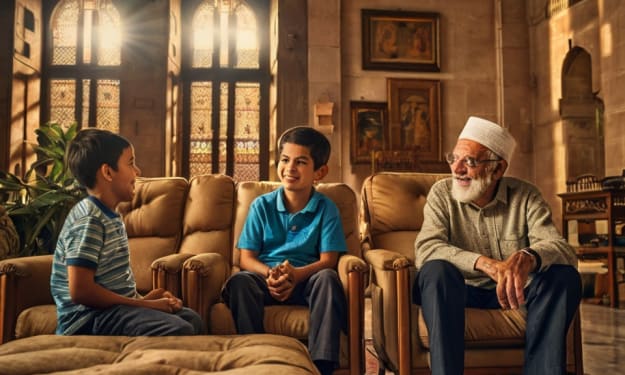
A Nighttime Tale: Grandpa’s Story About Al-Azhar BY:Ubaid “Hey children! You’re still awake?” Grandpa Aslam’s voice broke the silence of the living room. He had just walked in and found Maryam and Abdullah glued to a mobile phone, playing a video game with intense focus. His tone carried a mix of surprise and mild disapproval. “You two are usually good kids who go to bed early. What’s going on tonight?” he asked, raising his eyebrows. “Grandpa, we just can’t fall asleep,” Maryam replied quickly. “And tomorrow is a holiday, so we asked Mom and Dad if we could play some games a little longer. They said yes.” “Oh, I see,” Grandpa said with a smile. “But tell me, why must it always be games on your phone? You could read a book or a magazine instead.” Maryam shook her head. “But Grandpa, we’ve already read all the books and magazines we have.” This time Abdullah added, “Yes, we’ve finished them all. That’s why we’re playing games.” Grandpa chuckled softly. “Well then, no problem. How about tonight I tell you about a place that perhaps you’ve never read or heard about before?” The children’s eyes lit up instantly. They had grown tired of their game and loved the idea of listening to one of Grandpa’s stories. Maryam quickly put the phone aside and said with excitement, “Yes, Grandpa! Please tell us. We’re bored of playing anyway.” Both children turned their full attention to him. Grandpa adjusted his glasses, leaned back in his chair, and began. “All right then. Tonight, I’ll tell you about a thousand-year-old center of learning in the Islamic world, a place called Al-Azhar University. It’s located in Cairo, the capital of Egypt.” Maryam immediately interrupted. “Grandpa! Egypt? Isn’t that the same country where the Pyramids are? Our teacher told us that the pyramids are one of the wonders of the world.” “Yes! And Egypt has a huge river too,” Abdullah added proudly. “Our Quran teacher told us that the River Nile is even mentioned in the Holy Quran.” Grandpa nodded approvingly. “Exactly, my dear children. You both are right. Egypt is indeed the land of the pyramids and the Nile. Its history goes back thousands of years, and that’s why historians and travelers take such deep interest in its monuments and culture. Among these historical treasures is Al-Azhar, one of the greatest universities in the world.” The children leaned in closer, curiosity sparkling in their eyes. “You see,” Grandpa continued, “Muslims conquered Egypt during the caliphate of Hazrat Umar (may Allah be pleased with him) in the seventh century. Later, in the tenth century, a mosque was built in Cairo. This mosque was named Al-Azhar, after Hazrat Fatimah al-Zahra (may Allah be pleased with her), the beloved daughter of our Prophet Muhammad (peace be upon him). Alongside the mosque, a school was established, and with the passage of time, that school grew into what we now know as Al-Azhar University.” “Grandpa, what do they teach there?” Maryam asked eagerly. “Well, in the beginning,” Grandpa explained, “there were only thirty-seven teachers. They taught subjects like the Holy Quran, Islamic jurisprudence, and the Arabic language. But over the centuries, Al-Azhar expanded enormously. Today it has hundreds of professors, and students can study not only religious sciences but also modern subjects—astronomy, medicine, physics, chemistry, engineering, commerce, and many more.” Abdullah’s eyes widened. “That’s amazing! So people from all over the world study there?” “Absolutely,” Grandpa said. “Scholars who graduate from Al-Azhar are respected worldwide. Its religious rulings, or fatwas, are considered authentic and authoritative across the globe. That’s why Al-Azhar is one of the most influential universities in the Islamic world.” The children were now completely engrossed. Grandpa smiled, enjoying their attention. “And do you know?” he added. “Even non-Muslims recognize its greatness. When Napoleon Bonaparte led the French invasion of Egypt in 1798, he was astonished by the level of knowledge, discipline, and organization he found at Al-Azhar. In fact, he wrote about it in his diary, praising its teachers and students. Later, when he formed a consultative council to govern Egypt, he included Al-Azhar’s senior scholars in it. That shows you how much respect he had for this institution.” Maryam gasped in wonder. “Grandpa, can we visit Al-Azhar one day?” “Of course, my dear,” Grandpa said warmly. “Not only can you visit it as tourists, but if you wish, you can even study there. Students from all over the world come to Al-Azhar to seek knowledge.” “That’s wonderful!” Abdullah said with excitement. Maryam clapped her hands. “Thank you, Grandpa! You always tell us such amazing stories. Tonight we learned something so new and inspiring.” Grandpa smiled, his eyes twinkling with pride. “Remember, children, true knowledge is a treasure greater than any game or toy. Always value it, and never stop seeking it.” The children nodded eagerly, their earlier desire to play games long forgotten. That night, as they finally drifted off to sleep, their young minds were filled not with flashing screens but with dreams of pyramids, rivers, and the thousand-year-old halls of learning at Al-Azhar.
By Ubaid about a year ago in Confessions
The Promise That Shattered My Life
A Promise That Shattered My Life BY:Khan Every morning at seven, I arrived at the agency, ready to dive into the day’s work. One morning, around ten, the postman handed me a letter. As I opened it, I found myself reading the words of a woman who had written: “Assalamu Alaikum, son. I am a reader of your magazine. I’ve heard that you write about people’s pains and struggles. I too wish to share mine—so that perhaps others read, understand, and maybe, my sorrow becomes lighter.” The very next day, she sent me her full story. What follows is her account—raw, painful, and unforgettable. --- A Childhood of Neglect From as far back as I remember, my home was never peaceful. My parents rarely got along, and the greatest tragedy of our household was the preference for sons over daughters. Girls were treated like a burden, as though we were born only to tolerate neglect. This discrimination shook me deeply. My brothers were given importance, while I was invisible. I often wondered why our home wasn’t like others—why daughters couldn’t receive the same love as sons. Many nights, I cried myself to sleep, thinking, If only I had been born somewhere else. My mother, however, had one dream: that her children should study. She herself was denied education, and her in-laws constantly mocked her for being uneducated. Out of her insecurity, she pushed us toward books. Yet, how could a child flourish in a house full of tension? Though I was intelligent and hardworking, when it came to exams, I froze. My heart pounded, my hands shook, and the paper remained blank. Finally, my father realized I needed extra help. --- The Arrival of a Tutor Enter Buland Bakht, a young man who had just graduated and was searching for a job. To support himself, he gave tuition lessons to students—including my brothers. One day, my father asked him to also teach me. I needed more than a tutor—I needed kindness, care, and understanding. Buland Bakht became all of that. His gentle encouragement awakened my interest in studies, and slowly, he became the center of my world. What started as respect turned into affection, and soon, we crossed the threshold of love. He promised me that once he secured a job, he would speak to my parents and marry me. His words were my lifeline, and I believed him with all my heart. --- The Promise of Marriage My father admired him greatly. “He is like the son I never had,” he often said. With such praise, I was convinced that our path to marriage would be smooth. When Buland hesitated to approach my parents, I gathered courage and shared my feelings through my sister. To my surprise, my mother responded positively. “If this is true, then let him bring his parents to formally ask for your hand.” Buland looked uneasy when confronted, but eventually, his mother visited our home. To everyone’s surprise, she liked me instantly, and soon, our engagement was announced. My heart soared—I felt my dreams coming true. --- The First Betrayal But fate had other plans. Just days before the wedding, my brother spotted Buland at the railway station buying a ticket to Murree. When questioned, he casually replied, “I’m traveling with a friend.” My family laughed it off as a joke. That evening, when my mother went to his home, his parents looked worried. They explained that he had been offered a new job and had to leave immediately. “The wedding date will need to be postponed,” they said. Imagine our humiliation. Invitations had already been sent, relatives had started arriving, and suddenly, we had to call it all off. My parents faced endless embarrassment. Still, we waited patiently for him to return. --- The Shocking Truth Weeks turned into months. Each time, he gave excuses. Finally, another date was fixed. Guests gathered once more, preparations were made, and my bridal dress lay ready. But the night before the ceremony, devastating news arrived: Buland had returned—with a wife. As it turned out, while tutoring me, he had also been teaching the daughter of a wealthy businessman. He had lured her with the same promises. When her family discovered his upcoming wedding, she threatened to take her life unless he married her. Pressured and frightened, he chose her wealth and influence over his promise to me. My dreams collapsed in an instant. --- A Life Forever Changed That day marked the death of my innocence. My wedding canopy was never raised, and the yellow of my bridal henna turned into the yellow of mourning. Years passed, my hair turned white, but the scars remain as fresh as ever. Since then, I never married. Weddings now terrify me. The laughter, the music, the rituals—everything feels like a cruel reminder of betrayal. My sisters went on to live happy, stable lives. But I, being more sensitive, broke under the weight of deception. I often reflect: if my parents had given me love and attention, perhaps I wouldn’t have fallen so easily for the false affection of a stranger. --- Lessons Learned Parents often forget that not all children are the same. Some are strong; others, fragile. A tender heart needs extra care, or else it shatters. In my case, neglect at home made me vulnerable to the first person who showed me kindness. Buland Bakht—was he a coward, a fool, or a deceiver? I will never know. But what I do know is that his betrayal destroyed my chance at a normal life. Today, I wish to tell every parent: your love and harmony at home is the greatest gift you can give your children. If denied, they may seek it elsewhere—and sometimes, that search ends in tragedy.
By Khan about a year ago in Confessions