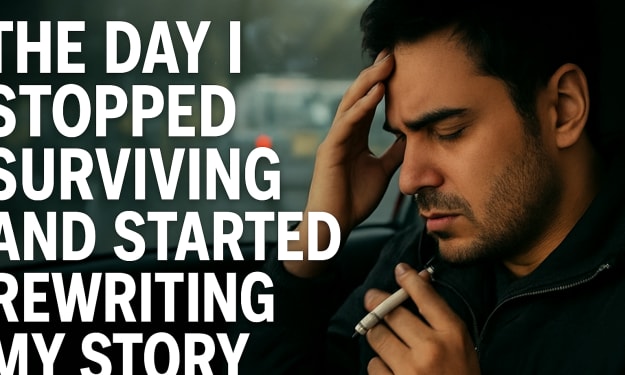
Bad habits
When Survival Mode Wasn’t Enough Anymore
This personal story explores what happens when you stop performing strength and choose honesty instead. It wasn’t a single dramatic moment that changed me. No breakdown in a grocery store aisle, no epiphany sparked by a self-help book, and no perfectly timed sunrise that whispered the truth into my ear.
By Tee G.12 months ago in Confessions
Beauty, Jealousy and Blood: The Forgotten Story of Sher Alam & Maimoona.
The Tragic Tale of Sher Alam and Maimoona In Larah Nawagai — where members of the Ghilji tribe live today — a tragic incident took place about a hundred years ago. Its central figures were Sher Alam and Maimoona, and the land there still mourns this sorrowful event.
By Voxwrite ✍️ 12 months ago in Confessions
What Happened When I Finally Stood Up for Myself
What Happened When I Finally Stood Up for Myself BY: Ubaid For most of my life, I convinced myself that being quiet was the safest option. I told myself that peace was more important than pride, that swallowing my words made me “easy to deal with,” and that avoiding conflict meant avoiding pain. But the truth is, silence can become its own kind of prison. It starts small—letting someone talk over you, laughing off insults, agreeing when every part of you wants to say no. And then one day you wake up realizing that the version of you inside your head is nothing like the version the world sees. For me, that moment came on an ordinary Tuesday. I was working at a small marketing firm, the kind of place where the coffee is always burnt and the deadlines arrive before the brief. I’d been there for almost two years and had quietly taken on extra tasks, extra pressure, and extra stress without ever speaking up. My supervisor, Daniel, had a talent for delegating his responsibilities to anyone who wouldn’t complain—and I was his favorite target. That Tuesday morning, he strolled into the office with his usual half-smirk. “Ubaid, I need you to finish the Rivera proposal. It’s due today.” I felt a knot tighten in my chest. “But I don’t even have the project files,” I said carefully. “Oh, they’re in my inbox somewhere,” he waved dismissively. “Just figure it out.” Figure it out. The same words he always used. The same expectation that I would magically create results from thin air, while he enjoyed the credit. I opened the email chain and felt my frustration rise. He hadn’t given me anything—no notes, no drafts, not even the client’s requirements. I had been pushed before, but this time something in me clicked differently. Maybe it was exhaustion. Maybe it was the way he didn’t even look at me when he dumped the work. Or maybe I had simply reached the point where staying quiet hurt more than speaking up. I took a deep breath and walked to his office. He didn’t even look up. “Yeah?” “Daniel,” I said, steadying my voice, “I’m not doing the Rivera proposal.” That got his attention. He looked up sharply. “What do you mean you’re not doing it?” “I mean it’s your responsibility,” I replied. “You haven’t given me the files or the briefing. I can’t produce a full proposal from nothing. And even if I could, it shouldn’t always be my job to fix things you leave unfinished.” He stared at me like I had suddenly started speaking in another language. “Are you seriously refusing a task?” “For the first time,” I said. “And only because it’s not mine to begin with.” His eyes narrowed. “Careful, Ubaid. This attitude won’t look good.” Something inside me hardened—not anger, but clarity. “What won’t look good,” I said calmly, “is the pattern of you reassigning your projects to juniors and taking credit for their work. If you want to talk about attitude, we can bring HR into it.” There it was. Words I had been too afraid to say for months. The room felt quiet, heavy, but I didn’t shrink. I held his gaze for the first time instead of looking at the floor. He blinked. His tone shifted. “Fine,” he muttered. “I’ll handle it.” I walked out of the office, my heart pounding so loud I could feel it in my fingertips. I expected fear, regret, or anxiety—but what I felt instead was freedom. A strange, exhilarating freedom I had denied myself for years. The rest of the day passed quietly, but something interesting happened. Coworkers who had never spoken more than a polite hello suddenly approached me. One whispered, “I heard what you told Daniel… good for you.” Another said, “He does that to everyone. You finally called it out.” I realized something shocking: I wasn’t the only one suffering in silence—I was just the only one who finally said something. Later that afternoon, HR asked me to drop by. My stomach tightened, but they weren’t there to scold me. They wanted to “understand the recurring pattern in the department.” Apparently, I wasn’t the first complaint they’d heard about Daniel—but I was the first one willing to attach my name to it. Standing up for myself didn’t just shift my own life; it shifted the entire environment around me. That night, as I walked home under the soft glow of streetlights, I felt like I was breathing fully for the first time. I kept replaying the moment I said no. The moment I chose myself over fear. It wasn’t loud or dramatic. It didn’t come with applause. It came quietly, the way truth often does. But it changed everything. I realized that courage isn’t the absence of fear—it’s the decision that your voice matters more than your comfort. That speaking up isn’t about confrontation; it’s about protecting your dignity. That boundaries aren’t walls; they’re respect. Most importantly, I learned that the world treats you the way you teach it to treat you. When I finally stood up for myself, I didn’t become someone new—I simply let the real me step into the light. And once you taste that kind of freedom, you never let yourself shrink again.
By Ubaid 12 months ago in Confessions
A Choice I Never Thought I’d Have to Make
A Choice I Never Thought I’d Have to Make BY: Khan I always believed life moved in a straight line. You study, you work, you earn, you build something that feels like stability. That’s what I thought adulthood was. But life has a strange way of revealing its real syllabus only when you least expect it. My real lesson came the day I had to make a choice I never imagined would be placed in my hands. It started on an ordinary Tuesday morning. The city was already awake—honking buses, vendors lifting shutters, motorbikes weaving through traffic. I was sipping my coffee by the office window when my phone buzzed. The number flashing on the screen stopped my heartbeat for a second. It was the hospital. My mother had been admitted. I rushed out immediately. For the entire drive, my mind replayed the same fear: Please, let her be okay. My father had passed away years ago, and it had always been just the two of us. She was the strongest person I knew—she had survived grief, loneliness, sleepless nights working double shifts, and raising me with more love than money. She didn’t deserve more pain. When I reached the hospital, the smell of antiseptic and the cold quietness of the hallway made my stomach twist. A doctor approached me with a file in her hand, her expression calm but serious. “She needs immediate surgery,” she said. “But there is a complication.” My heart sank. Complication meant cost—something I was already struggling with. My salary barely covered rent and bills. I had savings, but they were small. Still, I told myself I would do anything for her. Then came the part that shattered me. “She is stable for now,” the doctor continued, “but another patient in critical condition needs the same specialist. Only one surgery can be performed today.” It felt like the world tilted. “So… you’re asking me to choose?” The doctor nodded slowly. “Both patients need the operation urgently. Your mother is older, but her chances of recovery are good. The other patient is a young boy… only eight years old.” A boy. Someone’s son. Someone’s whole world. My legs went weak. I sat down on the bench, feeling like all the air had left the room. How could I possibly choose between my mother and a child? This wasn’t a decision any human being should have to make. I walked into the ward where my mother was resting. Her eyes opened when she heard my footsteps. Even lying there, pale and exhausted, she gave me the same warm smile that had comforted me my whole life. “What did the doctor say?” she asked softly. I told her everything. I didn’t hide anything—I couldn’t. She listened quietly, and then she reached for my hand. “My child,” she whispered, “if the boy needs it more… let them save him.” “No!” I shook my head fiercely. “I’m not losing you too. Not like this.” She squeezed my hand, her grip weak but full of meaning. “I have lived my life,” she said. “But that boy… his life is just beginning. We don’t get to choose the tests life gives us. We only choose how we respond.” Her words cut through me like a blade. I felt anger, helplessness, love, and heartbreak mixing inside me. Part of me wanted to fight for her with everything I had. Another part of me felt a painful pull toward the innocent child whose future depended on my decision. I stepped outside again, leaning against the cold wall. Every scenario ran through my mind. If I chose my mother, I saved the person I loved most. But if I chose the boy, I saved a life that hadn’t even started yet. What kind of person would that make me? What kind of son would I be? What kind of human? Time was running out. The doctor approached again. “We need an answer.” I closed my eyes. My mother’s voice echoed in my heart: We only choose how we respond. With trembling hands, I nodded. “Save the boy.” The words felt like they ripped something out of me. The doctor touched my shoulder gently and rushed away. I slumped into the chair, feeling hollow. When I returned to my mother’s room, she smiled proudly, even though tears glistened in her eyes. “You made the right choice,” she whispered. “I made the hardest choice,” I whispered back. She pulled me close, brushing my hair like she used to when I was a child. “Hard choices shape us. Easy ones teach us nothing.” The hours that followed felt endless. Every beep, every footstep in the hallway tightened the knot in my chest. Finally, the doctor returned. “The boy is safe,” she said with relief. “And… your mother will be scheduled for surgery tomorrow morning.” I stared at her, stunned. “Tomorrow? But you said—” “We managed to get another specialist to return early from leave,” she explained. “Your mother will still get her chance.” My knees almost buckled. I rushed to tell my mom, and when I did, she simply smiled and said, “See? When you do the right thing, the world finds a way to meet you halfway.” The next day, her surgery was successful. She recovered slowly but beautifully. And I realized then that sometimes life tests you not to break you, but to reveal the strength you didn’t know you had. That day changed me forever. I learned that true courage isn’t about fighting for what you want—it’s about choosing what’s right, even when it hurts you most. It was a choice I never thought I’d have to make… and one I’ll carry with me for the rest of my life.
By Ubaid 12 months ago in Confessions
11:11 Make a Wish. Top Story - November 2025.
I am a huge believer in angel numbers, signs from the universe etc. About three years ago I really started paying more attention to them, and the signs they were trying to give me. Whenever I would see 11:11 even growing I always made a wish. Over the years I've had many wishes from finding love, to being a model, well know writer the list goes on. These last few months though my greatest wish is to love myself, and become a better version of myself everyday. It's not easy, somedays it feels easier to just fall back into the old me where I am comfortable. Even though I know that version of me no longer suits my life. It almost feels like breaking up with someone you've been in a relationship long term. That version of me is someone I've carried with me for at least 2 decades at this point, and I find it hard to just let her go sometimes.
By Kimmiekins412 months ago in Confessions
You can’t please everyone
By all means when you try to be at peace with everyone and do everything right, you soon realize that you can’t please everyone and its just an impossible task. The main reason being that people have different understanding of the world, when you find yourself in the middle trying to appeal to everybody, you almost always become a hypocrite because you have to change your positions based on the person in front of you. On one end you have people who expect you to move a certain way, and on the other end you have another set of people who expect you to move a certain way, this ultimately leads you to have to make a choice and since you try to appeal to everybody, you find yourself switching your opinions one way or the other.
By real Jema12 months ago in Confessions
I Didn’t Know I Was the Villain
I used to think every story I lived in made me the quiet hero—the one who tried, who cared, who didn’t want to hurt anybody. I thought if my heart was in the right place, everything else would follow. I didn’t know you could become the villain without ever meaning to. It started with small things. A forgotten text. A promise I meant to keep but didn’t. A habit of disappearing whenever life felt too heavy. At first, the people around me laughed it off. “That’s just how you are,” they would say. And I believed them. I thought my flaws were quirky, forgivable, harmless. But life has a way of revealing the sharp edges you never saw on yourself. It was my best friend who told me the truth—not with anger, but with a softness that somehow hurt more. “You don’t show up,” she said quietly. “Not when it matters.” I opened my mouth to defend myself, to remind her of the times I did show up, the times I tried. But she kept talking, and every sentence felt like watching a mirror crack. “You’re not a bad person,” she said. “You’re just… careless. And careless people can do a lot of damage.” The word “damage” hung in the air like smoke. I didn’t know what to say. I didn’t think I was hurting anyone. I thought being overwhelmed gave me the right to step back. I thought silence was better than saying the wrong thing. I thought people who loved me would understand without me having to explain. But understanding doesn’t grow out of silence. She left the conversation with a weak smile, the kind people use to hide disappointment, and for the first time, I realized that good intentions don’t erase bad impact. After that day, I started noticing things—things I had never paid attention to before. My brother stopped calling me first because I never called back in time. He started saying, “I figured you were busy,” even when he clearly wanted me around. My coworker stopped sharing her ideas with me because I made her feel unheard once—just once—but it was enough to make her retreat. And maybe worst of all… my mom stopped telling me when she wasn’t doing well, because the last time she opened up, I told her, “I’m kind of dealing with my own stuff right now.” I wasn’t trying to be selfish. I wasn’t trying to be cold. I wasn’t trying to be the person people couldn’t rely on. But intentions don’t write the story. Actions do. I think that’s when the truth finally hit me: I became the villain by living in a world where only I mattered. For years, I had believed that if someone loved me, they would wait. They would forgive. They would understand. They would carry the weight of my inconsistency because they knew I didn’t mean harm. But people get tired of carrying someone else’s weight. One night, I sat on my bed and scrolled through old conversations—long paragraphs sent to me, short replies sent by me, invitations I dodged, apologies I never followed through on, moments I brushed off as “not a big deal.” Suddenly it looked like evidence. Pages of it. Evidence that the story I’d been telling myself—that I was kind, thoughtful, easy to love—wasn’t the whole truth. Maybe I was kind in my head. Maybe I was thoughtful when it was convenient. Maybe I was easy to love only for people who didn’t expect consistency. But real love requires effort. Real friendship requires presence. Real relationships require someone who shows up, not someone who disappears and calls it coping. The next morning, I didn’t know where to start. How do you fix something when you’re the one who broke it without noticing? So I started small. I called my mom. I asked about her day. I listened without rushing. She sounded surprised, but in a warm way. I texted my brother and told him I missed him. Not because I needed anything, but because I finally understood how it felt to be needed only when convenient. I apologized to my best friend—not the dramatic kind of apology people write paragraphs about, but a real one. The quiet kind that admits responsibility without excuses. She didn’t say “It’s okay.” She said, “Thank you.” And somehow that felt more like forgiveness. I know it’ll take time to build myself into someone better. Someone present. Someone reliable. Someone people don’t have to prepare themselves around. But trying is a choice. Showing up is a choice. Learning from the hurt you didn’t mean to cause is a choice. I used to fear becoming the villain in someone else’s story. What I didn’t realize was that the real tragedy isn’t being the villain. It’s not recognizing that you are one—and staying that way. Now, every day, I choose differently. I choose to be aware. I choose to be accountable. Not because I want to avoid being the villain… …but because I finally understand the responsibility of being human in other people’s lives. And maybe that’s how redemption starts—quietly, in the small, ordinary moments where you decide to be better than the person you didn’t know you were.
By Jhon smith12 months ago in Confessions