
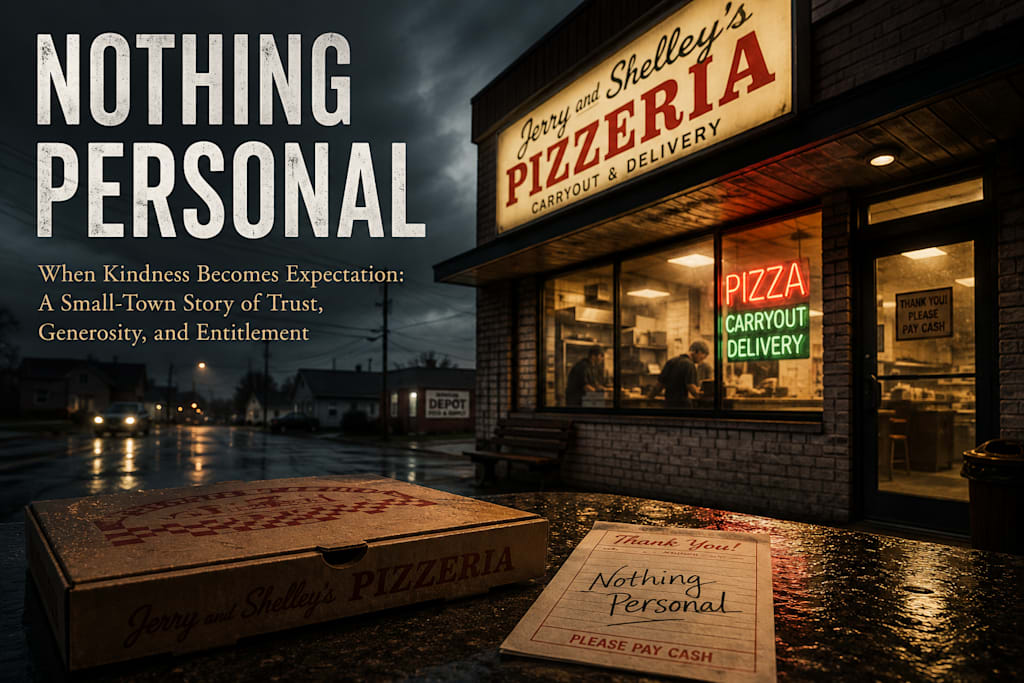
NOTHING PERSONAL
When Kindness Becomes Expectation: A Small-Town Story of Trust, Generosity, and Entitlement

Author's Note
This story is inspired by real events. The names of the people, the business, and certain identifying details have been changed to protect the privacy of those involved. Some scenes and conversations have been recreated for narrative purposes while remaining faithful to the spirit of what occurred.
People ask me why we don't do credit. They ask it in a certain way, a little wounded, like I've accused them of something before they even got their wallet out, and I always tell them the same thing. It's nothing personal and it never was. Then they leave and they think I'm a hard man, and that's fine, I've been called worse by better.
But I'll tell you what I don't say at the counter, because it takes too long and because Shelley doesn't like me telling it. She says it makes me sound bitter. I told her once that a man is allowed to be bitter about something that actually happened, and she said, "Sure he is," and went right on wiping down the make table without looking up, which is how she wins an argument without having one.
We did do credit. Three times in eleven years, three separate men, and I said yes to every one of them without thinking twice about it. Three for three. And every one of them found a way to make me sorry for it, each one a little worse than the last, and not one of them ever thought he'd done a thing to me. That's the part. Not the money.
And that's only counting the ones who got credit. There's a fourth man in this, and he never asked me for credit in his life.
The shop is mine and Shelley's. Not a franchise, not a corporation, not a group with four locations across the county and a man in an office somewhere telling me what my cheese ought to cost. Two names on the paper, hers and mine, one store, and every dollar that goes out that door goes out of our own pocket. When a man beats me for forty dollars, there's nobody above me to eat it. I eat it. Shelley eats it. Jerry and Shelley's Pizzeria, which was her idea for a name and which I said sounded like a bar until she pointed out we'd already paid for the sign. There's no dining room. There never was. Carryout and delivery only, and we do our own delivering, no apps, no third-party outfit, our own cars and our own warming bags.
Shelley runs the inside. She runs all of it, and she runs it better than I would. In eleven years I've heard my wife raise her voice maybe four times, and two of those were at me. What she does is stand at the end of that make table on a Friday with tickets coming off the printer faster than a person can read them, and she gets quieter and quieter, and everything goes where it's supposed to go. She knows who's behind before they know it. She'll slide down and start laying a pie on Nick's board, and he won't look up, he'll just keep going, and they'll work like that for twenty minutes without a word.
She's the one people ask for. There's a woman named Dot who has ordered a small onion and green pepper every Thursday since the week we opened and won't order it from anybody else. If Jenny picks up, Dot says, "Oh, that's alright, honey. I'll try back." Shelley knows Dot's hip is bad and knows which one of Dot's kids isn't speaking to her, and Dot knows my wife had a scare in 2019, and none of that has ever taken longer than ninety seconds with the printer going behind her.
And she's funny, which nobody expects out of a quiet woman. Not joke funny. Timing funny. Our first year I spent forty-five minutes on a milk crate in the walk-in with a flashlight in my teeth fixing a shelf bracket, and I came out cut up and freezing and said, "I fixed it." And it went over behind me while I was still saying it. Four hundred cans. Shelley waited about four seconds and said, "Sounds like you fixed it." Then she laughed so hard she had to sit down on the flour bin, and I started, and Lena came around the corner to see what was wrong with us. People read the quiet and stop there.
Lena has managed for nine years and knows this place better than I do. Lena's the one who tells me no, and that's worth having, because anybody can tell you yes. When I got the idea to add a lunch buffet, which would have been the dumbest thing I ever tried in this business, she listened to the whole speech and then asked me one question. She said, "Who's watching the pans while you're out at the depot?" That was the entire conversation, and she went back to counting boxes.
And Shelley leans on her harder than she leans on me. Those two have a thing at close where neither one leaves until the other is finished, and I've watched them do it a hundred times and never once heard them arrange it. Lena starts breaking down the make table, Shelley starts the mop water, and it happens. When Lena's marriage came apart, she was on days for four months, and Shelley never explained to me why the schedule changed, and I never asked.
Nick runs the fryers and the dish pit and the phone and about six other things at once on a Friday and has never once mentioned that he's doing all of it. Twenty-six years old, and he doesn't hurry, not even the night the walk-in quit on us in August. He came out of the back and said, "Jerry, it's warm in there." That was all. Then he helped me move four hundred dollars of product into a neighbor's cooler at eleven that night and came back the next day at ten.
And Jenny has my front counter and has had it a long time, and I'll come back around to Jenny.
What I do is everything outside those four walls. Supply house at six in the morning, depot on Tuesdays, grocery store on a Saturday because the cheese order came up light again. I write the checks, I argue with vendors over a case of tomatoes, I sign the lease every three years. And I deliver, more than anybody else on the schedule, and when Shelley needs a
hand inside I'm on the make table with her. I'm the boss of this business and my wife runs my shop, which isn't a contradiction to anybody who's ever owned anything. But it means I'm out of that building a great deal of the time, and that turns out to matter later, so hang onto it.
We have two other drivers. One is Lena's girl, Katie, part-time around school, and she's good. Polite at the door, comes straight back, has never in two years needed telling twice. And then there's Mary. Mary has never been on time in her life. Not late, understand. On time, which is a thing she has simply never done, and when she's here she likes to sleep in her car out back with a hot order sitting on the rack under her name. She comes back off a run and doesn't come inside and doesn't tell a soul, so Lena's standing there holding a bag saying, "Does anybody know if Mary's back yet?" and Mary's thirty feet away with the seat laid down.
I haven't fired her. Shelley asks me why about twice a month. She asked again in March, standing at the sink with her back to me, and she didn't turn around; she just said, "Jerry." That's how she asks it now. Just my name. And I said, "I know." And she said, "Do you, though?"
I don't have a good answer for that. It comes up again.
Now here's a thing you wouldn't guess from the sign out front. I don't own this building. The Char King owns it. The drive-through sharing my back wall, the burger place with the speaker box and the two-lane wraparound, that man owns the whole plaza, and I write him a check on the first of every month and have for eleven years. He's a decent enough landlord and a rotten conversationalist, and I see him maybe four times a year. His employees I see constantly, and the reason is plumbing.
The building was one unit before it was two. When they split it, all the water stayed on my side. Both restrooms, the mop sink, everything. So the lease I signed, the one I sign again every three years, says the tenant next door has access to the restroom through the connecting door in the back hallway during all hours of operation. It's in writing. I agreed to it, and I've never regretted agreeing to it, because a person has to wash his hands and nobody should have to walk around a building in February to do it. What I regret is what came through that door along with the people who needed it.
So that's the arrangement. My landlord's employees walk through my kitchen hallway all day long, I can't say a word about it, and one of those employees was Ben.
I'll get to Ben. He's the reason the answer is no now and forever. But he was third, and I want to do this in order, because the order matters. If it had only been Ben, I might have talked myself into believing I got unlucky one time.
The first was Kevin, and Kevin wasn't a customer, he was a vendor. He washed windows for a living. That was the job, and he was good at it. He had a route that ran through this plaza and up the road and out past the bank, business to business, ladder and squeegee and a five-gallon bucket in the bed of his truck, and everybody on that route hired him because Kevin could leave glass looking like there was no glass in the frame at all. I hired him same as they did. Paid him better than the going rate, because I've been on the wrong end of a check in my life and I know what it does to a man. And I paid him on the spot, cash in his hand at the counter before his bucket was back in the truck. Never a wait. Never a short count. Never once told him to come back Friday. He was in here every three weeks for four years. He knew Shelley's mother had died. He knew Nick was saving for a truck.
One winter, a Tuesday, he came in and did the windows and I counted his money out on the counter the way I always did, and he didn't pick it up. He stood there with his hat in his hands, actually in his hands, turning it, looking at the money and not at me.
I said, "What?"
He said, "Jer, my girl turns seven Saturday."
I said, "Okay."
And he said, "I was hoping." And then he stopped. He just stopped right there in the middle of it and rubbed the back of his neck and looked out the window at his own truck. A man doesn't stop in the middle of a sentence unless the next part is going to cost him.
So I said, "Kevin, what do you need?"
He said, "Six pizzas. Wings. A couple two liters. And that cinnamon bread the kids like." He said it fast, like getting it over with, and then he said, "I can get you next month, it's just, with Christmas, and the truck needed brakes, and..."
I said, "Stop. I said take it, pay me whenever."
There was nothing to think about. You don't ask for a deposit from a man you've been handing cash to every month for four years. He tried to shake my hand about six times in ten seconds, and I told him to get out of here before he wore my arm out.
Saturday he came and got it. Two trips to the trunk, and he had his daughter with him in the truck, a little thing in a purple coat, and she waved at me through the glass and I waved back. He said, "Jerry, I appreciate this, you have no idea." And I said, "Go, the wings are getting cold."
That is the last conversation I ever had with Kevin.
Three weeks went by, which was nothing, that was his normal cycle. Four weeks. At five weeks Shelley said something while we were closing, not making a thing of it. She said, "Have you seen Kevin?" And I said, "He'll be around." And she said, "That's not what I asked you."
At seven weeks I called him. It rang and rang and there was no machine on it. I called again the next week and it went straight to nothing, which means a phone shut off or a phone looking at my name and deciding.
The windows went dull that spring. That's how I marked the time. Not by the money, by the glass. It comes on slow, and then one morning you pull in and the sun is at a certain angle and you can see all that film, and you understand a man hasn't been here in a while. I bought a squeegee and started doing them myself on Monday mornings, which I still do, and I'm not good at it. I leave streaks. Shelley points them out.
Every so often somebody would spot him. Lena saw him at the drugstore. Nick saw him at a car wash on Cleveland Avenue. And I saw him myself one time, at the gas station out on Tuscarawas, and this is the part I want to tell you.
I was on pump four. He came out of the store with a bag, maybe forty feet from me, and he looked up and saw me. I know he saw me, because I watched it land on his face. Then he turned around and became extremely interested in a rack of windshield wipers on the sidewalk.
I put the nozzle back and started toward him. Two or three steps.
And he moved. He didn't walk off. He shifted around to the far side of that rack so the rack was between us and kept his back to me and kept his eyes on those wipers, and I stopped, because there's nothing you can do with that. A grown man hiding behind a display of windshield wipers.
I stood there another few seconds like an idiot, because I had the whole speech ready. "Keep the money. I don't want it. Come do my windows, I'll pay you like always, we're square." That was all I was going to say to him. He waited me out. When I finally got in the truck, he went the long way around the building to get to his.
Two hundred and forty dollars bought that, and it cost him a customer on his route he never had to fight to get paid by. I never tried to collect it. I couldn't tell you what he did with the money. I could tell you exactly what it cost him, because I've run those numbers more times than I want to admit and they've never come out right.
Shelley didn't say, "I told you so," about Kevin. She never said one word about it. What she did was, about a month after the gas station, she came and stood next to me on a Monday while I was doing the windows, and she took the other side of the glass and worked her way toward me, and neither one of us said anything about why.
The second was Curtis, years later, and Curtis is the one I should have learned from. He asked for credit one time. Twelve dollars on a Wednesday. He was short and he was embarrassed about it, or he did a good impression of embarrassed, and Shelley wrote it down and thought nothing of it and neither did I. Twelve dollars.
And from that Wednesday on, Curtis never paid at the counter again. Not once, not a dollar. He'd order and then when it came time, he'd already be turning his shoulder away, and he'd say, "Put it on there." It took me a while to notice how smooth he was about it. He never asked. Asking would have meant somebody could say no. He announced it, and then he was talking about something else before you could get your mouth open.
The number climbed through October and into November. Shelley kept the running total in her head, which is a thing she does, and one night in December she said it out loud in the car on the way home. Just the figure. Nothing attached to it.
And I said, "He's good for it."
And she said, "I know he's good for it. That's not the part that bothers me."
I said, "What's the part that bothers you?"
She said, "He doesn't think it's a favor anymore."
Two nights later he settled the whole thing at once out of a fold of bills, and I want you to see how he did it. He flattened each bill on the counter with the side of his hand before he laid the next one down. Smoothing them. Looking up between bills to see if anybody was watching. He had the look of a man doing me a tremendous favor. And when he finished, he left his hand on the money a second, waiting for somebody to say something, and Shelley said, "Thank you, Curtis," in the voice you'd use on a stranger holding a door, and he took that as everything he needed.
Then he ordered on credit again that same night. Before she had the bills in the drawer.
The night it turned for me, his car wouldn't start. He came in and ordered and leaned on the counter and said, "Hey, Jer, I got a situation." He said the alternator, or the starter, he wasn't sure which, and he said it like he wanted me to help him diagnose it. Then he said, "Any chance you could run me home when you get a minute?"
I had four deliveries stacked and it was ten after six on a Friday. And I said, "Yeah, let me get these out and I'll run you."
He waited forty minutes. I'll give him that. He waited without complaining, sitting on the bench by the door on his phone.
Fifteen minutes out to the east side in the snow with my wipers half frozen, and he talked the whole way. A job he almost got. His brother, who apparently owes everybody in three counties. The Browns. He was easy to be around, that's the thing I keep having to explain to people, and about halfway there I remember thinking this was fine, this was what you do.
Then, right around the light at Harmon, he said a thing I didn't catch the shape of until later.
I asked him what he was going to do about the car. Just talking, watching the road.
He said he wasn't going to be in any big hurry about it.
I said, "You need a car, Curtis."
And he said, "Eh." Easy, looking out the window. "Parts are parts," he said. "It'll keep."
Something went by in the back of my head at about half speed, not fast enough to catch, because I was busy in the snow. It sounded like a man being reasonable. It was not.
I pulled into his lot. He got out and then leaned back in the open door with the snow coming in on my seat and the dome light on his face and said, and I can still hear the sound of it, he said, "I'm gonna get that ride from you again, chief."
Not a question. Not thank you. Not sometime, if you can, if it's not a problem.
"I'm gonna get that ride from you again."
He said it the way you tell a man you'll see him Sunday.
And that's when the thing at half speed caught up with me. He wasn't in a hurry about the car because he didn't need to be in a hurry about the car. He'd already worked out what the car was for now, and it was me, and he worked it out about nine minutes into a fifteen-minute drive.
I said something. "Get it looked at, Curtis," something like that. It came out flat.
He laughed and shut the door and went up the walk with his pizza and never looked back at the truck.
I sat in that lot with the engine running longer than I needed to.
Shelley was still at the shop with her coat on because she'd waited on me. She took one look at my face and said, "What?"
I told her what he said.
She didn't laugh and she didn't get mad. She leaned back against the prep sink and folded her arms and thought about it, and then she said, "Jerry, that's the second time you've come in here with that same face on."
I said, "What face?"
She said, "The one where you're trying to figure out if you're the one being unreasonable."
That was the whole conversation. She got her purse and I turned the lights off.
When the credit stopped, Curtis stopped. That's the part nobody believes. He didn't argue and he didn't get sore. He came in on a Tuesday and ordered and I said, "We're cash now, Curtis," and he said, "Oh," and stood there with his hand halfway to his pocket, and I watched him decide. He said, "You know what, let me come back." He never came back. He had no further use for a pizza place that made him pay for pizza, and I haven't laid eyes on him in four years.
And I haven't even counted Mickey, because Mickey never asked me for credit. Mickey asked me for free, which is worse, because with credit there's at least a number and both of you can see it.
Mickey came in a couple times a week for years, and somewhere along the line I started handing him a pizza now and then and waving off his money. There was no reason for it. I liked him. He could come through that door and read the room in a second and a half and say the exact thing that would get Nick laughing at the fryer, and if you've ever worked a Friday night in a kitchen you know what that's worth. He had a rough stretch and I'm nice. That's the whole explanation, for him and for all of it. A free one every so often. Nothing written down. Whenever it struck me.
I remember the first time. He had his money out on the counter and I put my hand flat on top of it and slid it back at him and said, "Get out of here." And he said, "Jerry, come on." And I said, "I said get out of here." And he grinned and put it away and told Jenny I was the last good man in this county.
Then he started coming in when I was out.
I told you to hang onto that. I'm out of that building constantly, on a delivery or at the depot or standing in line at the bank, and Mickey learned my truck. He'd come by when it wasn't in the lot and tell whoever had the counter that Jerry said he could get a free one, Jerry told me to swing in, go ahead and ask Jerry. And whoever had the counter would make it and hand it over, because who lies about a thing like that.
He got at least five that way. Probably more.
Now, Jenny. Jenny's been on my counter longer than almost anybody, and she's the reason I sleep at night when I'm not in that building. She isn't suspicious by nature. She's paying attention, all the time, at a level most people are not. She'll tell me a regular ordered different than usual and seemed off about it. She doesn't make a production of it. She files it, and three weeks later it turns out to matter.
So Mickey came in on a Thursday afternoon and I was at the depot. Jenny told me all of this after, and Nick filled in the rest, because Nick was ten feet away at the fryers the whole time.
Mickey came up and did the whole thing. Big hello. Asked about her kid by name. Then he said, "Hey, Jerry told me to come get one, the usual, sausage and mushroom."
And Jenny said, "Jerry told you that."
He said, "Yeah."
She said, "Today."
And Nick said that's when it changed, because Mickey answered a beat too late. He said, "Yeah, this morning," and he said it easy, but he had to go get it first, and Jenny heard him go get it.
She said, "Okay." And she wrote the ticket. And she set it down by the make table and didn't put it up on the rail and didn't tell Nick to fire it. She left it lying there face down and went and did something else with her hands.
He came back thirty-five minutes later. Jenny said she knew it was him before the door was all the way open, because he came in fast, and people picking something up don't come in fast.
"Where is it?" he said.
She said, "I didn't make it."
And he leaned across my counter. Not at her, over it, both palms flat down, the way a man does when he wants you to understand how much bigger he is than the counter. Nick said he heard the sneeze guard rattle.
He said, "What do you mean you didn't make it?"
She said, "I didn't make it."
And he said, "I already paid for that."
Now here's why I'll keep Jenny as long as she wants to be kept. She didn't get loud. She didn't go get anybody. She didn't back up off the counter either. She said, "Okay. Then you have a receipt."
And there was a long piece of nothing right there. The phone rang in the middle of it, and we've never had a machine, so a ringing phone in my shop is money walking out the door, and Jenny let it ring. She stood there and let my phone ring and looked at him. Nick said the fryer timer went off too, and he didn't go pull the basket, he let the thing scream, because he wasn't about to move.
Mickey straightened up off the counter and put his hands out to the sides, palms up, the whole show. "This is unbelievable," he said.
She said, "It might be."
He said, "You know what, I've been coming in here six years."
She said, "I know how long you've been coming in here, Mickey."
And whatever was in that, and I wasn't there so I can't tell you what was in it, it went through him. Nick said he stopped talking and looked at her a second like he was recalculating. Then he said, "I want to talk to Jerry."
She said, "He'll be back around four."
And Mickey left, and here's the tell. He didn't wait until four. He came back at four fifteen, because he'd spent that time convincing himself it was still going to work.
I got in a little before that and Jenny told me. She told it flat, the way she tells everything, and when she got to the part about the receipt I asked her how many she thought there had been before this one. And she said, "Jerry, I don't know, and I couldn't prove any of it, and I didn't want to be wrong about a man in front of you."
She was more worried about accusing an innocent man than about my money. That's who works for me.
Shelley came out from the back while Jenny was telling it and stood there with a towel over her shoulder and didn't interrupt once. And when it was done she said it quietly, to me, not to Jenny. She said, "This is what I've been trying to say to you."
I didn't have anything to answer with.
Then he walked in.
I came around that counter and out the front door with my keys still in my hand and he backed up onto the sidewalk. I'm not proud of this next part and I'm not sorry about it either. I went off on him out there in front of the whole plaza, the nail place and the tax office and whoever was sitting in the drive-through line at the Char King. I asked him how many. That's what I kept asking. How many times. He wouldn't answer it. What he did instead was get to work on his feelings, which is what that kind of man does when you ask him a number. He said I was calling him a liar in front of people. He said he'd been coming here for years. He said he couldn't believe I'd do him like this over a pizza.
And I said, "Mickey, I gave you the pizzas. I gave them to you. That's the part you can't get down. I gave them to you, and it wasn't enough, so you stood at my counter and used my name."
And that's when he started telling me what he was going to do to me.
What he was going to do to me. Over food I'd been putting in his hands for free out of my own pocket for two years.
So I went at him. And he went backwards. Fast, walking backwards down that sidewalk the whole way, still running his mouth, still telling me what was going to happen to me, past the Char King and past the nail place, and a woman coming out of the tax office stopped and stepped back inside, and he never once turned around, he just kept going with his finger up, and then at the end of the building he turned and took off up the road at a good clip.
A grown man threatening my life while walking backwards away from me. Crybaby. That's all he ever was, and I'd been feeding him.
Shelley was in the doorway when I turned around. I don't know how long she'd been there. She said, "Get in here, Jerry." Not angry. She was pale, and she said it again, quieter. "Get in here."
We stood in the back hallway, the same hallway I'm going to tell you about later, and she put her hand on my chest and left it there and said, "Don't ever chase somebody down the sidewalk again."
I said, "He threatened me."
She said, "I know what he did." And then she said the thing I still think about. She said, "If you'd caught him, what were you going to do?"
I didn't have an answer for that either.
Then she said it, and she's said it to me exactly once in eleven years. She said, "You are too nice, Jerry, and I'm tired of watching it land on you."
So that was the ground already under my feet before Ben ever walked through my door. Two men I gave credit to, one man I gave free food to, and eleven years.
Ben ran the drive-through window at the Char King. My landlord's employee, not my landlord, which is a distinction that mattered later. Thirty-five or so, jaw hanging a little slack when he was thinking it over, and a headset he never took off, not on his break, not in my lobby, so he was always half somewhere else and always ready to tell you he was busy.
And I want to be honest about the first year, because if I'm not honest about the first year then none of the rest of it means anything.
I liked Ben.
He was in and out of that hallway six times a shift for the bathroom, and he never went through without sticking his head around the corner to say something to whoever was on the line. He called Nick chef. Every time. "Chef, what's good today?" Nick acted like it annoyed him, and it didn't annoy him. He learned Jenny's kids' names inside of a month. When our sign light burned out, he was up on the ladder holding it for me before I asked, in his own uniform, on his own time, and when I tried to hand him a couple pizzas for it he waved me off and said, "Don't insult me, Jerry."
He talked about his kids constantly. Two of them, a boy and a girl. He had a picture on his phone of the boy in a Little League uniform with the pants three sizes too long, and he showed it to me twice in one week and didn't remember showing it the first time. He worked doubles. He came in one January afternoon with his hands cracked open from the cold and the sanitizer, and Shelley made him stand there while she went and got him gloves out of our own supply, and he tried to pay her for them.
And Shelley liked him. I don't skip past that part, because it's the only reason I'm able to forgive myself for any of this. My wife is careful about people and she doesn't hand out an opinion until she has one. About two months in she was working the pass and she looked up and watched him out there leaning on the counter making Jenny laugh about something, and she said, "He seems nice."
That's a large statement out of her. Thirty-one years and I could name everybody she's ever said it about.
I'm telling you this because people hear the rest of this story and they picture some obvious lowlife walking through the door with a sign on him. That is not what happened. What happened is a guy I liked, that my wife liked, who held my ladder and knew my employees' kids by name, turned into something else so slow I couldn't tell you the day it happened.
First time he ordered from me he was five dollars short on a large pepperoni. He counted it twice on the counter, moving the bills around with one finger, and then he looked up, red in the face, and said, "Jerry, I'm five short. I'm sorry. Let me run next door and see if somebody's got it."
And I said, "Sit down. Forget it, take it. Get me Thursday."
He said, "You sure?"
I said, "Ben, go eat."
He came Thursday, before his shift, still in his street clothes, and he put a five on the counter and said, "I told you." He was proud of it. That's what I saw on his face, and I liked him for it.
I've thought about that Thursday more than a man should think about a Thursday. Because paying me didn't end it in his head. Paying me proved it was there. He got trusted one time and came through one time, and out of that he figured him and me had an understanding now, and that it didn't have an end on it.
Next week he came in on his fifteen and ordered and didn't go for his pocket at all. He turned toward the cooler and said over his shoulder, "Put it on my thing."
I said, "Your thing."
He said, "Yeah, the thing you got," and he came back with a bottle of pop and leaned on my counter and grinned at me like the two of us had been through something together. He said, "We're good, right?"
And I stood there a second. I remember standing there. Because there was no thing. There had never been a thing. There had been one Thursday. And I could feel exactly how it would sound if I said that out loud with two customers behind him waiting, how small it would make me look over eleven dollars.
So I said, "Sure." And he paid me nine days later.
That's on me. Every one of these men got their start because I didn't want to look small in front of a room.
Then it was every week, and then three times a week. Coming over on his fifteen with the headset still on, ordering a large sausage and jalapeño and an order of wings, and by the time Lena turned the screen around he was already walking to the cooler saying, "Add it on, add it on." Lena stopped turning the screen around after a while. She said she felt stupid doing it.
And here's the thing that got me the first month and never stopped getting me. The pocket. He had cash. He carried a fold of it with twenties on the outside, and he'd haul it out at my counter to dig for a gum wrapper or a scratch-off and set that money right down in front of me, in front of Jenny, while he was telling me to put it on his thing. Then he'd pick it back up and put it in his pants.
He was never broke. Not one time, not in front of me. He just didn't want today's money leaving his hand today. Later money didn't sting.
And he always paid. I'll say that plain, because he said it constantly. "I always pay, Jerry, ask Shelley, I always pay." He said it like a diploma he'd earned, and Shelley would say, "Mm," and keep working, and he never once caught what that meant. He did pay, in two weeks or three, sometimes four, sometimes not until the number got past sixty and I started standing at the end of the counter with my arms folded while he ordered. Then he'd peel the bills off slow, licking his thumb, waiting for somebody to say something admiring about it, and order on credit again out of the same visit.
Then came the days off, which is where it stopped being about money at all.
He came in on a Sunday in a Bengals jersey with a plastic grocery bag and set it up on my counter like he was making a delivery to me. Frozen chicken breasts, sweating through the bag.
Nick came up front to see what he needed.
Ben said, "Chef, do me a favor, drop these for me real quick."
And Nick said, "I can't do that, man."
Ben laughed. He honestly laughed, like Nick had said something clever. He said, "No, real quick, they're already thawed."
Nick said, "We can't cook outside product. Health code. It's not about me. If we get inspected with somebody's grocery store chicken in my fryer, they can shut the whole place down."
And Ben looked at him, and then at the fryer, which was six feet away, hot, empty, doing nothing at that exact moment. And he said, "But it's right there."
Nick said, "I know."
And Ben said, "It costs you nothing."
Nick told me later he almost did it. Not because he was scared of Ben. Because Ben said, "For his kids," and Nick is twenty-six and his own father wasn't worth a damn, and he stood there with a bag of somebody else's chicken sweating on my counter trying to find a way to say yes.
What he said instead was, "I'm sorry, man, I can't."
And Ben looked at the fryer again, and then he lowered his voice and leaned in and said the thing that actually bothered Nick afterward.
He said, "Who's going to know?"
And Nick said, "I would."
And Ben went, "Alright, Chef. Whatever." And he picked that bag up off my counter and carried it out and it dripped the whole way to the door, and Nick got the towel and wiped it up and didn't say anything to anybody for three days.
That was his song and he came back to it every time. Store fries, frozen egg rolls, once a package of wings from the discount place down the road. Always for his kids. Because his kids have to eat, and the fryer is right there, and it's already hot, and it costs you nothing. Nick told him no eleven or twelve times over about five months, always polite, always the same three sentences, and every single time Ben looked at him like the rule had changed overnight and nobody had bothered to send him word.
Nick came to me after the fourth or fifth one and asked if he was handling it wrong. That's what got me. Nick thought he was the problem.
I said, "No." I said, "You're handling it right, and I would take care of it." Then I did not. I let it go another two months. Shelley knew I'd said I would. She didn't remind me. She watched me not do it, and every so often she'd look up from the table when Ben came through that hallway, and then look at me, and go back to work.
And then there was the door, and this is where the lease comes back around on me.
We're closed Mondays. I come in alone to do dough and inventory and now, thanks to Kevin, the windows. The Char King runs seven days. And Ben knew that hallway like his own driveway, because he had every right to be in it, because the bathroom is on my side and it's in writing.
So I'd come in and find the drawer by the prep sink standing open. Not the register. Never the register, and I'll be fair to the man about that. Forks. Spoons. Napkins, forty at a time. The little plastic cups, the ranch, the Parmesan packets, whole handfuls of it. All of it to eat lo mein from the Chinese place at the end of the plaza, food he bought somewhere else with money he had on him.
The one time I caught him I came around the corner with a bag of flour on my shoulder and he was standing in my hallway with my drawer open and a fistful of my forks. He didn't jump. He didn't put them back. He held one up between two fingers and said, "What, this?"
And I stood there with fifty pounds of flour on my shoulder trying to find the beginning of the sentence.
I said, "Ben, you're in my hallway on my closed day taking my supplies to eat food you bought somewhere else."
And he said, "Over a fork."
He said, "You can't be serious over a fork."
He was amazed at me. That's the one thing all four of them had in common. Every one of them, at the exact moment of getting caught, was amazed at me.
And he wasn't even the only one. There's another one over there named Robbie who has never asked me for anything in his life, and who I've found in my hallway on closed days with his arms full of plasticware and sauce cups more times than I can count. Robbie doesn't think he's stealing. Robbie thinks a hallway is a hallway. He comes in for the bathroom, which he's entitled to do, and walks out with sixty cents of my inventory, which he is not, and the one time I said something he said, "Oh, my bad," set it all down, and did it again the following Monday.
Now the night it ended for good.
It was a Friday in February. I'd been up since five, I'd done a depot run and the bank, the cheese had gone up for the fourth month running and I'd spent twenty minutes on the phone that morning being told there was nothing anybody could do about it, and I was standing at my own counter because Jenny had gone in the back for change.
Ben came in on his fifteen. Two larges and a two-liter. And when I didn't move he said the thing.
"Put it on my thing."
And I said, "Ben, no more. Pay tonight."
That was the whole speech. Four words and his name.
He had money in his pocket. I watched the fold when he reached past it for his phone, and that's the picture I have of him, a man reaching past his own money to get to his phone.
There were four people in that lobby waiting on carryout. A guy in a work coat with his keys in his hand. A woman with two kids, the little one hanging off the front of her coat. A kid by himself over by the door on his phone.
And Ben got very still. That's what I remember. Not loud right away. Still. His jaw did the thing it did when he was working something out, and the ticket printer went off behind me, that little grinding noise it makes, and nobody moved.
Then he called me a name I'm not going to write down. Loud. And then he called me a cheap old man, and I heard the woman with the kids move, and when I looked over she'd gotten her body between them and him without taking her eyes off the counter.
And then he said what he said about Shelley.
I'm not going to put it down. I've never repeated it to anybody, not to Lena, not to my brother, and I'm not going to start here. It was about her personally. It had nothing to do with anything that had happened in that room. He reached for the thing that would cost the most.
And Shelley was standing right there.
That's the part I didn't know for about two seconds, which is how long it took me to get my head turned. She'd come up out of the back with a tray of dough in her hands and she was standing in that doorway behind me, and she heard all of it.
She didn't say anything. She didn't move. She stood there holding that tray, and the oven timer was going, and the kid by the door had put his phone down, and nobody in that lobby made a sound.
Then she turned around and walked the dough back to the cooler, because she had a tray of dough in her hands and it was going to sit out, and that is my wife.
I want to tell you I went after him. I did not. I stood behind my own counter with my hands flat on it and let him walk out, and I've gone back and forth for two years on whether that was the best thing I ever did or the worst.
He went out to the lot and stood under my own sign with his phone up in front of his face telling whoever was watching that Jerry and Shelley's was filthy, that we cheated people, that he'd seen things in that kitchen. Loud enough to come through glass that I clean myself. He tagged us in it. Two hundred people saw it.
The guy in the work coat said, "For what it's worth, I wouldn't have paid him either." I told him his order would be right up.
Shelley read the comments at our kitchen table at midnight with her readers on. I made coffee neither one of us drank. She had her phone flat on the table and went through it slow with one finger, and every so often she'd stop and say a name out loud. Not to me. Just saying it.
"Bill Hardy. Bill Hardy's been getting a Wednesday large from us for six years."
Then she said, "Nancy Wheeler commented on this."
And I said, "What did she say?"
She said, "She didn't say anything. She just left one of those faces."
I said, "Which face?"
And my wife turned the phone around and showed me, and it was the little one with its mouth open, and I sat there at my own kitchen table at midnight looking at a cartoon face that a woman we've known since our kids were small had put underneath a video of a man screaming that my shop was filthy.
I said, "Shel, nobody believes him. Not one person who's ever been in our building believes a word of it."
She kept scrolling.
I said, "The health department was here in October, we scored a ninety-eight, I have it framed on the wall out there."
She said, "I know what's on the wall, Jerry."
And then she took her glasses off and folded them and set them on the table and said, "I don't care what he said about the kitchen."
And I didn't have anything. I sat there.
Then she said, "I told you he seemed nice."
Not you should have listened to me. Not I told you so. She took it off of me and put it on herself, at midnight, over a thing she had no part in. She's done that every time for thirty-one years.
I said, "Shel, that's not on you."
She said, "I know." And she got up and rinsed her cup out, which she didn't need to do, and went to bed.
I sat there until about two in the morning, and what I sat there thinking about wasn't Ben. It was Kevin behind that wiper rack. It was Curtis leaning back in my truck door with the snow coming in. It was Mickey walking backwards up the sidewalk with his finger in the air. It was every time I'd said, "Sure, take it," and I was trying to find the one where it worked out.
There was not one. Eleven years. Not one time.
And I still didn't think I'd been wrong to do it. That's what scared me. Thirty years in business, and I could feel myself already deciding the next one would be different.
She was up at six. She was on the phone with the cheese company at seven fifteen. And at about eleven that morning a fellow came in and said, "Hey, I saw something online about you guys," and my wife said, "Oh, you saw that," and smiled at him, and had him laughing inside of twenty seconds, and took his money, and told him to have a good one.
Then she went in the back and stood at the sink a minute with the water running and didn't wash anything.
He came back nine days later. Nine days.
Came in on his fifteen with the headset around his neck, almost bashful, kicking at my floor tile with the toe of his shoe. Jenny was on the counter and she didn't say one word to him. She held up a finger at him, "One second," and walked back and got me, which is exactly what I would have wanted.
Lena was at the make table and she stopped working. Lena doesn't stop working. She stood there with her hands up over a pie and watched the front.
I came out. He had his hands in his pockets and he rocked back on his heels a little and said, "Hey. We good?"
That was it. That was the whole thing. We good.
I let it sit.
I didn't say anything at all, and Ben can't stand a quiet room, so he started filling it in himself. He said, "Look. It was a Friday. I'd had a day, man. You know how it is."
I said, "No."
He said, "What?"
I said, "I do not know how it is."
And he did that little laugh out of the nose and looked over at Jenny like she might come in on his side, and Jenny was looking at the order screen, and there was nothing on the order screen. He looked at Lena and Lena had gone back to the pie. And he stood there in the middle of my lobby and I watched him understand, for about a second and a half, that there was not one person in that building on his side of it.
Then he said, "Alright. Alright."
He never apologized. I want to be exact about that, because it's the only part people ever ask me about. Not that day, not later, not once, not in any form. Not for the video, not for what he said to me, and not for what he said about my wife who had given him gloves.
Then he rubbed the back of his neck and said, "Can I get a large sausage and jalapeño?"
And before I could get a word out he said it. He said, "Put it on my thing."
Nine days. And he still had a thing.
And I said, "We do not do credit. Not for you and not for anybody."
He said, "Since when?"
And I said, "Since now."
And his face did something I still think about at two in the morning. It wasn't anger. I've seen anger, I saw it out of him in that lobby nine days before. This was confusion. Honest confusion, like I'd told him water runs uphill. He looked at me, and then at Jenny, and then down at my counter, like there was going to be something on it that would explain it to him.
He said, "But I always pay."
And I said, "I know you do, Ben."
And that finished him, because there was nowhere to go from there. He couldn't argue the money. The money was the only thing he ever had, and it wasn't the point, and I think for about one second he knew it.
He asked again Tuesday. Asked again Wednesday. Asked twice on Friday, the second time loud, with customers standing there, working the room. "Hey, does anybody believe this guy?" And a man in line looked at his shoes and Ben kept going. "Hey, buddy, you believe this."
And understand, he didn't owe me a cent by then. He was square. He'd paid off every last dollar, eventually, the way he always did.
It was never about the balance. He needed it open. As long as it was open he was somebody who got taken care of. The day it shut he was a guy in a headset at a drive-through window with a pocket full of money he was too scared to spend.
I would have put a deadbolt on that door. I priced one. Sixteen dollars, and I had the chisel out on a Monday morning and everything, and Shelley came in to do the books and found me squatting there with my glasses up on my head, and she asked what I was doing, and I told her, and she said, "The bathroom."
And I said, "What about it?"
And she said, "Jerry. The bathroom."
So I sat down on a milk crate and read my own lease again, the paragraph about restroom access during all hours of operation, and I put the chisel away. My landlord owns the burger joint. My landlord's employees have a legal right to walk through my building, and they'll still be walking through it long after Ben has moved on to whatever's next for him, and there's not one thing I can do about it except pay my rent on the first.
So I put a hasp and a padlock on the silverware cabinet instead. Shelley held the door steady while I got the screws started and neither one of us said anything the whole time. That's where I am now, eleven years in, a grown man locking up forks. She says it looks ridiculous back there, and she's right.
And people still ask me why we don't do credit, and I still tell them it's nothing personal. But it is personal. It was personal every time. Every one of them I said yes to, I said yes because I liked him. That is the only qualification any of them ever had to meet. Every one of them was a man I was glad to see walk through my door. Kevin couldn't stand in a parking lot with me. Curtis quit eating my food over a ride home in the snow. Mickey told me what he was going to do to me while backing up the sidewalk. Ben stood in my lobby and said what he said about my wife.
Shelley asked me one time, late, after the comments, whether I would do it again for the right person. The right person. She wasn't being smart with me. She meant it, and she was giving me a way out, because she knows I need there to be a right person out there somewhere.
I told her, "I've never once been able to tell in advance who that is."
And she said, "Neither have I."
That's the whole thing, right there, in my wife's four words. It's not that people are bad. Most people are not. It's that kindness has a way of turning into expectation. And expectation has a way of turning into something people think you owe them. God help you the day you decide the favors are over.
If you enjoyed this story, more stories from Jerry and Shelley's Pizzeria are coming soon. Each story stands alone, but together they explore the people, relationships, and unexpected moments that happen behind the counter.
About the Creator
Joey Raines
I mostly write from raw events and spiritual encounters. True stories shaped by pain, clarity, and moments when God felt close. Each piece is a reflection of what I have lived, what I have learned, and what still lingers in the soul.
Enjoyed the story? Support the Creator.
Subscribe for free to receive all their stories in your feed.
Comments
There are no comments for this story
Be the first to respond and start the conversation.