
It’s These Damn Phones! How Modern Technology May Be Hurting Our Youth
A relatable scene, teens sitting together, but all staring at their phones.


The Paradox of Connection
I recently watched a TikTok video from someone in the education field expressing an immediate and noticeable decline among the youth in the academic space. Quite frankly, I can agree! While technological advancement has delivered great benefits, a growing number of educators are raising concerns about its impact on the youth. They are observing an increasing concern that the disadvantages of digital immersion are beginning to outweigh its benefits. A concern not merely a generational gap in understanding, but an unusual epidemic impacting the cognitive abilities, social skills, and mental health of the next generation.
The observations are obvious: students are struggling to read or write at age-appropriate standards, have an inability to maintain conversations, and have a pervasive decline in attention spans. The educator noted in the TikTok video that the ability to complete assignments without complaint or distractions is rapidly declining and that parents are not taking appropriate action or just don’t care enough.
Simply put, she suggested today’s parents aren’t “parenting” their children.
The question is no longer if technology is changing learning, but how it is eroding the foundational skills for a thriving adulthood.
The Mental Health Toll: An Epidemic of Comparison and Anxiety
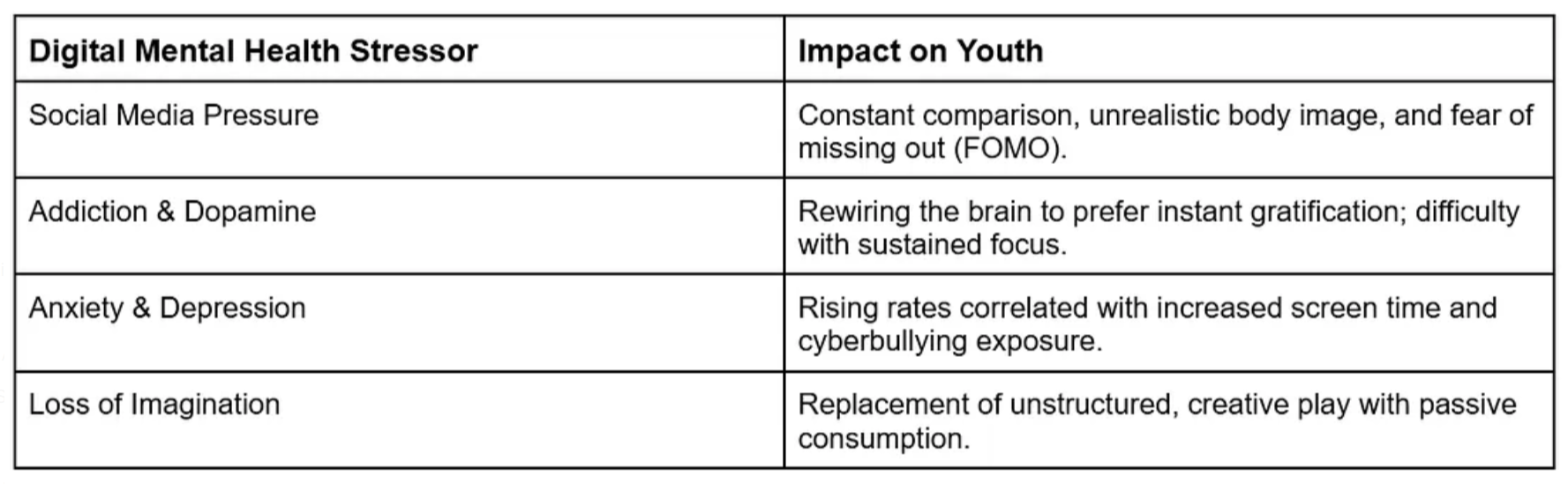
The cell phone has transitioned from an accessory to a necessity for all people. This constant tether to the digital world is exacting a heavy mental health toll on everyone, especially our youth. There is a rise in growing mental health struggles.
Data from the American Psychological Association (APA) indicates a clear correlation: 41% of teens with the highest social media use rate their overall mental health as poor or very poor.
The primary driver of this mental health crisis is social media. The apps the young generation are hooked on are creating a dopamine reward cycle that prioritizes short, immediate gratification. I, too, have experienced such emotions in recent years regarding certain apps, such as TikTok.
This environment fuels a constant state of comparison, where young people measure their worth against the curated, filtered, and often unrealistic standards of their peers and influencers. This pressure, coupled with the fear of missing out, contributes to rising rates of anxiety and depression among adolescents.
If you would like to read more of my thoughts surrounding mental health, check out my article: It’s Not Laziness, It’s Survival: The Truth About Mental Health Days.
The Erosion of Real-World Social Skills
As conversations are increasingly being replaced by text, emojis, and short-form video, young people are losing the critical opportunities to develop emotional intelligence.
A term that capitalizes on this decline in emotional intelligence is “Empathy Erosion.” This word perfectly explains what I am seeing myself. Empathy erosion stems from a lack of face-to-face interaction, which is the primary skill for learning to read nonverbal cues, understand tone, and navigate complex social dynamics. Young people are experiencing a lack of human connection, which is impairing their ability to interpret emotional cues in complex situations.
I watched another video where another creator was referencing some teenagers are not able to recognize immediate danger or assess a situation critically. If this persists, we are going to have a generation of young people who are not able to ground themselves into thinking independently.
The result is a generation that may be digitally fluent but socially stunted. Furthermore, this phenomenon creates an isolation paradox: youth feel more connected online yet lonelier in their real lives. There is no human connection.
Let me ask you a question: “Social media is nice, but at what cost to the developing brains of young people?”
If this continues, the consequences of these actions may not be recognized until adulthood. I witnessed the growing shift of this trend during my time in school, specifically around 2011–2014. My peers’ attention span started to wane, but social media wasn’t as big as it is now, and I think we were spared from the “cognitive delay " by a hair.
The Crisis in the Classroom: Focus and Cognitive Decline
The most immediate and visible impact of excessive technology use is the decline in educational focus. The modern classroom is a battleground against the smartphone. The primary culprit is the shorter attention spans and students' behavior towards administrators.
Students are unable to pay attention in a classroom for long periods of time. Every buzz or alert from their smartphones acts as a micro-interruption, forcing the brain to engage in context switching at any given moment. They are not able to break this habit because of the dopamine release. A study by the National Center for Education Statistics found that 73% of public school leaders feel cell phones have had a negative impact on their students’ attention span.
“More than two-thirds [of school leaders] feel cell phones have had a negative impact on their students’ mental health (72 percent) and attention span (73 percent).”
This scrolling culture stands in direct opposition to the concentration required for critical thinking and reading comprehension. When the brain is trained to gather information but struggles to focus, we observe young students having difficulty engaging with the complex demands of a textbook or a long essay assignment. The result is a generation that is struggling with the fundamentals of literacy.
We should be putting more time and energy into stopping this epidemic. However, the underlying factor no one wants to discuss is that we live in a corrupt country characterized by economic hardship, societal pressures, and a lack of human companionship.
Kids aren’t paying attention just because of phones, but because of their environment. We are unable to adequately take care of each other in this country.
Moving Forward: Reclaiming Focus and Connection
Acknowledging that there is a problem is the first step toward a solution. While technology does offer powerful tools for learning, its use must be managed to safeguard the cognitive and emotional development of young people. We have to set a precedent for what they consume, because it can come back on us in the future.
This is a collective responsibility for parents, educators, and society at large. Solutions must focus on re-establishing boundaries and prioritizing real-world engagement:
1. Establish Digital Boundaries: Implement “phone-free zones” in homes and classrooms, particularly during mealtimes, homework, and social gatherings.
2. Prioritize Unstructured Play: Encourage creative, imaginative play that is free from screens to help rebuild attention spans and foster problem-solving skills.
3. Teach Media Literacy: Equip youth with the critical thinking skills to understand how social media algorithms work, how content is curated, and how to protect their mental health from online pressures.
4. Advocate for Policy: Support school policies that limit or ban cell phone use during instructional time, allowing students to focus on the task at hand.
To ensure the next generation can thrive, we must move beyond the screen and actively work to reclaim the focus, empathy, and mental well-being that are being quietly eroded by the constant demands of the digital world.
Reclaiming the Real World
It’s time for both young people and adults to use technology consciously, not compulsively. It is here to make our lives easier, not more complicated.
We need to rehabilitate young minds to regain empathy and joy because without these attributes, we are doomed.
If you feel the same way, drop a comment below. Let’s talk!
About the Creator
Nozomi Rose
From a researcher of astrophysics to a writer, I am on a journey through life. Crazy right! Join me, as I am a proud cat mom who loves exploring the cosmos and new fantasy realms.
Enjoyed the story? Support the Creator.
Subscribe for free to receive all their stories in your feed.
Comments
There are no comments for this story
Be the first to respond and start the conversation.