
He Didn't Stop Cutting
Two pathology reports said it wasn't a tumor. Her brainstem is gone. Her tumor is still there.
I. Before the Incision
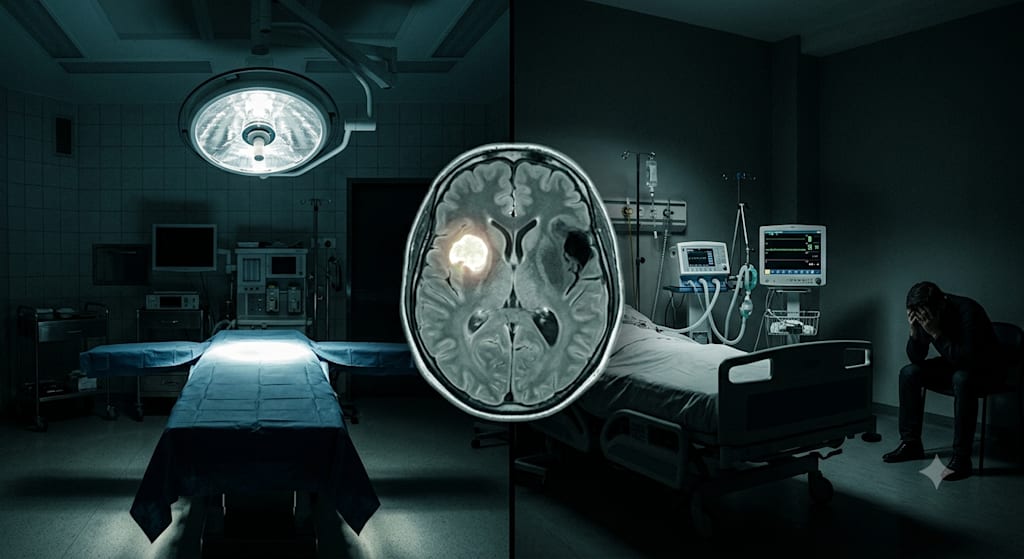
In July 2026, Kyoto University Hospital admitted a woman in her early fifties. She had a benign meningioma near the cerebellum. Her symptoms were mild: occasional dizziness, a slight unsteadiness when walking. She lived independently.
The hospital is one of Japan’s top academic medical centers – a tokutei kinō byōin (designated advanced‑treatment hospital). Its neurosurgery department is a flagship. The lead surgeon was in his forties, with over twenty years of practice and more than two thousand brain surgeries to his name.
The team recommended resection. The reasoning was standard: the tumor sat close to the brainstem, and long‑term compression risked progressive neurological damage.
She consented.
At the end of July, the operation began.
II. What Happened in Ten Hours
After the craniotomy, the surgeon followed routine protocol. He cut a small piece of tissue he believed to be the tumor and sent it for intraoperative frozen‑section pathology – a rapid test that returns results in twenty to thirty minutes.
The first report came back: no tumor cells.
He did not stop. He reasoned that the sampling site might be inaccurate.
He took another piece. Sent it again.
The second report came back: still no tumor cells.
Twice. Same conclusion.
Yet the surgeon continued to resect that same area.
The operation lasted ten hours.
Postoperative imaging revealed a devastating fact: the meningioma that needed removal was entirely intact. What had been excised was healthy brain tissue – including a portion of the brainstem, the structure that controls breathing, heart rate, and basic motor functions.
III. What She Is Now
She is conscious. She can blink to respond to the outside world.
Her limbs are immobile.
She cannot breathe on her own. She will depend on a ventilator for the rest of her life.
Before the surgery, she walked with a slight wobble. Now she lies on a hospital bed, kept alive by machines, day after day.
“The prospect of recovery is very unclear” – that is the hospital’s official phrase. In plain words: it may never get better.
IV. The Surgeon
The hospital has not released his name. Only his age and credentials: forties, over twenty years of experience, more than two thousand procedures.
A doctor who has practiced for over two decades, standing in the operating room, facing two written reports that said “not tumor” – and he chose to trust his own visual judgment: “This must be the tumor.”
Two test results. Neither could stop him.
V. This Is Not the First, but It Shouldn’t Happen Again
In medical safety terminology, there is a specific category for this: Never Event.
The definition is crisp:
The consequences are catastrophic.
The error is entirely preventable.
It violates fundamental safety protocols.
This case meets all three.
And it did not happen in a remote clinic. It happened at Kyoto University Hospital – where neurosurgery is one of its strongest departments. In such a place, a safety system designed to catch errors broke down in the face of one person’s conviction.
VI. The Distance Between an Action and a Report
Intraoperative frozen‑section pathology is not infallible. For central nervous system lesions, its concordance with final paraffin‑embedded pathology is roughly 70 percent. It offers a reference, not a final verdict.
But that is not the point here.
The point is this: when two consecutive tests gave the same negative result, the surgeon’s response was not “pause, recheck, consult.” It was “keep cutting.”
During those ten hours, there were anesthesiologists, nurses, and assistants in the room. No one called a halt.
Or perhaps someone did, and no one listened.
VII. Some Things Can’t Stand “I Think”
Japanese medicine has a deeply entrenched hierarchy: the attending surgeon’s authority is rarely challenged, especially in neurosurgery, where the “one‑man decision” culture has become almost an unwritten rule.
But medicine is not a multiple‑choice question – “I judge it is a tumor, so I remove it.” It is a verification loop: hypothesis, sampling, testing, cross‑checking, decision.
The evidence said “no” twice.
“I think so” won over “the test says no.”
That single action – continuing to cut – changed a human life irrevocably.
VIII. A Mirror
The hospital bowed in apology at a press conference. They promised an investigation committee. The process will move forward, and responsibility will eventually be assigned.
But for the fifty‑year‑old woman in the bed, those things no longer matter. The largest movement she can make for the rest of her life is a blink.
Her tumor is still there. The healthy brainstem is gone.
The weight of this accident does not lie in the answer to “Who is to blame?” It lies in a single fact: in 2026, in one of the world’s finest hospitals, one person’s subjective judgment overrode two objective laboratory reports, overrode surgical safety protocols, overrode every checkpoint that should have stopped the procedure – and then everything became irreversible.
Medicine has advanced for centuries. Safety checklists have been rewritten dozens of times. In the end, the system was broken by an action that no one in that operating room managed to stop.
The true “never event” is not this particular mistake itself. It is the system that made this mistake possible – a system still running, still silent, still waiting quietly before the next operation begins.
About the Creator
Jin
Writer of reamstories
https://reamstories.com/jin
Enjoyed the story? Support the Creator.
Subscribe for free to receive all their stories in your feed. You could also become a paid subscriber, letting them know you appreciate their work.
Comments
There are no comments for this story
Be the first to respond and start the conversation.